Field Guide
Green Jay
A thorn thicket in the lower Rio Grande Valley, south Texas, on a November morning. The mesquite is still green - this latitude does not lose its leaves - and something moves at the edge of the canopy that does not look like any North American bird ought to look. It is blue and green and black and yellow, all at once, and it is holding a small stick.
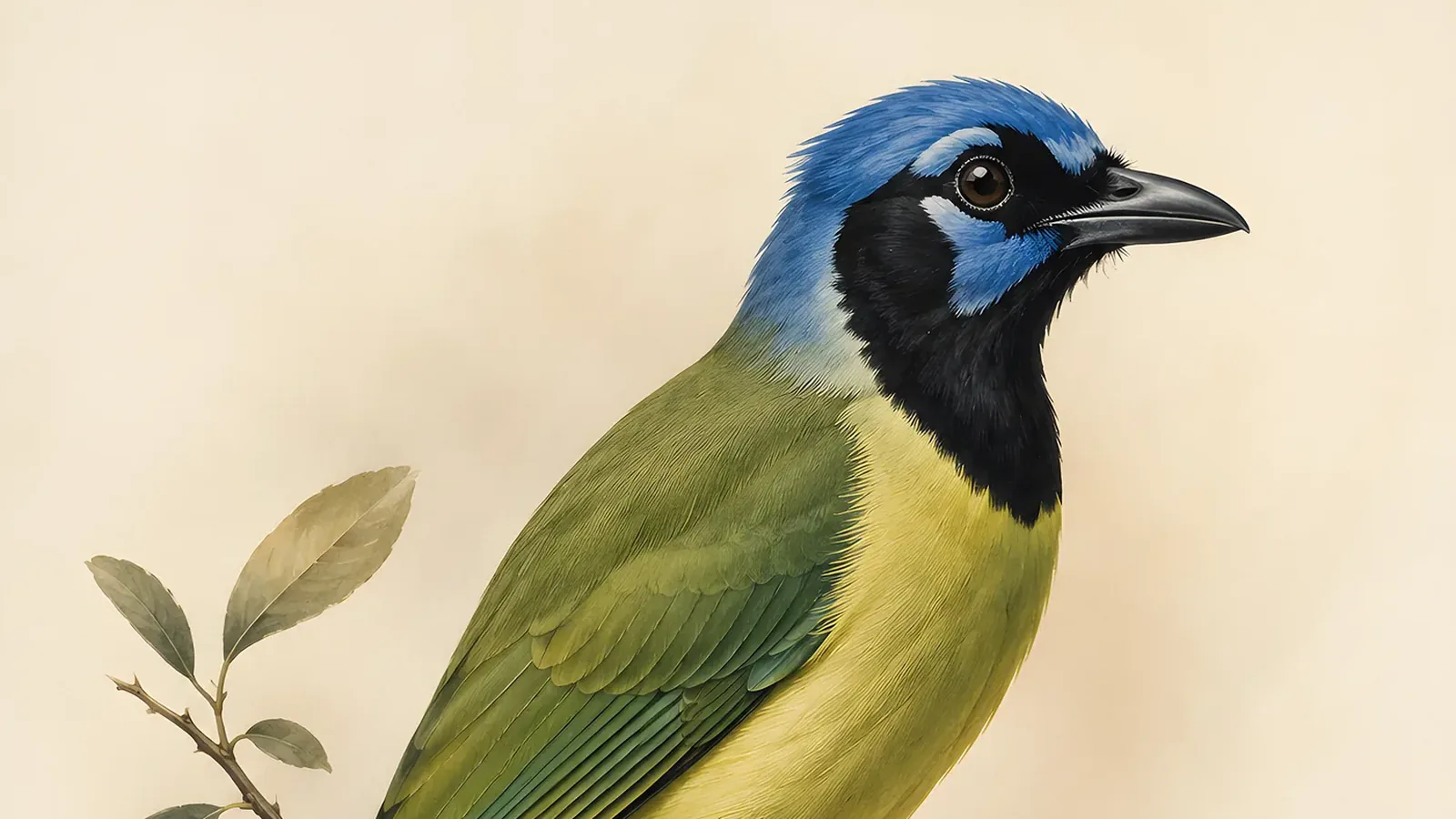
Cyanocorax yncas, the Green Jay, is the only North American corvid that crosses into the truly tropical. Every other jay of the United States belongs to the temperate zone. This one is a creature of the Neotropics that the continent barely touches, grazing south Texas on its way south through Mexico and down through the Andes to Peru and Bolivia. The point where it crosses the border is one of the strangest and most compressed wildlife transitions in North America - a few counties of subtropical woodland where the range of the United States abuts the range of a brilliantly coloured jay that, everywhere else in the world, you would need a passport to find.
What it looks like
The description strains credibility for a bird of forty degrees latitude. The body and folded wings are vivid green - not the washed green of some sparrows or the grey-green of certain warblers, but a saturated, leaf-green that reads as tropical even in shade. The tail is the same green above, but the outer feathers are bright yellow, a flash visible every time the bird lands or fans its tail in display. The head is a separate composition: the crown and nape are bright blue, running forward to meet a bold black mask across the face, black throat, and black bib that ends cleanly against the yellow-green breast. Cornell’s All About Birds records the nasal and frontal plumes as stiff and deep blue, giving the face a textured quality unlike any other North American jay.
Body length runs 27 to 30 centimetres. Weight is 65 to 100 grams, making it lighter than a Blue Jay despite similar length. Wingspan is 35 to 38 centimetres. The wings are shorter and more rounded than a Blue Jay, suited to the dense thorn scrub it navigates. The oldest recorded individual in Texas lived at least eleven years and seven months (Cornell Lab of Ornithology, banding records).
Males and females are identical in plumage. Juveniles are noticeably duller - the blue of the crown is muted, the green less saturated - and are distinguishable from adults through their first year.
| Measurement | Range |
|---|---|
| Body length | 27 - 30 cm |
| Weight | 65 - 100 g |
| Wingspan | 35 - 38 cm |
| Wild lifespan | up to 12 years |
| Clutch size | 3 - 5 eggs |
| Incubation | 17 - 18 days |
America’s southern edge
The United States range of the Green Jay is precise and small: the lower Rio Grande Valley of south Texas, from the river north into Kleberg and Jim Wells counties, with a recent northward expansion documented into Dimmit, Bee, Live Oak, and Maverick counties (Texas Breeding Bird Atlas, 2004). It does not wander. Audubon’s field guide notes it “rarely wanders any distance from nesting areas.” There are no vagrant records from the Gulf Coast, no strays from adjacent Mexican populations, no winter expansions. It lives where the subtropical thorn forest grows and nowhere else on American soil.
That habitat - dense stands of acacia, Texas ebony, hackberry, retama, and mesquite - is the southern reach of the Tamaulipan thornscrub, a biome that covers a broad wedge of northeastern Mexico and clips the southernmost tier of Texas. The woodland is not tall. The canopy rarely exceeds ten metres. But it is dense, interlaced with thorny scrub, and it holds the structure the Green Jay needs: enclosed volume with broken sightlines, proximity to water, and enough rotting wood to support the insect prey that makes up a large share of the diet.
South Texas holds small cities, citrus groves, and agricultural tracts, and the Green Jay is absent from all of them. It lives in the fragments of native thorn forest that remain - in wildlife refuges, on brushy ranch land, in the native corridors along the river. The IUCN assesses the species as Least Concern globally, with a population trend described as stable or increasing following earlier habitat losses in Texas (BirdLife International, 2024). The North American population is nonetheless a small and geographically fixed one.
The rest of the range runs south through Mexico and Central America and bifurcates in South America into Andean populations that have been treated by some authorities as a separate species entirely. The bird in the Texas thicket and the bird on an Andean slope in Peru share the name Cyanocorax yncas, but the geographic distance between them is vast. For the purposes of this page, the bird under discussion is the Rio Grande bird - the one a visitor to Santa Ana National Wildlife Refuge in Hidalgo County can find without crossing any border.
The tool user
“Two green jays were seen repeatedly probing with twigs and capturing insects.”
- Douglas C. Gayou, Wilson Bulletin, 94(4), 1982
In 1982, Douglas Gayou published a two-page note in the Wilson Bulletin that has been cited in every serious treatment of corvid cognition since. He observed Green Jays at a site in south Texas repeatedly picking up short twigs and using them to probe into bark crevices and pry at dead wood, dislodging insects that the birds then captured and ate. The behavior - spontaneous, repeated, apparently goal-directed - placed the Green Jay among a very short list of wild birds documented using handheld tools.
The list has grown since 1982. New Caledonian Crows are now the benchmark for avian tool use. Woodpecker Finches of the Galapagos are well-documented. A wild Blue Jay was recorded using a strip of newspaper to rake food toward itself (Naturalistic Observation, 2025). But the Green Jay case remains notable because the tool was not manufactured - it was selected. The bird picked a twig of appropriate size from the environment and applied it to a specific foraging problem. That selectivity is what separates tool use from incidental object contact.
Birds of the World (Cornell Lab) describes the foraging method in family flocks: the group moves through a tree from the base upward in a spiral, each bird examining dead and rotting branches with particular attention. The twig-probing behavior fits this pattern - a bird encountering promising wood with a concealed insect may reach for the tool that solves the problem. Whether the behavior is widespread within the Texas population or confined to individuals is not established. What is established is that the capacity exists, and that a corvid brain small enough to fit inside a 100-gram bird is fully capable of it.
What it sounds like
The Green Jay is a noisy bird and an honest one - it makes no attempt at stealth. The most frequent call in the thorn forest is a dry, rattling series, often written as cheh-cheh-cheh-cheh, repeated at intervals and carrying well through dense brush. There is also a harsher nasal call, eenk-eenk-eenk, and a higher, sharper stick-stick-stick used in apparent alarm. Softer notes - squeaky gurgles and frog-like croaks - occur between members of a family group in close contact.
The calls are not musical. They are the calls of a social bird keeping its group located and its territory advertised. A family flock moving through a thicket in the Rio Grande Valley is audible before it is visible, which is how most birders find their first one.
Like other corvids, the Green Jay is capable of mimicry, but this is not well-documented in the Texas population to the degree it is in, say, the Steller’s Jay or the Eurasian Magpie. The vocalizations it produces in south Texas are its own.
Diet
The diet is omnivorous across the year. Audubon’s field guide records the animal component as insects - beetles, grasshoppers, crickets, and wasps - along with spiders, centipedes, small lizards, small rodents, and the eggs and nestlings of other birds. The plant component covers seeds, nuts, berries, and fruit. The Animal Diversity Web (University of Michigan) summarizes the feeding category as “arthropods, vertebrates, seeds, and fruit.”
Foraging in the family group follows a consistent spatial logic. The flock moves through a tree from the lower trunk upward, examining each branch in sequence, pausing to probe with the bill - or, less commonly, with a twig - at dead wood and loose bark. The group covers ground quickly when moving between trees, using short direct flights. It slows again the moment it enters a tree worth working.
The family group matters here beyond its social function. More eyes cover more bark surface. A flush of an insect by one bird is available to the nearest bird. The cooperative structure of the flock is, in foraging terms, more efficient than solitary hunting in dense scrub.
Breeding with helpers
The Green Jay of the Rio Grande Valley breeds in a social system with a feature unusual among North American birds: the breeding pair is accompanied by one-year-old offspring from the previous year who remain on the territory and assist in territorial defense. These are the helpers - young birds who have not dispersed, have not bred, and whose presence on the territory benefits the family group’s ability to hold ground.
The nesting season runs from late March to mid-July in Texas (Texas Breeding Bird Atlas). The nest is a bulky cup of thorny twigs and small stems, lined with moss, grass, and dry leaves, placed 5 to 7.5 metres above ground - Audubon’s field guide gives a range of 5 to 15 feet (1.5 to 4.6 metres) - in a dense thicket or tree that makes approach difficult. The Audubon guide records clutch size as three to five eggs, pale grey-green with brown and lavender spotting. The female incubates alone for 17 to 18 days. The male feeds her on the nest, with Animal Diversity Web noting observations of at least six feeding visits per day during incubation. Fledging occurs at 19 to 22 days.
The helpers do not appear to take on direct nestling care at the same level documented in some other cooperative breeders, but their presence on the territory maintains the family group’s ability to resist incursion from neighboring jays. The system is understood as an intermediate evolutionary stage - a family structure where young remain philopatric and contribute to the group before eventually dispersing to breed on their own. The Texas population holds this pattern. South American populations of the same species are believed to have moved further along the same evolutionary axis, toward more fully cooperative breeding.
The Green Jay does not migrate. The family group - breeders, helpers, and fledglings from the current year - holds the same thorn forest territory through winter, working the same trees, making the same calls, and occasionally picking up the same kind of stick.
What the tool behavior says about the bird is the interesting question. Tool use in corvids is understood as an expression of behavioral flexibility - the capacity to recognize that an object in the environment can be recruited to solve a problem that the body alone cannot solve. The Green Jay arrived at that insight in a subtropical thorn forest in south Texas, using a stick, while its family watched. Whether the young birds learn the behavior by watching adults is not documented. But they are present, and the wood is full of insects, and the tool is lying there on the branch.
That is what a tropical jay brings to the edge of the United States: colour that belongs somewhere farther south, and a mind that keeps looking for what the bark is hiding.