Field Guide
Bicknell's Thrush
The fog arrives before first light on the summit ridge. Balsam firs no taller than a man stand in tight formation, their lower branches swept bare by decades of ice wind. The soil, where it exists at all, is cold and thin. Then, from somewhere deep in the tangle, a four-phrased song drops out of the grey: chook-chook, wee-o, wee-o, wee-o-ti-t-ter-ee. The final phrase lifts. It does not fall. That upward turn is the field mark.
Catharus bicknelli. Bicknell’s Thrush. One of the rarest and most range-restricted breeding songbirds in eastern North America, and possibly the one whose future is most precisely bounded by altitude.
What it looks like
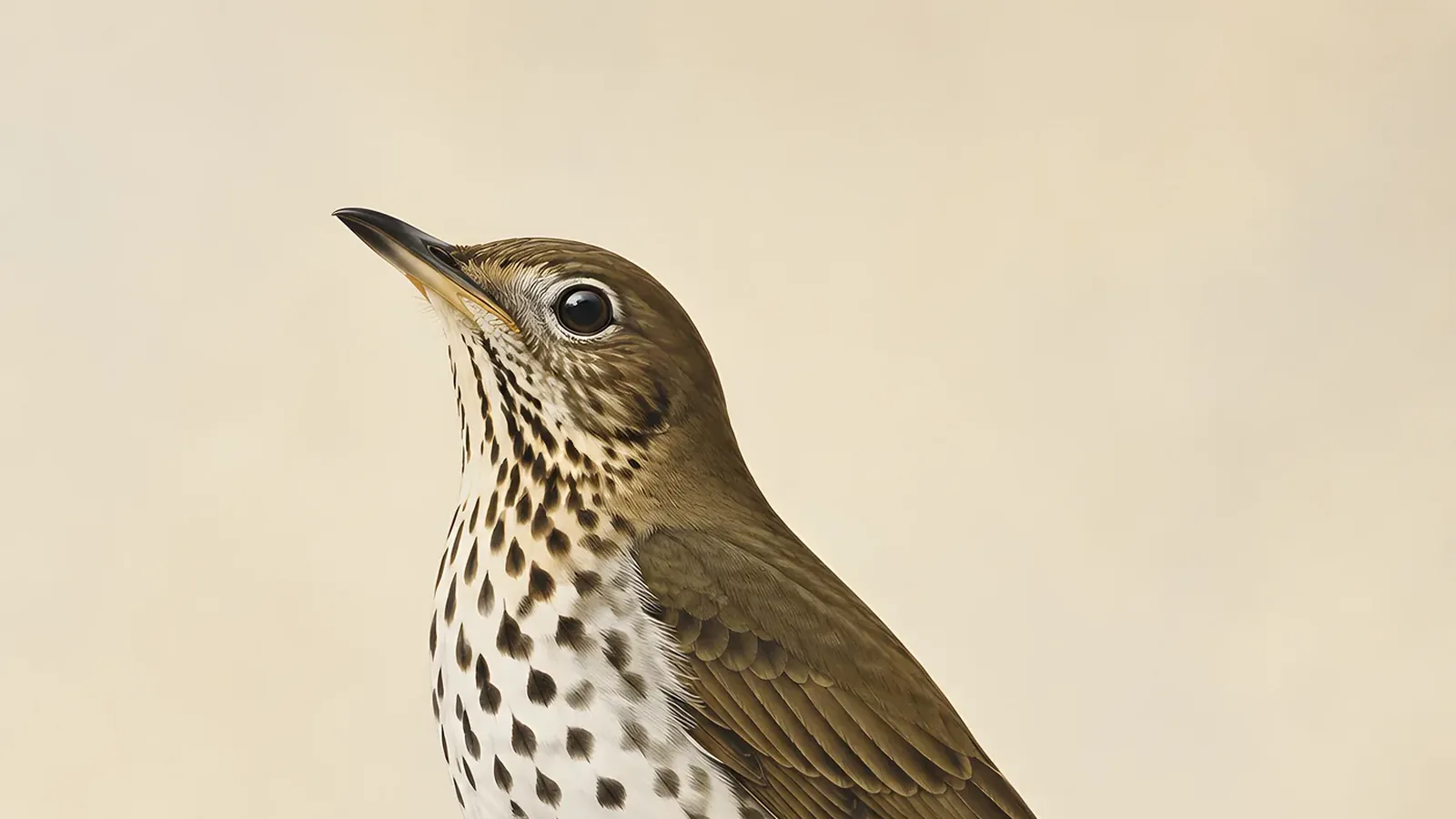
Stand within two metres of Bicknell’s Thrush and you will see a bird of quiet complexity. At distance it reads plain: olive-brown above, whitish below, bold dark spots distributed across the throat and breast in a loose necklace that softens as it reaches the flanks. Close the gap and the palette shifts. The upper tail and wing coverts carry a warm chestnut wash - slightly richer than on the very similar Gray-cheeked Thrush, though the difference rewards patience rather than demanding it. The face is unmarked grey, with a pale, indistinct eye-ring and a lower mandible that glows pale yellow where it meets the face.
Length runs 16 to 18 cm. Weight is 25 to 30 g - featherweight for a mountain species. Wingspan falls around 24 to 26 cm. Males average fractionally larger than females in wing length but are otherwise identical in the field. Underwings, rarely seen, carry a bold pattern: two pale bars alternating with two dark ones, a diagnostic detail if you can catch the bird in flight.
| Feature | Bicknell’s Thrush | Gray-cheeked Thrush |
|---|---|---|
| Upper tail colour | Warm chestnut | Cold olive-brown |
| Song final phrase | Rises | Falls |
| Breeding habitat | High-elevation NE firs | Boreal forest, far north |
| Winter range | Primarily Hispaniola | Greater Antilles + South America |
| Size | Slightly smaller | Slightly larger |
For most of the twentieth century this bird did not exist as a species. It was treated as a subspecies of the Gray-cheeked Thrush until 1995, when the American Ornithological Society acted on research by Ouellet (1993) demonstrating consistent differences in morphology, vocalizations, habitat preference, and migratory destination. A single year, 1995, gave the bird its taxonomic independence. It arrived as a full species already in decline.
The voice
Song is the surest separator from Gray-cheeked. Males deliver a four-phrased, fluting sequence that ornithologists render as chook-chook, wee-o, wee-o, wee-o-ti-t-ter-ee. Each rendition lasts about two seconds, followed by a pause of two to five seconds before the next. The critical point: the closing phrase rises in pitch, or holds level. On Gray-cheeked Thrush that same closing phrase falls. The contrast is audible with some practice.
The most frequent call is a harsh, downward-slurred whistle - rendered as beer or veer in most field guides, close to the call of a Veery but drier in quality. Near the nest, adults produce a low chook-chook contact note and, when alarmed, a thin rising weee. Males sing from exposed perches in the hour before dawn, fill the mid-morning with song, then fall largely quiet through the afternoon - a schedule that tracks the fog as much as anything else.
Two mountains, two countries
Bicknell’s Thrush occupies one of the smallest breeding ranges of any songbird on the continent. In summer it is confined to a handful of peaks and ridges across the high summits of New Hampshire, Vermont, Maine, New York’s Adirondacks and Catskills, and pockets of southeastern Canada including New Brunswick, Nova Scotia, and southern Quebec. Vermont Center for Ecostudies monitoring shows that more than 50% of the U.S. breeding population occupies just three public land units: White Mountain National Forest, Baxter State Park, and the High Peaks Wilderness Area.
The habitat specification is narrow even by those standards. Bicknell’s requires dense, short-statured balsam fir (Abies balsamea) forest, typically above 1,100 metres elevation at the southern edge of the range. The trees here grow slowly and stay small, shaped into thickets by orographic wind and ice. They create a close, humid microclimate - cool and damp and dim - that the bird appears to need absolutely. It also occupies areas of vigorous post-disturbance regrowth, including regenerating clearcuts at the right successional stage.
Come October the bird leaves and does not come back until late May. The winter range is almost as restricted as the breeding range. The majority of the global population spends the northern winter in the Dominican Republic, where the species occupies humid broadleaf mountain forest from around 1,000 metres up to 2,220 metres. BirdLife International data indicate the Dominican Republic holds approximately 51% of the species’ winter habitat. Haiti holds additional wintering birds, but Haiti has lost the majority of its original forest cover. Cuba, Jamaica, and Puerto Rico hold smaller populations. The bird is as constrained in January in the Sierra de Bahoruco as it is in July on the summit of Mount Mansfield.
That migratory corridor between the two ranges threads entirely east of the Appalachians, along the Atlantic coastal plain and out over open water - a route that makes the bird vulnerable to tower strikes and adverse weather at every point of the journey.
Diet
Bicknell’s Thrush forages on or very close to the ground, moving through the leaf litter and low fir branches with the deliberate hopping action of its family. The breeding-season diet runs toward invertebrates: beetles, ants, caterpillars, larvae of butterflies and moths, spiders, and flies. Nestlings receive particularly protein-rich items - adult sawflies, wasps, bees, and ants, delivered in quantities that support rapid growth in the short alpine summer. As late summer arrives and insects thin out, the diet shifts toward wild fruit: blueberries, bunchberries, and wild grapes where available. On the wintering grounds in Hispaniola’s mountain forests, the bird forages in a similar fashion, taking insects and seasonal fruit from the leaf litter and lower vegetation.
The strange breeding system
Most North American songbirds organize around pair bonds. One male defends a territory. One female builds a nest. They share the work of feeding young, more or less. Bicknell’s Thrush does not do this.
The species practices what reproductive biologists call female-defense polygynandry: both sexes take multiple mates, multiple males routinely provision the same brood of nestlings, and the genetic paternity of any given clutch is typically mixed. Goetz, McFarland, and Rimmer (2003, The Auk 120: 1044-1053) established this through genetic analysis of Vermont breeding birds, finding that more than 75% of broods showed mixed paternity and that individual males sometimes sired offspring in multiple nests during the same season. As many as four males have been documented feeding young at a single nest. No male defends a conventional territory. Home ranges overlap extensively and run from four to 80 hectares.
The adult sex ratio compounds this strangeness. In the Vermont population, breeding males outnumber females by more than two to one, despite nestling sex ratios approaching parity. The cause of this skew is not resolved.
What the mating system may be doing is distributing the risk. The breeding window is short and the conditions are harsh. A system that recruits multiple adult males to provision each nest may compensate for the compressed timeline and the unpredictability of high-elevation weather in June. Red squirrel predation accounts for 75% of nest failures, linked to biennial masting cycles in conifers. Overall nest success in Vermont has been measured at around 48% across long-term monitoring. Juvenile survival in the first 30 days post-fledging runs near 18%. The math of reproduction is tight.
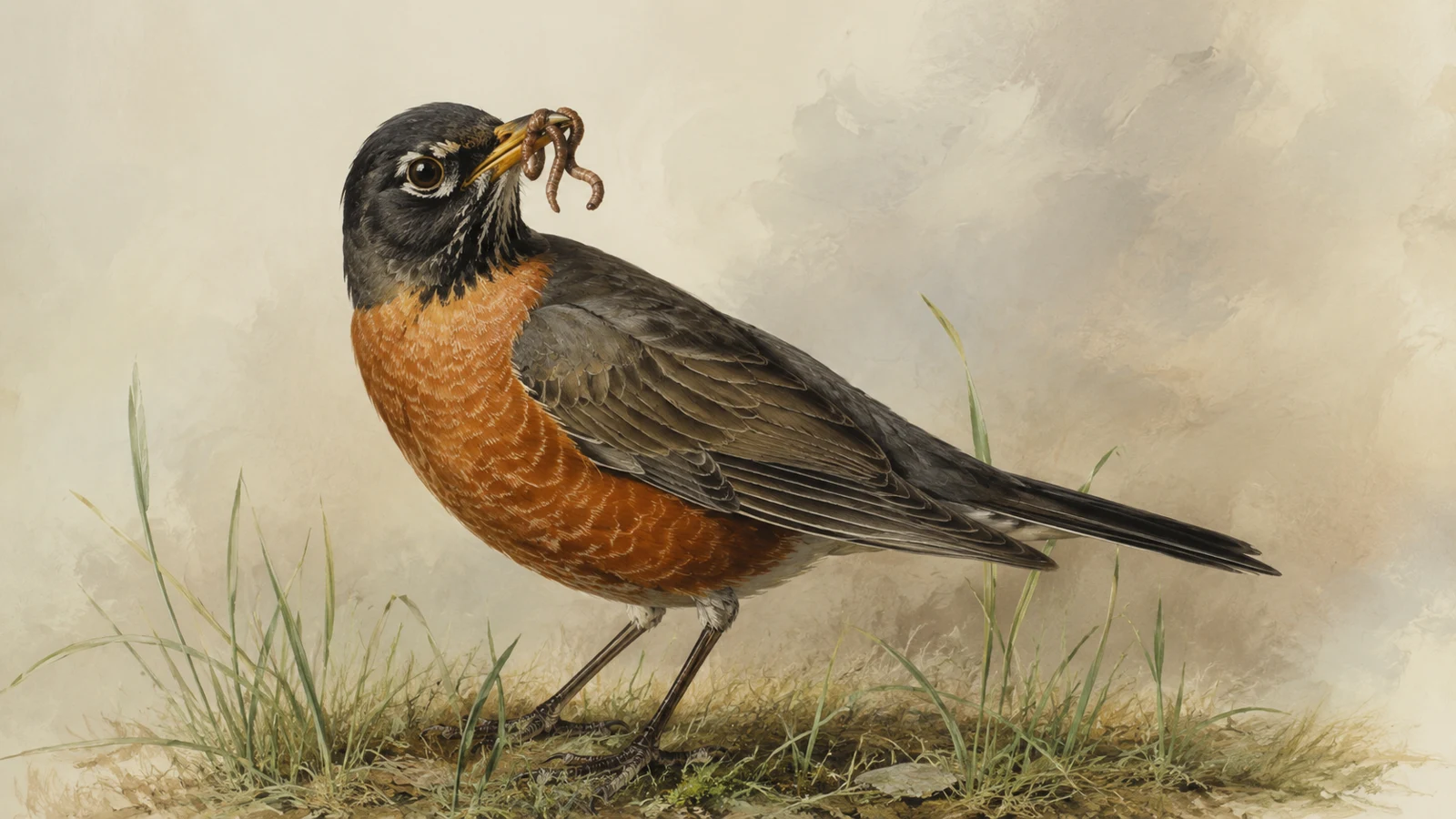
An American robin - a fellow Turdidae breeding in the valley two kilometres below - may attempt two or three nesting attempts per summer in warm lowland conditions. Bicknell’s Thrush, at altitude, may manage one.
Nowhere higher
The climate threat to Bicknell’s Thrush is not abstract. It has a specific geometry: the bird lives at the top of mountains, and the forest it requires is being pushed upslope by warming temperatures. Rodenhouse, Matthews, McFarland and colleagues (2008, Mitigation and Adaptation Strategies for Global Change 13: 517-540) modeled the relationship between temperature and balsam fir distribution across the Northeast, finding that a 1 degree Celsius warming reduces potential Bicknell’s Thrush habitat by more than half, and a 2 degree rise could eliminate most breeding sites in the Catskills and Vermont entirely. More than half of existing Northeast montane spruce-fir habitat may convert to hardwood forest within two centuries at current trajectory.
At lower elevations, hardwoods can migrate upward as conditions warm. At the summit, there is nowhere for the fir forest to go. The mountain simply ends.
Vermont Center for Ecostudies Mountain Birdwatch monitoring (Hill and Williams, 2025) recorded a 44% population decline across the U.S. breeding range since 2010, with an annual trend of -3.8%. The Catskills population is declining at -7.6% per year. Global population estimates have fallen from around 110,000 in 2010 to approximately 50,000 in the U.S. as of 2023, with total global numbers under 120,000. The IUCN lists the species as Vulnerable (VU). On the wintering grounds, deforestation on Hispaniola continues to reduce and fragment the montane forests the bird requires in the months when it is not being counted on New England peaks.
The oldest documented Bicknell’s Thrush was 11 years old - a male banded in Vermont, recorded still alive on the same ridge more than a decade later. That bird outlived a great deal: the biennial squirrel cycles, the late spring storms, the tower strikes of migration, the gradual conversion of the Haitian hillsides it wintered on. It came back, summit after summit, year after year, to the same dense firs and the same cool fog.
The question the species now poses is whether the fog itself will still be there - and the firs below it - when the next generation of birds arrives in late May. Every degree of warming narrows the answer. There is no altitude left in reserve.