Field Guide
Wood Thrush
Stand inside a mature eastern forest at dusk in late May. The light goes amber and then the colour drains out of everything, and then you hear it: four notes, fluty and unhurried, rising at the end as if asking a question. A rest. Then the phrase comes back lower. Then a cascading trill of extraordinary complexity follows, a sound like water over stones translated into music. That is Hylocichla mustelina, the Wood Thrush, doing the thing it does better than any other bird on the continent. And it is doing it, biologically speaking, with two voices at once.
What it looks like
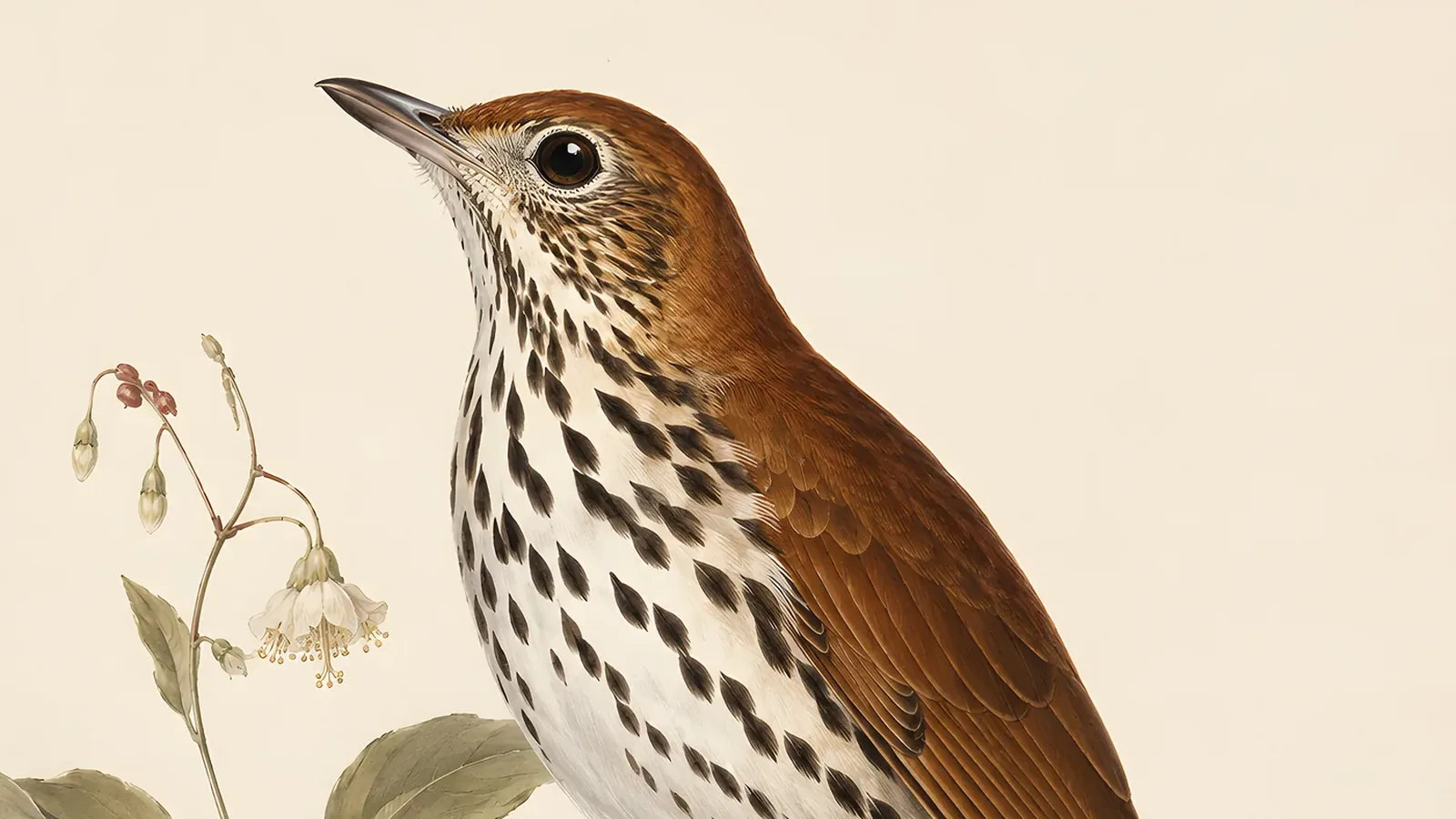
The Wood Thrush is a compact, upright bird - about 19 to 21 cm from bill tip to tail. It weighs between 48 and 72 g, heavier than it looks, with a wingspan of 30 to 34 cm. It sits with a thrush’s characteristic alert posture, body nearly vertical, tail low.
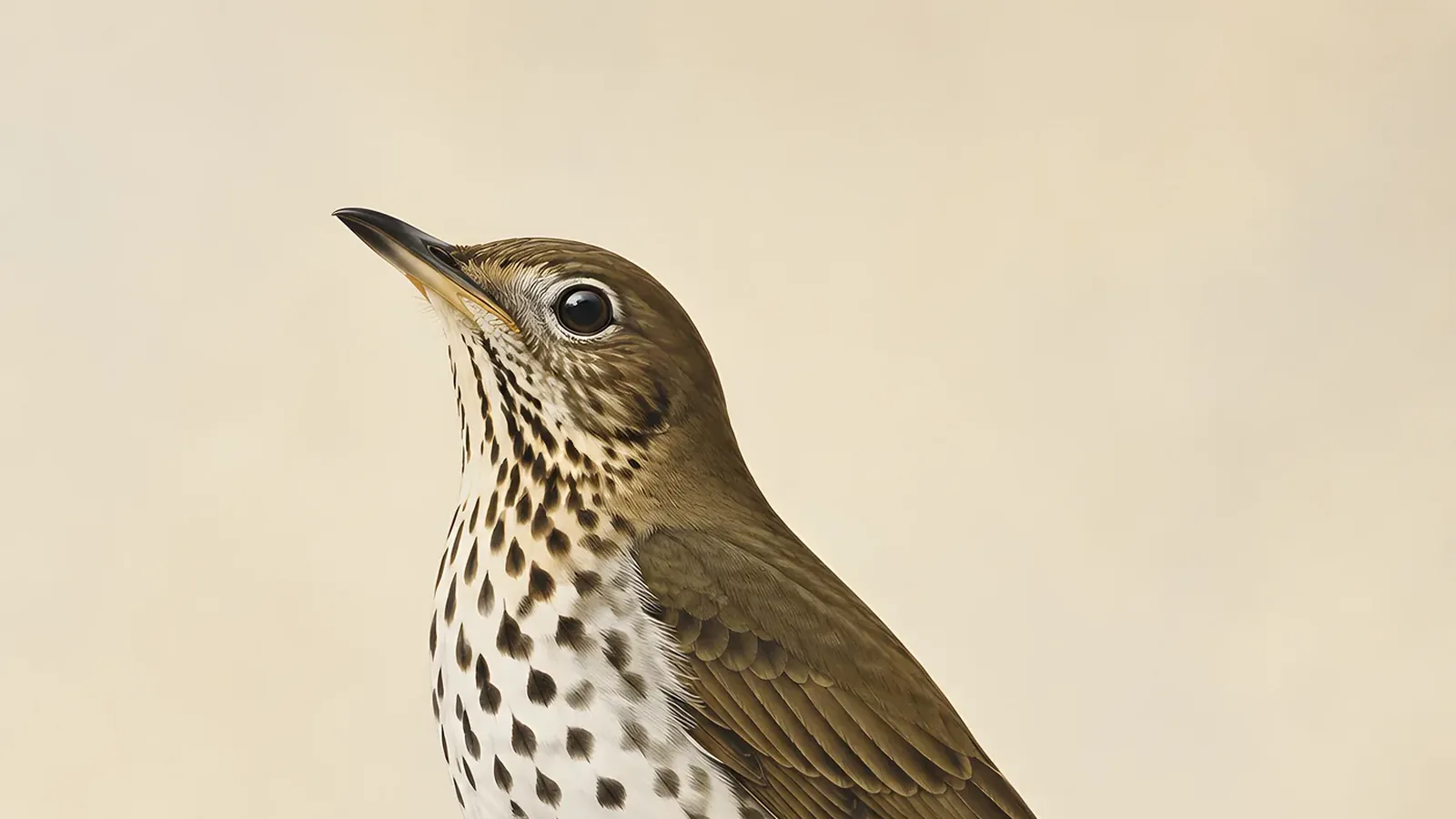
The head and upper back are a warm rufous-cinnamon, the colour of old mahogany in the sun. The back grades to olive-brown toward the tail. The underparts are white, and across the breast, flanks and belly run large, distinct blackish spots - not streaks, not smudges, but solid oval spots that make the bird look as though someone scattered dark seeds across a white cloth. The eye is large and brown, ringed by white, giving the face an open, slightly startled look.
| Feature | Description |
|---|---|
| Crown and nape | Warm rufous-cinnamon |
| Back and wings | Olive-brown |
| Underparts | White with heavy black-brown oval spots |
| Eye-ring | Prominent white |
| Bill | Stout, pale pinkish-grey |
| Legs | Flesh-pink |
The bold spotting is the key field mark in the eastern forest. The related Bicknell’s Thrush and the Hermit, Swainson’s, and Veery thrushes all share a spotted breast, but the Wood Thrush’s spots are the largest and boldest of the group, and its rufous head is stronger in colour than any of them. The sexes look identical.
The bird that sings in harmony
The song of the Wood Thrush is, by wide consensus among ornithologists and field naturalists, one of the most beautiful sounds produced by any North American bird. Henry David Thoreau called it “a sweeter and more powerful strain than any poet has sung.” That is not hyperbole. The song is genuinely extraordinary, and the reason is anatomical.
Birds produce sound through a structure called the syrinx, which sits at the base of the trachea where it forks into the two bronchi. Unlike the mammalian larynx, the syrinx has two sides, each independently controlled by its own set of muscles. Fine singers among the thrushes - and the Wood Thrush is the finest - can activate both sides simultaneously and independently. The result is that a single bird produces two separate notes at once, notes that harmonize with each other in perfect intervals as they travel through the single trachea. It is a genuine internal duet, performed by one bird.
In practice this means the song has three distinct parts. The first phrase, a low burbled introduction, warms the syrinx. The second phrase is the famous fluting ee-oh-lay (or ee-oh-lay-ee), the ascending call that carries through half a kilometre of forest. The third phrase is the trill - a shimmering, bell-like cascade where the dual-voice harmonics are most pronounced, where the sound appears to multiply and overlap itself. That third phrase is not a fast sequence of single notes. It is two-voice music, produced simultaneously, by one animal.
The oldest banded Wood Thrush on record was at least ten years and two months old (Cornell Lab of Ornithology, band return records). It sang every breeding season it was alive.
Range and the forest interior
The Wood Thrush breeds across eastern North America from southern Ontario and Nova Scotia south to central Florida, and west through the Great Plains edge states as far as eastern Nebraska. It is concentrated in the mid-Atlantic and Appalachian states - Virginia, Pennsylvania, Maryland, Tennessee and the Carolinas hold some of the densest breeding populations on the continent.
It is not a forest-edge species. It is a forest-interior species. The Wood Thrush needs mature deciduous or mixed forest with a closed canopy, a relatively open understory for foraging, moist leaf litter, and flowing water nearby. It does not thrive in suburban woodlots or hedgerows. It needs interior - the middle of a forest, away from the exposed margins where predators concentrate and where a different, more aggressive bird lays its eggs in other birds’ nests.
In October the Wood Thrush departs for its wintering grounds in the humid lowland forests of southern Mexico, Belize, Honduras, Guatemala, Nicaragua and Costa Rica. It spends roughly five months there, returning north in April. Both ends of that journey depend on the kind of dense mature tropical forest that is disappearing fast across Central America - a fact that complicates any recovery plan focused only on breeding grounds.
The decline
Here is what the numbers say. The North American Breeding Bird Survey, which has run continuously since 1966, shows the Wood Thrush has lost roughly 50 percent of its population over the past six decades, at an average decline of about one percent per year. Partners in Flight documents a 60 percent drop between 1970 and 2014. The species remains listed as Least Concern by the IUCN because its global range and absolute numbers have not yet crossed the thresholds for a higher category - but the trajectory is unambiguous, and the direction has not changed.
Three forces drive the decline, and all three intersect.
The first is habitat fragmentation. As eastern deciduous forest has been subdivided by roads, suburbs and agriculture, the interior habitat the Wood Thrush requires has broken into smaller and smaller parcels. Small forest fragments have more edge relative to interior. More edge means more Brown-headed Cowbirds. The cowbird is a brood parasite - the female lays her eggs in other birds’ nests, and the cowbird chick typically displaces or outcompetes the host’s own young. In unfragmented interior forest, cowbirds are rare. At the edges of small fragments, they are common. Donovan and colleagues documented across 30 landscapes in 17 states that nest parasitism rates in Wood Thrush nests are strongly correlated with fragmentation at a 20 km radius - the maximum foraging range of cowbirds. Midwestern populations in heavily fragmented farmland landscapes were producing as few as 0.3 to 2.1 fledglings per female per year, well below replacement.
The second force is acid rain. Hames, Rosenberg, Lowe, Barker and Dhondt (2002, Proceedings of the National Academy of Sciences, vol. 99: 11235-11240) showed that Wood Thrush breeding density is significantly lower in regions receiving high acid deposition - not because acid rain directly harms the birds, but because it leaches calcium from forest soils. Calcium-depleted soils support fewer land snails. Snail shells are a critical calcium source for breeding females, who use the mineral to form eggshells, and for growing chicks, who need it for skeletal development. Remove the snails, and the forest that looks perfectly intact on the outside becomes a calcium-poor environment that cannot support successful nesting. The mechanism is indirect, chemical, and invisible from above - exactly the kind of mechanism that is easy to miss until a bird has been quietly failing for thirty years.
The third force is the wintering ground. A 2015 study in The Auk (Rushing et al.) tracked Wood Thrushes with geolocators and found that individual birds show strong carry-over effects from wintering ground quality: birds that wintered in high-quality lowland forest arrived earlier on the breeding grounds, in better condition, and had higher reproductive success. This means that deforestation in Central American lowlands is not a separate problem from the breeding-ground story. It is the same problem, expressed in a different country.
Diet
The Wood Thrush forages almost entirely on the forest floor, flicking leaf litter aside with its bill to expose invertebrates underneath. The core summer diet consists of beetles, flies, ants, earthworms, spiders, and snails. It will take small salamanders and other soft-bodied prey opportunistically.
Snails deserve particular mention. As Hames et al. (2002) demonstrated, land snails are not merely incidental prey - they are a calcium delivery system. Females eat snail shells before and during egg-laying. Chicks receive snail fragments in their early diet. In regions where acid rain has reduced snail populations, this dietary pathway fails, and the effect propagates through the entire nesting attempt.
From late summer through migration and on the wintering grounds, the diet shifts toward fruits - dogwood berries, holly, pokeweed and other high-calorie forest fruits that fuel migration and sustain the bird through the non-breeding season.
Breeding
Males arrive on the breeding grounds two to three weeks before females and immediately begin establishing territories, which they defend vigorously with song. A male Wood Thrush sings persistently from dawn through the first few hours of morning and again at dusk. The song functions as simultaneous territorial advertisement and mate attraction, which is why losing it to cowbird parasitism and habitat degradation diminishes the forest twice - once in birds, once in sound.
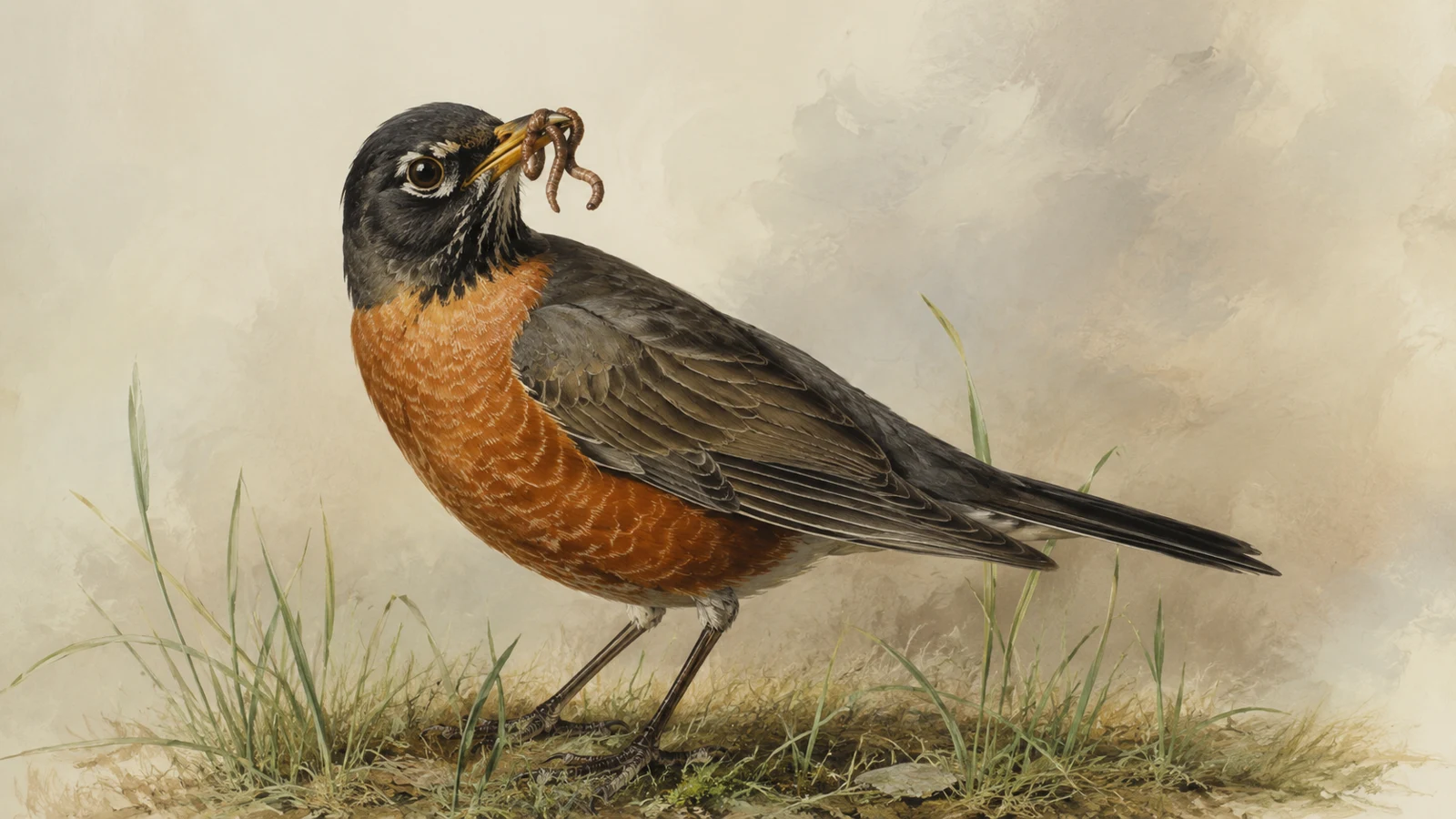
The female builds the nest alone, a neat cup of grass, leaves and plant fibers reinforced with mud in the middle layer - the same three-layer construction strategy used by the American Robin, the Wood Thrush’s close relative in the family Turdidae. The nest is typically placed in the fork of a small tree or shrub, three to six meters above the forest floor. She lays three to four pale blue-green eggs, incubates them alone for 13 to 14 days, and broods the chicks for the first few days after hatching. Both parents feed the nestlings. Chicks fledge at 12 to 15 days and become independent at roughly three to four weeks.
Nearly half of all Wood Thrush pairs attempt two broods per season. In years when the first brood succeeds early and cowbird pressure is manageable, the second nesting attempt can be the difference between a territory that contributes birds to the population and one that does not.
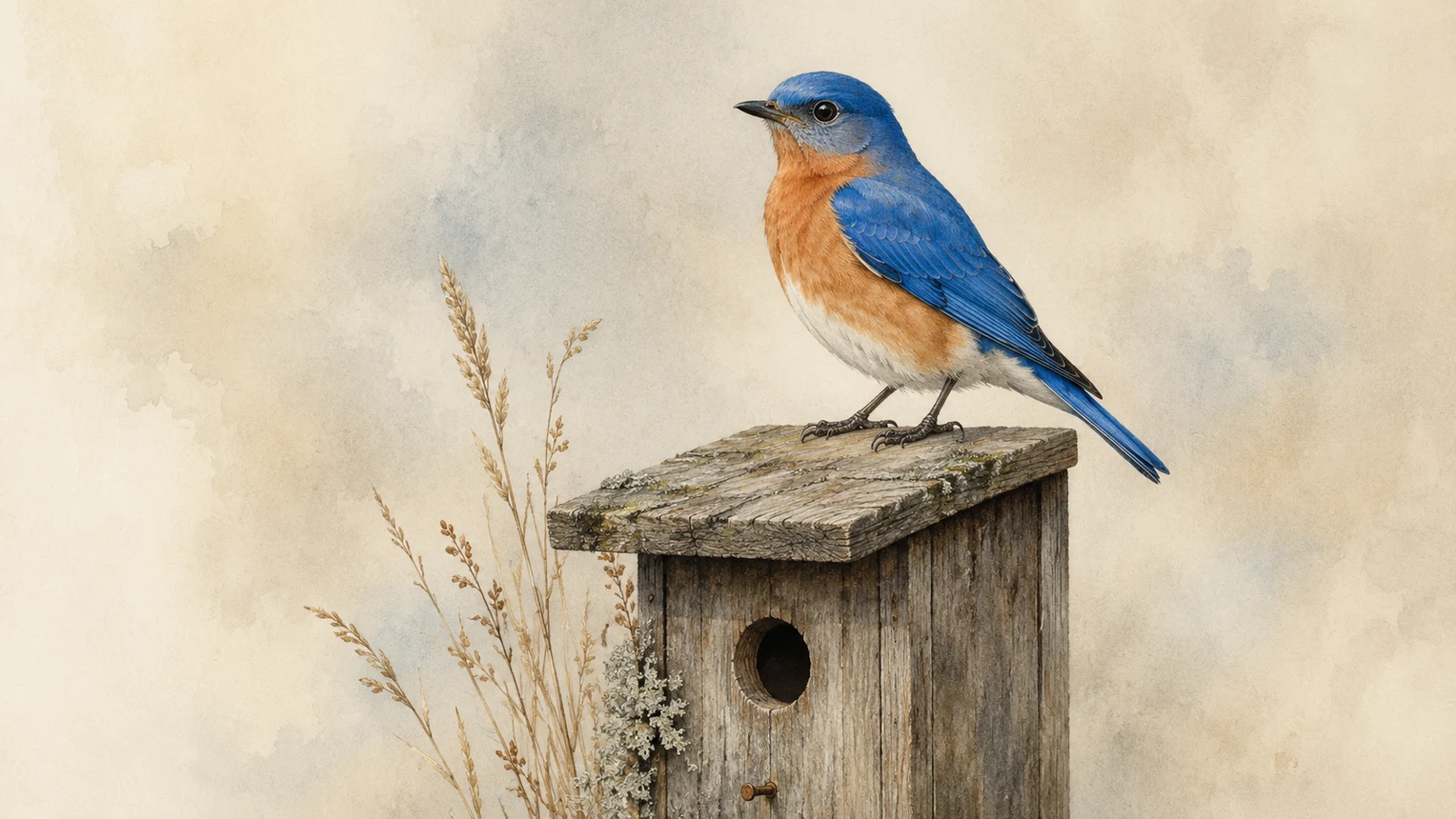
The Cedar Waxwing shares the Wood Thrush’s taste for summer fruit and its preference for mature forest, and the two species are sometimes seen foraging in the same trees during berry season. The Eastern Bluebird, by contrast, is a bird of open habitat - a useful reminder that the Wood Thrush is defined not just by what it is but by what it requires: not a yard, not a hedgerow, but a forest with enough unbroken interior that a bird with two voices and one breeding season can find enough snails, enough undisturbed leaf litter, and enough distance from the edges to raise its young without the sound of another bird’s egg cracking open in its nest.
The great eastern deciduous forest is still there. The question is whether it is still there in the right configuration - contiguous enough, deep enough, chemically intact enough - to sustain a bird that measures its health better than any instrument we have built. Every May, when the Wood Thrush sings its third phrase into the dusk and the two voices spiral around each other in the trees, that question is still open. Whether it stays open is a decision being made now, in forest policy offices and land trusts and agriculture boardrooms, by people who may never have heard the song they are deciding about.