Field Guide
American Robin
There are roughly 370 million American Robins on the continent. That makes the robin the most numerous landbird in North America, more numerous than House Sparrows, House Finches and European Starlings combined. The Western Meadowlark, the Yellow-rumped Warbler and the Mourning Dove come close, but the robin is the bird most North Americans have already seen this week without registering it.
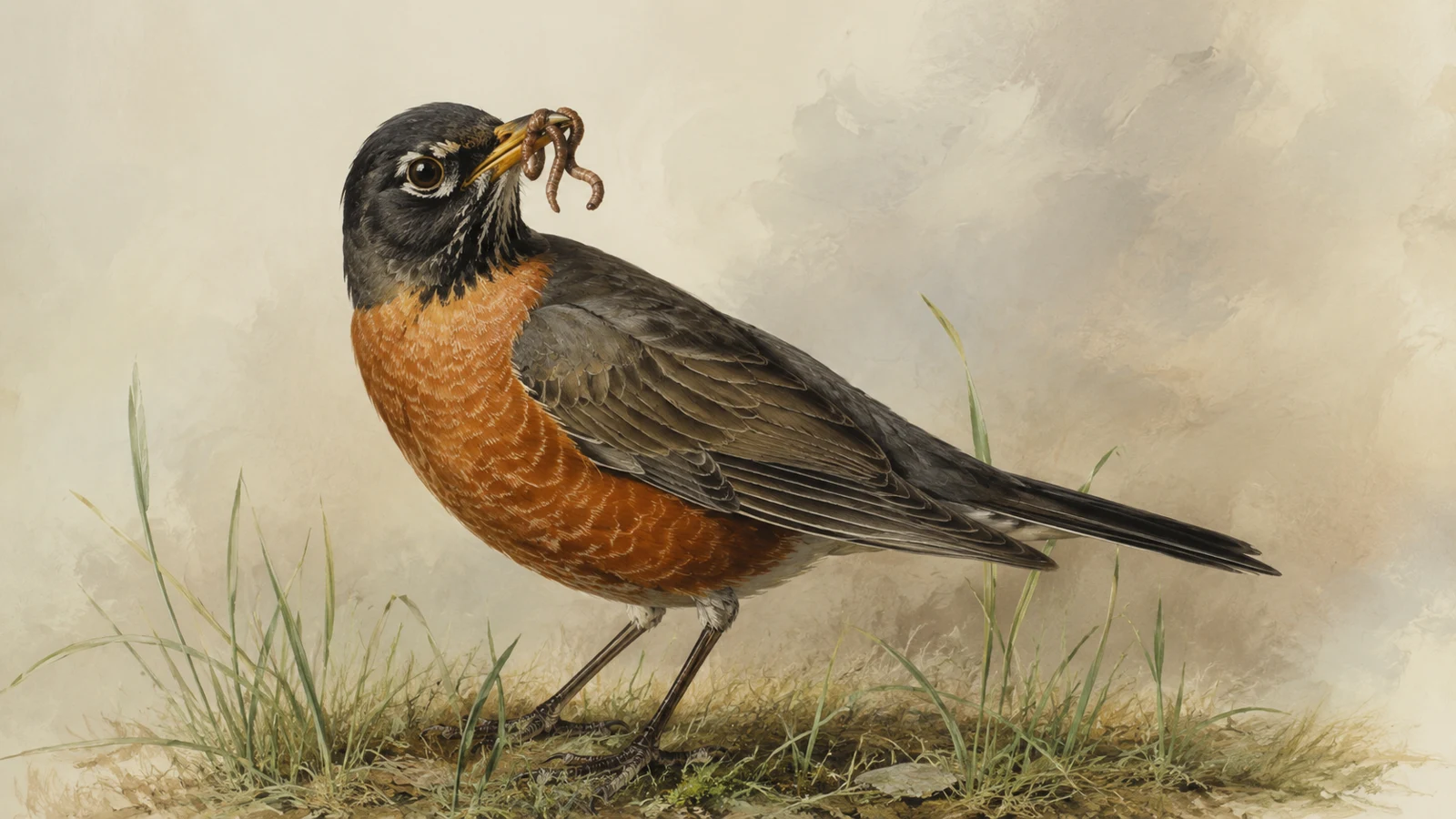
He is also the first bird most people in North America learn to identify. Grey back, brick-orange breast, white throat with dark streaks, yellow bill. The running-pausing-listening hunt on the lawn that no other songbird performs. And one of the easiest dawn-chorus voices to pick out: a confident slurred series of two- and three-note phrases that goes cheerily, cheer-up, cheerio, cheer-up, delivered from a high perch from before sunrise into mid-morning.
Plumage and identification
The breast colour is the easiest sex distinction in the species. A male’s chest is the colour of a terracotta pot. A female’s is a chalky version of the same orange.
| Feature | Adult male | Adult female | Juvenile |
|---|---|---|---|
| Head | Black | Charcoal grey | Streaked grey-brown |
| Back | Slate grey | Grey-brown | Brown with pale streaks |
| Breast | Deep brick-orange | Pale dusty orange | Buff with heavy dark spots |
| Throat | White with dark streaks | White with dark streaks | White |
| Bill | Yellow, dark tip in winter | Yellow | Yellow with dark tip |
| Eye-ring | Broken white | Broken white | Broken white |
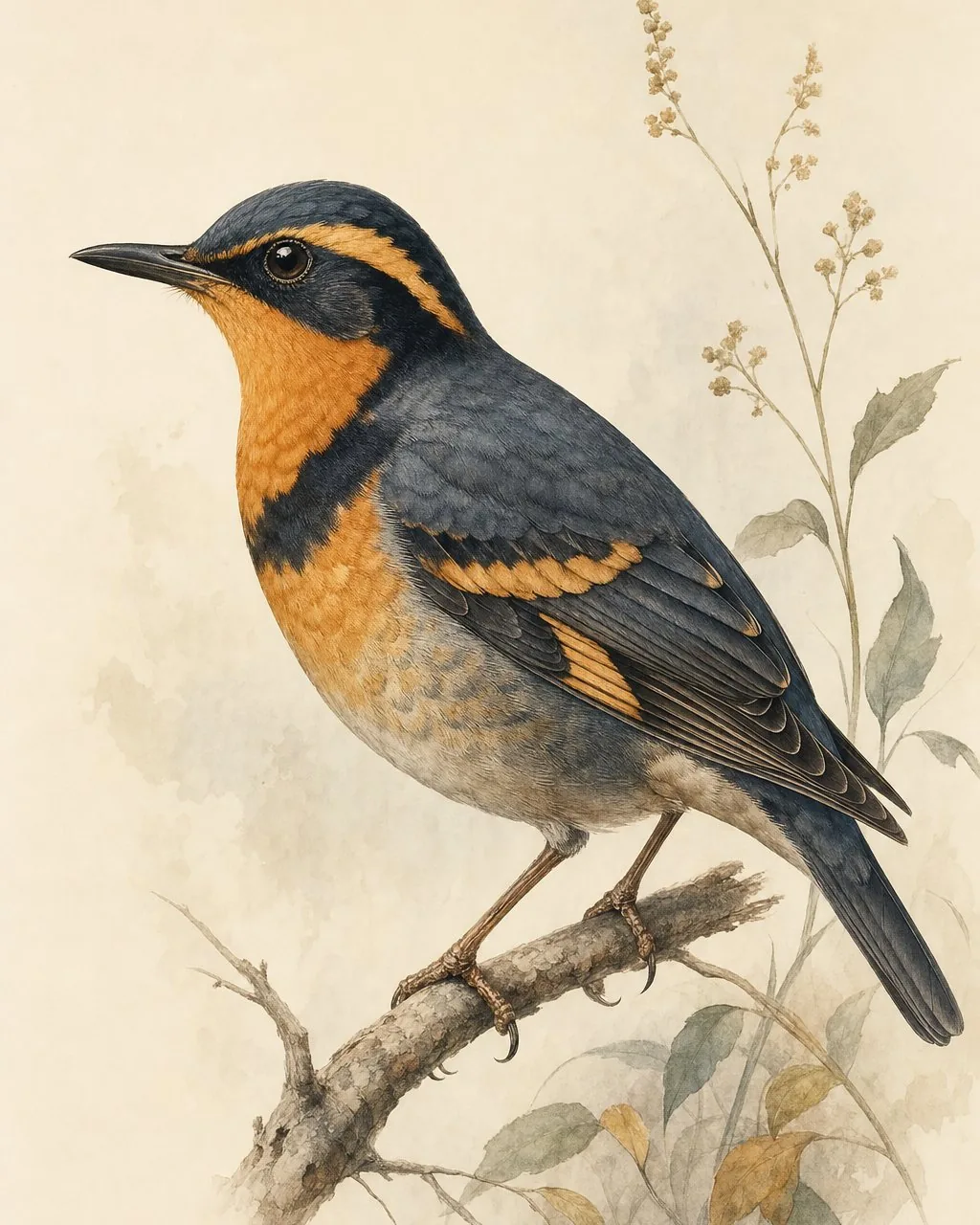
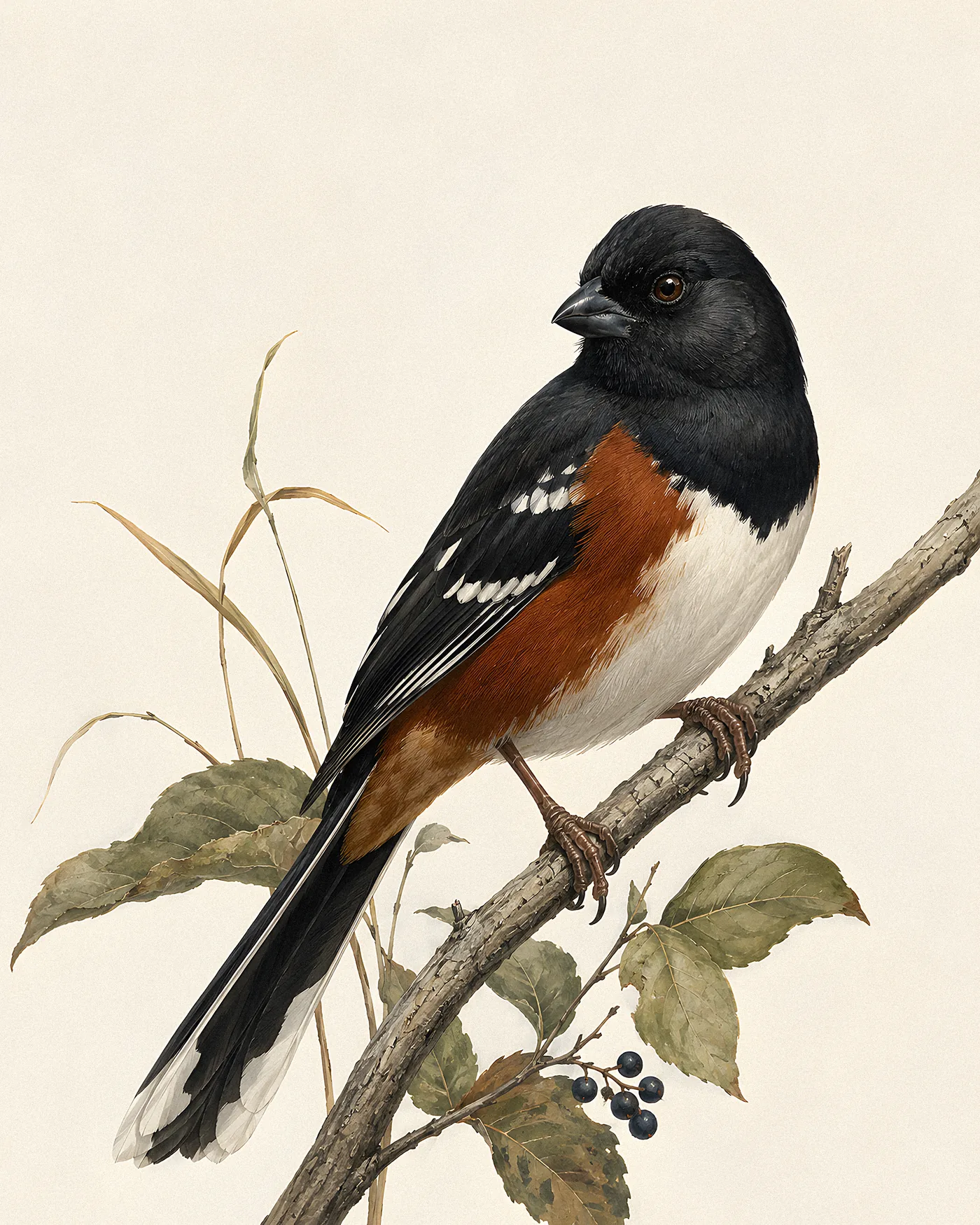
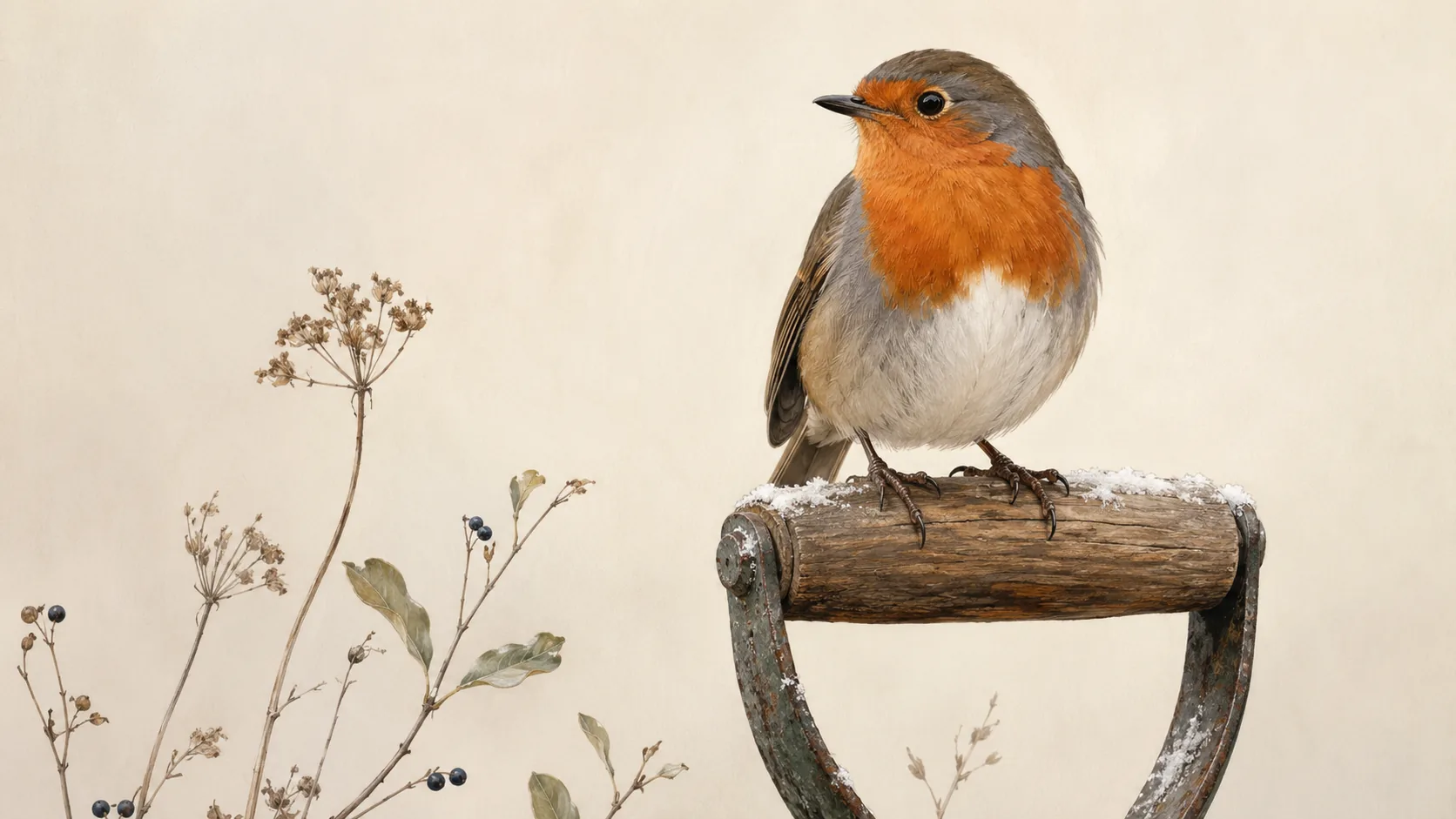
Common confusions: Varied Thrush in the Pacific Northwest (similar orange but with a black breast band), Spotted Towhee in the west, Eastern Towhee in the east, and the unrelated European Robin (which is much smaller, related to flycatchers, and shares only the name). See Birds that look like robins and Robin vs Cardinal.
Voice
The robin is the bird who sets the dawn chorus across most of suburban North America. He starts about 45 minutes before sunrise and sings continuously for two to three hours.
- Song. Long stream of slurred two- and three-note phrases - cheerily, cheer-up, cheerio, cheer-up - delivered conversationally and at length. The cadence sounds like the bird is telling you a story.
- Calls. A sharp yeep alarm. A quiet tut tut tut contact. A thin descending seee warning specifically for accipiter hawks overhead.
The dawn chorus is the male’s territorial broadcast. Once daylight is up he stops singing in long bouts and shifts to feeding. A robin singing at full song at 11 am in May is almost always a younger unpaired male.
Range and migration
The American Robin is a partial migrant. Year-round resident across the southern two-thirds of the United States. Migratory from the northern third and Canada, with winter populations shifting south to wherever fruit remains on the branch.
| Season | Where the robin is |
|---|---|
| Spring | Returning to lawns and woodland edges across northern range, peak song |
| Summer | Breeding across most of North America |
| Autumn | Flocks of dozens to thousands moving south, feeding on fruit |
| Winter | Southern half of US, with some northern resident birds clustering at fruit-bearing trees |
Habitat: lawns, parks, woodland edges, orchards, suburban gardens. Robins arguably need short grass turf more than any other common North American songbird. The species’ modern abundance is largely a product of European-introduced suburban landscaping with mown grass.
Diet
The robin’s diet flips seasonally.
- Spring and summer: insectivore. Earthworms, beetle larvae, cutworms, caterpillars. Pulled from short turf at speed.
- Autumn and winter: frugivore. Crabapple, hawthorn, juniper berries, sumac, mulberry, holly. A flock of 200 robins can strip a fruiting tree in a morning.
A robin does not visit seed feeders. To draw him in, plant native fruiting trees and leave the lawn long enough to host worms. See Plants that attract American Robins.
The head-tilt
A robin running on a lawn stops, tips his head sideways and freezes. The folk explanation is that he is listening for worms. The actual explanation is that he is looking.
The robin’s eyes are placed laterally on the head. A horizontal patch of grass cannot be examined with both eyes simultaneously - the bird has to rotate to bring one eye directly over the patch. A 1965 paper by Heppner, working with captive American Robins on prey-detection across visual, auditory and vibration channels, showed that visual cues dominate. Robins with normal vision but blocked hearing took worms as readily as controls. Robins with normal hearing but obstructed vision failed.
Hearing helps. The head-tilt is sight.
Breeding and nesting
The robin builds the best-known nest in North America. Most children who grow up in a robin-friendly suburb will have seen one before the age of ten.
| Feature | Detail |
|---|---|
| Nest site | Horizontal branch, gutter, porch light, window ledge. 1.5 to 4.5 m off the ground. |
| Builder | Female, with the male occasionally bringing materials |
| Materials | Twigs and grass plastered together with mud, lined with fine grass |
| Clutch | 3 to 5 eggs, robin’s-egg blue with no markings |
| Incubation | 12 to 14 days, by the female |
| Fledging | Young leave at 13 days, still streaky |
| Broods per year | 2 to 3 |
Robin’s-egg blue is one of the few bird colours that exists as a paint chip in its own right. The pigment is biliverdin, deposited in the shell during formation. The colour intensity is correlated with female health: paler eggs in stressed females, deeper blue in well-fed ones. Some research has argued that the colour itself is a signal to the male about female condition, and that males of robin pairs with brighter eggs invest more in chick-feeding. The 2011 paper by English and Montgomerie in Behavioral Ecology and Sociobiology is the standard reference.
Drunk robins
A documented winter phenomenon. Fermenting over-ripe crabapples, hollyberries, juniper and pyracantha all produce ethanol. Robins gorging on these in late winter can become measurably intoxicated: stumbling, swaying, flying into windows, occasionally dying from acute alcohol poisoning. The behaviour shows up in wildlife rehabilitator reports every February and March.
If you find a robin clearly impaired on the ground in late winter, the right move is usually to place him in a small ventilated box in a dark quiet space for a few hours. Most recover by evening.
Range edge: the European Robin question
The “robin” in British, Irish and Scottish folklore is not this species. It is the European Robin, Erithacus rubecula, a smaller and largely unrelated bird belonging to the Old World flycatcher family. Early colonial settlers in North America applied the familiar English name to the American species because of the shared orange breast. Both birds carry symbolism around homecoming and winter, transferred from the older European tradition. See the European Robin field guide for the actual British robin and Robin symbolism for the shared cross-cultural reading.
Print available
A study of an American Robin pulling a worm from spring lawn is available at the American Robin Print, and the bird is part of the Songbirds Set curated collection.