Field Guide
Dickcissel
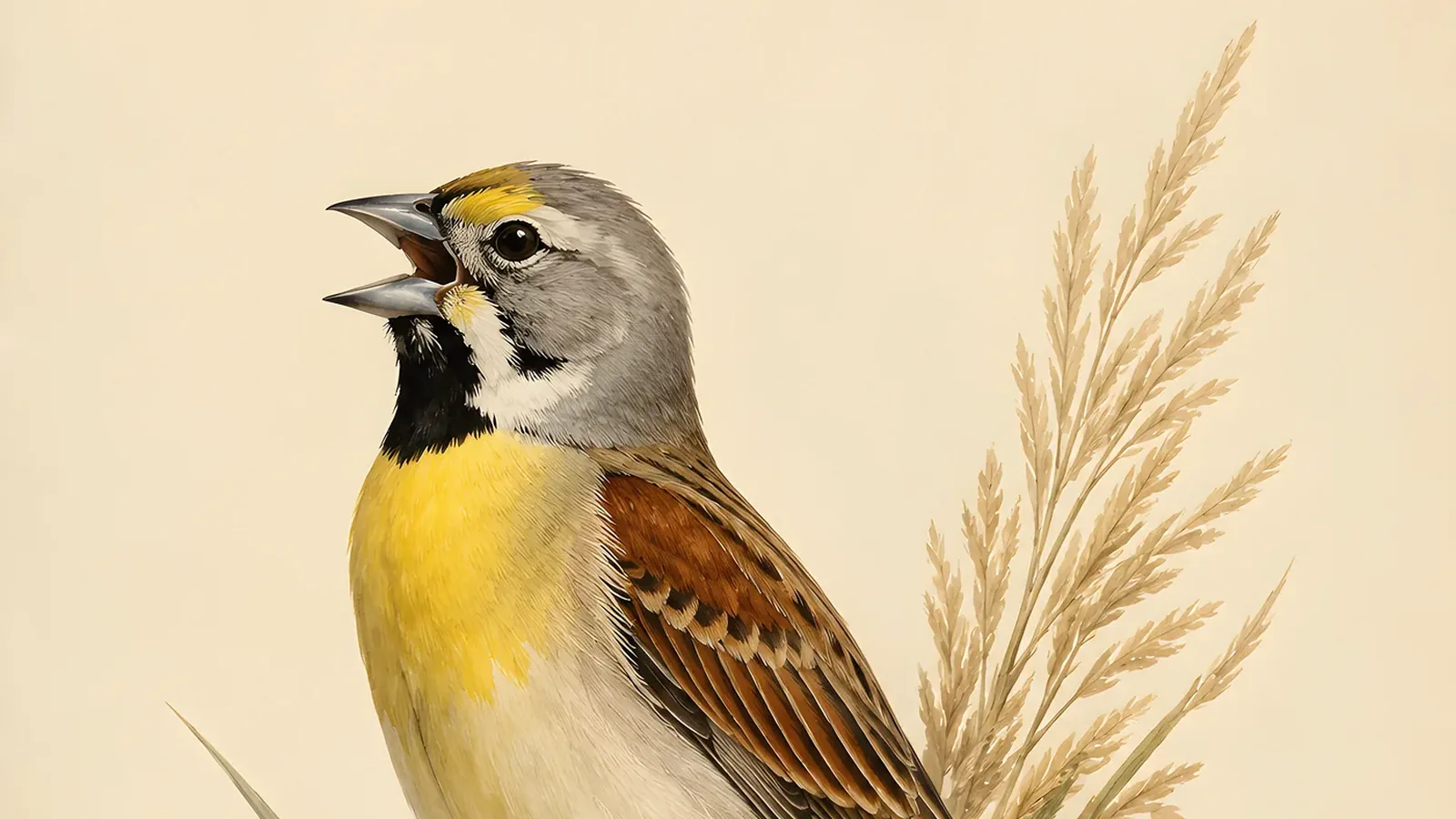
A male Spiza americana - the Dickcissel - is perched on a fence wire above a Kansas hayfield, sixty centimetres of wire holding the whole summer still. The grass below him is thigh-high and seed-heavy. The sky is the flat bright white of mid-July. He leans forward on the wire and opens his bill and delivers the song that gave the species its name: dick-dick-cissel, dick-dick-cissel, two dry ticks followed by a buzzing, nasal trill. He does this from before sunrise. He is doing it now, past noon, in heat that has silenced the red-winged blackbirds. He will still be doing it at dusk.
No bird on the continent announces itself more plainly, or is more reckless with the announcement.
What he looks like
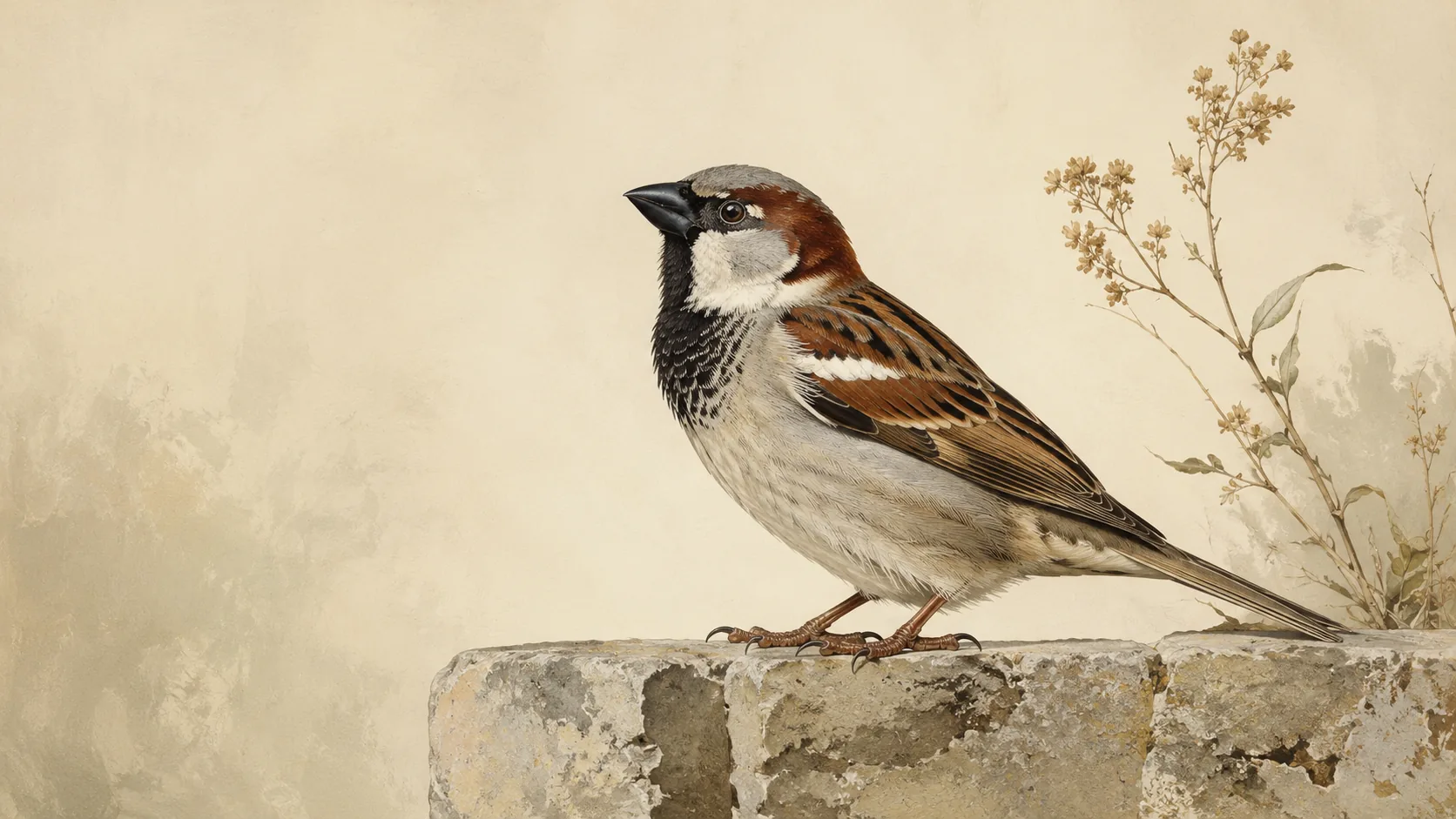
The breeding male carries a colour scheme you would not expect from a member of the cardinal family. The head is grey, cleanly capped. The supercilium is yellow, bold and precise, framing a dark eye. The throat is white, and below it sits a solid black bib - not spotted, not streaked, a clean badge, like a gentleman in a worn field jacket who has kept his collar crisp. The breast is chrome yellow, brightest at the centre. The shoulders carry a patch of chestnut-rufous, the same shade of brick-red you find on a house sparrow, and the effect of the whole bird - grey head, yellow breast, black bib, rust at the shoulder - is something between a miniature meadowlark and a sparrow that has dressed above its station.
The wing feathers are brown with pale edges. The tail is short and slightly notched. The bill is conical and stout, heavier in proportion than you might expect, the seed-cracker of the Cardinalidae at work.
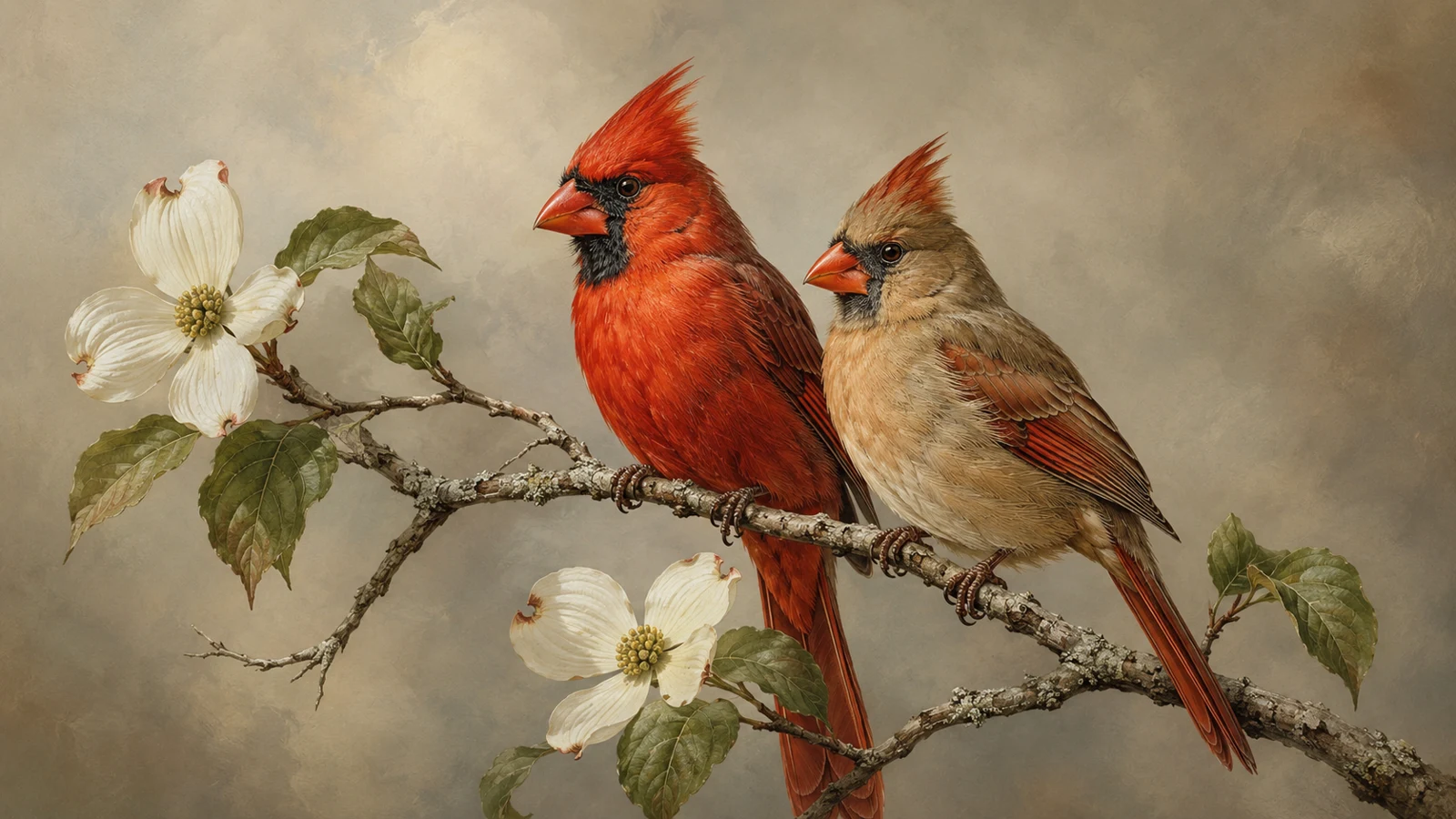
The female is quieter in every respect. She is streaked brown above, pale and lightly streaked below, with a wash of yellow on the breast that can be nearly absent. The yellow supercilium is there if you look for it. A first-year male is intermediate, showing the pattern of the adult but with the colours washed and the bib incomplete.
| Measurement | Range |
|---|---|
| Length | 14-16 cm |
| Weight | 27-49 g |
| Wingspan | 23-28 cm |
| Max recorded lifespan | 4.8 years (BBL longevity records) |
The song that names him
The song is not melodic. It is buzzy and slightly harsh, a sequence of paired dry notes leading into a trill: dick dick cissel cissel cissel, or rendered by some as see-see, dic-dic, ciss-ciss-ciss. The intervals are irregular enough that no two ornithologists write it the same way, but the effect is unmistakable once you know it. The species named itself. Very few birds can make that claim.
The male sings from exposed perches - fence wires, tall forbs, the crest of a shrub - and he sings through the heat of the day with a persistence that most grassland birds abandon by mid-morning. He is territorial, and territory is partly advertisement, which means the song carries across the open ground where his voice needs to reach. The Southern Wisconsin Bird Alliance notes that a single male may attract up to six females in a season, a polygynous arrangement that gives the song its urgency. More females means a better season. The song is not poetry. It is logistics.
The call note is a sharp, flat chk - useful in migration when the bird drops into a weedy field edge and gives itself away with one syllable.
The gambler
The Dickcissel is, at its core, a bird that bets on weather. In the core breeding range - the tallgrass and mixed-grass prairies from Iowa to Nebraska and Missouri - the population is relatively stable year to year. But in the peripheral range, which can extend east to the Atlantic coast and north into southern Canada in good years, numbers swing wildly. Aldrich (1948) documented the erratic nature of the breeding distribution, noting dramatic annual shifts in where birds appeared across the eastern fringe of the range.
This is not random. The Dickcissel tracks moisture. A wet spring in a normally dry county can pull hundreds of pairs into country that held none the previous year. A drought in the core range can scatter birds eastward into farmland states where they are rarely expected. The bird is reading the landscape for what it needs - tall, dense grass with good forb diversity and standing insects - and moving toward it regardless of what field guides say it ought to do.
Fretwell (1977, 1979) warned that this dependence on a shifting, patchwork resource made the species especially vulnerable, arguing at one point that “Dickcissel extinction predicted before the year 2000.” That prediction did not come true, but the population data behind it were real. The North American Breeding Bird Survey has recorded a decline of roughly 40 percent since monitoring began in 1966 (Sousa, Temple and Basili 2022, Birds of the World). The bird is not extinct. It is less common than it was. Those are different facts, both worth holding.
In Illinois, which sits in the core breeding range, the Dickcissel was once among the most abundant birds of the agricultural interior. It still nests there. But the conversion of tallgrass prairie to row crops - which now covers more than 99 percent of what was once the greatest grassland on the continent - has reduced the bird to hayfields, roadsides, and the shrinking strips of native grass that Conservation Reserve Program enrollment has kept from the plough.
One country for winter
Almost every Dickcissel on the continent spends the winter in one place. The llanos of Venezuela - the seasonally flooded savanna of the interior - receives the bulk of the global population, a concentration so extreme that Basili and Temple (1999, Ecological Applications) estimated individual roosts in agricultural areas holding up to three million birds. Three million birds. In a single roost.
This creates a problem. A rice farmer in the Venezuelan llanos who wakes up to find three million Dickcissels in his fields is not thinking about North American conservation. He is thinking about his crop. The relationship between the species and agriculture in Venezuela has been poorly characterized - Basili and Temple’s models showed that Dickcissels consume relatively small proportions of Venezuela’s rice and sorghum production in aggregate, and that individual farmers who suffer greater losses perceive a problem larger than the national data support. But perception drives action, and the action taken has been severe.
Since at least the 1960s, farmers in Venezuela have aerially sprayed roosts at night with organophosphate and organochlorine pesticides. The Southern Wisconsin Bird Alliance (Steele 2025) reports that tens of thousands of birds may be poisoned or shot in a single night. The scale of this mortality, falling on a population that has concentrated itself into one country, converts what would otherwise be a manageable pressure into a conservation flashpoint. The Dickcissel’s habit of gathering - the ecological efficiency of a communal roost - becomes the mechanism of its own destruction.
The IUCN lists Spiza americana as Least Concern (LC), and the global population of roughly 28 million means the species is not in immediate danger of extinction. But the 40 percent decline documented since 1966, falling on a bird that funnels its entire population through a single wintering bottleneck where it is actively killed as a pest, is not a comfortable margin.
The Dickcissel’s mistake, if a bird can make one, is that it solved the problem of winter by going somewhere together. The entire species in one country. The entire species available in one night.
Diet
The Dickcissel is, in the breeding season, an insect and seed eater in roughly equal measure. Grasshoppers, beetles, caterpillars, and other arthropods make up much of the summer diet and are the primary food fed to nestlings. As grasses go to seed through July and August, the diet shifts toward seeds - grasses, forbs, weeds, and grain - the same foods that fuel the long flight south and make the species so effective at exploiting agricultural country on both ends of the migration.
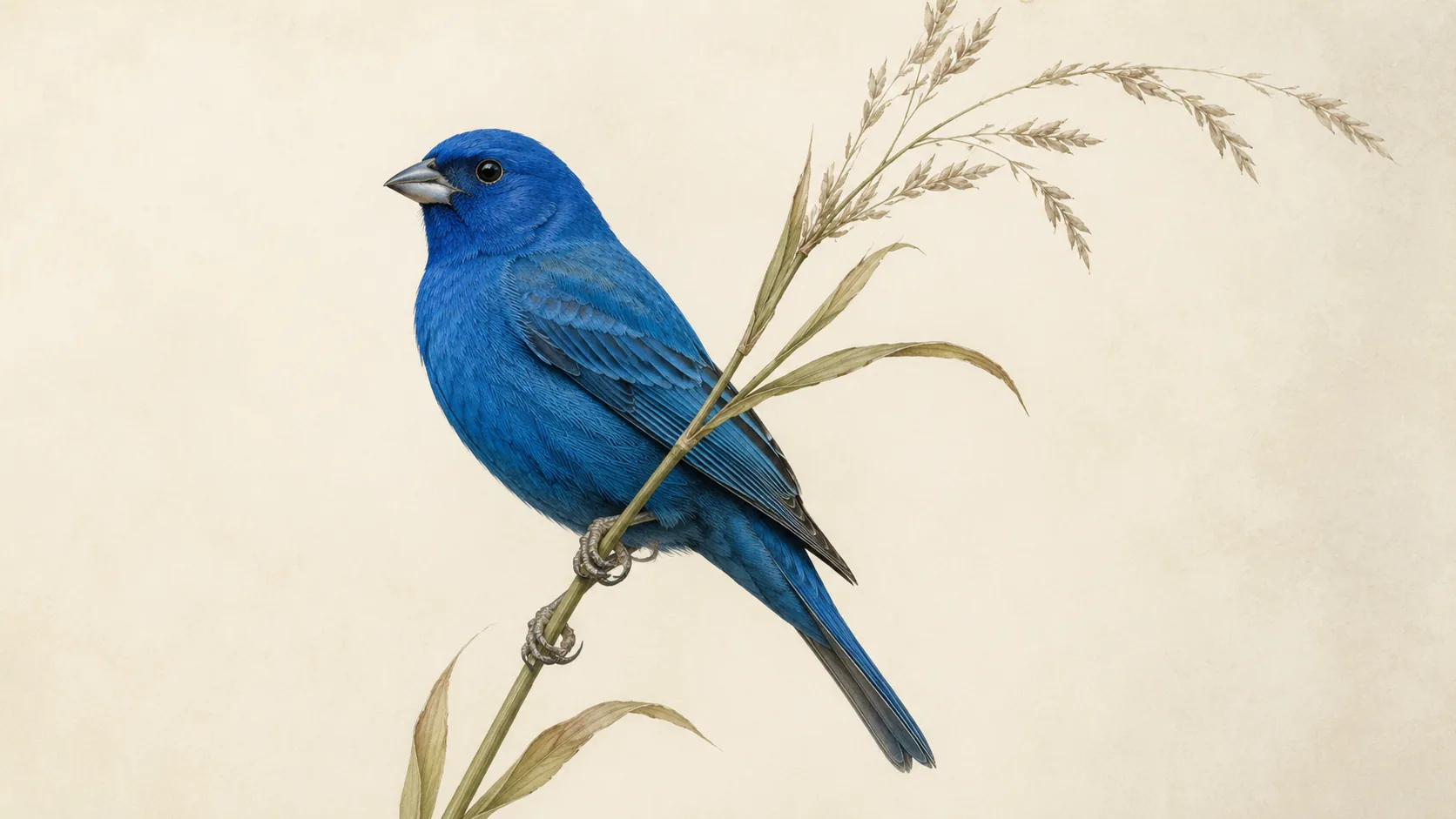
At the roost in Venezuela, the birds forage on rice and sorghum in the fields around the communal site. This is the behaviour that creates the conflict with farmers. An indigo bunting forages alone or in small loose groups. A Dickcissel arrives in a flock of tens of thousands.
Breeding
The female chooses the nest site and builds alone. The cup is woven from grasses, strips of vegetation, and occasionally leaves, positioned low - on or near the ground in a grass clump, or a little higher in a low shrub or forb stem, rarely more than a metre up. The male is conspicuous and loud nearby but contributes little to construction.
The clutch runs three to six eggs, pale blue and usually unmarked, with incubation lasting around 12 to 13 days, the female alone on the eggs. Fledglings leave the nest at eight to ten days and are brooded and fed for another week or so as they strengthen. Nesting success is strongly influenced by hayfield management - a cut taken in early July, when Dickcissel nests in hayfields are most densely occupied, can destroy an entire season’s production in a field. Grasslands larger than 25 acres fare better. The interior of a large block is somewhat buffered from predation and disturbance in ways that small fragments are not.
The male’s polygyny - common but not universal - means that females in late-establishing pairs receive less male investment in territory defence, though the female manages brood care regardless. In a good year the species can raise two broods in the southern part of the range.
The Dickcissel is a bird with a simple gamble at its centre. It bets on the rain to find its breeding ground each spring, singing its own name from any fence wire that points west into the grass. It bets on the efficiency of numbers to get through the winter, gathering into roosts so large they darken the sky over the Venezuelan llanos and make the species, briefly, the most abundant bird on the continent. Both bets carry risk. The rain is erratic. The roost is a target.
What makes the Dickcissel worth watching is not the yellow breast or the black bib or the raspy, self-naming song - though any of those would be enough. It is the fact that this small bird, this prairie sparrow-cardinal of the tallgrass and the hayfield, has staked its entire existence on two calculated risks, repeated every year, for as long as grasslands have existed in North America. The gamble has held, mostly. The margins are tightening. The bird keeps singing.