Field Guide
Painted Bunting
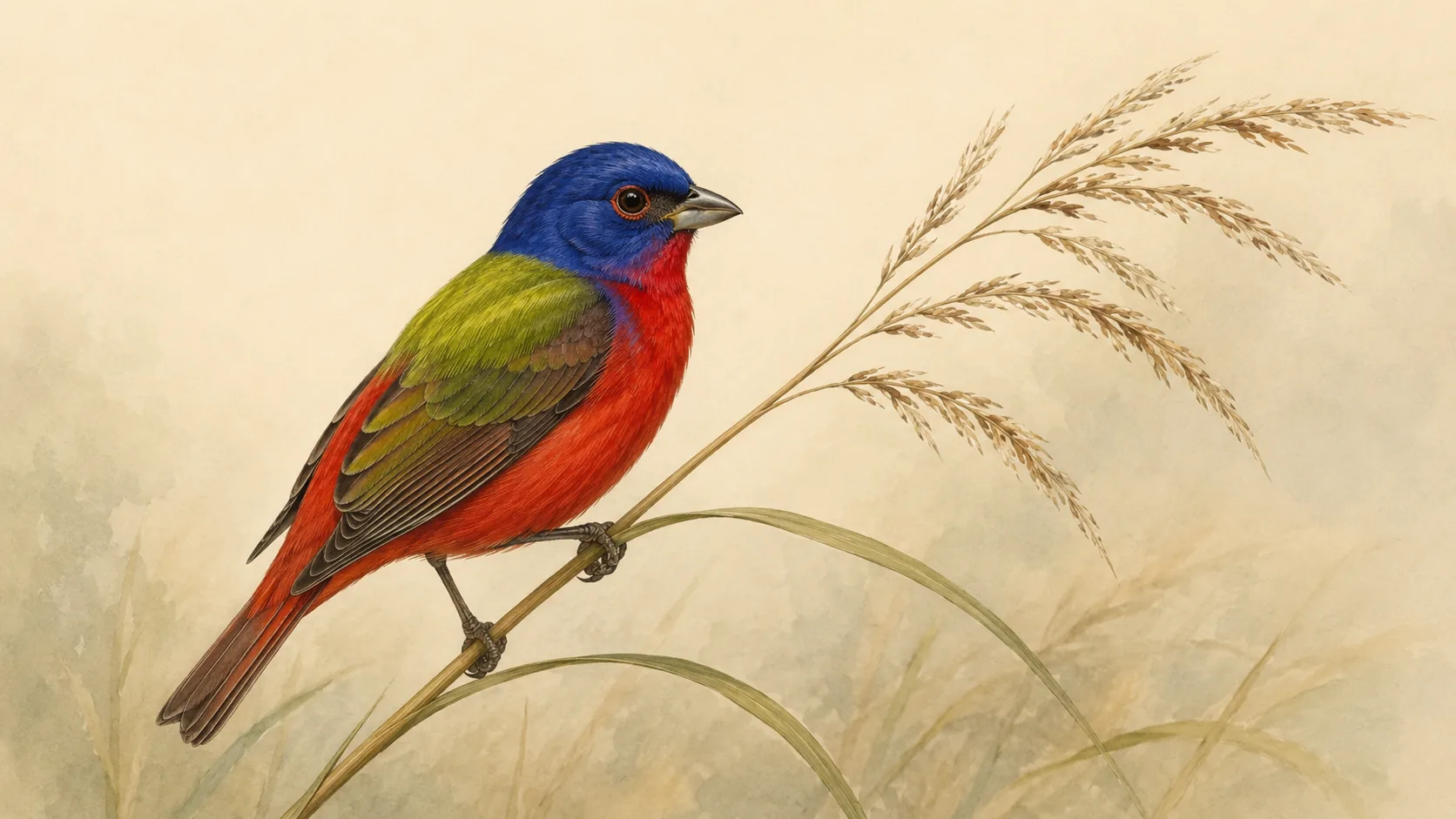
On a May morning in the live-oak scrub of coastal South Carolina, a small bird drops onto a bare twig and the colour arrives before the shape does. Deep blue head. Lime-green back. Underparts and rump in a red so bright it looks wet. No North American songbird carries this palette, and no field guide photograph quite prepares you for it. The first reaction is almost always disbelief, then a quiet recalibration of what a wild bird is allowed to look like.
The French had a word for him. Nonpareil. Without equal. Passerina ciris earned it honestly. He is the size of a goldfinch, weighs less than a tablespoon of water, and looks like a paint chart that fell into a hedgerow. The wonder is not that he exists. It is that he hides so well, and that catching sight of him remains, decade after decade, one of the great prizes of the southern backyard.
What he looks like
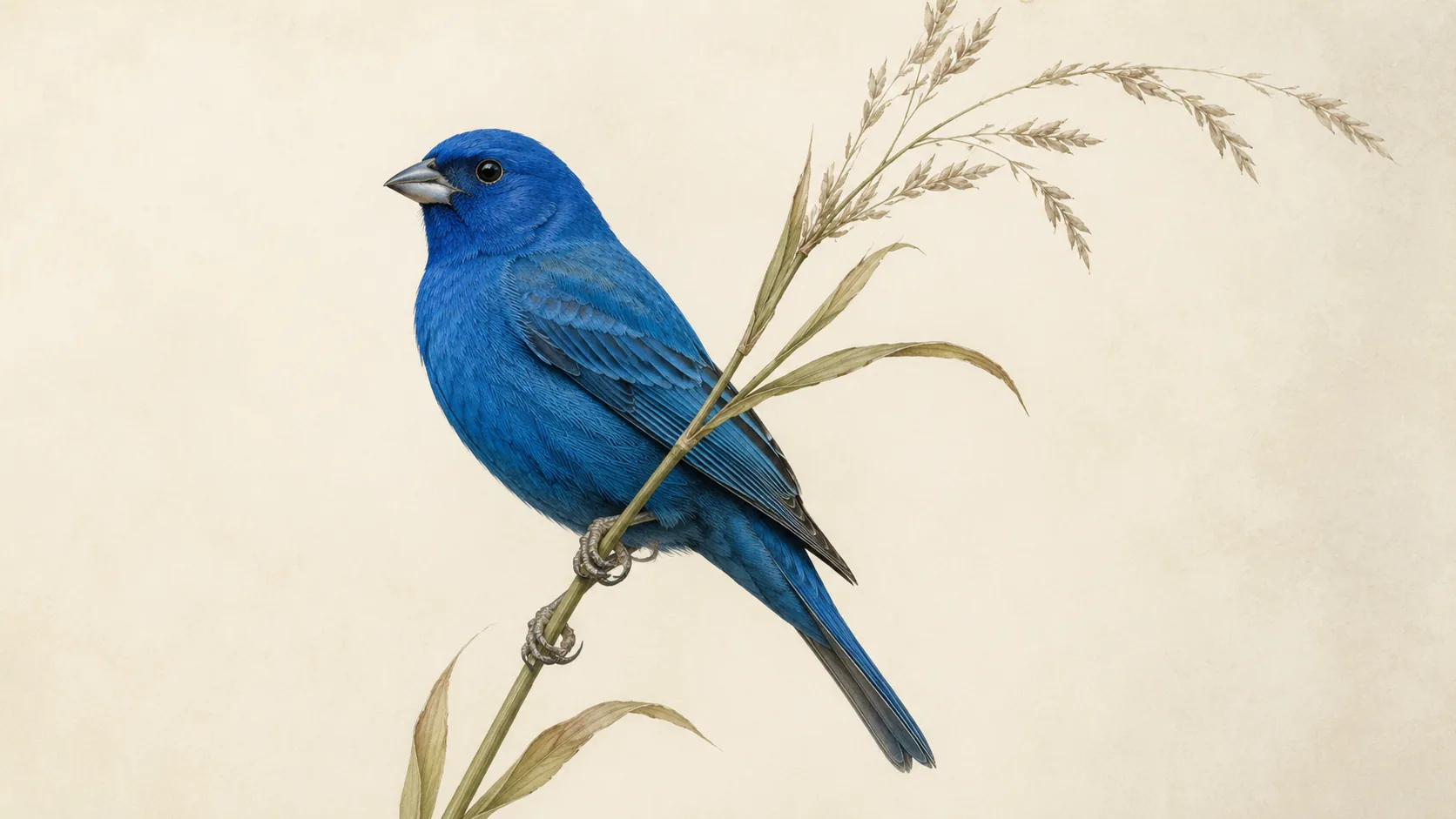
The adult male is unmistakable and, frankly, unbelievable. A violet-blue head and nape. A vivid yellow-green mantle across the back. A scarlet-red throat, breast, belly and rump. A narrow red eye-ring set into the blue. The wings carry green and dusky tones, the tail a brownish-red. Held in the hand or seen in good light, the four blocks of colour meet without blending, which is what makes the bird read, at distance, like a printing error in three plates.
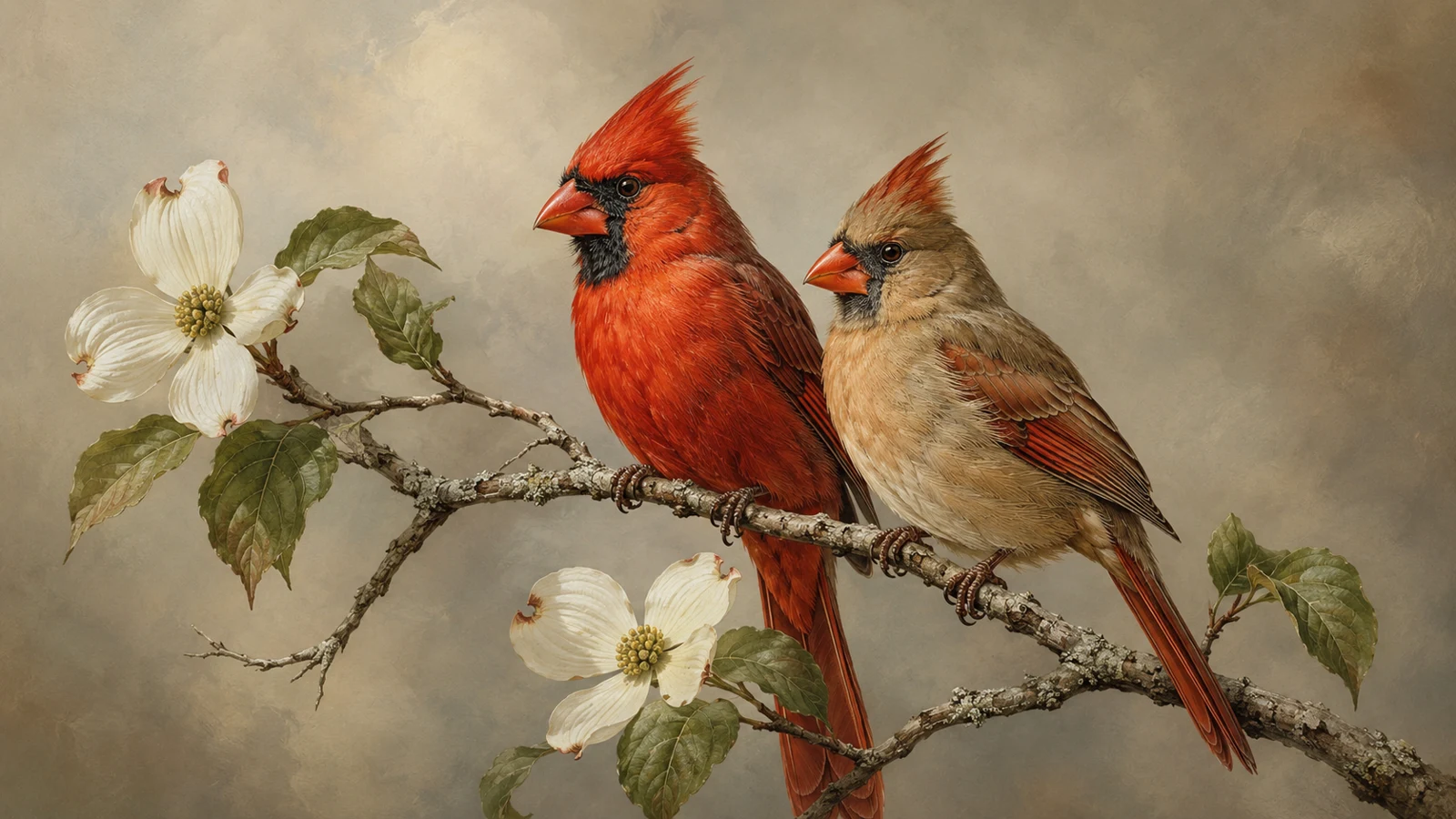
The female and the first-year birds wear nothing of the kind. She is a uniform bright yellow-green, lemon-tinged below and greener above, with a pale eye-ring and no streaking. Cornell Lab notes she is the only truly green finch-like bird across most of the species’ range, which makes her own ID surprisingly easy once you stop searching for something drab. She is not a lesser version of the male. She is a different and quietly lovely solution to the same body.
Young males are the slow part. A first-spring male often still looks female-green while already singing, and the full adult plumage is not complete until his second autumn. Both sexes share the stubby, deep-based, seed-cracking bill that places the species, despite the finch-like shape, in the cardinal family, Cardinalidae.
What he sounds like
Only the male sings. The song is a sweet, rambling, slightly metallic warble of high musical notes, a few seconds long, delivered from an exposed perch at the top of a shrub or a wire. There is a thin, glassy quality to it that carries further than the bird’s size suggests. He sings through the breeding season to hold a territory, and a single male will often work several song perches around his patch in rotation.
The common call, given by both sexes, is a sharp metallic tsick or chip, the contact and alarm note you are most likely to hear before you ever see the bird in dense cover. In the breeding thickets the song is the giveaway. Track the warble to its source, wait for the singer to lift to an open twig, and the colour does the rest.
Range and habitat
The Painted Bunting breeds in two separate populations that do not meet. One runs along the south-Atlantic coast from coastal North Carolina through South Carolina, Georgia and into northern Florida. The other, larger, spreads across the south-central states from Louisiana and Arkansas through Texas, Oklahoma and into northern Mexico. Between the two lies a gap of several hundred kilometres with no breeding birds at all.
The migration is as unusual as the plumage. The species is a nocturnal migrant, the western population often crossing the Gulf of Mexico. Cornell Lab documents a behaviour rare among songbirds: western birds begin their autumn migration before moulting, stop at staging areas in northern Mexico to replace their feathers, then continue south. That migrate-then-moult sequence is common in waterfowl and almost unheard of in passerines. Eastern birds largely winter in southern Florida and the northern Caribbean, western birds in Mexico and Central America.
The habitat is consistent across the year: semi-open ground with dense low growth. Brushy field margins, woodland and roadside edges, coastal scrub, hedgerows, overgrown thickets and gardens with thick cover. The bird wants edge, not interior forest, and it wants somewhere to drop out of sight the instant it stops singing.
Diet
For most of the year the Painted Bunting is a seed eater, and grass seeds are the staple. It forages low, hopping through stems and reaching up to strip seed heads, or feeding on the ground beneath them. In the breeding season the balance shifts hard toward insects and other arthropods, taken from foliage and the ground, and nestlings are fed almost entirely on this protein. Berries and small fruits fill in at the edges.
On the breeding grounds the bird will come to feeders, and a feeder offering white millet near dense cover is the classic way to draw one in. It is a shy feeder, quick to bolt, and it wants thick shrubs within a short flight. A brush-edged southern garden with millet and a tangle to hide in is one of the few reliable ways to bring nonpareil to within a few metres of a kitchen window.
Breeding and nesting
The female builds the nest and does it alone, an open cup woven of grasses, weeds and leaves and lined with fine grass, rootlets and animal hair. She places it low, typically between roughly one and three metres up in a dense bush, a vine tangle or a low tree, well hidden in foliage. The male holds and defends the territory but does not help build.
Audubon and Cornell Lab give a clutch of three to four eggs, occasionally five, whitish to pale bluish with reddish-brown spotting. The female alone incubates for about eleven to twelve days. The young leave the nest roughly twelve to fourteen days after hatching. Pairs commonly raise two broods in a season, and in the south sometimes more, with the male taking a larger share of feeding the fledglings while the female starts again.
The cost of being the most beautiful
The Painted Bunting’s plumage is also its oldest threat. The adult male has been trapped for the cage-bird trade for centuries, and on the tropical wintering grounds in Mexico and the Caribbean that pressure continues, illegal but persistent. A bird this colourful is, to a trapper, a standing temptation. The trade pulls breeding-age males out of the population at exactly the wrong end.
Habitat loss is the larger modern problem. Coastal scrub and swamp thickets in the east have been developed away, and the mid-migration staging areas the western birds depend on have been degraded. Surveys have tracked a long, slow decline since the 1960s, and Partners in Flight estimates a global breeding population in the low millions. The IUCN currently lists the species as Least Concern, downlisted from Near Threatened in 2018 as assessments improved, but the eastern population in particular remains a conservation watch-point rather than a settled success.
A bird that beautiful was never going to be left alone. The Painted Bunting’s plumage is its glory and, in the cage-bird markets of its wintering range, its oldest danger.
The longevity record offers a small counterweight. Cornell Lab reports the oldest known wild Painted Bunting, from a Florida banding study, at least twelve years old. For a bird that crosses the Gulf of Mexico in the dark, dodges trappers all winter and weighs less than a slice of bread, twelve years is a quiet kind of triumph.