



In October 1890, a Brooklyn pharmacist named Eugene Schieffelin released 60 European Starlings into Central Park. History remembers the starling introduction as the great ecological blunder. What history mostly forgets is that Schieffelin was following a template already four decades old - one set in 1851, in the same city, by the same impulse, with a bird that proved equally unstoppable. Sixteen Passer domesticus were loosed in Brooklyn. Fifty years later the House Sparrow had crossed the continent under its own power, reaching places no one had carried it.
That journey is the thesis of this species. The House Sparrow is not simply an introduced pest. It is the most successful vertebrate colonist in recorded history, and it became that not through aggression alone but through a biological machinery 11,000 years in the making - one that evolution built specifically for life alongside humans.
What she looks like
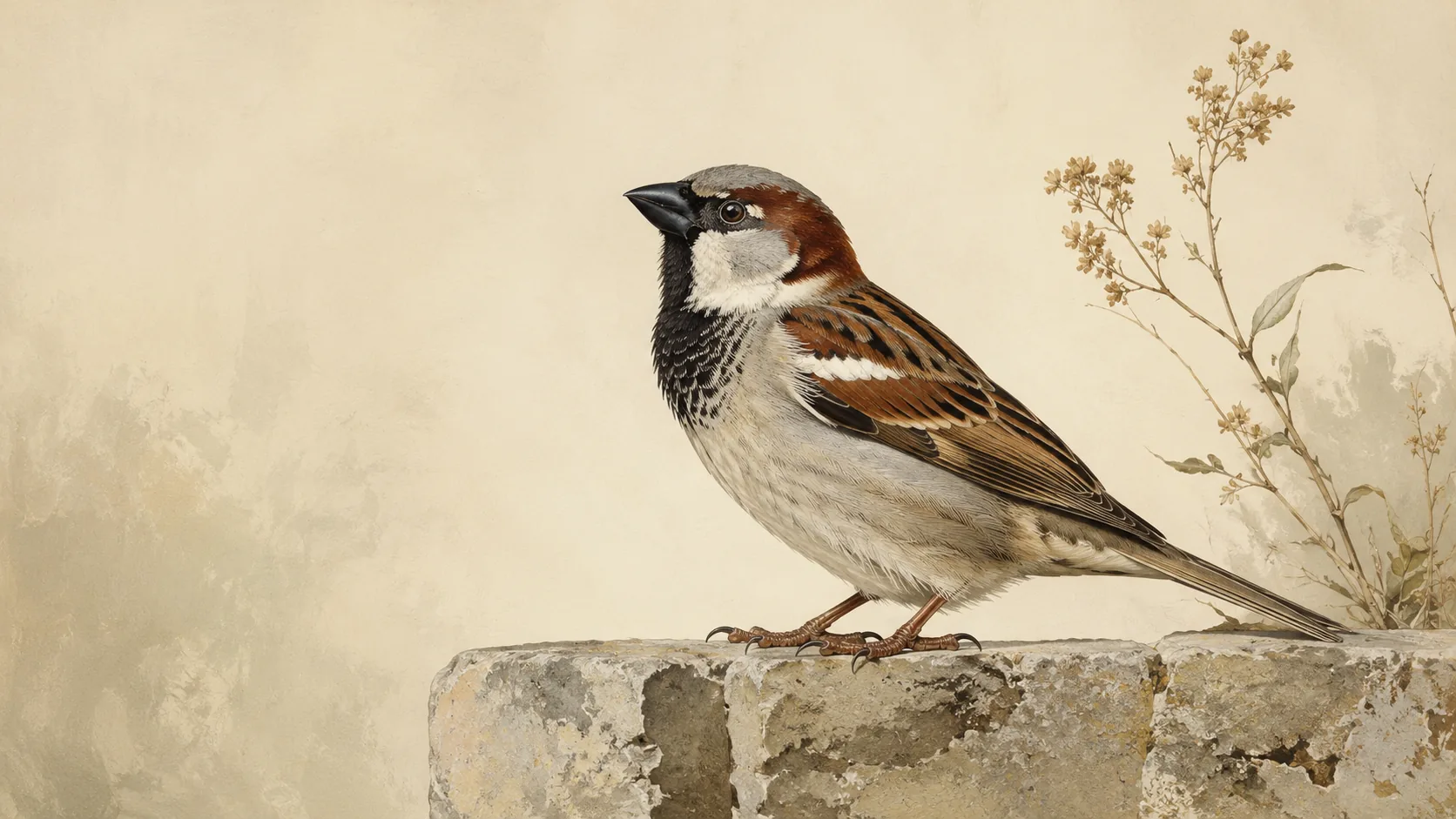
The House Sparrow is a stocky, chunky bird, 14 to 16 centimetres long, weighing 25 to 32 grams, with a wingspan of 19 to 25 centimetres. The bill is short and stout - built for cracking seeds. The tail is short. The posture is hunched and assertive.
Males and females look markedly different. He is the more immediately recognisable: a black bib extending from throat to chest, white cheeks bracketed by chestnut, a grey crown, and a chestnut nape. His back is streaked brown and black. In fresh autumn plumage the bib is obscured by pale feather tips; by breeding season, those tips have worn away, leaving the full bib exposed without a single moult.
She is quieter in every sense. A pale buff eyebrow, plain grey-buff underparts, and a streaked brown back. No bib, no chestnut. She is well-suited to sitting on a nest in a gap in brickwork and being overlooked.
Juveniles resemble females. First-year males show a reduced bib that grows with age.
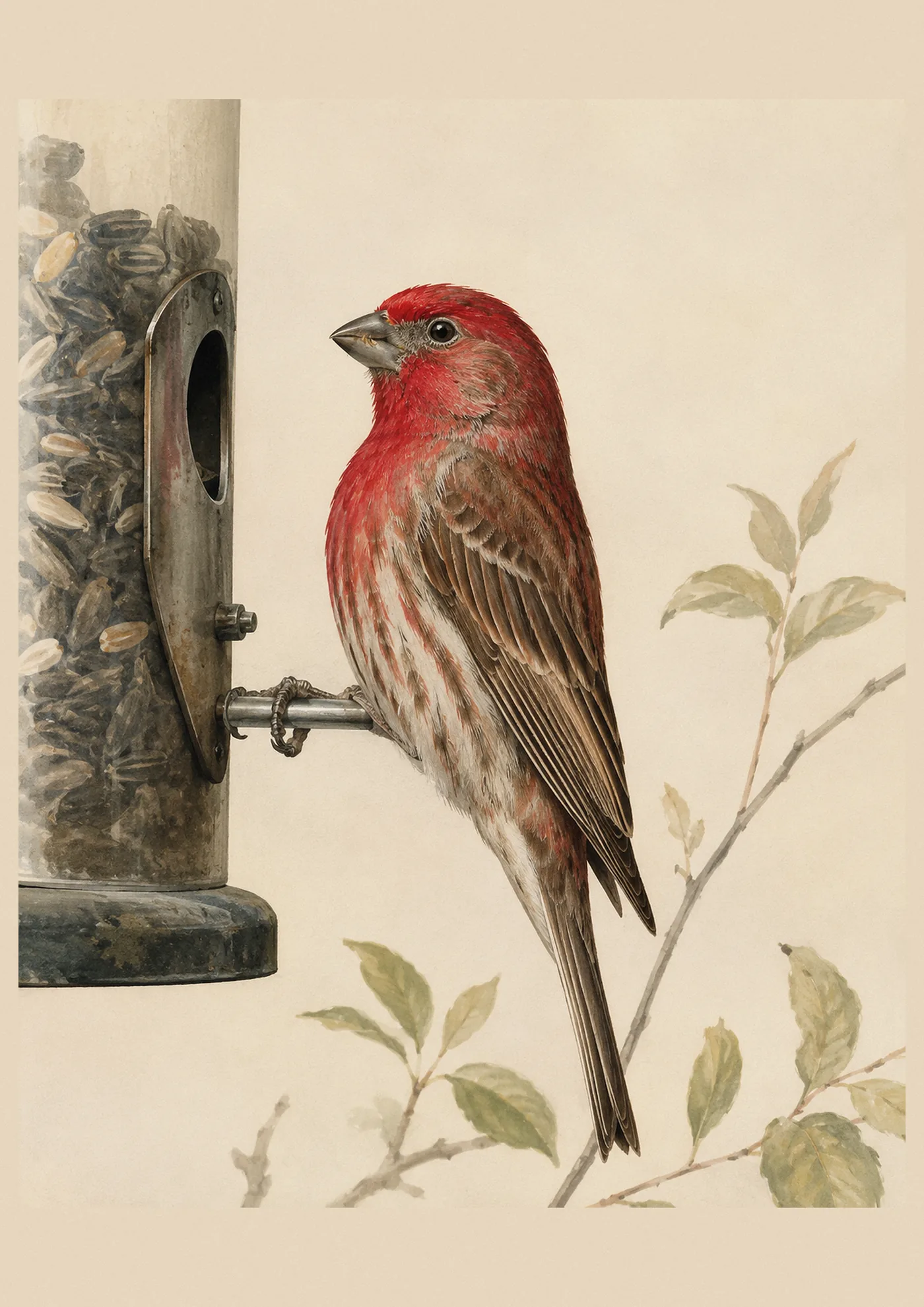
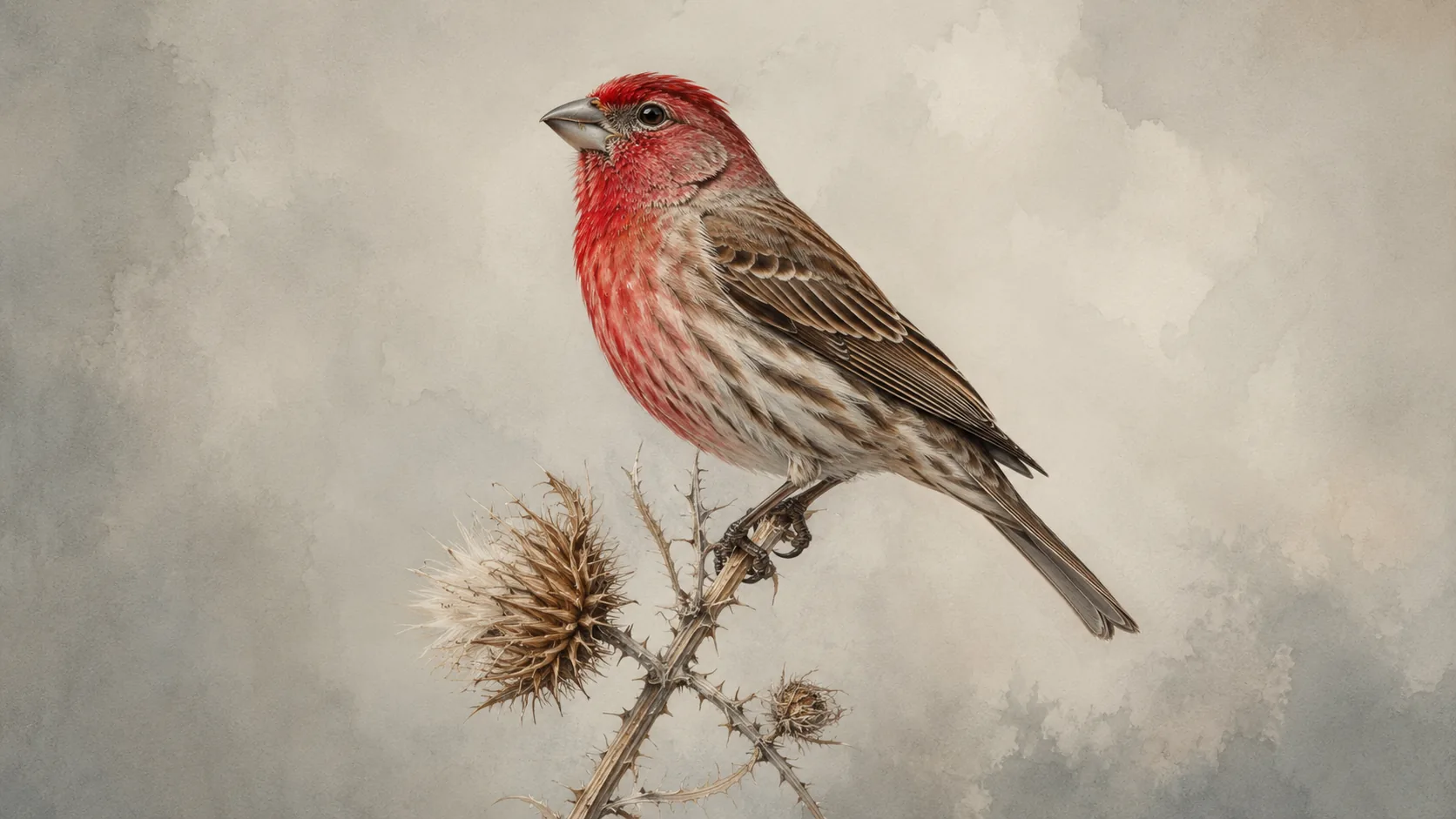
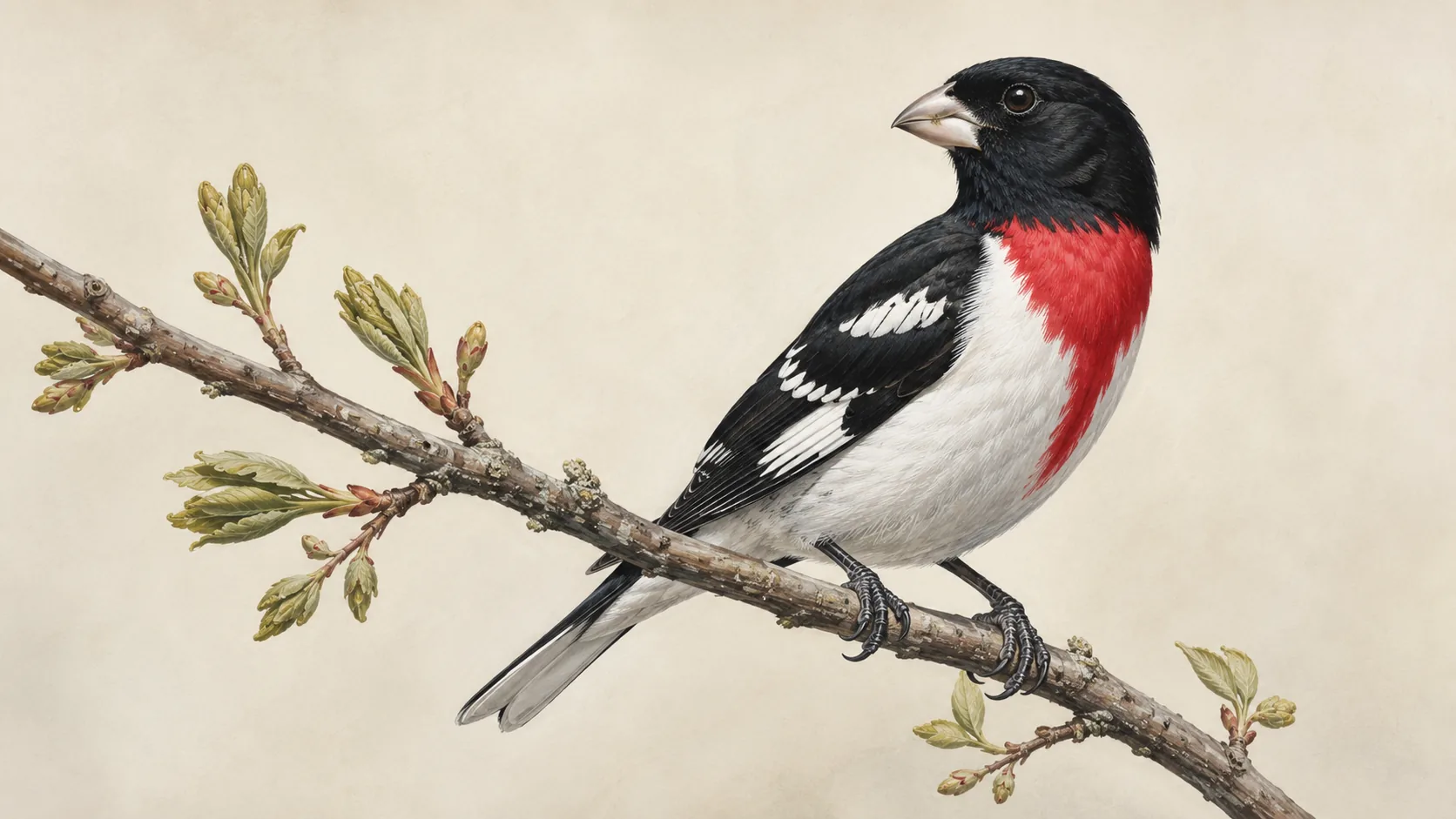
The species most often confused with her in North America is the House Finch, which shares the same feeder and the same appetite for suburban gardens. The House Finch has a notched tail, a finer bill, and - in the male - red, not black, on the head and breast. The female House Sparrow’s thick bill and plain face, without the House Finch’s streaked breast, settle the identification.
The voice
She chirps. The word is correct and the word is inadequate. A House Sparrow’s repertoire consists primarily of short, emphatic monosyllables - a repeating cheep or chirp - delivered with the confidence of a species that does not need to attract mates across long distances because it already lives where the mate also lives. There is a subdued warbling song, produced mainly by males in spring, that passes unnoticed in the noise of any town. There is a sharp alarm call. There is a communal chattering that a colony of birds produces from a hedge in late afternoon, a sound that most urban dwellers have heard all their lives without consciously registering it.
The voice is not designed for distance or complexity. It is designed for the fifteen centimetres between two birds on the same ledge.
Range and habitat across the year
The Audubon Society’s field guide notes the House Sparrow as a permanent resident “across most of North America” from Alaska south through Mexico. The native range stretches across Eurasia and northern Africa. Beyond that, via human introduction, the species now holds territory in Australia, New Zealand, South America, southern Africa, and most inhabited islands in between.
Cornell’s Birds of the World characterises it as having “a nearly worldwide distribution” and “a preference for habitats modified by humans.” That phrase repays attention. The House Sparrow does not merely tolerate human settlement. It has evolved, over 11,000 years since the emergence of Neolithic agriculture in the Middle East, to require it. A 2018 study published in Proceedings of the Royal Society B (Ravinet et al.) identified two key gene variants - one governing beak and skull development, one producing the amylase enzyme needed to digest agricultural starches - that are present in domesticated populations and absent in the handful of remaining wild, migratory populations in Central Asia. The city sparrow and the country sparrow are not the same animal, genetically. The city sparrow has been selected for us.
She is found wherever people are: cities, towns, suburbs, farms, train stations, airport terminals, the concourse of a shopping centre with a roof vent large enough for a nest. She is absent from dense forest, open grassland without structures, and true wilderness. The habitat is human.
In the United States she does not migrate. The flock that occupies your garden hedge in August occupies it in January. She has no reason to leave.
Diet
The diet is predominantly seeds - waste grain, spilled millet, dropped chips, cracked corn, and the black-oil sunflower seed that fills North American feeders. The Audubon field guide describes her as foraging “primarily on the ground by hopping.” She does not cling to seed socks or hang from suet cages as a chickadee does. She waits below, collecting what falls.
During nesting season, and particularly while feeding nestlings, she takes insects - caterpillars, beetles, aphids - in quantities that would surprise anyone who thinks of her as strictly a seed-eater. Nestlings cannot survive on grain alone. Protein drives fledging success.
She is demonstrably comfortable eating almost anything that calories can be extracted from. This is not a side note. It is the trait that made 1851 possible.
Breeding and nesting
Breeding begins in March and extends through August, producing two or three broods in a typical year. Clutches contain three to six eggs. The eggs are whitish, spotted grey and brown, and incubation takes roughly 10 to 14 days. Fledglings leave the nest at about 15 days.
She nests in enclosed spaces - holes in walls, gaps in roof eaves, the cavities behind guttering, birdhouses, and occasionally dense hedges. The nest is a loose, untidy mass of grass, straw, feathers, and whatever fibrous material is available. Both parents incubate and both feed the young.
The preference for cavities puts the House Sparrow in direct competition with native cavity nesters. In North America this means the Eastern Bluebird, the Tree Swallow, and the Black-capped Chickadee among others. A House Sparrow pair will evict an established bluebird pair from a nest box, destroying eggs and killing nestlings if the box is undefended. This is not malice. It is nesting-site competition operating at the intensity that only a colonial species with multiple broods per year can sustain.
Nest box programmes targeting bluebirds and tree swallows routinely trap and remove House Sparrows. It is conservation management at the level of individual birds, exhausting and ongoing.
A colonial intelligence
The most consequential and least-noted behaviour of the House Sparrow is what ornithologists call ‘local enhancement’: the rapid transfer of information about food sources through a group. One bird finds grain. Within minutes, the flock knows. The mechanism is not communication in any complex sense - it is attention and proximity, the social calculus of a species that evolved in flocks at grain stores and threshing floors.
Cornell’s Birds of the World notes that House Sparrow populations have attracted nearly 5,000 scientific papers, making the species one of the most studied birds on Earth. The research interest is not sentimental. The House Sparrow is useful precisely because it is common, tolerant of handling, reproductively prolific, and genetically variable across urban-rural gradients. It has served as the model organism for studies of sexual selection, urban adaptation, pollution response, and disease ecology.
The bird that chips seeds off your patio is carrying 11,000 years of selection for exactly that behaviour. It is not an opportunist. It is a specialist.
What the decline means
The IUCN lists the House Sparrow as Least Concern globally. The Audubon Society records a North American population that peaked around 1900 and has been falling since - with a cumulative decline of close to 80 per cent between 1966 and 2019, according to the North American Breeding Bird Survey. In Britain, where the bird was once the most common species on garden lists, almost 30 million House Sparrows have vanished since 1970, according to RSPB monitoring data.
The causes are not fully agreed upon. Loss of invertebrate prey through pesticide use. Loss of nest sites in newly insulated and sealed buildings. Reduced availability of grain around modern agricultural facilities. The same human transformation that the sparrow evolved to exploit has, in its latest iteration, begun to run ahead of it.
The House Sparrow is not in crisis. But the idea that a bird built for human settlement might struggle inside it is a small, sharp reminder that adaptation has limits - and that the relationship was never as one-sided as it looked from a park bench.