Free shipping to the US, Canada & Europe
Biology
The average wild cardinal lives 3 years - but that figure hides the real story. A cardinal that survives its first year is built to last much longer.
August 3, 2023 4 min read
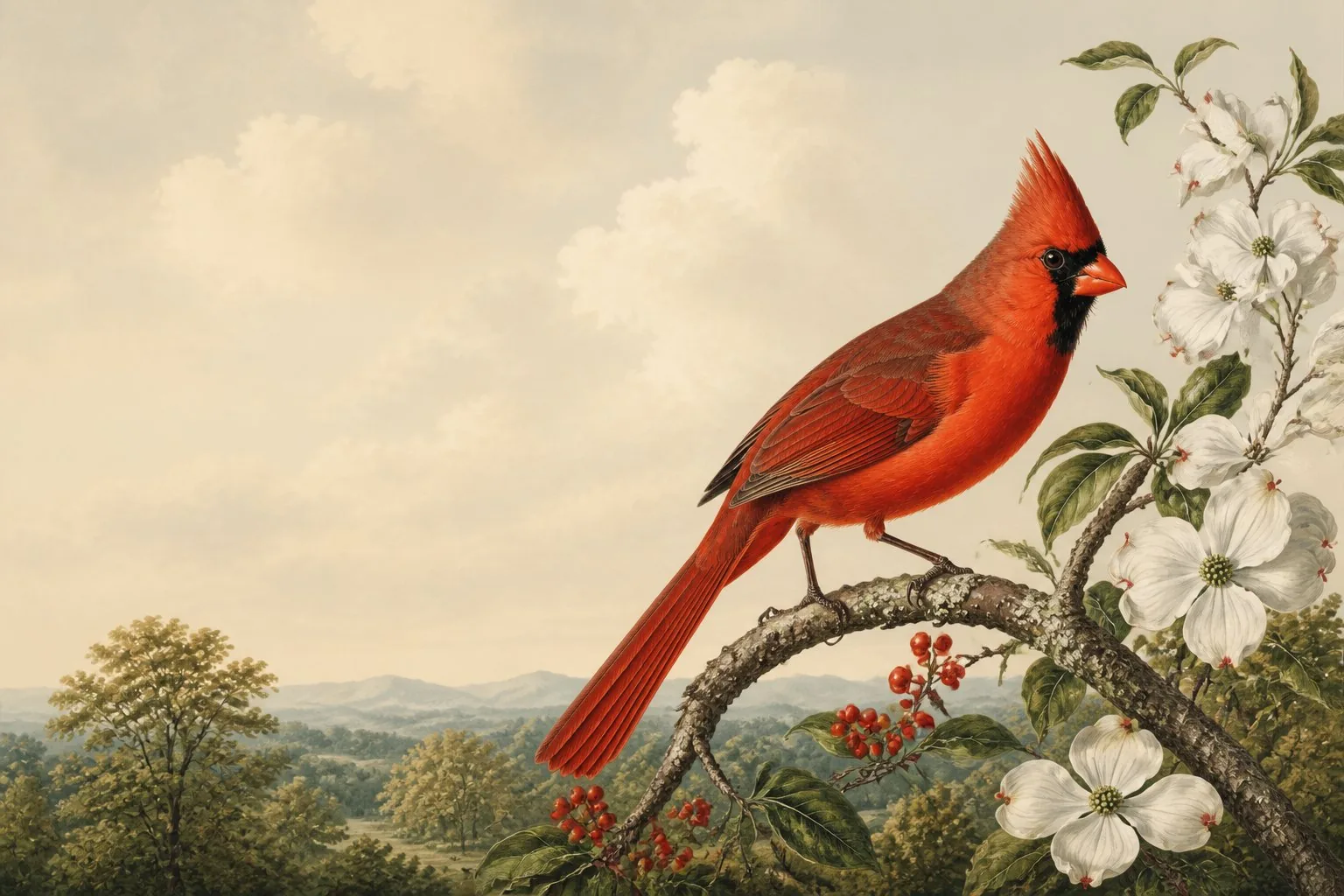
The longevity record for a wild Cardinalis cardinalis - a Northern Cardinal banded as an adult and recovered 15 years and nine months later - belongs to a bird that spent most of its life doing something almost no cardinal manages: surviving.
That number is not the average. The average wild cardinal lives about three years. The two figures are not contradictions. They describe the same animal at different stages of the same gamble, and understanding how they fit together tells you more about the bird than either figure alone.
Cardinal mortality is not distributed evenly across a bird’s life. It is front-loaded, and it is severe. The majority of birds hatched in any given summer will not see the following spring. Nestlings are taken by snakes, blue jays, and squirrels before they can fly. Fledglings - those brown, stubby-tailed juveniles you see hopping along fencerows in late June - are clumsy and loud and poorly hidden. Cats find them. Hawks find them. Some simply starve before they learn to forage efficiently.
This is why the three-year average is almost misleading. It includes all those first-year deaths, and it drags the mean down to a number that understates how long a competent adult cardinal can live.
Cardinal lifespan at a glance
| Metric | Figure |
|---|---|
| Average wild lifespan | 3 years |
| Typical adult lifespan (post year one) | 5 to 7 years |
| Maximum recorded (wild, banded) | 15 years, 9 months |
| Captive lifespan | 13 to 15 years |
| Age at breeding maturity | 1 year |
The moment a cardinal clears its first winter, the odds shift. The bird has learned which feeders are safe, which hawks patrol which sky, which shrubs hold the best cover. Long-term monitoring of banded populations shows that surviving the first year is the single strongest predictor of living several more.
Predation is the dominant cause of death at every stage. Cooper’s Hawks and Sharp-shinned Hawks take adult cardinals at feeders with enough regularity that any backyard birder runs a feeder long enough will eventually witness it. Domestic cats - by the Cornell Lab’s estimates, the largest human-caused source of wild bird mortality in North America - take fledglings and juveniles at a scale that matters at the population level.
The threats that get less attention are the structural ones. Window strikes kill millions of birds annually in North America, and cardinals are vulnerable because they are bold, territorial birds that investigate their own reflections. A male cardinal defending his territory against a window is not stupid; he has simply never encountered glass before. Dirty feeders transmit salmonella and avian pox. Neither is a quick death.
Cold and food scarcity do not kill healthy winter cardinals directly. Cardinals are non-migratory and genuinely cold-tolerant. What harsh winters kill are birds already weakened - by molting, by late-season parasite loads, by injuries. A bird arriving at winter in good condition usually survives it.
The 15-year-and-nine-month cardinal is not a curiosity. It is a proof of concept. That bird lived through at least 15 winters, at least 30 to 45 broods’ worth of breeding seasons, and the full catalog of threats - cats, hawks, windows, disease - without a fatal encounter. It was banded as an adult, which means it had already cleared year one before the clock started.
What those years looked like is not in the record. But the biology is consistent: that bird molted every August, as all cardinals do, replacing every feather. It wintered without migrating. It sang every February to establish territory, drawing attention to itself at the worst possible time of year. It did everything the species does, and it did it for a decade and a half.
A cardinal that survives its first year is not playing the same odds as a fledgling. It is a different animal in a different phase of the same life.
The threats you can remove are the ones that matter. Cats indoors is the single highest-leverage intervention - not for sentimental reasons but because the numbers are not close. Window decals on large glass panels are the second. Clean feeders, scrubbed with dilute bleach every week or two, prevent the feeder from becoming a disease vector.
Plant dense native shrubs and you provide cover that predators cannot easily penetrate. Cardinals nest in shrubs, not nest boxes. The habitat is the intervention.
Cardinals are a songbird species that do not migrate, which means the birds in your yard in December are the same birds that will attempt to nest there in April. The group that gathers at winter feeders - a loose assembly, not a flock in the social sense - is next year’s breeding population waiting out the cold.
The male at your feeder in February, in full red, is most likely not a juvenile. The banded records suggest a male in vigorous territorial song in late winter has probably done it before. His brightness is evidence: carotenoid pigments that produce cardinal red require a full season of good foraging to accumulate. A dull bird in March is often a first-year male. A saturated one is usually not.
The 15-year bird had a year-one. He survived it, and then he survived 14 more. The three-year average does not describe him. It describes the hundreds of birds that shared his first summer and did not make it to his second winter. The record holder was not lucky. He was, for a very long time, good at being a cardinal.
As an Amazon Associate we earn from qualifying purchases. Linked products are ones we genuinely recommend.

 August 3, 2023
 4 min read