Biology
Do cardinals mate for life?
Yes. Mostly. With caveats most cardinal owners do not know about.
A mated pair of Northern Cardinals stays together year-round, across multiple breeding seasons, often across the bird’s entire adult life. This is unusual for a North American songbird. Most species pair up in spring, raise broods, separate by August, and reform pairs the following spring with whoever is closest. Cardinals do not. Cardinals keep the relationship between seasons.
The data behind this comes mostly from long-term banding studies in the eastern United States. Marked pairs show a high rate of mate fidelity from one year to the next. When a pair breaks up, it is almost always because one of the two birds has died. Voluntary “divorce” - re-pairing while both birds are still alive - is rare in cardinals and has been documented mainly in cases where the original nest failed badly.
So the pair is real. The next question is what the pair actually does together, and this is where cardinals do something almost no other common backyard bird does.
Mate-feeding
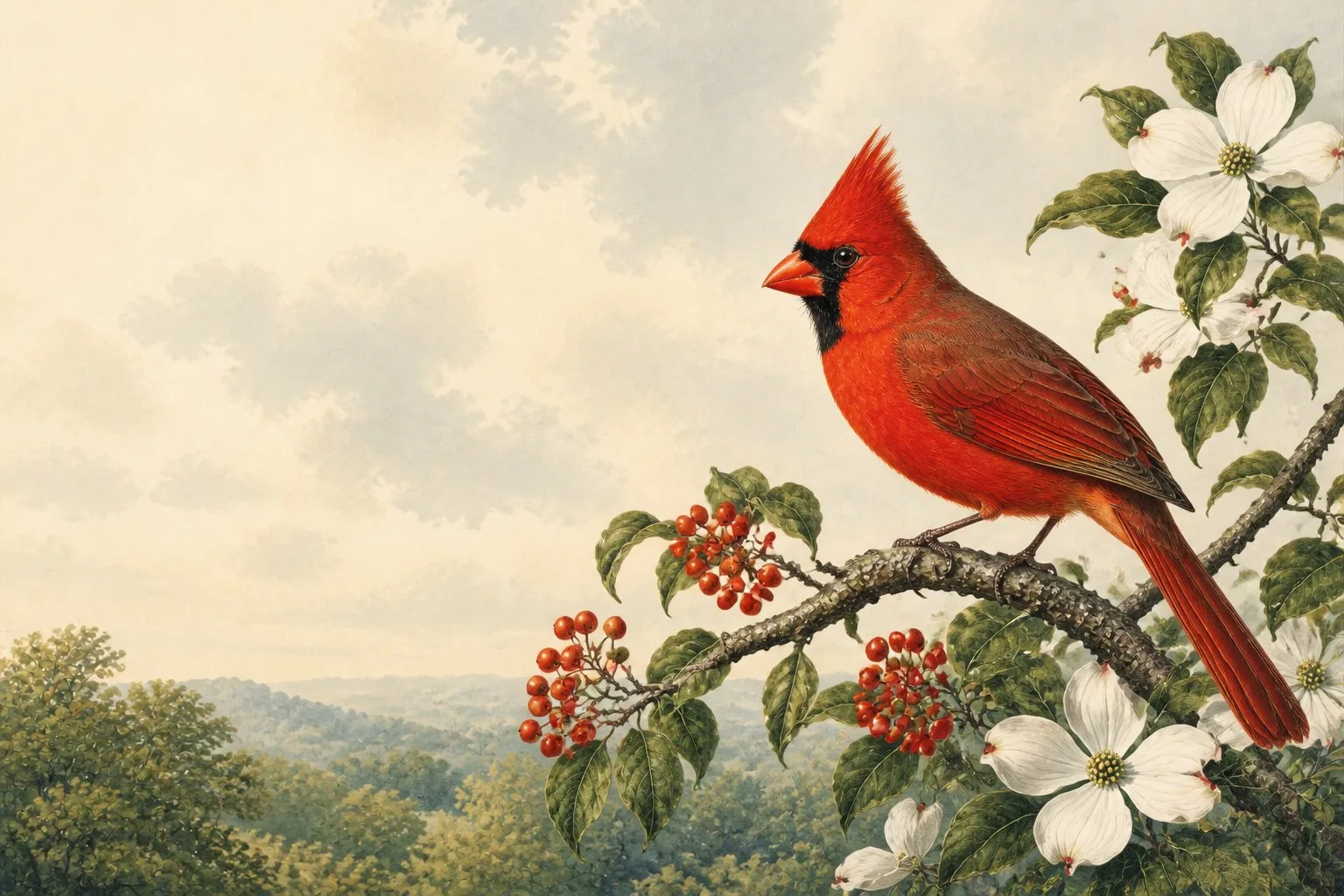
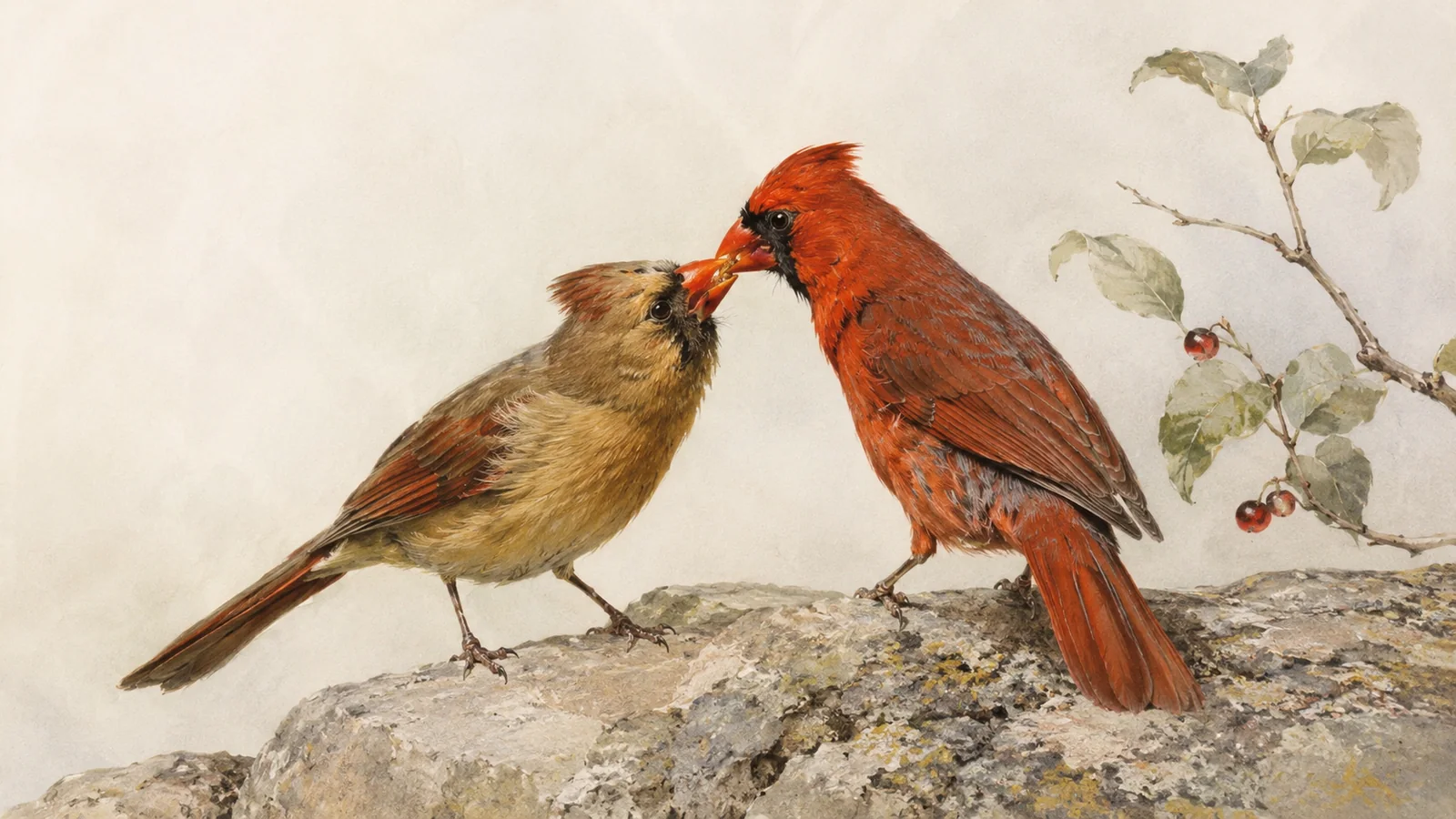
A male cardinal will pick up a sunflower seed at the feeder, fly to where his mate is perched, and pass the seed directly to her bill. He will then go back for another. He will do this repeatedly. The behaviour has a name in the ornithological literature - courtship feeding or mate-feeding - and it is one of the most clearly affectionate-looking things any wild bird does in public.
A pair-bonded cardinal at your feeder in March is therefore very easy to identify by behaviour alone. Watch for two minutes. If the male picks up a seed, flies to a perched female, and hands it to her without eating it himself, you are looking at a mated pair in active courtship mode.
The behaviour peaks in March and April as the pair begins breeding. It tapers off through summer and resumes in winter when the pair re-coordinates after the broods have fledged.
What looks like sentiment is, biologically, two things at once. The food transfer is a nutritional contribution from male to female during the calorically expensive period when she is forming eggs or feeding nestlings. The behaviour is also a bond-maintenance ritual. Birds whose pair-bond is functioning perform mate-feeding regularly. Birds whose bond has degraded usually stop.
What “mate for life” actually means
The phrase is shorthand. The honest description is that cardinals show high seasonal and inter-seasonal mate fidelity, with re-pairing on death of a partner.
| Scenario | What happens |
|---|---|
| Both birds survive winter | Pair stays together for the next breeding season |
| Male dies | Female re-pairs with an unmated male, often within weeks |
| Female dies | Male re-pairs, sometimes by the next breeding season |
| Nest fails badly | Usually no effect on the pair-bond; pair tries again |
| Repeated nest failure | Some evidence of divorce in this case, but data is thin |
A cardinal’s lifespan in the wild is about three years on average, with the oldest banded bird reaching nearly sixteen. A successful pair may stay together for three or four breeding seasons before one bird dies. That is genuinely a “lifetime” by cardinal standards.
By comparison, the species most commonly cited as the gold standard of avian monogamy in North America are the Bald Eagle (mated pairs use the same nest for 30+ years), the Mute Swan (rarely re-pair after a partner’s death), and the Sandhill Crane (also long-lived, also high fidelity). Cardinals are not at that absolute extreme. They are at the more interesting middle of the spectrum: long enough for the relationship to look genuinely sustained, short enough that the species has built in re-pairing as a fallback when partners die in numbers. Other backyard birds sit at different points on that spectrum. Blue Jays and falcons each handle the question their own way.
What the female does that the male does not get credit for
The pair-bond reads, at the feeder, as a male-dominated relationship. He is the one bringing seed. He is the one singing from the high perch. He is the one driving off rivals.
The female is doing more than the casual observer registers. She:
- Sings. Cardinals are among the few North American songbirds where the female sings regularly, and her song is more complex than the male’s. The pair counter-sings across the territory and the female’s song is often delivered from the nest as a signal to the male about feeding timing.
- Builds the nest. Almost entirely. The male brings materials.
- Incubates the eggs. The male occasionally relieves her for short periods but the incubation work is hers.
- Defends the nest. A nesting female cardinal will physically confront predators that approach the nest, including squirrels, blue jays and snakes.
The pair-bond is symmetric in maintenance work and asymmetric in visibility. The male is the bird people see. The female is the bird doing the harder job.
How to know your garden pair has been together for years
You usually cannot. Cardinals do not carry rings or markings most observers can read at distance. But two indirect indicators:
- The pair returns to the same nesting territory year after year. If you have a cardinal pair nesting in your holly in May 2024 and you have a cardinal pair nesting in the same holly in May 2025, it is statistically more likely to be the same pair than two different pairs.
- The male’s red gets brighter year by year. Cardinal carotenoid plumage intensifies for several years before stabilising. A male who looks more intensely red this March than last is probably the same bird, a year older, and probably still with the same mate.
A cardinal pair occupying your garden for a decade is, by these measures, both possible and not uncommon. Many backyard birders who have kept records find the same pair on the same shrub across many years.
What this changes for you
The cardinals at your feeder are not casual acquaintances. They are a long-term relationship, monitored by neither party in the way humans monitor relationships, sustained through one of the harder ecological lives on the continent.
If you want to see the pair at its most visible, the windows are:
- Mid-March through April. Courtship feeding, intense duetting, nest-building.
- Late June through July. Both parents feeding overlapping broods, sometimes from the same feeder visit.
- December through February. Pair-bond maintenance through the winter convergence. The pair feeds at the same dish at the same time. Mate-feeding sometimes appears in mild winter weather.
The behaviour to watch for, always, is the seed transfer. If you see it once, you can confirm a pair-bond. If you see it a dozen times in a spring, you are watching a healthy long-term partnership that has, statistically, been going on for years and will probably continue.