Field Guide
Trumpeter Swan
In the Centennial Valley of Montana, where geothermal springs keep the water liquid even in January, a pair of Trumpeter Swans feeds in the shallows before first light. The male - a bird that may weigh 12 kilograms, as much as a large domestic cat - moves slowly, methodically, hauling pondweed up from below the ice edge. His mate works ten metres to his left. They make almost no sound. The call that gives the species its name, the resonant bugling that carries two miles across mountain terrain, belongs to a different register than this: the feeding bird is a working body, not a spectacle.
In 1932, the National Park Service surveyed the entire contiguous United States and found 69 Cygnus buccinator (Banko, W.E., 1960, The Trumpeter Swan: Its History, Habits, and Population in the United States, North American Fauna 63). Most of them were here, in this valley, kept alive by warm water in a cold landscape. That a bird of this scale - the largest native waterfowl in North America and one of the heaviest flying birds on the continent - survived at all is the conservation argument this species makes simply by existing.
What it looks like
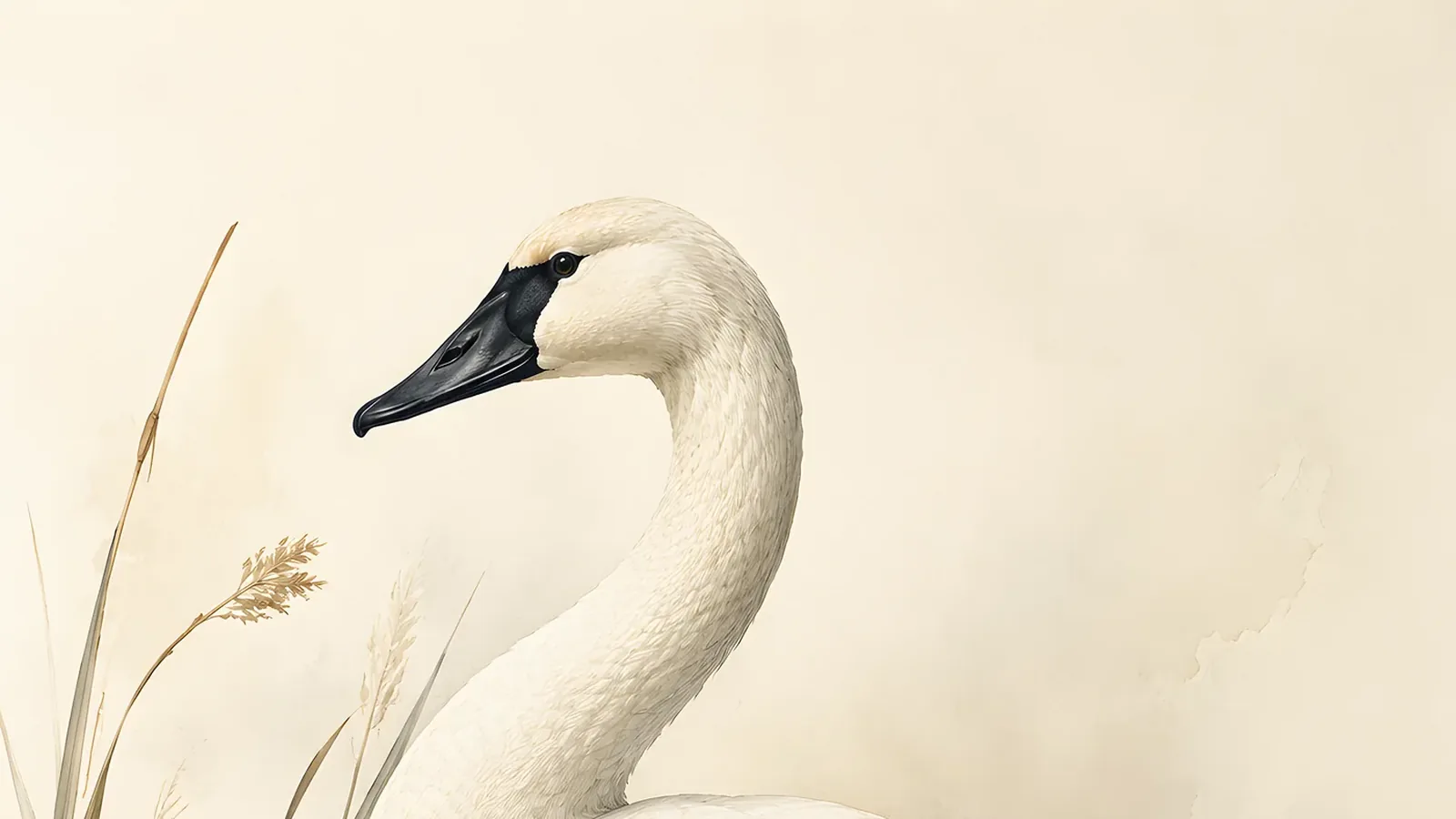
Cygnus buccinator is all white in adult plumage. No buff, no grey, no cream. Pure white from wingtip to wingtip, from crown to tail. The effect is total, and at the scale of this bird - 138 to 165 centimetres in length, with a wingspan of 185 to 240 centimetres - it registers as something architectural rather than merely avian.
The bill is entirely black. No orange, no yellow: a long, flat, all-black bill that meets the eye without interruption. A narrow line of salmon-pink or reddish colour sometimes runs along the cutting edge of the lower mandible where the two bills meet - this detail, barely visible at distance, has sent careful observers back to their field guides to confirm they were not looking at a juvenile. The lores - the feathered area between eye and bill - are also black, so that the eye appears set into a continuous dark mask. The overall face pattern is clean and austere.
Immature birds are mottled grey-brown through their first year, shifting to white by their second. The bill of an immature is pinkish-orange with a dark tip, which can cause momentary confusion before the bird’s sheer size resolves the identification.
| Measurement | Range |
|---|---|
| Body length | 138 - 165 cm |
| Wingspan | 185 - 240 cm |
| Weight (male average) | 12.7 kg |
| Weight (female average) | 10.0 kg |
| Maximum recorded weight | 17.2 kg |
Males are notably larger than females. The largest known Trumpeter Swan weighed 17.2 kilograms and measured 183 centimetres in length with a wingspan of 3.1 metres. These are numbers that place the bird in a short list of flying creatures at the upper boundary of what muscle and bone can sustain in the air.
Telling it from a Mute Swan
The mute swan is a European bird. It was introduced to North America and now occupies much of the northeastern United States, the Great Lakes, and scattered inland waters - exactly the territory where Trumpeter Swan reintroduction programs have worked hardest. The two species increasingly share wetlands, and the distinction matters for census accuracy and management decisions.
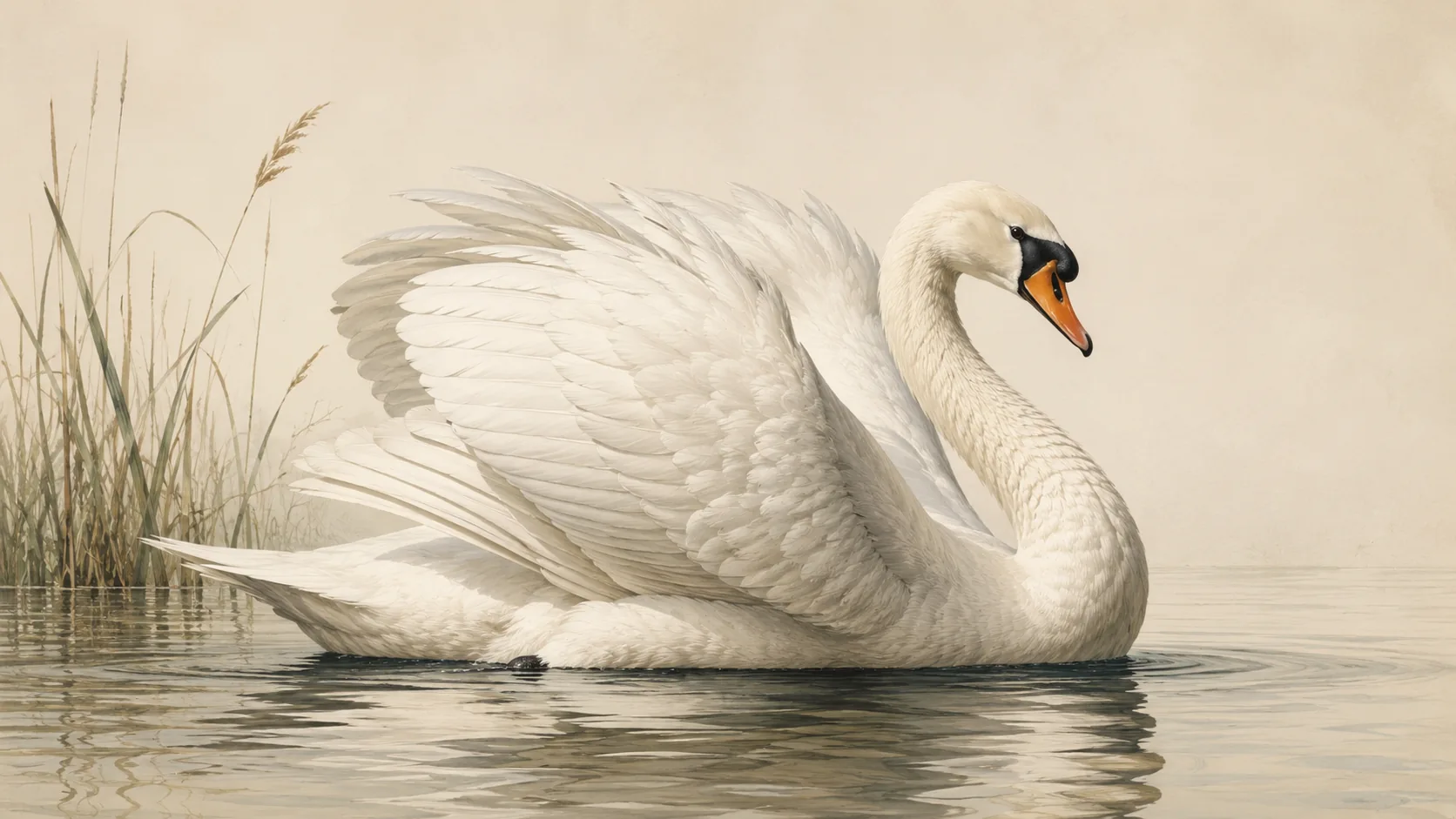
The bill is the first place to look. Mute Swan has an orange bill with a prominent black knob at the base. Trumpeter has an all-black bill with no knob. This is reliable in all ages except very young immatures of both species.
The second character is neck posture. Mute Swan holds its neck in a pronounced S-curve at rest on water. Trumpeter holds its neck straighter, more upright. David Sibley, writing for the Trumpeter Swan Society, notes that the Trumpeter’s head appears to sit more directly on the neck, while the Mute Swan’s head tilts forward off the curved neck, giving a different profile at any distance.
The Tundra Swan - the smaller native species that shares many of the Trumpeter’s wintering grounds in the Pacific Flyway - is harder. It is also all-white with a black bill, and the two can occur in the same flock. Size helps when both are present: the Tundra is measurably smaller, moves more quickly through the water (“prancing” where the Trumpeter moves “ponderously,” per Sibley’s phrase), and typically shows a small yellow spot in front of the eye - though roughly 10 per cent of Tundra Swans lack this mark entirely. The clearest separator, when the birds are vocalising, is the call.
The voice and the windpipe
The name is accurate. The call of Cygnus buccinator is a low, resonant, bugling note - a single syllable, sometimes doubled, that carries across open terrain at distances where visual identification is still uncertain. The Alaska Department of Fish and Game describes it as a “deep, French horn-like call.” The Trumpeter Swan Society characterises it as “resonant, sonorous, loud, low-pitched, bugle-like,” audible two miles away in mountainous terrain. It is an absolute field identifier between this species and the Tundra Swan, whose call is higher-pitched, more wavering, and closer to a yodelling whistle than a trumpet blast.
The anatomy behind the sound is exceptional. The Trumpeter Swan’s trachea does not follow a direct path from throat to lungs. It loops into the sternum - literally penetrating the breastbone and forming an S-shaped curve inside the chest cavity before continuing to the lungs. Banko (1960) documented that the trachea “invades the sternum at its anterior end and then forms the bulbous mass” visible on the upper sternal surface. Hinds and Calder (1971, The Condor) measured the tracheal volume and found it more than three times larger than predicted for a bird of the Trumpeter’s size.
The functional consequence is a resonance chamber built into the skeleton. The longer the trachea, the lower the fundamental frequency of the call it produces. What the bird carries inside its sternum is the biological equivalent of a trombone slide - extra length that drops the pitch to that characteristic register nothing else on a North American wetland reproduces.
Range and habitat
The Trumpeter Swan breeds across a broad arc from coastal and interior Alaska through western Canada and into the northern Rocky Mountain states. The Greater Yellowstone wetlands of Wyoming hold the core of what the Trumpeter Swan Society calls the Rocky Mountain Population - fewer than 800 adult and subadult birds in the lower 48 states, a figure that sounds healthier than it is when placed against the species’ historical range.
Before commercial hunting, Trumpeter Swans nested across most of the northern United States from Oregon east to the Great Lakes. By the 1930s, the lower-48 population had collapsed to the Yellowstone-Centennial Valley corridor alone.
Habitat requirements by season:
Breeding. Large, shallow, productive freshwater wetlands with emergent vegetation for nest concealment and abundant aquatic plant growth. Pairs establish territories of two to six square kilometres and defend them against other swans. Nests are built at the water’s edge or on muskrat lodges - structures up to 3.5 metres wide that the pair may add to over multiple seasons.
Winter. Ice-free water. This is non-negotiable. Geothermal springs in Idaho and Montana kept the remnant Centennial Valley population alive during the bottleneck years. Coastal bays, slow rivers kept open by current, and managed refuge impoundments now support the wintering flocks. In Minnesota and Wisconsin, reintroduced birds that breed inland move to partially frozen rivers and lakes in winter, or join coastal flocks in open water.
Diet
Adults eat almost exclusively aquatic vegetation. The Audubon Field Guide lists pondweed, sedges, rushes, arrowleaf, wild celery, bulrush, and burreed as primary food plants. The Alaska Department of Fish and Game adds horsetail, water milfoil, widgeongrass, and pond lily. The bird feeds by surface dipping - submerging the long neck to reach submerged stems and tubers - and by full up-ending in shallower water, tail raised at a vertical, in the same posture used by mallards but scaled up to something that stops observers in their tracks.
Cygnets eat invertebrates heavily in their first two weeks - insect larvae and small aquatic animals provide the protein load needed for rapid growth. By late summer, the diet shifts toward plant material and stays there for life.
Winter flocks in agricultural areas sometimes graze on spilled grain and waste crops, an opportunistic behaviour that extends the available habitat but brings birds into closer contact with road traffic and powerlines - two of the leading mortality causes in the current population.
From fewer than 100
The mechanism of the near-extinction was not habitat loss. It was commerce. Between 1772 and the late 1800s, Hudson’s Bay Company trappers and hunters harvested Trumpeter Swans across the northern interior for feathers, quills, and skins. Swan-skin powder puffs were fashionable in Europe. Swan quills - stronger than goose quills - commanded premium prices as writing instruments. The Trumpeter Swan Society cites Hudson’s Bay Company records showing approximately 108,000 swan skins sold between 1823 and 1880 alone. Market hunting continued at a scale of three to five thousand birds killed per year until populations simply could not sustain it.
“By 1933, there were thought to be only 69 Trumpeters alive in North America.” - Banko, W.E., 1960, The Trumpeter Swan: Its History, Habits, and Population in the United States, North American Fauna 63.
The 69 birds Banko referenced were the known birds. Most were in the Centennial Valley of Montana, where geothermal springs maintained unfrozen water year-round and gave the remnant population the one thing it needed to survive the winter. A larger Alaskan population was not documented by biologists until 1954 - which means that for two decades, the Centennial Valley birds were believed to be essentially all that remained.
The U.S. Fish and Wildlife Service established Red Rock Lakes National Wildlife Refuge in Montana in 1935, specifically to protect this population. Supplemental winter feeding programs at the refuge produced a 10 per cent annual population increase through the late 1930s and 1940s. By 1954, the Yellowstone population had reached 642 birds (Coluccy, J.M., 2024, Ducks Unlimited). The first translocation program moved birds from Red Rock Lakes to other western refuges. Minnesota received 40 subadult swans in the 1960s. From those relocations grew the Interior Population - now estimated at more than 27,000 birds - and reintroduction programs in Wisconsin, Michigan, Ohio, and Ontario.
The 2015 continent-wide census by the Trumpeter Swan Society found 63,016 birds. The species is listed as Least Concern by the IUCN. Ohio removed the Trumpeter Swan from its state Threatened Species List in 2024, following 28 years of recovery work that brought the state population to nearly 900 birds nesting in 26 counties.
This is a clean result. The bird was nearly gone because of a product demand. The demand ended. The product was removed from the equation. A refuge was established. Birds were moved. The population recovered. Not every conservation story resolves this clearly, with each intervention traceable to a specific outcome. The Trumpeter Swan’s return is one of the cases where the chain of cause and effect holds together long enough to follow from near-extinction to a morning in the Centennial Valley, where 12 kilograms of white bird hauls pondweed from below the ice and says nothing at all.
The lesson is not that conservation is easy. It is that it works when the threat is identified and removed, when the habitat is protected before the last birds are gone, and when people are willing to move eggs and cygnets across state lines for decades on the basis that the species deserves to fill its range again. The Trumpeter Swan occupied most of temperate North America before the feather trade. It is working its way back to something approaching that extent. The sternum still holds its windpipe. The windpipe still makes the call. The call still carries two miles.