Field Guide
Great Egret
In 1902, roughly a ton and a half of Great Egret plumes were sold at a single London auction. The aigrettes, those filamentous breeding plumes that trail from a bird’s back like white lace, were worth twice their weight in gold at the market’s peak. Getting them required shooting the birds on their nests during the breeding season, the only time the plumes appear, which meant that the nestlings starved in the trees above the bodies of their parents. The calculation was simple and devastating: the fashion industry was willing to pay, and the birds were there.
Ardea alba is now one of the most widespread wading birds on the planet, found across six continents and breeding from Argentina to southern Canada. That recovery is not an accident. It is the direct result of the conservation campaigns that followed the plume-trade era, and the Great Egret’s silhouette on the Audubon Society’s logo is a reminder of what those campaigns were actually for. The bird is a monument to what nearly happened.
Identification and appearance
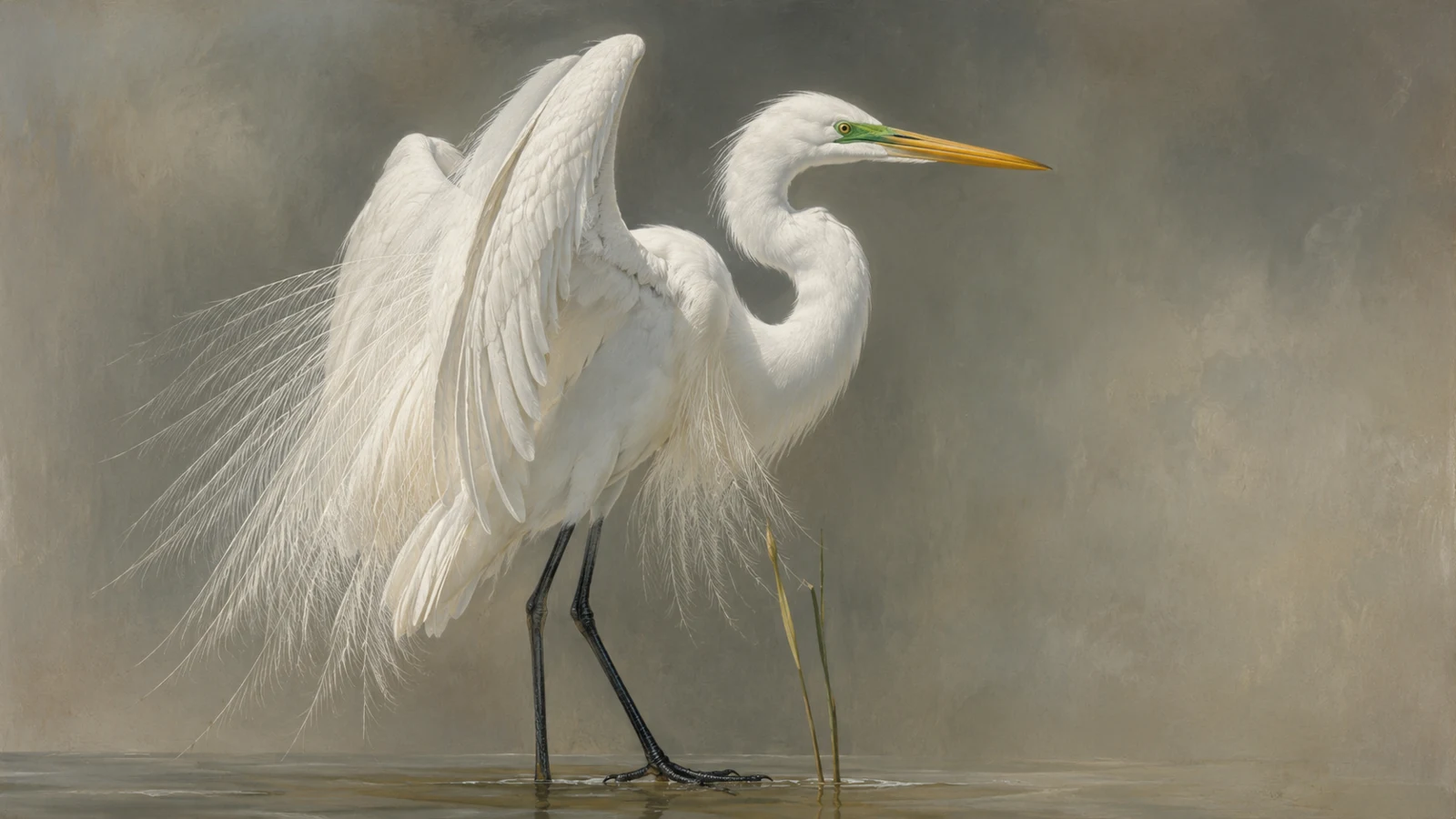
The Great Egret is the largest all-white egret in North America, measuring 80 to 104 centimetres long, weighing 700 to 1,700 grams, and spanning 140 to 170 centimetres in flight. No other combination of size and colour is possible to confuse with it at range: all white, with a long dagger-shaped yellow bill, black legs, and the characteristic S-curve of the neck in flight that marks the heron family.
The plumage details shift through the year. In nonbreeding plumage the bare skin of the face is yellow, the bill is yellow, and the legs are black. In breeding condition - spring and early summer - the facial skin turns electric blue-green, the bill darkens, and the bird grows a cascade of aigrette plumes from the scapulars, up to 50 centimetres long, extending past the tail and raised during courtship displays. These plumes have no barbs that hold the feather vanes together, which gives each one the feathery, disconnected quality that made them so prized in millinery and so difficult to describe without resorting to the word lace.
Males and females look identical in all plumages. Cornell’s Birds of the World notes four subspecies are recognised globally (alba, melanorhynchos, egretta, modesta), separated mainly by geographic range and soft-part colour. In North America the subspecies is egretta, the bird that ranges from the southern United States north into Canada.
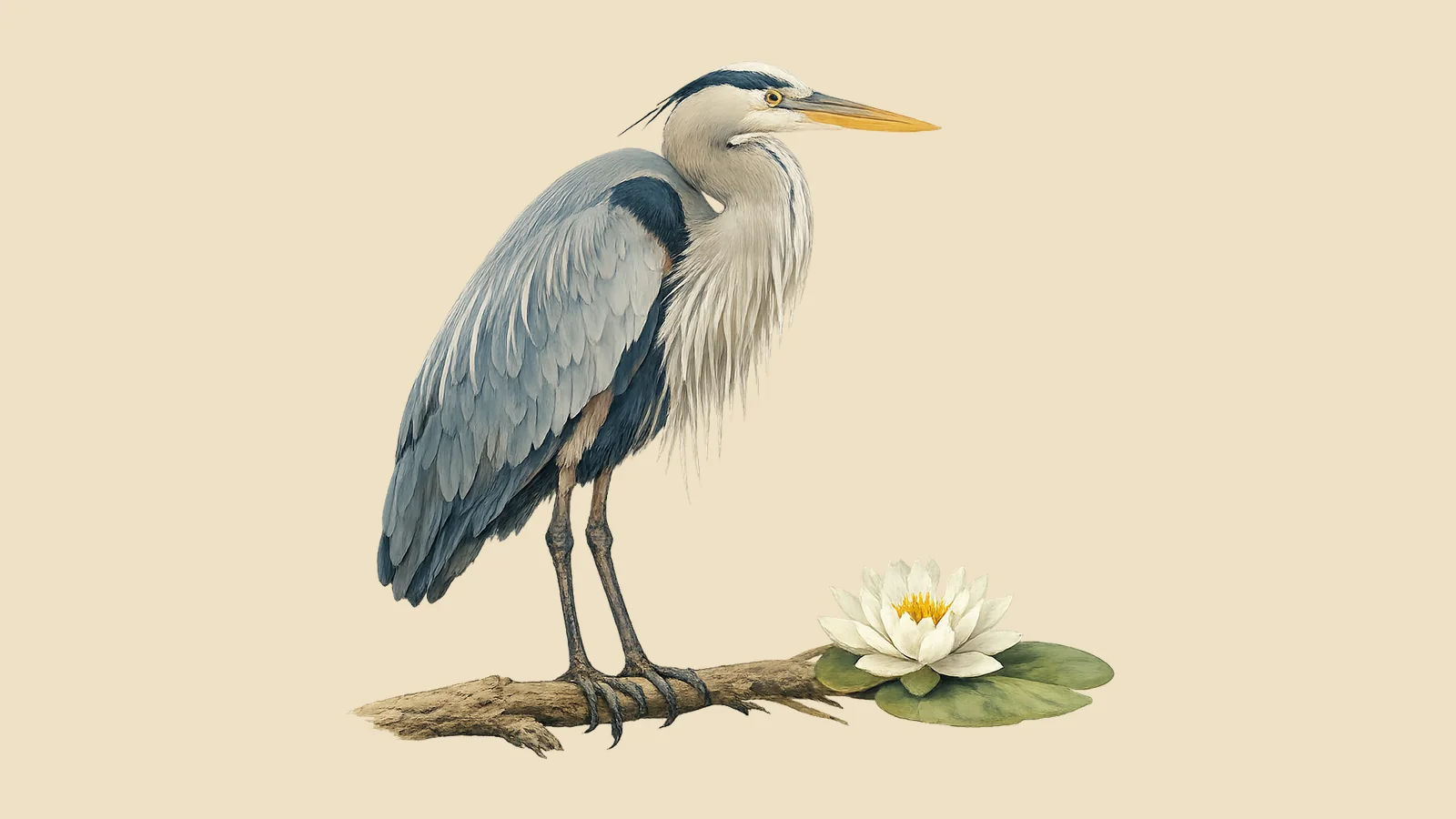
The Great Blue Heron is the most common confusion species: larger, grey-blue, with a chestnut flank and a dark crown streak. At any distance, colour alone separates them. The Snowy Egret is much smaller and has yellow feet where the Great Egret has black. The Great Egret carries no head plumes in any season.
Voice
Not a bird that announces itself often. The call is a low, hoarse croak, sometimes rendered as a guttural frahnk, delivered when flushed from the water or during disputes at the colony. At the heronry in breeding season the noise level rises considerably - a mix of croaks, rattles, and bill-clapping during courtship - but the bird is silent in the field most of the time. You locate it by sight, not by sound.
Range and habitat across the year
The Great Egret is found on every continent except Antarctica, which makes it one of the most successfully distributed large birds on earth. In North America, breeding range extends from Florida and the Gulf Coast north to southern Canada, and west to California and the Pacific coast. Audubon’s field guide records year-round presence in California, Florida, Texas, and much of the Southeast, with breeding populations pushing further north into the Great Lakes, New England, and the northern Plains through summer.
The habitat is water in almost any form: freshwater marshes, shallow ponds, the margins of slow rivers, tidal flats, coastal lagoons, flooded agricultural fields, and wet meadows. Cornell’s Birds of the World documents nesting at elevations up to 4,100 metres in the Andes, which is exceptional for a bird typically associated with low coastal wetlands. The species is not bound to a particular water type. It finds what it needs and uses it.
Migration in North America is partial. Southern populations are largely resident. Birds from northern breeding areas move south in autumn, though the range has been expanding northward in recent decades as populations recover. European expansion has been documented since the late 1970s, with colonisation of France, Belgium, the Netherlands, and beyond.
Diet
A generalist predator with a technique that rewards patience. The Great Egret typically wades into shallow water, stands still, and waits. When prey moves within range, the bill strikes in a motion fast enough that the eye barely tracks it. Fish are the staple. The diet also includes frogs, salamanders, aquatic insects, crayfish, small snakes, and occasionally small rodents taken at the water’s edge.
It also forages on dry ground, walking slowly through grassland in the manner of the Great Blue Heron. The Audubon guide notes that Great Egrets sometimes hover briefly above the water surface before striking - a technique not widely documented in the family and unusual enough to be worth noting when it appears.
The foraging strategy shifts with prey availability. In areas where fish concentrate, birds may feed in aggregations. Where prey is scattered, they defend feeding territories against other egrets with the same focused aggression they bring to the colony.
Breeding and nesting
Great Egrets nest in colonies, often mixed with other herons and egrets. The heronry is typically positioned over water - on islands, in swamp forest, or in large trees above a marsh - to reduce access by ground predators. Cornell’s Birds of the World records nest heights from 4.4 to 27 metres. Some heronries have been in continuous use since the 1950s and 1960s.
The male arrives first and selects a display territory within the colony. He performs the aigrette display there, raising and fanning the long plumes and stretching the neck upward with the bill pointed at the sky. When a female investigates, the pair bond is established through a sequence of mutual displays that can last several days. Material for the nest is delivered by the male and arranged by the female, though the Cornell account notes that nest-material theft from neighbouring birds is common enough that near-constant guard is needed throughout incubation.
The nest itself is a platform of sticks, 0.5 to 1.2 metres wide, relatively shallow and not well-built. Cornell’s Birds of the World describes them as “relatively unstable compared to those of other herons and egrets,” which contributes to variable nesting success year to year.
Clutch size runs from one to six eggs, with typical clutches averaging three to four. Eggs are pale greenish-blue. Both parents incubate for 23 to 27 days, and both provision the young. Chicks begin short flights at 35 to 51 days and reach independence at around 62 to 67 days. The entire nesting cycle spans roughly 90 days.
The oldest banded Great Egret on record, documented in Cornell’s Birds of the World, lived 22 years and 10 months. It was banded in Ohio.
A behavioural note worth sitting with
Great Egrets are aggressive within the colony. They steal sticks. They defend territory against birds of the same species and sometimes larger ones. What they also do, less visibly, is act as indicators of wetland health on a continental scale. Their distribution tracks productive shallow water in a way that mirrors the health of the wetland systems that hundreds of other species depend on. When egret colonies collapse or shift, the cause is almost always a shift in the underlying system.
The IUCN lists the species as Least Concern, with an estimated global population of 590,000 to 2.2 million individuals and a trend that is increasing across North America and Europe. The turnaround from the 1880s - when market gunners were stripping colonies wholesale - to the current stable or growing population is one of the cleaner conservation stories on the continent.
The aigrette that nearly ended this species is the breeding plume the male grows each spring for a single season and then sheds. The birds grew it to attract mates. What they nearly attracted was extinction.