Field Guide
Mallard
Sometime in late October, a male Mallard in full breeding plumage stands at the edge of a city pond and looks, to most passing eyes, unremarkable. He is the default duck. The one people draw from memory. The yardstick against which every other duck gets compared. That familiarity has cost him his reputation.
The thesis worth holding through everything that follows is this: Anas platyrhynchos is one of the most ecologically and historically significant birds on the continent, and its ordinariness is a trick of scale. When you are everywhere, you become invisible.
What he looks like
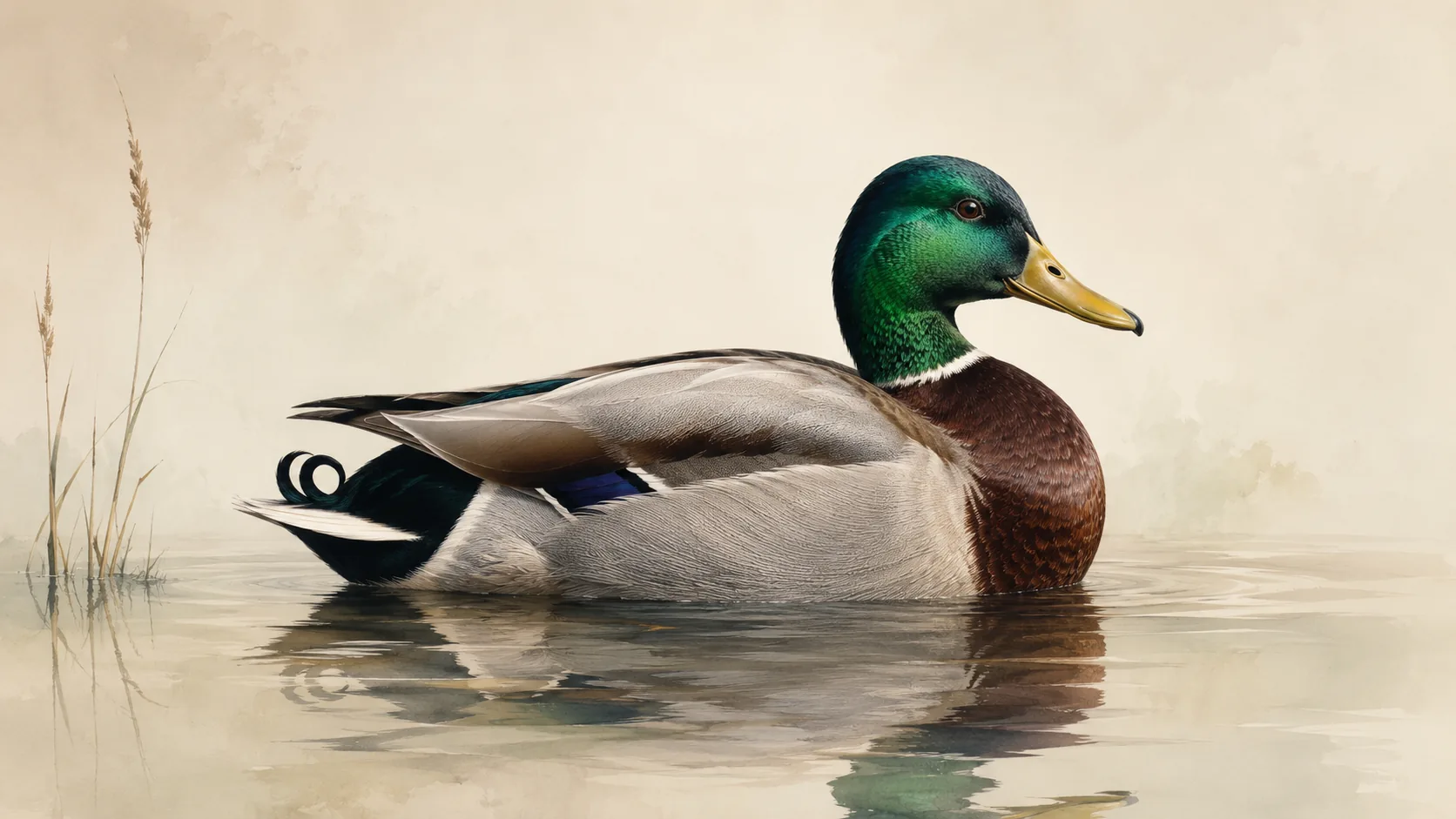
The male in breeding plumage is difficult to mistake. His head is a deep iridescent green - not painted but structural, the colour shifting from teal to near-black depending on angle and light. A clean white ring separates the head from a chestnut breast. The body is grey, the rump black, and the tail carries a curl of black feathers that points skyward like a signature. The bill is yellow. The feet are orange.
At 50 to 65 centimetres long and weighing 900 to 1,600 grams, he is a substantial bird - bigger than a pigeon, smaller than a Canada Goose. The wingspan runs 79 to 97 centimetres. On both sexes, a blue-violet speculum - a patch of iridescent secondary feathers - catches the light in flight, bordered by white bars that flash against the brown of the wingbeat. That speculum is the field mark that holds across seasons and sexes when little else does.
The female is streaked brown throughout, a pattern that reads as dull until you see her against a nest. Then the camouflage is exact. Her bill is orange mottled with black. She is quieter in colour and, as it turns out, noisier in voice.
The voice
The loud, descending quack that most people think of as simply “duck sound” belongs to the female Mallard. It is a contact call, a decrescendo note that drops in pitch and volume across a series of four to five syllables. Males produce a quieter, raspier sound - a soft raeb that carries little distance. This asymmetry is useful for field identification: a duck quacking loudly across a pond is almost certainly female.
Both sexes produce additional calls - soft grunts, whistles during courtship, alarm calls - but the female’s loud quack is the defining sound, and it has become, through familiarity and imitation, the sound the word “duck” summons in most people’s minds.
Range and habitat across the year
The Audubon Society’s field guide describes the Mallard as a partial migrant ranging across the Northern Hemisphere, from Alaska and Canada through the entire continental United States, wintering “wherever open water and food remain accessible.” That range extends across Europe and Asia, making this one of the most widely distributed ducks on earth. The IUCN lists the species as Least Concern, with a breeding population in the tens of millions across North America - though numbers shift considerably with wetland conditions year to year.
Numbers fluctuate. Wet years on the Great Plains swell the breeding population; drought years compress it. Over the past 50 years, the North American count has cycled between approximately five million and 19 million birds, which is itself an illustration of how tightly duck numbers track wetland availability.
In habitat, the Mallard is a generalist in a way that few waterfowl manage. Marshes, farm ponds, city parks, river backwaters, flooded agricultural fields - it uses all of them. What it requires is shallow water for dabbling and cover near the water’s edge for nesting. Beyond those two conditions, it adapts.
Diet
The Mallard feeds by dabbling at the surface and by up-ending - tipping forward with tail in the air - to reach aquatic vegetation just below. Its diet shifts by season and opportunity. During the breeding season, invertebrates - insects, crustaceans, mollusks - make up a larger share. Through the rest of the year, seeds dominate: seeds of sedges, grasses, pondweeds, and, where agriculture adjoins wetland, waste corn and other grain. It will take acorns. It will take almost anything it can swallow.
This dietary flexibility is part of the reason the Mallard thrives at the edges of human settlement. A park pond with regular bread-feeding is not good Mallard habitat - bread carries little nutritional value - but the same birds using that pond are also working the adjacent marsh edge at dawn.
Breeding and nesting
Pair formation in Mallards happens in autumn, months before the spring breeding season. Courtship continues through winter: groups of males display around a single female, dipping their bills, rearing up from the water, and performing a head-flick that shows off the iridescent head. The female chooses. The bond that results is seasonal, not permanent.
She selects the nest site, sometimes more than a mile from water, in dense vegetation, at the base of a tree, or occasionally in an elevated spot - a tree cavity, a roof garden, a hay bale. She builds the nest alone from grasses and leaves, lining it with down plucked from her own breast. She lays seven to 13 eggs, one per day, then incubates them alone for roughly 28 days. The male leaves early in incubation, joining other males in marshes to begin the post-breeding molt.
The ducklings are precocial - covered in down, eyes open, capable of walking and swimming within hours of hatching. She leads them to water almost immediately. Fledging takes 50 to 60 days. First-year survival is low: many ducklings do not survive the first weeks. Adults in the wild average five to 10 years, though the oldest recorded bird, a male banded in Louisiana, was at least 27 years and seven months old when he was shot in Arkansas in 2008.
The eclipse, and what it means
Here is the behaviour quirk that most field guides mention briefly and most birders overlook: after the breeding season, the male Mallard molts all his flight feathers simultaneously, becoming flightless for three to four weeks. At the same time, his body feathers shift to a cryptic brown pattern - the eclipse plumage - that makes him look, to the casual eye, like a female. Darker face, dull body, speculum still visible, but none of the green or chestnut of breeding dress.
The eclipse is both a vulnerability and a solution. Losing all flight feathers at once grounds the bird completely, which in most species would be fatal exposure. The brown eclipse plumage reduces visibility to predators during the flightless window. The bird that looked unmistakable in April is, in July, genuinely easy to overlook.
This is not unique to Mallards - many duck species do it - but it is worth knowing because July and August produce some of the most confused pond-side identifications in birding. The dominant brown duck at your local park in midsummer may be a male Mallard in eclipse, not a female, and the only clean field mark distinguishing them is bill colour and a careful look at the face pattern.
The ancestry
Every domesticated duck on earth descends from the Mallard, with the single exception of the Muscovy Duck. The Pekin duck of Chinese cuisine, the farmyard duck of European tradition, the Call Duck used as a hunting decoy - all are Anas platyrhynchos, selectively bred for size, temperament, or egg production. The Audubon field guide notes this directly, and Cornell’s Birds of the World confirms the ancestral relationship. It is an unusual distinction for a wild bird: the Mallard did not merely tolerate the proximity of human civilization. It became part of it, genetically and economically, in a way that has lasted thousands of years.
The drake at the park pond, waiting for bread he should not be eating, is the ancestor of the duck on the table. He carries that history in feathers that most people stopped looking at before they finished looking.