Field Guide
Canada Goose
In late October on the Platte River in Nebraska, you hear them before you see them: a ragged honking rolling south from a grey sky, growing louder until the formation is directly overhead, then fading into the distance. The sound is one of the most specifically North American things a person can experience. Branta canadensis has been making that crossing for longer than there have been people standing below watching it.
The thesis here is this: the Canada Goose is treated as a pest, but it earns that reputation by doing exactly what its biology evolved to do. It is a large, social, herbivorous waterfowl that thrives in open grassland near water - and North American cities have provided more open grassland near water than the continent has seen since the Pleistocene. The bird is not broken. The landscape changed to fit it.
What you are looking at
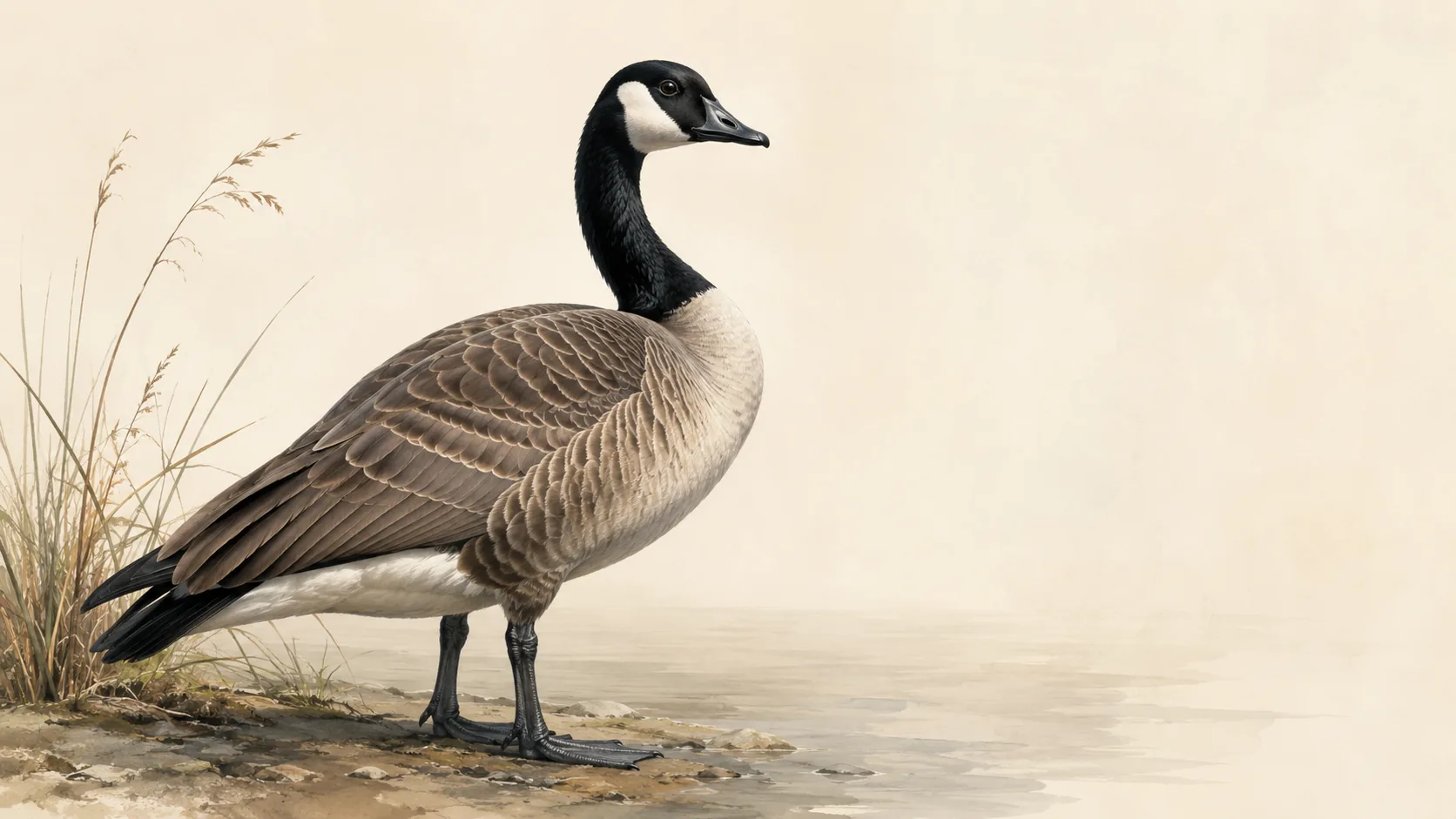
The Canada Goose is a large bird, 76 to 110 centimetres from bill tip to tail, with a wingspan of 130 to 170 centimetres. It weighs anywhere from 2.9 to 8.9 kilograms, making the biggest individuals roughly as heavy as a Thanksgiving turkey. Size varies significantly across subspecies - the giant Canada Goose of the interior Great Plains is among the largest waterfowl in North America, while the cackling subspecies of the Arctic coast (now treated as a separate species) is nearer mallard-sized. Within a single flock in Ohio or Ontario, this size variation is visible.
The field marks are not subtle. The head and neck are entirely black. A white chinstrap patch runs from cheek to cheek beneath the chin. The body is brown-grey above and pale, often cream-white, below. The rump is white. The bill and feet are dark. No other common North American goose combines all four of those features. Confusion species at distance are limited: Snow Geese are white or have white wing patches; Brant are smaller and darker, with no chinstrap; domestic barnyard geese may approach the silhouette but are thicker-bodied and usually white or piebald.
Males and females are identical in plumage - Audubon’s original plates cannot tell you which sex you are looking at without observational context. Males are slightly larger but the difference requires direct comparison.
The voice
Cornell Lab describes the Canada Goose call as a deep, resonant honk in males and a higher-pitched call in females - the two are distinctly different when a pair is calling together, even if each is recognisable as a goose to any ear. The flight calls carry far. Geese heading south in November are audible at half a kilometre in still air, and the cumulative sound of a large formation can reach further.
On the ground the repertoire expands. A goose protecting a nest or goslings produces a low warning hiss - and will follow it with a wing-spread charge toward a dog, a jogger, or a person who has misread the bird’s intent. The neck goes low and forward. This is not bluff. Canada Geese in defence of young have knocked cyclists from bikes and sent dog walkers to urgent care. They weigh as much as a large house cat and have a wingspan reaching wider than most people’s arm spread.
Range and the year
The species breeds across most of Canada, Alaska, and the northern continental United States, nesting wherever there is open water and an elevated site near its edge: shorelines, islands in rivers, the grassy banks of retention ponds in office parks. The Audubon Society’s range data places it across every contiguous US state and most Canadian provinces in at least one season, with year-round residency in much of the northern and central US.
Migration, where it still occurs, follows traditional flyways. The Atlantic, Mississippi, Central, and Pacific flyways all carry Canada Geese south in autumn and north in spring. But a large and growing share of the eastern population no longer migrates at all. Urban and suburban birds in particular have found that golf courses, park lawns, and university quads offer essentially unlimited short-grass forage and that city ponds rarely freeze solid enough to force departure. Cornell’s Birds of the World notes the dramatic increase in year-round resident populations in the lower 48 states across the latter half of the twentieth century.
The IUCN lists the species as Least Concern, with a population that is stable to increasing. It is one of the conservation success stories of North American wildlife management - nearly hunted to regional extinction by the early twentieth century, then recovered through both protection and deliberate reintroduction.
Diet
The diet is almost entirely plant material. Grasses, sedges, the leaves and shoots of aquatic vegetation, agricultural grain left in fields after harvest, and the manicured turf of any lawn kept short enough to be palatable. Audubon’s field guide notes occasional insects, mollusks, and crustaceans, particularly during breeding season, but the overwhelming majority of foraging observations involve terrestrial or aquatic plants.
The grazing method on land is exactly what it looks like: the goose walks slowly through grass, pulling vegetation with the bill’s serrated edges. In water it dabbles - submerging the head and neck while the tail tips upward - or up-ends entirely in shallower areas to reach bottom growth. A flock of 200 geese on a park lawn in late summer can strip the top layer of turf from a large area within days. This is why park managers, golf course superintendents, and university groundskeeping departments have a complicated relationship with the bird.
Breeding and nesting
Pairs form in late winter or early spring, often within the wintering flock, and appear to mate for life, or close to it. Both the Alaska Department of Fish and Game and Audubon’s field data note that established pairs return together to the same nesting area year after year.
The female selects the nest site - always near water and on slightly elevated ground - and builds it herself. The structure is a large, open bowl of grasses, sedges, and moss, lined with down pulled from the female’s own body. Clutch size runs four to seven eggs. The female incubates alone, sitting tight for 25 to 30 days, while the male guards the nest perimeter. Both parents escort the goslings from the moment the brood hatches.
Goslings are precocial: they walk and swim within hours of hatching and begin foraging on their own almost immediately. The family moves as a unit. Goslings fledge at around 40 to 48 days, but the family group typically stays together through the first autumn migration, with young birds learning the migration route from their parents. This is cultural transmission - route knowledge passed from one generation to the next by direct experience rather than instinct alone.
The V-formation as engineering
The V that every schoolchild in North America learns to associate with this bird is not aesthetic preference. It is aerodynamic strategy. Each bird in formation, except the leader, flies in the upwash produced by the wingtip vortex of the bird ahead and to one side. That upwash partially offsets the energy cost of flight. The bird at the point position works hardest and rotates to the back of the line periodically; other birds cycle forward as position-holders tire. Studies of tracked flocks suggest typical daily distances of several hundred kilometres, with wind-assisted flights pushing further - distances achievable precisely because the formation conserves individual energy along the route.
What makes this behaviour worth noting is not that it is clever but that it is coordinated. Each bird must position itself precisely relative to its neighbours, adjust continuously for wind and turbulence, and respond to the rotation of the lead position. It is social behaviour expressed aerially, and it works at the scale of the continental migration.
The question the bird asks
The Canada Goose succeeds so thoroughly in human-modified landscapes that the species has become, in some quarters, a byword for nuisance wildlife. The management literature is dense with hazing protocols, egg oiling programs, and fencing solutions. Some of this is warranted. A thousand geese on a reservoir used for municipal drinking water is a real problem.
But the bird is doing nothing it was not built to do. It grazes short grass near open water and raises young in protected sites and migrates along established corridors. The corridors have narrowed and the grass has moved into cities, and the goose has followed. That it has done so successfully enough to generate complaints is not a failure of the bird. It is a precise measurement of how thoroughly the North American landscape has been remade into Canada Goose habitat.
The next time you hear the honking above an October suburb, that sound is not a nuisance. It is a species reading the landscape correctly and flying accordingly.