Field Guide
Great Horned Owl
If you live anywhere on the North American continent with mature trees, there is a Great Horned Owl within walking distance of your house. She hunts the half-hour after sunset and the half-hour before dawn. She covers a territory of two to three square kilometres. She has been there for years, often the same individual, often the same nest. You have almost certainly never seen her.
This is the bird’s defining feature. She is the apex nocturnal predator of two continents, she will take a skunk and a Cooper’s Hawk in the same week, her grip strength is around 500 pounds per square inch, and almost everything she does is invisible. The five low hoots of a male answering a female at 4 am in November are, for most people, the only evidence she exists.
Plumage and identification
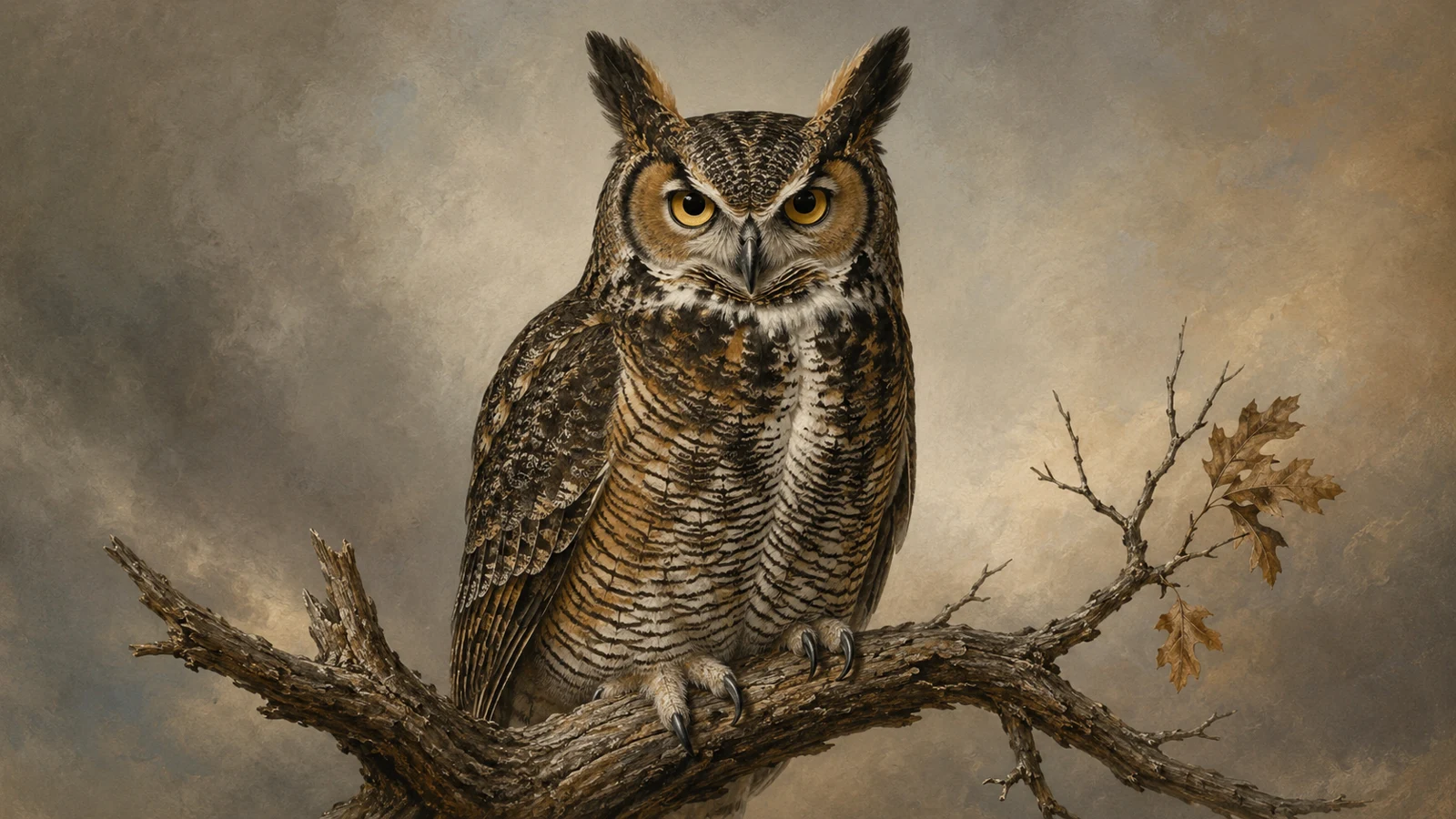
The “horns” are not ears. They are display feathers that the bird raises when alert and lays flat when relaxed. Their function is debated - probably a combination of camouflage (breaking up the head silhouette in a leafless tree) and intraspecific signalling.
| Feature | Detail |
|---|---|
| Size | Large, roughly the bulk of a Red-tailed Hawk |
| Build | Heavy-set, broad-chested, rounded head |
| Ear tufts | Long, widely spaced |
| Face | Rusty-orange facial disk framed by a black border |
| Eyes | Bright yellow, forward-facing |
| Upperparts | Brown mottled with grey, buff and black |
| Underparts | Pale buff with dense horizontal dark barring |
| Throat | White, often shown as a clean patch against the dark breast |
The species shows wide regional variation. Pacific Northwest birds are sooty dark. Arctic Bubo virginianus subarcticus birds are pale frosty grey. Sonoran Desert birds are pale buff with reduced markings. Cuban birds are smaller and warmer-toned. Ornithologists currently recognise about a dozen subspecies, though molecular work suggests the picture is messier than the named subspecies imply.
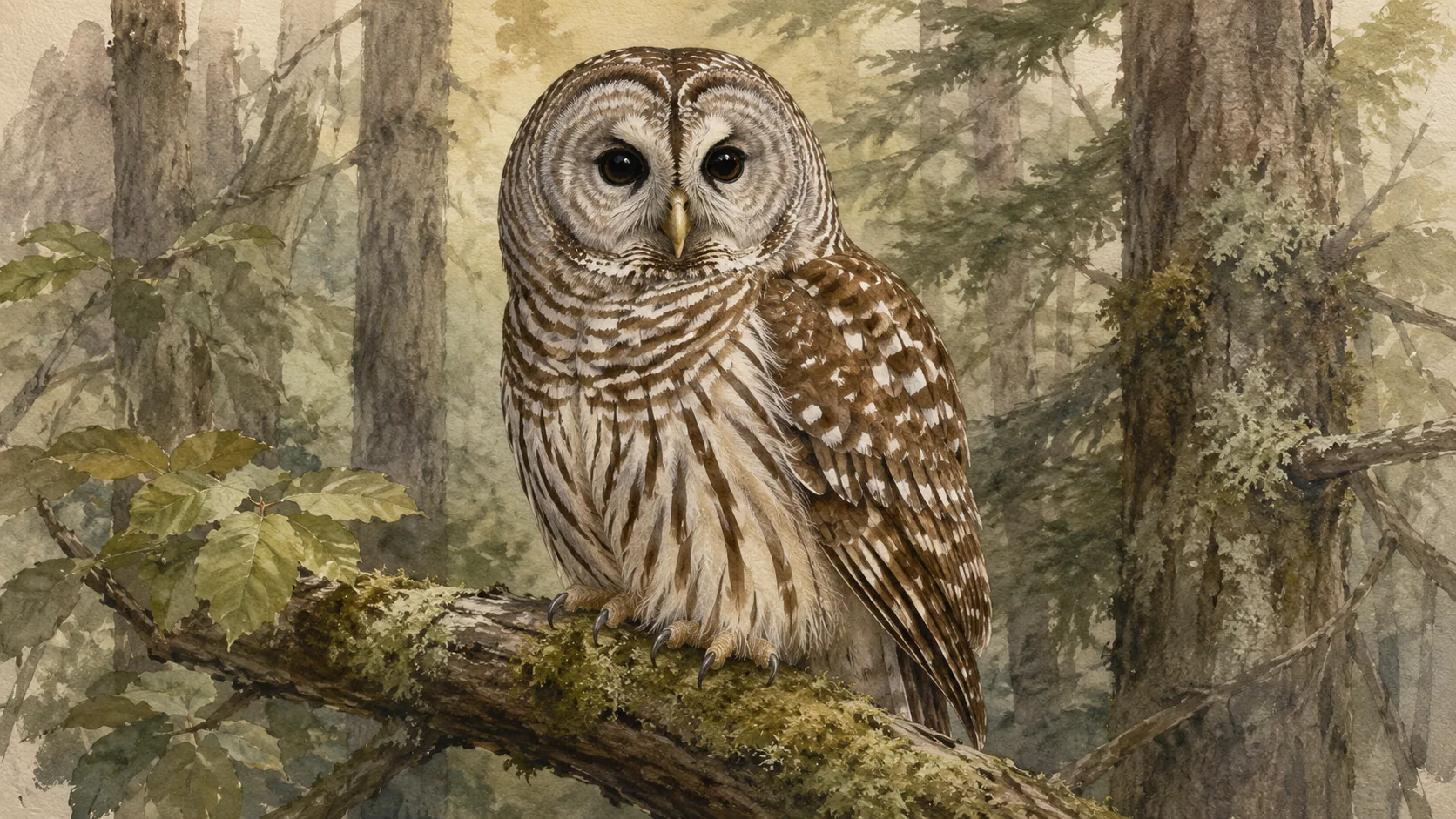
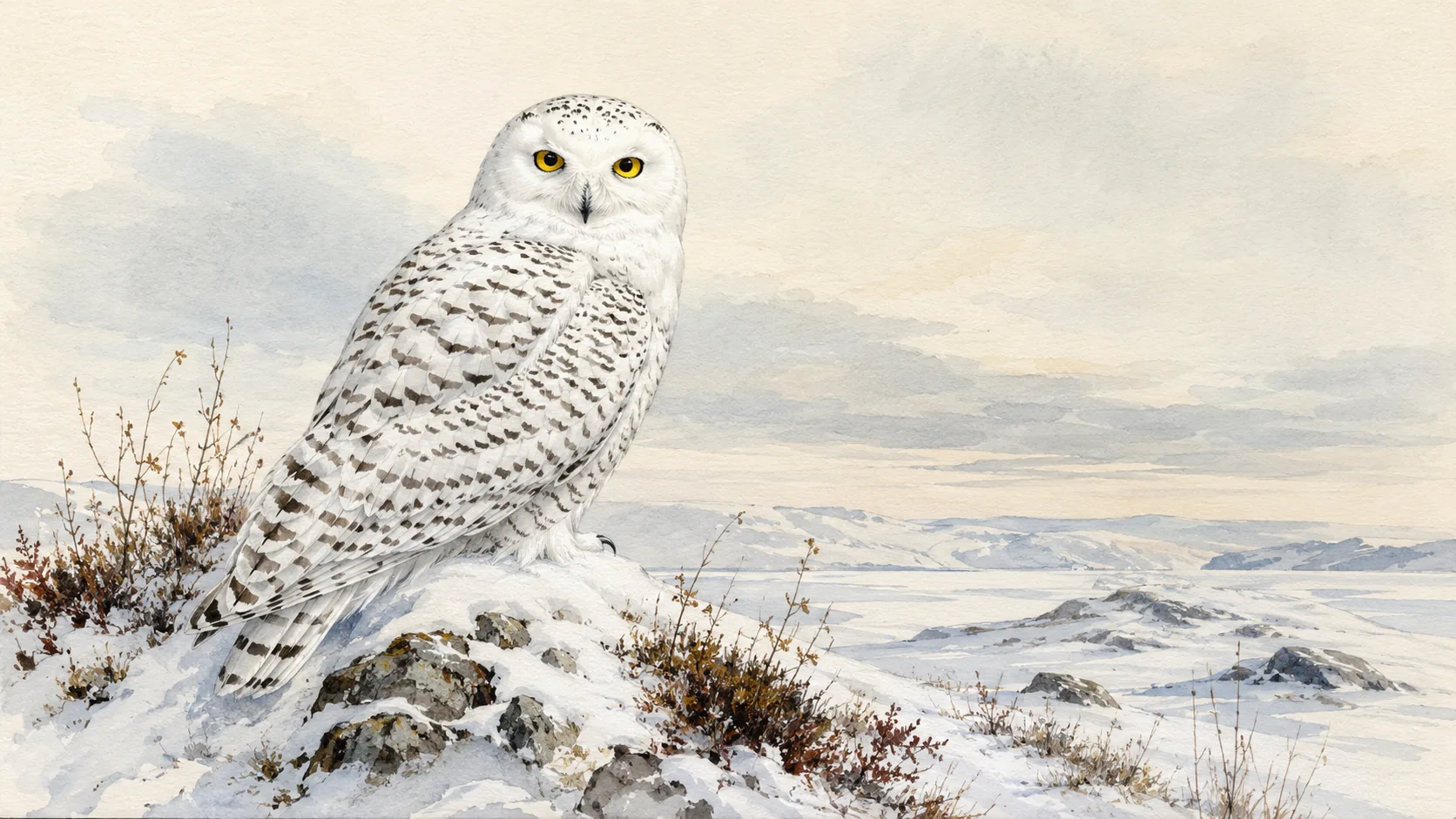
Common confusions: Long-eared Owl (slimmer, vertical streaking, ear tufts closer together, much less powerful), Barred Owl (no ear tufts, dark eyes, vertical streaking), Snowy Owl (white). See Birds that look like owls.
Voice
The deep-voiced owl. Both sexes hoot.
- Male territorial hoot. A series of four to five low resonant hoots in a hoo-hoo HOO-HOO hoo cadence, pitched low enough to carry up to 1.5 kilometres on still air.
- Female hoot. Higher pitched, often 5 to 8 hoots, slightly irregular.
- Duet. Mated pairs counter-call across territory boundaries at dusk and pre-dawn in late autumn and early winter. The duet is the simplest way to confirm that a pair holds your local territory.
- Bill clack. A sharp wooden snap given as a close-range threat.
- Begging young. A drawn-out raspy shreeeek that runs through summer nights from fledged but still-dependent juveniles.
The hooting season peaks October through January. By February the pair is courting and most pairs have eggs by mid-February in southern populations, into April in the north.
Range and habitat
Year-round resident essentially everywhere on the continent except the highest Arctic. The bird is habitat-agnostic. She will take a territory in:
- Mixed and deciduous forest.
- Coniferous forest.
- Desert with mesquite or saguaro.
- Suburban parks, cemeteries, golf courses.
- Open farmland with shelterbelts.
- Mangrove swamp.
- Mountain canyon, river valley, abandoned barn.
The single requirement is a perch from which to hunt and a cavity, snag or stick nest in which to raise young.
Diet
Catholic in the older sense of the word. The published list of recorded prey species runs into the hundreds.
| Category | Examples |
|---|---|
| Small mammals | Cottontail, jackrabbit, vole, mouse, rat, squirrel |
| Medium mammals | Skunk, opossum, raccoon, mink, marmot, weasel |
| Birds | Crow, heron, duck, pheasant, grouse, other owls, Cooper’s Hawk, Red-tailed Hawk |
| Reptiles and amphibians | Snake, frog, salamander |
| Invertebrates | Large insects, scorpions, crayfish |
| Fish | Occasional, taken from shallow water |
The Great Horned Owl is the only common North American predator that routinely takes skunks. Her sense of smell is poor, which removes the chemical deterrent that protects skunks from most other predators. A skunk-eating owl smells like a skunk for weeks.
She is also one of the few birds known to kill other raptors. Red-tailed Hawk nests within Great Horned Owl territory are vulnerable to night predation of nestlings. The hawk dies. The relationship is asymmetric.
For specific predation questions see Do owls eat foxes, Do owls attack humans and Do owls attack cats and dogs.
Breeding and nesting
The earliest breeder of any common North American bird. Pair-bonding in October, eggs by January or February in much of the range. The strategic logic of the early start is that owlets fledge in May, exactly when small-mammal populations are peaking, giving the young an easy summer of hunting before winter.
| Feature | Detail |
|---|---|
| Nest site | Does not build a nest. Takes over old stick nests of Red-tailed Hawk, crow, heron or eagle. Will also use tree cavities, rock ledges, broken-off snags, abandoned buildings. |
| Clutch | 1 to 4 white eggs, usually 2 |
| Incubation | 30 to 37 days, by the female |
| Fledging | Young branch out of the nest at 6 weeks, fed by both parents into autumn |
| Broods per year | 1 |
The non-nest-building is worth noting. The Great Horned Owl is the only common North American raptor that essentially never builds her own nest. She steals one. The bird whose nest she takes either tries to rebuild somewhere else that season or skips a year. Red-tailed Hawks have been documented timing their own breeding to avoid territory overlap with established Great Horned Owl pairs.
The silent flight
The leading edge of the wing carries a comb-like serrated fringe of feather barbs that break the rush of air over the wing into small turbulent eddies rather than one large sheet. The result is a flying bird that produces essentially zero aerodynamic noise. Prey hears nothing until the talons close.
The fringe is a structural adaptation found across most owl species but is particularly well-developed in the larger species like Great Horned. Wagner and colleagues (2017, Interface Focus) characterised leading-edge serrations in barn owls and showed that these structures, shared across most owl species, suppress aerodynamic noise across the frequency range where small mammals hear best. The serrated leading edge has since been the basis for wind-turbine blade design intended to reduce aerodynamic noise.
Head rotation, ears and eyes
- Head rotation. Up to 270 degrees in either direction. Specialised arterial structures, including bony reservoirs that pool blood at extreme angles, prevent the carotid arteries from shearing as the head turns.
- Asymmetric ears. The actual ears are openings in the side of the head, set at slightly different heights. The asymmetry allows the brain to compute prey location in three dimensions by comparing the millisecond delay between the two ears.
- Eyes. Forward-facing, about 5 per cent of total body mass (in a human equivalent, this would be the size of grapefruits). The eyes are tubes, not spheres, and cannot move in their sockets. The neck does the work that human eye muscles do.
The eyes, ears and silent flight together give the bird a hunting capability that no daytime raptor matches. She can locate a vole through 60 centimetres of snowpack, drop on it through the air without producing audible warning, and kill it before the vole has finished registering motion.
Where to hear Great Horned Owls
Walk out after dark in late October or November anywhere with mature trees. Listen between 9 pm and midnight, or between 4 am and dawn. The deep five-note hoot is unmistakable. Wooded city parks, suburban cemeteries and any patch of farmland with a tree line will support a pair.
Folklore
Owls carry some of the deepest and most ambivalent symbolism of any bird. Wisdom in Greek tradition - the owl of Athena. Death-omen in much of medieval European and parts of Native American tradition. Guardian of the unseen in Celtic folklore. Messenger in modern Western pop culture, partly through Harry Potter and partly through the broader twentieth-century rehabilitation of corvid and owl species in children’s literature.
Full reading at Owl symbolism and spiritual meaning.
Print available
A study of a Great Horned Owl on a leafless oak at dusk is available at the Great Horned Owl Print, and the bird is part of the Owl Quartet collection.