Field Guide
Great Gray Owl
The snow gives no sign of what is underneath it. A meadow at the edge of a Manitoba spruce stand in February, a flat expanse of white without a track or a tunnel. Then a bird drops from a low perch on silent wings, hovers for two seconds directly overhead, and drives headfirst through the crust. It disappears up to its shoulders. When it pulls back up it has a vole, caught in a darkness it never saw, seized on the strength of a sound that passed up through forty centimetres of packed snow to reach two small openings hidden in the feathers of its face.
This is Strix nebulosa. The Great Gray Owl. The Phantom of the North.
What it looks like
The first impression is size. This is the tallest owl in North America, measuring 61 to 84 centimetres from bill to tail. But the second impression, if you are standing close enough, is that the size is mostly air. Cornell Lab and the National Audubon Society are both clear on this: the Great Horned Owl and the Snowy Owl both outweigh it. Adult Great Grays typically come in between 790 and 1,450 grams, with females heavier than males. A large female Snowy Owl can weigh nearly twice that. What looks so formidable about this bird is not mass but volume, and volume here is feathers.
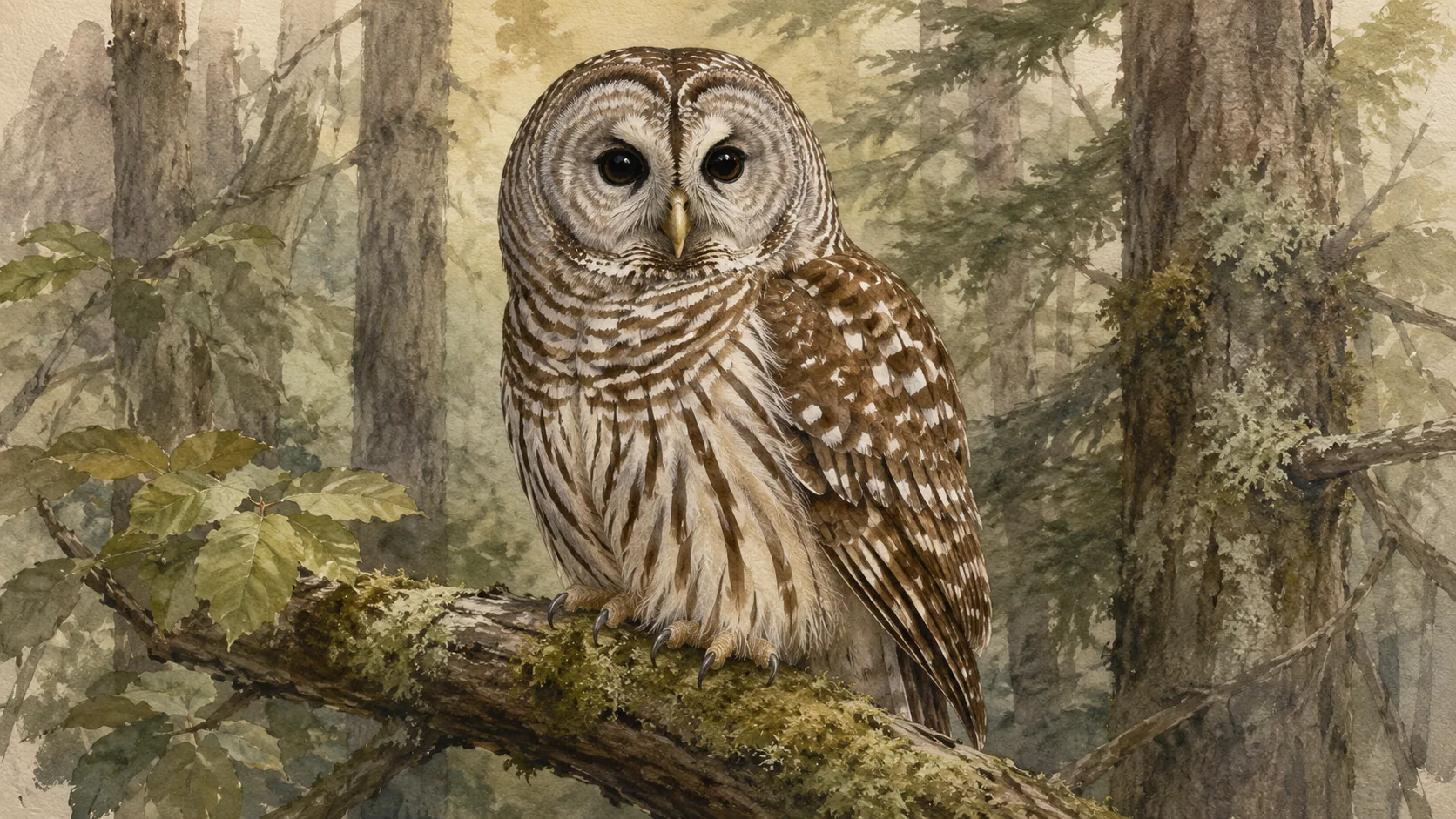
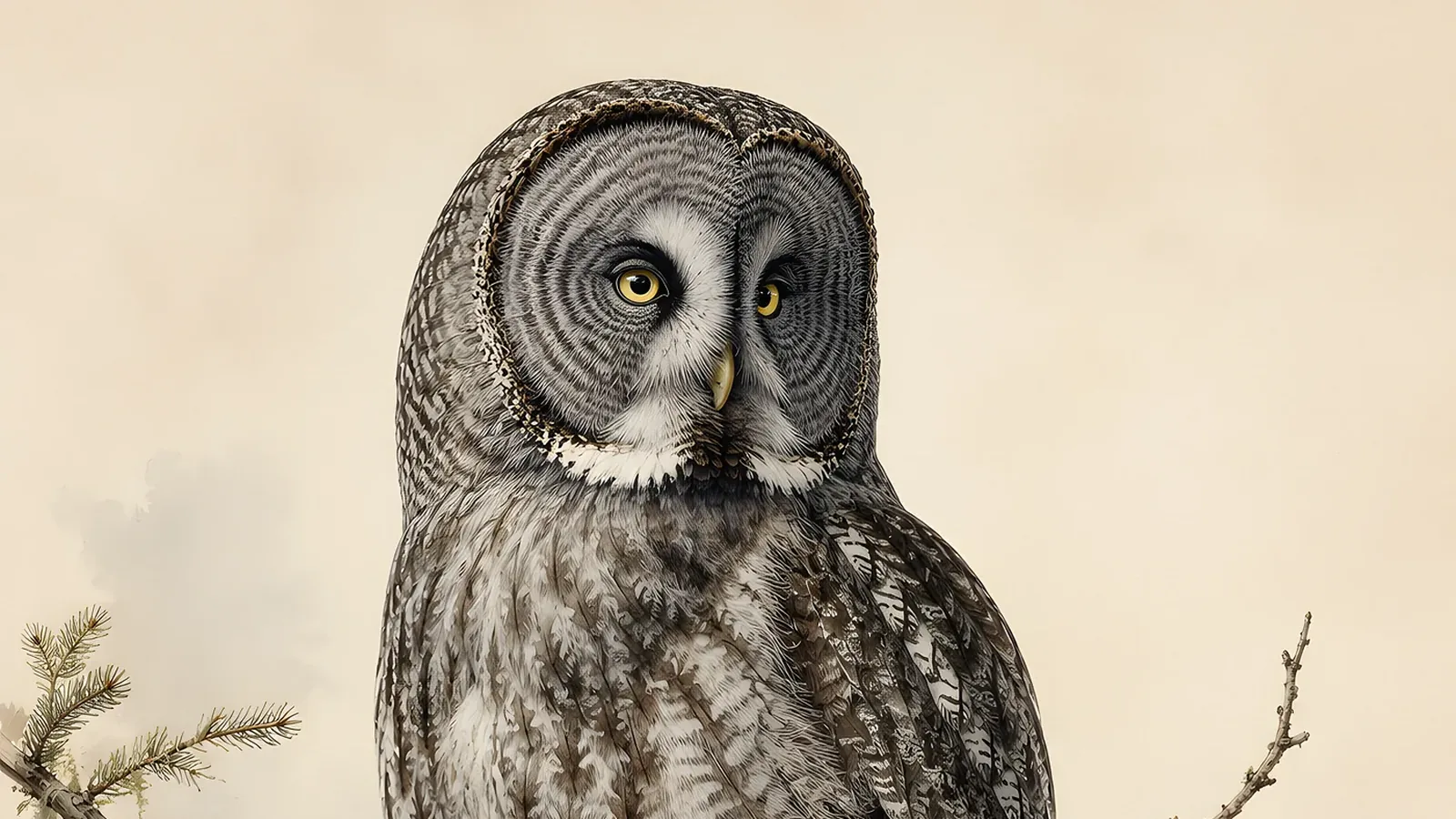
The plumage is the colour of lichen on bark - a soft, complex grey-brown, barred and mottled in a pattern that dissolves against the vertical lines of a spruce trunk. There are no ear tufts. The crown is round and flat-topped. The tail is the longest of any owl species, contributing significantly to that overall body length. The bill is yellow, small among so much surrounding feathering, and the eyes are a hard, cold yellow above it.
What dominates is the face. The facial disc is the largest, relative to body size, of any bird of prey. It spans the full width of the bird’s head, a set of concentric rings in grey and brown, framed by a dark border, with two white patches at the throat below it that catch the light like a cravat. There are no large forward-facing features to it. What you notice is the geometry: the perfect circular architecture of a precision listening device.
| Measurement | Range |
|---|---|
| Length | 61 - 84 cm |
| Weight | 790 - 1,454 g |
| Wingspan | 137 - 152 cm |
| Tail length | 285 - 347 mm |
| Incubation | 28 - 36 days |
Big bird, light owl
The Great Gray’s apparent bulk is a cold-weather adaptation. Boreal winters in the northern Canadian interior routinely reach minus 40 degrees, and a bird that spends those nights perched on an exposed snag needs insulation the way a house needs walls. The feathering is so dense and so long that it creates dead-air pockets throughout the plumage, working exactly as down does in a sleeping bag. Strip it away and the actual body is notably small.
This matters for understanding the species’s place in the owl hierarchy. The Great Gray is the largest-looking owl, but it punches well below that size in terms of striking power. It hunts almost exclusively voles and other small rodents. The Great Horned Owl, shorter in length but heavier and armed with significantly larger talons, can take hares, skunks, and domestic cats. The Snowy Owl is built for the same brutal weight class. The Great Gray is built for cold and for patience.
The most imposing owl on the continent is, in practice, a specialist in animals that weigh less than a slice of bread. The feathers are a disguise, and they work in both directions.
Hunting by sound through snow
Christopher J. Clark and colleagues at UC Riverside, publishing in Proceedings of the Royal Society B in 2022, worked out in quantitative detail what field observers had known for decades: that Great Gray Owls can locate prey through snow by hearing alone, and that the physics of this feat are genuinely strange.
Snow attenuates sound. It is not a simple barrier but a medium with its own acoustic properties, and it affects different frequencies differently. Clark, Duncan and Dougherty measured attenuation coefficients of 0.3 decibels per centimetre at 500 Hz, rising to 0.6 decibels per centimetre at 3 kHz. Above 3 kHz, sound barely passes through snow at all. The study showed that only low-frequency sounds - below 3 kilohertz - transmit effectively through snow layers of any depth.
The Great Gray Owl’s enormous facial disc is built to gather exactly this end of the spectrum. Clark described it as functioning like radar, a broad parabolic surface funneling low-frequency vibration toward the ear openings. The disc is the largest of any bird of prey, and it is tuned for the sounds that penetrate snow: the low rustle and scratch of a vole moving in its subnivean tunnel at depths of 40 to 50 centimetres or more.
The second problem is accuracy. Snow does not merely quiet sound - it bends it. The refractive index of snow measured in the Manitoba study was 1.16, sufficient to produce an acoustic mirage in which the apparent position of the sound source is displaced from its actual position. An owl flying toward a sound localized while in forward flight would strike the wrong spot.
The owls solve this by hovering. Rather than committing to a stoop from distance, the Great Gray positions itself directly overhead, reducing the path length between it and the prey and minimizing the angular displacement of the mirage. At that position, directly above the animal, refraction cannot cause a lateral error. The bird strikes from above, legs and talons punching through the snow crust with the full weight of the bird driving them, and seizes prey in darkness it has never seen.
Audubon field records and the Owl Research Institute both document successful strikes through snow up to 45 centimetres deep. The wings leave impression marks on the snow on either side of the plunge hole like a negative of a bird in flight.
What it sounds like
The Great Gray is largely a silent bird outside the breeding season, which is part of why it can vanish so completely into the boreal forest. The advertising call of the male is a series of deep, evenly-spaced hoots, very low in pitch, delivered slowly and descending slightly in scale. The Owl Pages transcribes it as a soft whooo-ooo-ooo-ooo held over six to eight seconds and repeated at intervals of 15 to 30 seconds. In still winter air this carries up to 800 metres.
The call is lower than most people expect from a bird this size. It is almost subsonic at the edge of perception, felt in the chest as much as heard by the ears. The Audubon Society Field Guide describes it as a very deep, booming hoot repeated ten or more times and gradually descending in scale. Females produce shorter calls at higher pitch.
The species calls most actively in the weeks before nesting begins - late winter in most of its range, when the forest is still deep in snow and the days are only beginning to lengthen.
Range and habitat
This is a Holarctic species, present in northern North America and in a continuous band across northern Eurasia from Scandinavia to eastern Siberia. In North America the core breeding range runs from interior Alaska across the boreal forest belt of Canada, reaching south in the western mountains to Montana, Idaho, Oregon, and north-central California in the Sierra Nevada, and east to northern Minnesota, where the Minnesota Breeding Bird Atlas documents it as a locally regular nester in the deep boreal forest of the northeast.
In winter the bird is largely sedentary. It does not migrate in any formal sense. When it moves, it moves in response to prey. In years when vole populations collapse across the boreal interior, sometimes described as cyclic crashes on a roughly four-year rhythm linked to lemming and vole population cycles, Great Grays push south and east into states where they rarely appear. These irruptions bring birds to southern Minnesota, Wisconsin, Michigan, and occasionally into the northeastern United States, where they land on fence posts and hunt in daylight with the mild indifference of an animal that has never learned to fear people.
Breeding habitat is dense boreal and montane coniferous forest, specifically forest with adjacent openings: bogs, muskegs, wet meadows, and forest clearings. The species needs the trees for roosting and nesting and the open ground for hunting. Pure closed-canopy forest without meadows holds very few birds. The combination of dense spruce and tamarack with adjacent wet clearings, common through northern Canada and the northern Rockies, is the landscape this owl has shaped itself to occupy.
Breeding
Great Grays are early nesters. Egg-laying typically begins in March or April across the northern range, while snow still lies two and three feet deep. This timing is not incidental. Vole populations peak in late winter and early spring under the snow, and the owlets will need the highest prey density of the year to survive.
The species does not build. It takes over the abandoned stick nests of other raptors - Northern Goshawks, Common Ravens, Ospreys - or uses the flat tops of broken snags, which can be 10 to 15 metres above the ground. The nest is used repeatedly, sometimes for many consecutive years, and the same pair will return to the same site as long as the structure holds.
The female lays two to five white eggs, with clutch size closely tied to prey availability. In strong vole years she may lay four or five. In poor years, two, or nothing. Incubation takes 28 to 36 days and is done entirely by the female, while the male hunts for both birds. The male’s provisioning of the female before and during incubation is one of the clearest behavioural expressions of pair bond strength: a bird that cannot keep the female fed will not successfully raise young in a northern winter.
Young owls leave the nest at three to four weeks, long before they can fly, clambering out onto nearby branches in behaviour called branching. They take true flight two weeks after that. The female guards the brood with notable aggression - observers have been struck by adults, which will target the head of an intruder at close range. The young birds remain with the family unit for some weeks after fledging, learning the fundamentals of the one skill that will define their lives: listening to snow.
The Great Gray Owl’s oldest documented wild individual was recovered 13 years after banding, a figure that represents the known ceiling more than a typical outcome. Starvation is the leading cause of death in this species. The prey is small, the winter is long, and the math is always tight.
The IUCN lists Strix nebulosa as Least Concern, with an estimated global population of around 50,000 breeding pairs and no sign of systematic decline across its vast range. In California, where a tiny isolated Sierra Nevada population sits at the extreme southern edge of the range and is fully dependent on old-growth montane forest, the state lists it as Endangered, with perhaps 100 to 200 pairs remaining.
The continent-wide picture is stable. The argument this owl makes - that an animal measuring nearly a metre tall can be mostly feathers, and that the largest face in the raptor world can be an ear - is a working proposition across thousands of square kilometres of northern forest. The snow keeps the secret. The owl keeps listening.