Field Guide
Mute Swan
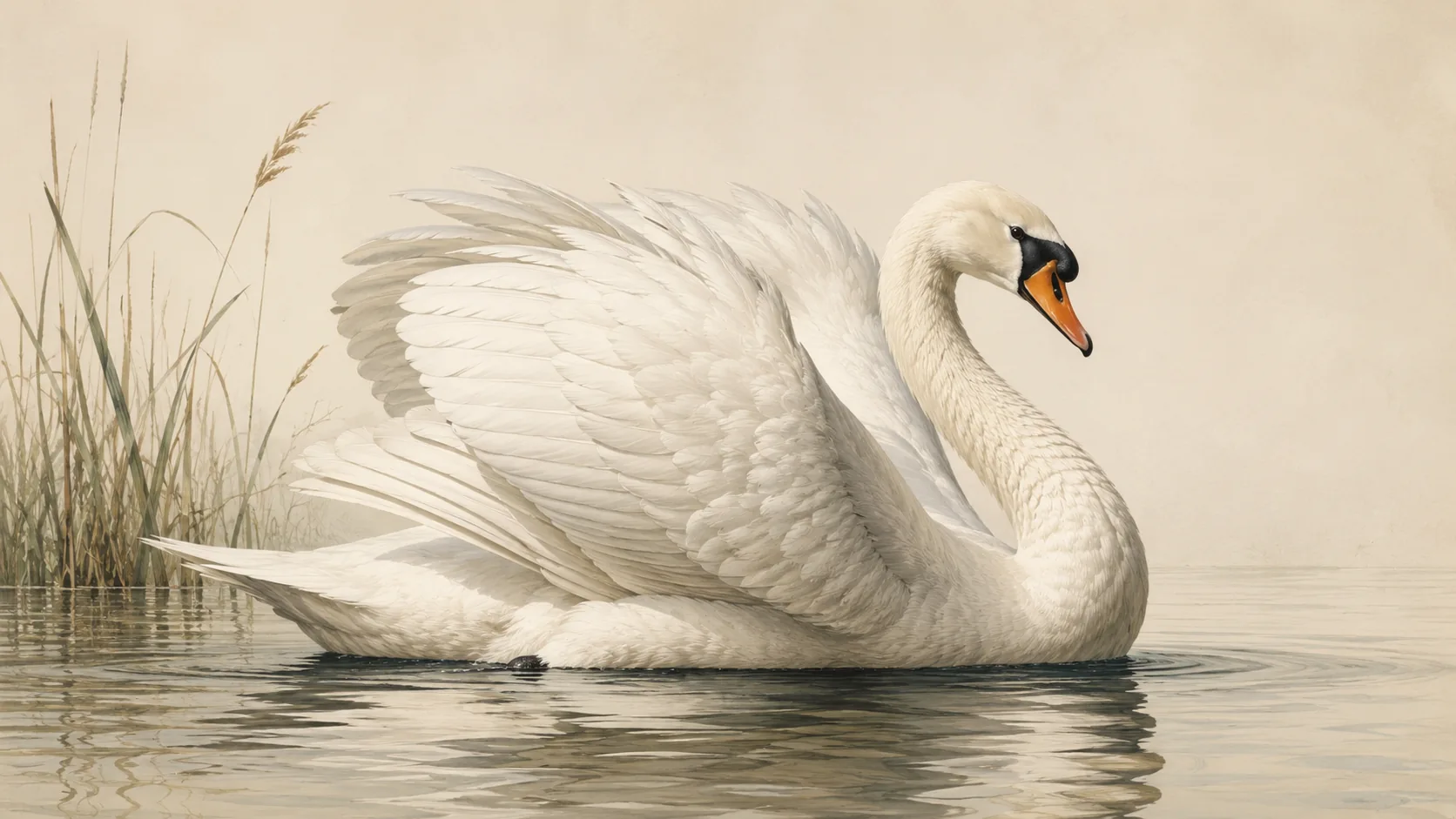
In July, at a bend in the Thames or a reed-fringed reservoir in the East Midlands, you can find a Mute Swan that cannot get airborne. Its wing feathers have dropped out - all the primaries and secondaries gone at once, a total simultaneous moult that lasts six to eight weeks. The bird paddles the same few acres it has always claimed, orange bill tucked against the S-curve of its neck, looking complete. It is not. The Swan Specialist Group records that males moult first, then females, with the female holding off until the males recover flight - a staggered arrangement that keeps at least one capable adult operational while the cygnets are still grey.
This is the thing about Cygnus olor that the postcard never shows: it earns its authority through a body that costs a great deal to maintain, that grounds itself seasonally, that eats up to four kilograms of aquatic vegetation per day to sustain itself through the moult. The bird standing on a riverbank with its wings arched is not performing for spectators. It is calculating threat.
What it looks like
The adult Mute Swan is all white above a black-and-orange bill. The bill’s distinguishing feature is the black fleshy knob at the base of the upper mandible - larger on the male than the female and a reliable field character at close range. Both sexes are otherwise identical in plumage. Legs and feet are dark grey.
Body length runs 125 to 160 centimetres. Wingspan reaches 200 to 240 centimetres. Males average around 10 to 11 kilograms; females run lighter at eight to nine. This makes the Mute Swan one of the heaviest flying birds in the Northern Hemisphere, sharing that distinction with the Dalmatian Pelican and the Kori Bustard.
Cygnets hatch grey-brown. The grey runs through pale grey to buff to white over the first year. A pale morph - known as a ‘Polish’ swan - produces white cygnets with pink feet; this morph is genuinely white from hatching and is controlled by a single gene, giving it textbook status in avian genetics courses.
Confusion with other British swans is possible but limited. The Whooper Swan and Bewick’s Swan both have yellow-and-black bills, no knob, and straighter, more upright neck profiles. At rest on water, the Mute Swan holds its neck in a pronounced S-curve; the other two hold theirs nearly vertical. In flight, Mute Swan wingbeats produce a slow, loud, rhythmic thrumming audible from a considerable distance, where the others are essentially silent on the wing.
Voice
The name is a slight misnomer. Cygnus olor is quieter than its relatives but not silent. It produces hissing, snorting, and grunting sounds at close range, particularly when threatened or during nest defence. Cygnets have a soft, high whistle. In flight, the wing sound carries in still air across open water at distances that make it a useful identification feature even when the bird is not yet visible. The RSPB describes it as a distinctive musical note produced by the outer primaries vibrating against each other.
Range and habitat across the year
The species is native across most of temperate Europe and into Central Asia, with the range extending east toward the Black Sea, Caspian Sea, and into Central Asian steppe lakes. Cornell’s Birds of the World places the core native range between roughly 43 and 63 degrees north in Europe. Introduced populations now occupy the northeastern United States, the Great Lakes region, and smaller areas in Australia and New Zealand.
In Britain and Ireland, the BTO’s surveys show the species is widespread on lowland waters, largely absent from upland areas, and has expanded its range - including a winter range expansion into Shetland. The Bird Atlas 2007-11 recorded a 19.7 per cent increase in winter distribution compared with the 1981-84 survey.
Habitat is flexible: slow rivers, lakes, reservoirs, sheltered coastal bays, brackish estuaries, town park ponds. The bird requires enough submerged aquatic vegetation to sustain its daily intake and enough water depth and width to generate a takeoff run. Takeoff requires a long surface run into wind; the heavier males on calm days need the most room.
Some British birds are sedentary on their breeding territory year-round. Others, particularly young non-breeders, gather into winter flocks that can number in the hundreds on large wetlands. The RSPB notes that cold-weather arrivals from continental Europe bolster eastern England populations in winter.
Diet
The Mute Swan is primarily an aquatic herbivore. It feeds by dipping its long neck below the surface to reach submerged vegetation - pondweeds, eelgrass, stoneworts, and algae - or by up-ending in shallower water in the manner of a dabbling duck. The BTO notes that increased autumn cereal sowing has improved winter food supplies in arable Britain, as birds now feed on spilled grain and winter-sown fields. The Swan Specialist Group records an adult in moult requiring up to four kilograms of vegetable matter per day to fuel feather regrowth.
Small invertebrates, insect larvae, and worms are taken incidentally. The Audubon field guide notes the species also accepts artificial feeding by the public, which the bird’s presence in urban parks has normalised across Britain and Ireland.
Breeding and nesting
Pairs form at two to three years of age and Cornell’s Birds of the World notes that pair bonds “often last for life,” though mate switching does occur after nest failure or a partner’s death. First breeding typically occurs at three to four years old.
Nests are large mounds of reeds, rushes, and plant material built at the water’s edge or on a small island, sometimes reused and enlarged over successive seasons into structures a metre high. Clutch size is four to seven eggs. Incubation runs 34 to 44 days (the BTO gives this range); fledging takes 120 to 150 days - a slow developmental schedule consistent with the size and complexity of the bird.
The male - called the cob - defends the territory with a display that is among the most recognisable in British wildlife: neck pulled back, wings raised and arched over the body into what is called the ‘busking’ posture, the bird powering across the water toward whatever has provoked it. The display is not entirely theatrical. Cobs have been documented injuring dogs, canoes, and occasionally people who entered breeding territories. The aggression is real and the force behind those wings - capable of generating a two-metre wingbeat arc - is not trivial.
Cygnets are often seen riding on the back of one parent during their first weeks, sheltered under the arched wings. This behaviour, recorded across Europe and confirmed in British populations, appears to serve thermoregulation and predator protection simultaneously.
The lead fishing weight chapter
The single most consequential event in the modern history of the British Mute Swan population did not involve habitat change, hunting law, or climate. It involved a small piece of metal.
Lead fishing weights, lost or discarded by anglers in rivers and lakes, were ingested by swans as grit - necessary for digestion - and caused lead poisoning. The BTO estimates that between 3,000 and 3,500 British swans died annually from this cause through the 1970s and early 1980s. The British population at the time was roughly 18,000 birds. A ban on the sale of lead fishing weights came into force in 1987. The IUCN lists Cygnus olor as Least Concern globally, but the British recovery - a 25 per cent population increase between 1995 and 2023, recorded by the BTO - is directly attributable to that regulatory change.
The lead fishing weight ban is one of the cleaner examples in British conservation history of a specific, reversible cause producing a specific, measurable recovery. The swan did not need habitat restoration, reintroduction schemes, or landscape-scale intervention. It needed one product removed from sale.