Field Guide
Seaside Sparrow
At low tide on a Virginia saltmarsh, the cordgrass leans east and stays there. A sparrow drops into the base of a stem three metres off the path and vanishes completely. Not startled, not in flight, just gone. You stand and wait. A minute later it reappears two metres to the left, walking on the mud between the stalks in a way that looks less like a bird and more like a vole. This is the Seaside Sparrow, and almost everything it does is designed to keep you from finding it.
It is one of the few birds in North America that is truly bound to a single habitat. Not a preference. A requirement. No saltmarsh, no Seaside Sparrow. The two are inseparable in the way that a coral reef fish is inseparable from coral.
What it looks like
Compact and thick-necked for a sparrow. The head looks slightly large, the tail short. It sits heavy on its feet.
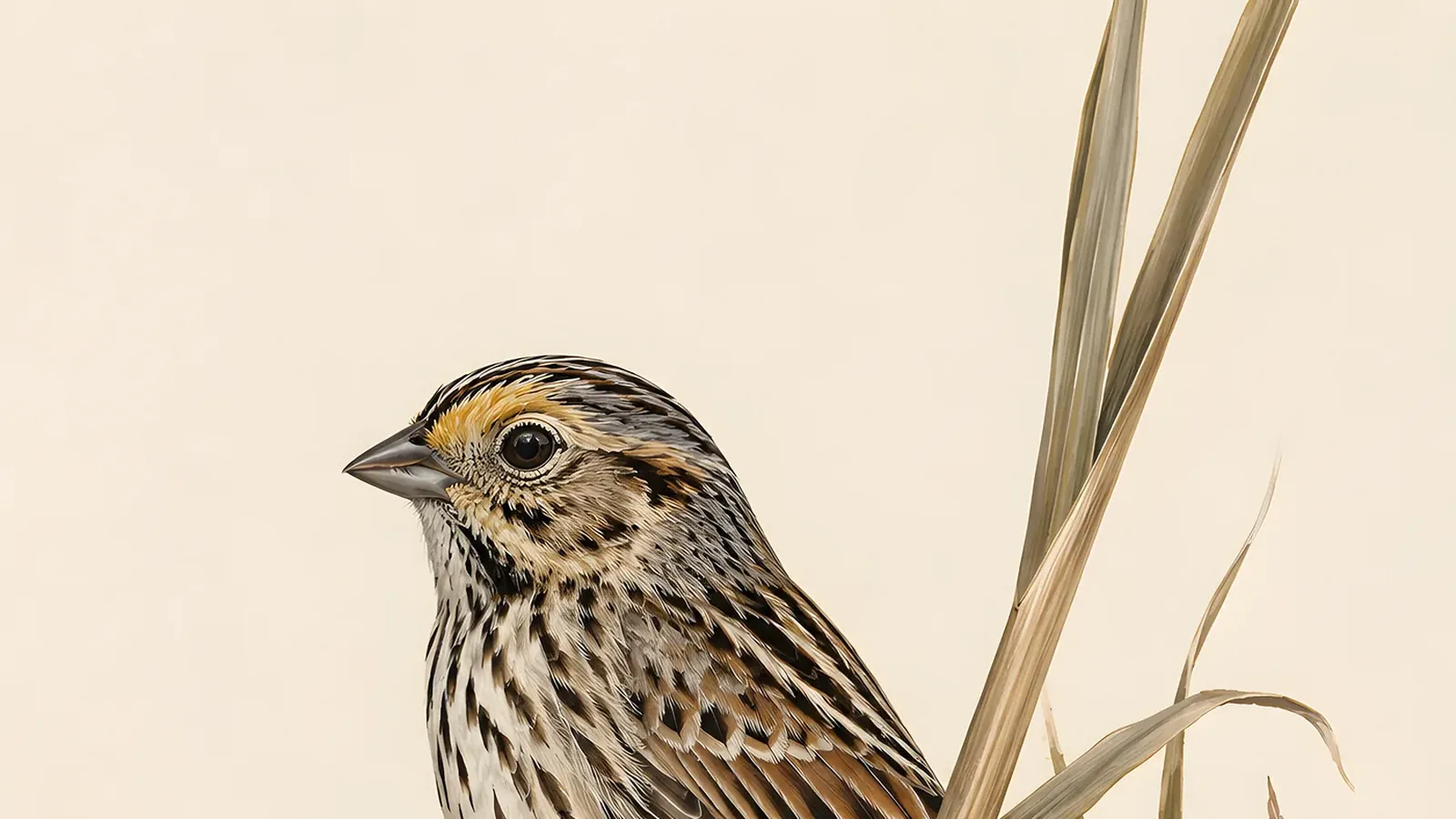
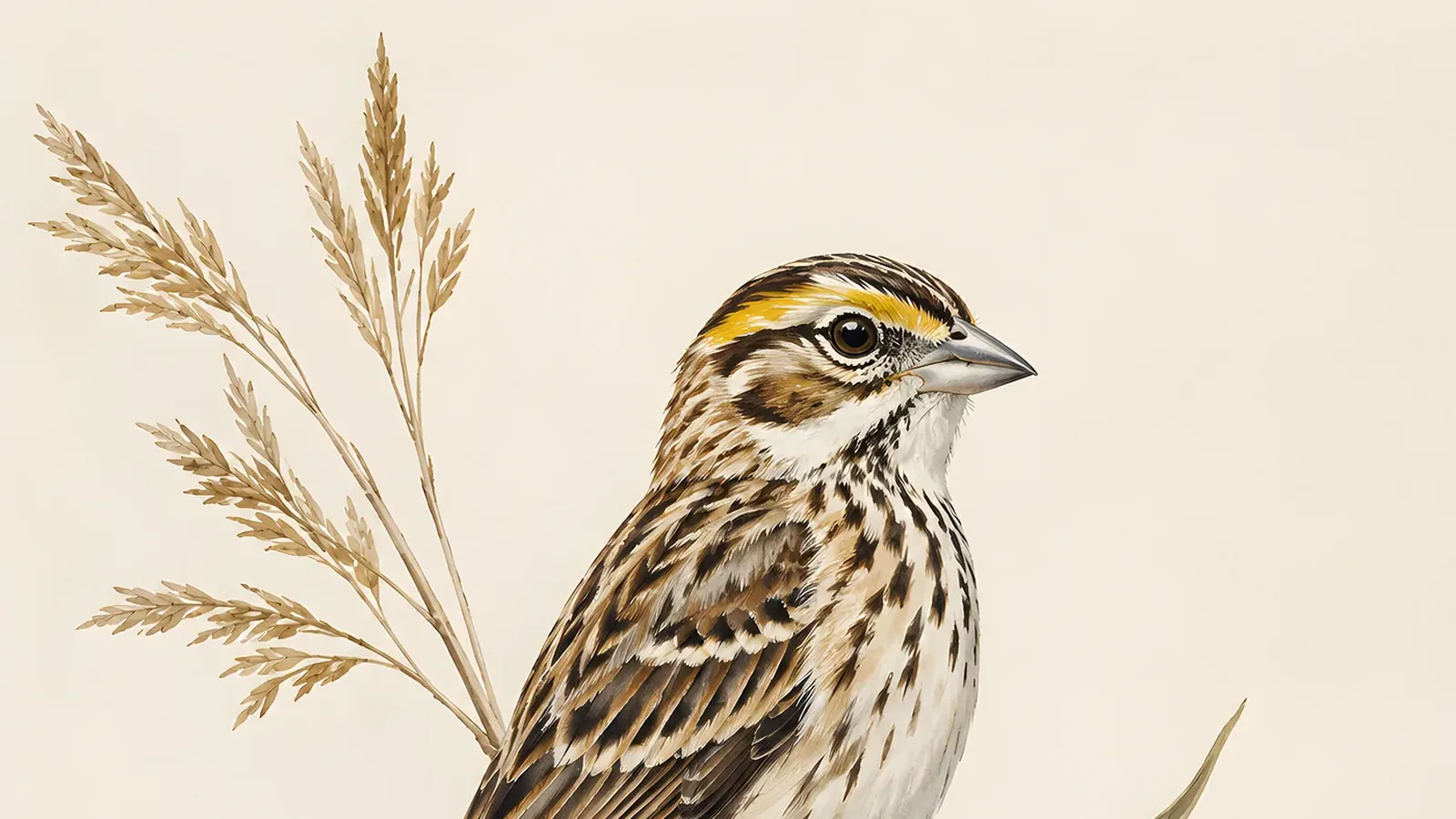
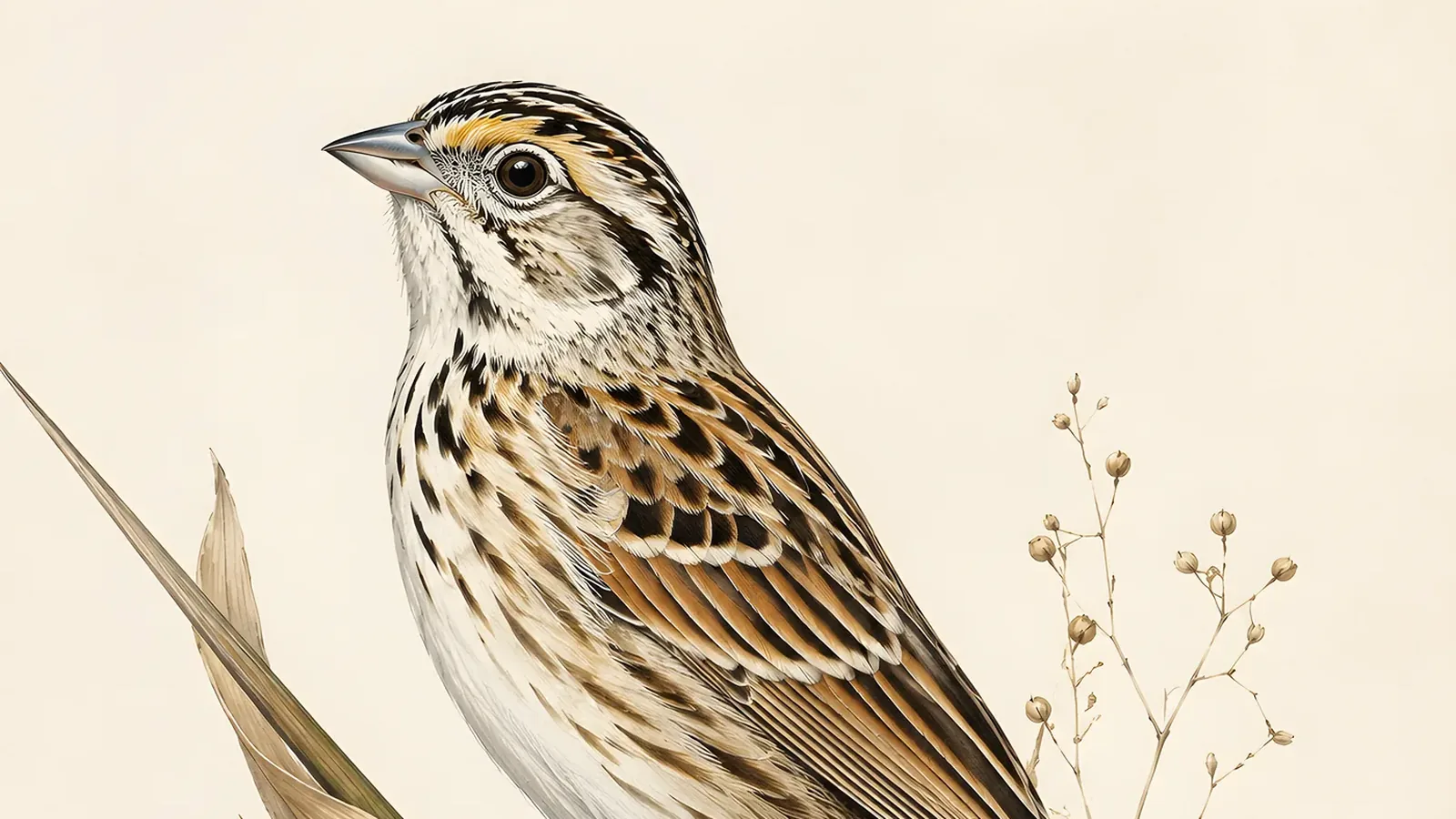
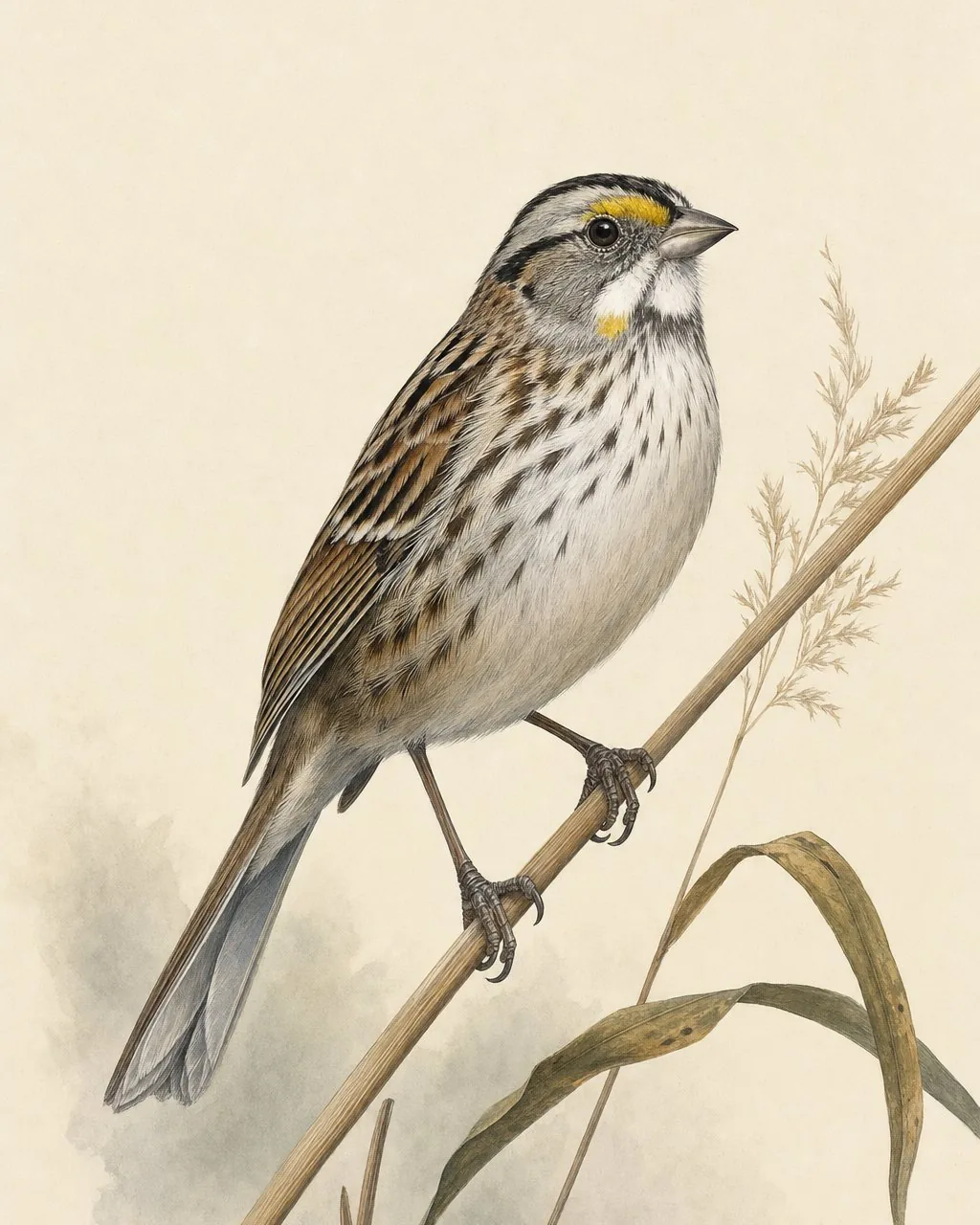
The back and wings are brown, streaked with darker brown in a pattern that dissolves into the shadows of cordgrass stems at any distance over ten metres. The underparts are pale with heavy, blurry streaking on the breast and flanks - not the clean, sharp breast streaks of a Song Sparrow, but broader smudges that echo the stems it hides among.
The face is where identification starts. A yellow supraloral spot sits between the bill base and the eye, vivid enough to catch light even in poor conditions. The malar stripe is dark and well-defined, bordering a pale grey cheek. The bill is heavier than most sparrows, slightly decurved at the tip, shaped for probing mud.
Overall colour impression at distance is a medium-brown bird with a dark-streaked chest and one flash of yellow. No wing bars. No strong cap pattern. On the Atlantic coast the race maritima is the grey-brown bird most birders encounter. Gulf Coast birds tend toward darker, more heavily streaked plumage. The extinct Cape Sable subspecies from Florida, now lost to us, was paler.
In the hand, the feet are notably large and strong. This is a bird that walks on tidal mud and grips wet grass stems in wind.
| Feature | Measurement |
|---|---|
| Length | 13 - 16 cm |
| Weight | 19 - 30 g |
| Wingspan | 17 - 19 cm |
| Lifespan (wild) | 3 - 8 years |
| Clutch size | 3 - 5 eggs |
| Incubation period | 11 - 13 days |
Voice
The song is unlike anything else in the marsh. A short, dry, buzzy phrase with a quality sometimes compared to an insect - tup-tup zeeeeeeee - the zee a long, descending, electric hiss. It carries surprisingly far over open tidal flats, and the male sings from exposed stem tops in a way that seems to contradict his otherwise secretive nature. He climbs to the highest point available, delivers the song, and drops back into cover before you have finished lifting the binoculars.
The call note is a sharp, dry chip, almost identical to the saltmarsh sparrow, which shares the same habitat across much of its range. Separating the two by call alone requires practice and patience.
Males in good territories will sing through the heat of the day at peak season. The song rate drops in poor weather, but even on overcast days with an east wind off the water, birds call from within the grass. You hear the marsh before you see what is in it.
Range and habitat
The Seaside Sparrow breeds in saltmarshes along the Atlantic and Gulf coasts of North America, from southern Maine down through Virginia, the Carolinas, Georgia, and Florida, and westward around the Gulf Coast through Alabama, Mississippi, Louisiana, and into southern Texas.
It does not migrate in the way that most sparrows do. Northern birds shift slightly southward for winter, but the movement is modest - a few hundred kilometres at most. The bird’s habitat is not seasonal. Saltmarshes do not freeze solid or disappear in cold months, and the invertebrate food within them remains accessible year-round in most of the species’ range.
The habitat requirement is specific: high-quality stands of cordgrass (Spartina alterniflora in the low marsh, S. patens in the high marsh), undisturbed enough to allow ground nesting, and with adequate tidal flooding to support the invertebrate communities the birds feed on. Altered marshes - those disturbed by dredge spoil, ditched for mosquito control, or degraded by nutrient runoff - support fewer birds or none. The bird has no backup habitat. A degraded marsh is not a sparrow that has moved elsewhere. It is a sparrow that is gone.
Diet
Almost entirely animal matter. Amphipods, snails, beetles, moths, and other invertebrates taken from the mud surface and from within the base of cordgrass stems. The bird is an active hunter on the mud at low tide, probing with that decurved bill into crevices and between root tangles. It will take small crabs and the eggs of other invertebrates when available.
Seeds are eaten sparingly, mainly in late autumn and winter when invertebrate availability drops. Even then, the diet tilts heavily toward whatever small animal prey can be found. This is not a finch adapted to marsh life. It is an insectivore adapted to saltwater.
Breeding
Nesting begins in May and runs through July, with two broods common in productive marshes. The female constructs the nest herself, a deep cup of marsh grass built on or just above the ground, often fastened into living cordgrass stems to survive tidal surge. The entrance faces away from prevailing wind. Construction takes four to six days.
The female lays three to five eggs, pale greenish-white with reddish-brown spots concentrated at the larger end. Incubation runs eleven to thirteen days. Nestlings are brooded by the female alone in most accounts, though both adults bring food. The young leave the nest at nine to ten days, still unable to fly, and follow their parents through the grass for another week before becoming independent.
Males defend territories with singing rather than chasing. The territories on productive marsh are small - sometimes under a hectare - and males in dense habitat stack up at close spacing, their buzzy songs overlapping across the flat expanse of cordgrass. In some population studies, nest density exceeds one pair per two hectares in optimal areas.
The extinction story
Here is the thing about Ammospiza maritima that the field guide numbers do not convey: it has already lost one piece of itself entirely, and several more are on the edge.
The Dusky Seaside Sparrow, Ammospiza maritima nigrescens, was a subspecies restricted to Merritt Island and the St. Johns River marshes of east-central Florida. It was dark - heavily streaked black on a whitish background, more boldly marked than any other race. The bird was discovered by Charles Johnson Maynard in 1872.
By 1980, six individuals remained. All male. The last surviving female had died years earlier, and no captive breeding program could reach the subspecies in time. The six males were transferred to a facility at Walt Disney World in Orlando, in the hope that cross-breeding with the closely related Scott’s Seaside Sparrow might preserve some genetic material through hybrid offspring. The hybrids were produced. They were not the bird. Researchers called them “five-eighths Dusky,” a phrase that captures the entire tragedy in the arithmetic.
The last pure Dusky Seaside Sparrow was a male named Orange Band. He died on June 17, 1987, at Walt Disney World. He was old, by sparrow standards. He had been banded as an adult years earlier in the wild, which meant he had lived long enough to watch his entire kind disappear around him.
What killed the subspecies was flooding. The marshes of Brevard County were flooded by the U.S. Army Corps of Engineers and Brevard Mosquito Control beginning in the late 1950s and through the 1960s, an attempt to control mosquito populations around the growing space industry installations at Cape Canaveral. The impoundments converted tidal cordgrass marsh to open water and freshwater pools. The birds had nowhere to go. By 1969 the population had crashed to fewer than 100 individuals. No meaningful protection arrived before the collapse was complete.
The extinction is the clearest case study available of what happens when a saltmarsh specialist loses its habitat without warning and without alternatives. The lesson has not been adequately applied to the other subspecies that remain.
The Cape Sable Seaside Sparrow, Ammospiza maritima mirabilis, found only in the freshwater and brackish marl prairies of southwestern Florida, is considered one of the most endangered birds in the United States. Its entire population occupies a range of fewer than 150,000 hectares. Hydrological management of Everglades water flow directly controls whether it breeds successfully in any given year. It has no other home.
Several Atlantic Coast populations are also considered vulnerable to sea-level rise. Saltmarsh habitat is already contracting along the northeastern coast as tidal flooding increases. The birds that breed in low marsh, nearest the water, are losing nesting habitat first.
A marker bird
The Seaside Sparrow does not travel. It does not adapt. It does not come back once the marsh is gone. That is not a character flaw. It is the consequence of perfect specialisation over deep evolutionary time. The bird became exactly what a saltmarsh required of it, and the saltmarsh became, in turn, the only place the bird could exist.
Watch it walk the mud at low tide, probing with that heavy bill, indifferent to your presence because the marsh grass conceals it and always has. The populations doing that today in the tidal cordgrass from Maine to Texas are the descendants of birds that have occupied these same sedge-edged estuaries for tens of thousands of years. Orange Band was the last of his line. The others still have time. Whether they keep it depends on what we decide to do with the marsh.