Field Guide
Bullfinch
Tudor England put a price on the Bullfinch. Henry VIII’s Vermin Act of 1532 - extended and sharpened through the 16th century - offered a penny per head for bullfinches killed in orchard parishes. The birds ate fruit buds at a scale that alarmed growers, and the Crown treated them as a managed pest. The bounties ran for generations. The bullfinch survived them all.
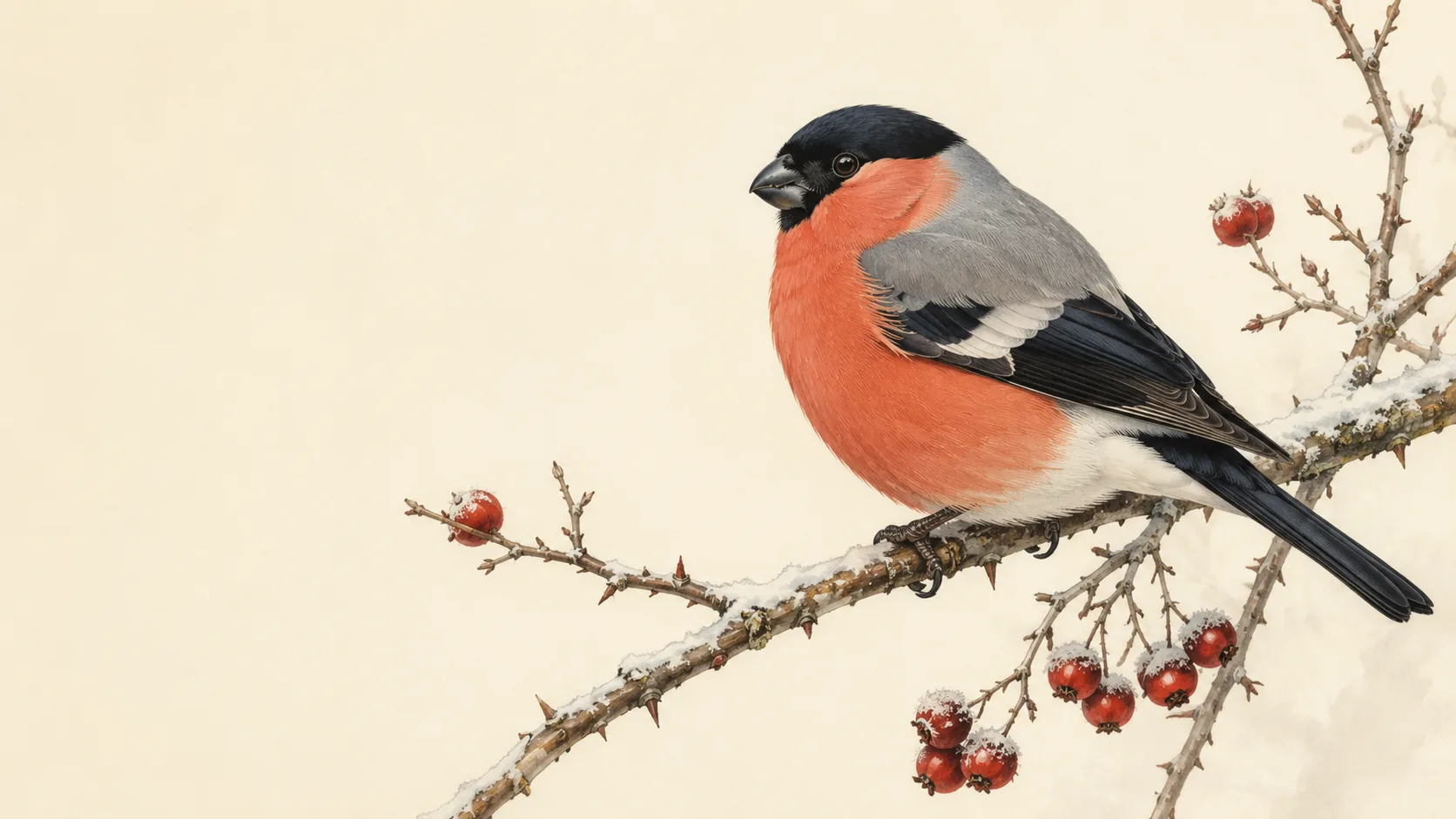
Pyrrhula pyrrhula is still here, in the hedgerows and woodland edges of Britain and Ireland, still eating buds in spring with the same unhurried precision that made him an agricultural enemy five centuries ago. He is the most private of the common garden finches, the one you hear rather than see, and the one that rewards a patient watcher with something genuinely unexpected: a male whose chest is the colour of a coal fire banked low, carrying the warmth without the flame.
Identification
The male is not easy to misread. He carries a jet-black cap that wraps tight to the base of his stubby bill, a pale grey mantle, and wings that stripe cleanly in black and white. In flight the white rump flares like a signal, readable from thirty metres. His breast is a deep, saturated rose-red - not the scarlet of a Northern Cardinal, not the washed-pink of a House Finch, but something warmer and more contained. He is 14 to 16 centimetres long and weighs 21 to 27 grams: compact, bull-necked for a finch, which is where the name originates.
The female wears the same structural pattern - black cap, white rump, barred wings - but where he is rose-red she is a warm greyish-brown across the breast and flanks. The similarity of pattern between the sexes is one of the species’ diagnostic features: the plumage logic is identical, only the palette changes.
Juveniles lack the black cap through their first summer, which can cause brief confusion, but the white rump is already present and the bill shape is distinctive at any age: short, deep, almost domed, built for leverage rather than probing.
Voice and call
The call is a two-note whistle, soft and descending - a sound the Wildlife Trusts describes as melancholy, and the comparison holds. It carries well through dense hedge but does not project across open ground the way a chaffinch or greenfinch does. The BTO’s BirdFacts records the call as “a soft single whistle,” understating its character slightly. In practice it runs as a quiet “pew… pew,” the second note marginally lower, with a pause between that gives it something of a question mark.
The song is rarely heard and rarely written about. It is quiet, rambling, and close-range - a private communication, not a territorial broadcast. The species is one of the few songbirds in which captive birds were historically taught to sing specific human melodies by German organ-pipe mimics, a practice documented as early as the 17th century. The birds were called “piping bullfinches” and fetched significant prices. Whatever the bullfinch lacks in volume, he compensates in pitch accuracy and retentiveness.
Range and habitat across the year
The BTO’s population estimate stands at 265,000 territories in the UK (2016 data), and the species is broadly distributed across Britain and Ireland, absent mainly from the open uplands, the far north of Scotland, and exposed coastal strips. Beyond Britain, the species’ range runs from the Atlantic fringe of Europe east across Siberia to the Sea of Okhotsk and south through the Caucasus, with subspecies reaching Japan. For practical purposes in the UK, the bullfinch is a sedentary bird: the BTO characterises movement within Britain and Ireland as “relatively sedentary,” with no significant seasonal migration.
Habitat preference runs to woodland edge, scrub, and thick hedgerow rather than open canopy. The bird is most often found where dense cover meets some kind of structural variety - an orchard boundary, a hedged lane, the margin where a managed wood meets a field. In winter, small family groups and pairs move quietly through garden shrubbery and orchards. The RSPB lists woodland, orchards, and hedgerows as the primary habitat, and that triangle captures the bird’s year well. It is not a feeder-station regular in the way that the goldfinch or blue tit is, though it will visit garden fruit trees in late winter when orchard pickings thin out.
Diet
The bud-eating that earned the Tudor bounty remains the defining dietary behaviour of the species in spring. Bullfinches take the buds of fruit trees - cherry, plum, pear, apple, and gooseberry among them - with a selectivity that gardeners find infuriating and ornithologists find interesting: the birds preferentially take flower buds over leaf buds, and they show consistent site fidelity, returning to the same tree on successive mornings until the crop is stripped. In summer they shift to weed seeds, insects, and berries. In autumn and winter, berries carry the bulk of the diet: bramble, elder, and ash keys are all recorded. The bill’s compact dome is well adapted to crushing seeds, but it works equally well peeling buds with the curved cutting edge.
The historical classification as an orchard pest is not unfounded - a pair working a young fruit tree through February can remove most of the flower buds before bloom - but the bounty culture that produced mass killing reflected agricultural economics rather than ecological harm. The bullfinch does not expand its range when orchards are dense. It does not colonise new territories in response to food abundance in the way that an irruptive species does. It occupies what it occupies and eats what is there.
Breeding and nesting
Breeding begins in May, later than most finches. The nest is built low in dense shrub - hawthorn and blackthorn are the preferred sites - from a foundation of fine twigs and rootlets overlaid with moss, hair, and plant fibres. The structure is shallow, loosely built, and well-concealed. Clutch size runs to four or five eggs, incubated by the female for 14 to 16 days. Both parents feed the chicks, which fledge in 15 to 17 days. Two broods per season is the norm, with occasional thirds. The BTO’s average first clutch date for British birds is 17 May.
Pair bonds appear stable across seasons: bullfinches are commonly cited as monogamous and are frequently seen in pairs throughout the year, moving together through winter habitat in a way that suggests the pair remains cohesive long after breeding ends. This year-round pairing sets the species apart from the looser aggregations formed by the goldfinch or siskin in winter.
The 51 per cent question
The bullfinch is Amber-listed in the UK, downgraded from Red in 2009 after some stabilisation in population counts. The BTO’s long-run data shows a 51 per cent decline from 1967 to 2023 - more than half the post-war breeding population gone in a human lifetime. The causes remain imprecisely understood. Agricultural intensification and the reduction in mixed woodland structure are the primary suspects, but the BTO’s own summary notes the reasons are unclear. There is no single decisive culprit in the way that pesticide impacts on the grey partridge were eventually quantified.
What is known is the scale of what was lost. The bird that the Tudor state treated as a serious enough agricultural threat to put under formal statutory management is now a Priority Species under the UK Post-2010 Biodiversity Framework - meaning its conservation requires specific action, not passive goodwill. The penny-a-head bounty and the Priority Species listing occupy the same century-long arc as the bird has moved from pest to protected.
That arc is worth keeping in mind the next time the double-note call comes out of a hedgerow and you cannot find the bird in the twigs. He is still there, still eating buds, still outlasting whatever official position is taken on his presence.
The Bullfinch has survived Tudor bounties, orchard clearances, and half a century of agricultural change. He is still the most private bird at the woodland edge - heard first, found second, and worth the wait.