Field Guide
Burrowing Owl
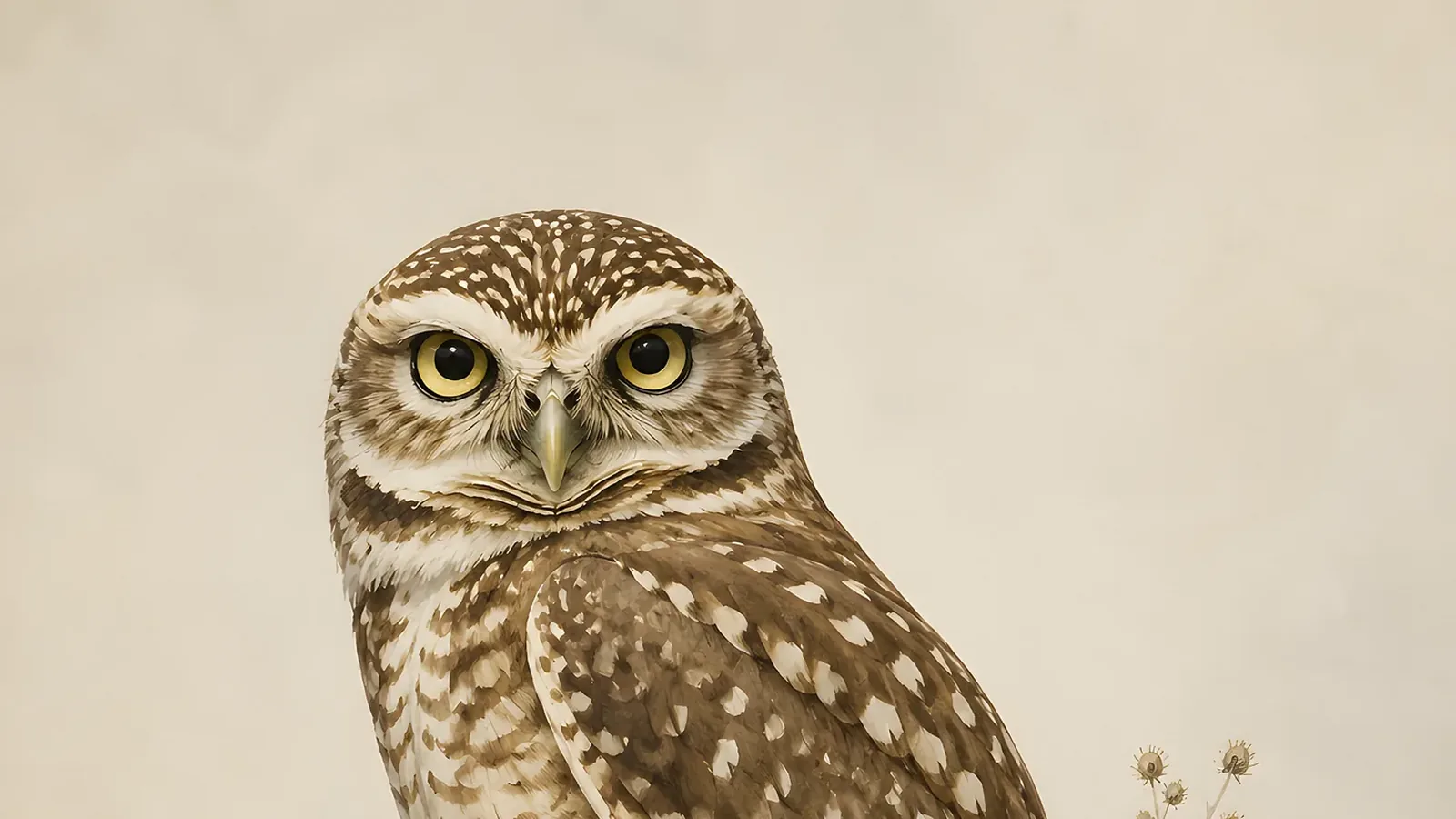
High noon on the shortgrass prairie of eastern Colorado. No shade anywhere. A small owl stands bolt upright at the lip of a hole in the ground, yellow eyes wide, nodding its round head at a passing truck in that reflex bob that made frontier cowboys call it the “howdy bird.” It is 23 centimetres tall. Its legs are strikingly long for an owl - improbably long, almost wading-bird long. Around the burrow entrance, someone has scattered fragments of dried dung.
This is Athene cunicularia, the Burrowing Owl, and the dung is not refuse. It is gear.
The owl has placed it deliberately. Douglas Levey, R. Scott Duncan, and Carrie Levins reported in Nature (431: 39, 2004) that burrows supplied with cattle dung attracted dung beetles at ten times the rate of bare burrows - and owls at baited sites ate six times more beetle species. The researchers removed all dung, randomly restocked half the burrows, and reversed the treatment as a check. The result held each time. The Burrowing Owl carries dung to its doorstep, waits, and harvests what arrives - a bait-and-wait strategy that Levey and colleagues classed as tool use.
That fact is the thesis of this bird. The Burrowing Owl went underground, adopted a diurnal schedule that most of its family abandoned, and invented fishing with bait. It is stranger than it looks standing there, nodding at traffic.
What it looks like
The Burrowing Owl is small and compact: 19 to 25 centimetres long, 120 to 185 grams, with a wingspan of 51 to 61 centimetres. No ear tufts. The head is round and flat-topped, the facial disc reduced compared to forest owls that rely heavily on acoustic hunting. What the bird does have, unmistakably, are legs - long, sparsely feathered legs designed for running on open ground rather than perching in canopy.
| Measurement | Range |
|---|---|
| Length | 19 - 25 cm |
| Weight | 120 - 185 g |
| Wingspan | 51 - 61 cm |
| Longevity (wild) | up to 9 years 11 months |
The plumage is brown above, spotted and barred with white and tan. The underparts are white with brown barring across the chest and flanks. A white throat patch stands out clearly against the brown face. The eyes are bright yellow, and the bill is pale grey-green. In flight, the wings appear long and somewhat pointed - the silhouette of a bird built for low, rapid travel over open ground rather than the deep wingbeats of larger owls.
Juveniles lack the barring on the underside - their bellies are plain buff. This is the quickest way to distinguish young-of-year birds in summer.
The owl underground
Burrowing Owls do not excavate burrows in most of their range. They inherit them. In the western states and Great Plains, the typical nest and roost site is an abandoned black-tailed prairie dog burrow - a tunnel 60 to 90 centimetres below the surface, angled to keep rain out, with a nest chamber at the end. Ground squirrel burrows serve the same purpose across the Pacific states and interior Southwest. In the unique case of Florida, where prairie dog and ground squirrel colonies do not occur, the Florida subspecies (A. c. floridana) is one of the few populations in the range that regularly digs its own burrows, sometimes beside gopher tortoise colonies whose excavations shape the surrounding soil.
The association with prairie dogs goes far beyond opportunistic house-hunting. The Audubon field guide notes that Burrowing Owl populations track prairie dog town density closely. Black-tailed prairie dog colonies have contracted by an estimated 98 per cent since 1900 through poisoning campaigns, disease, and habitat conversion - and Burrowing Owl numbers across the Great Plains have followed. Partners in Flight data recorded a 33 per cent decline in the breeding population between 1965 and 2016.
Once established, the owl lines the burrow entrance with grass, feathers, and the dung that serves as beetle bait. The nest chamber holds four to eight white eggs. The female incubates for 28 to 30 days while the male hunts and stands guard above. Young owls appear at the entrance at around three weeks and move fully to the surface at four weeks.
The burrow’s interior serves one more defensive function. When a predator investigates, a nestling alone in the dark produces a sustained, churring hiss. Rowe, Coss, and Owings (1986), writing in Ethology (72: 53-71), tested this call against ground squirrels from two populations - one with a long evolutionary history of encountering rattlesnakes, one without. Squirrels from rattlesnake country responded to the owl hiss with nearly the same alertness they showed to a recorded rattlesnake rattle. The authors described the behaviour as acoustic Batesian mimicry: the young owl, unable to flee, borrows a sound that the predator already fears. The observation that nestling burrowing owls hiss like rattlesnakes dates to at least 1881, when it was reported in the British journal Nature by a naturalist who noted the similarity was striking enough to cause alarm.
The dung and the beetles
Most documented tool use in birds involves extracting food from a fixed location - a crow probing with a stick, a vulture dropping a stone onto an egg. Dung-scattering is categorically different: the owl places material in the environment ahead of time, changes the distribution of prey around it, then waits. It is closer to what a fisherman does than what a woodpecker does.
Dung beetles locate dung by smell and arrive in numbers. They are slow-moving enough to be easy prey for a bird that stands on the ground and watches. The effect in Levey’s experiment was not marginal. Ten times more beetles at baited burrows. Six times more species. Over a breeding season, with young to feed, that difference matters enormously. The behaviour has been recorded across multiple states and in Florida, making it characteristic of the species rather than a local tradition.
What it sounds like
The primary territorial call of the male is a soft two-note coo - coo-coooo - lower and more mellow than a dove’s, repeated persistently at dawn and dusk. The Audubon field guide describes the full repertoire as “liquid cackling,” with chattering alarm notes and chirping contact calls. Juveniles add the rattlesnake hiss from underground.
Unlike most owls, Burrowing Owls are active in daylight throughout the year. This makes them among the most observable owls in North America - a bird you can find in full sun, standing at the burrow mouth, watching you watch it.
Range and habitat
The Burrowing Owl breeds from southern British Columbia and Manitoba south through the Great Plains, intermountain West, and Southwest, through Florida, Central America, and across South America to Tierra del Fuego. Northern populations migrate south in autumn. Florida and southwestern populations are largely resident.
The habitat requirement is simple: open, flat terrain with sparse vegetation, exposed soil, and an existing colony of burrowing mammals. Shortgrass prairie, sagebrush flats, desert grassland, and airport verges all qualify. The bird does not use forest or dense shrub cover.
Breeding
Nesting begins in late March to April. The male courts by hovering above the burrow and performing high-arcing display flights. Pairs bond for the season and often for multiple years. Clutch size is large by owl standards - typically six to nine eggs, occasionally up to 12, reflecting the high insect productivity of open grassland in summer.
After fledging at around six weeks, the young disperse widely - banding data shows Great Plains juveniles may move hundreds of kilometres. This dispersal once linked prairie dog towns across continuous grassland. As that matrix has fragmented, isolated colonies are less likely to be recolonized after local losses.
The IUCN lists Athene cunicularia as Least Concern globally, a status that reflects the species’ large total range and abundant South American populations. In western North America, the picture is sharper. The Stanford Conservation Program notes the breeding population declined by 33 per cent between 1965 and 2016 based on Breeding Bird Survey data. California and the Dakotas have seen the steepest regional drops. The eastern screech-owl and great horned owl both occupy forested habitats that remain relatively intact. The Burrowing Owl’s problem is that its habitat - open grassland with colonial burrowing mammals - is the one North American ecosystem that has been most systematically reduced.
The Burrowing Owl descended into the earth, took over someone else’s tunnel, adopted the day shift, and learned to fish for beetles with bait. The question is not whether a bird this behaviorally inventive can persist. The question is whether we will leave enough open ground for it to do so.
What the dung-baiting tells us is that this is a bird tightly fitted to its ecosystem - one that evolved alongside dung beetles alongside large grazers alongside the same open prairies. Remove any element of that chain and the trick stops working. The prairie dogs are mostly gone. The trick still works where they remain. That is the argument for keeping them.