Field Guide
Henslow's Sparrow
Stand at the edge of a wet meadow in Ohio in late May at dusk. Bring patience. The cattails are brown, the grass is knee-deep, and somewhere in it something is hiccuping. Not singing - hiccuping. A flat, two-syllable spasm, tsi-lick, rising and falling in a fraction of a second before silence swallows it again. It comes from a grass stem three feet in front of you, and you still cannot see the bird.
Centronyx henslowii - Henslow’s Sparrow - is one of the most present-and-invisible birds on the continent. Not because it is rare, though in many places it is. Not because it is well camouflaged, though it is superbly so. But because it has, by any objective measure, the least impressive song in the North American avifauna, and it lives in grasslands most birders drive past without stopping. Getting to know it requires a deliberate decision to care about a small brown bird that hisses from a wet field and then disappears into the roots.
That decision is worth making.
What it looks like
Adult Henslow’s Sparrows are 11 to 13 cm long and weigh between 10 and 15 grams - roughly the heft of three pennies. The wingspan runs 16 to 20 cm. The build is stocky and compressed, with a notably large, flat-crowned head that gives the bird a slightly brutish look out of proportion to its size.
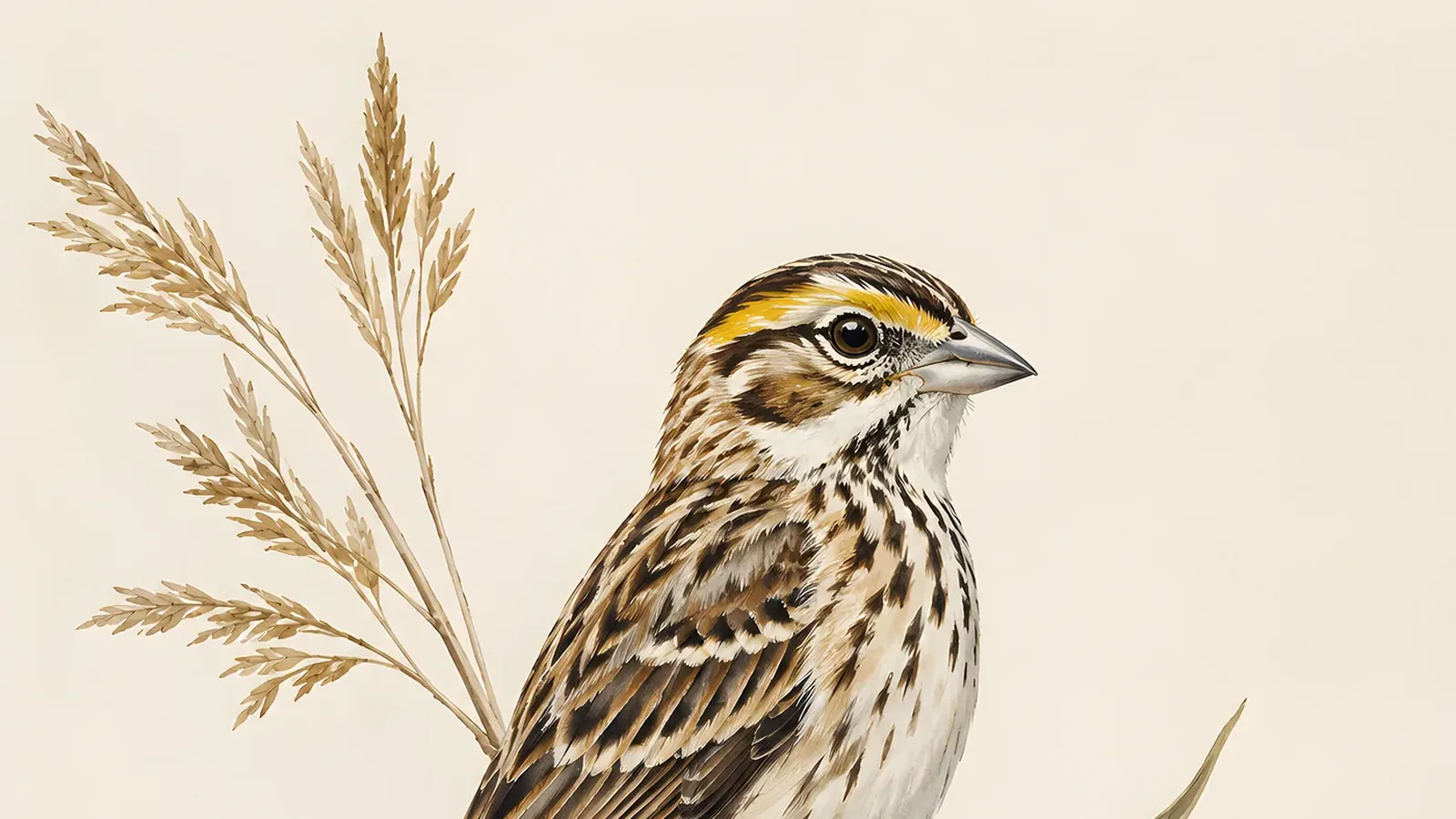
The plumage is a study in camouflage that rewards close inspection. The head is washed in olive-green - a flat, military tone unlike the brighter yellows of most grassland sparrows - with dark lateral crown stripes and a pale central stripe running from bill to nape. The face shows a clear olive tone, paler on the supercilium and darker on the malar stripe. The nape and upper back are a warm chestnut-buff, heavily streaked with black. The wings are distinctly rusty, a warm rust-brown that flashes briefly in flight and is one of the key field marks Victor Emanuel noted when briefing search teams at the Freeport Christmas Bird Count in the 1970s. The chest is white or buff-white with fine dark streaks running down the breast and flanks. The tail is short and slightly forked.
Juveniles are buffer overall with black streaking on head and back. In the hand, the flat olive head with its reddish wings and streaked chest makes the species unmistakable. In the field, the combination of olive head, rust wing, and habitat - low wet grassland with dense litter - narrows identification quickly even before the bird vocalizes.
The worst song in the woods
Roger Tory Peterson, in his field guide, wrote that Henslow’s Sparrow “utters one of the poorest vocal efforts of any bird; throwing back its head, it ejects a hiccoughing tsi-lick.” This is not hyperbole for Peterson. He was specific. The song is brief (under half a second), thin, and buzzy - a compressed insect-like hiss rather than anything approaching melody.
The full song is more complex than the two-note field impression suggests. Ornithologists have described it as four to six groups of frequency-modulated notes ranging from roughly three to ten kHz. The final cluster is the loudest, which is what the ear catches as the characteristic tsi-lick. At very close range, with good hearing, one sometimes catches an introductory note that makes the song sound trisyllabic - closer to f’lee-sic. More often the opening notes are simply lost to wind and distance, and the bird seems to produce a hiccup and nothing more.
What the song lacks in beauty it makes up in persistence. Males sing through the night, delivering the same two-note spasm hundreds of times an hour in breeding season. Peterson noted that the bird “often hiccoughs all night long.” A listener some distance away may be forgiven for assuming the sound is made by an insect. Many do.
This unremarkability is precisely why the species matters to think carefully about. Henslow’s Sparrow is not a shy bird by temperament - males perch openly on grass stems to sing. But the song broadcasts almost nothing: no territory defense in musical terms, no display of fitness, nothing that carries across a field. It is a locator call wearing the name of a song.
Range and habitat
Henslow’s Sparrow breeds across interior eastern North America, with the main concentration in an arc from western New York and Pennsylvania west through Ohio, Indiana, Illinois, Kansas, and Iowa. A smaller population persists in the Carolina Piedmont. The species winters in weedy fields and open pine savanna through the American South, from Texas and Arkansas east through the Gulf Coast to Florida and the Carolinas.
Breeding habitat is specific. The bird requires dense, tall grasslands - vegetation between 30 and 61 cm in height, with deep litter layers and standing dead stems. It strongly avoids woody encroachment. Even scattered shrubs shift habitat quality downward. Wetness helps but is not essential. What matters is structure: depth of grass and litter, openness of canopy, the presence of perching stems. Patch size matters too. Studies suggest populations do poorly in grasslands under roughly 100 hectares, likely because small fragments encourage edge predation and reduce singing-male density below the threshold for female attraction. The bird is, in this sense, a landscape-scale indicator rather than a field-scale one.
Diet
Summer diet is dominated by arthropods. Animal Diversity Web synthesizes available stomach-content data suggesting the diet is approximately 36% crickets and short-horned grasshoppers, 19% beetles, and 18% plant material, with caterpillars, spiders, and snails making up the balance. This insect-heaviness shifts seasonally: in winter, seeds from weedy grasses and sedges become the primary food source, though opportunistic insect-taking continues when conditions allow. Fledglings are fed almost exclusively grasshoppers and caterpillars in the first weeks post-nest.
Foraging is entirely on or near the ground. The bird moves through dense grass and litter with a creeping walk, gleaning prey from stems and the soil surface. It rarely flies to pursue prey and avoids the open sky wherever possible.
Breeding
Nesting begins in May and may extend through two broods into August. The nest is a shallow open cup constructed by the female from dried grasses, placed directly on the ground or just above it - typically tucked against a grass clump or concealed in a shallow depression. The cup is often domed loosely with surrounding stems, offering additional concealment. Clutch size is three to five eggs, incubated by the female alone for 10 to 11 days. Chicks fledge in nine to ten days post-hatch - an unusually short developmental window that reduces nest exposure during the most vulnerable period.
The species is socially monogamous but breeds in loose colonies where population density permits. Males establish small singing territories on or near the ground, perching on grass stems to deliver their tsi-lick at intervals. Colony dynamics mean that adjacent males may sing within earshot of one another without significant conflict. Females choose territories, and evidence suggests that local male density may itself be a habitat-quality signal - good grassland attracts more males, which attracts more females, which concentrates nesting effort in the patches worth holding.
The oldest recorded individual was more than six years old when recaptured and rereleased in Louisiana in 2001, per USGS Bird Banding Laboratory records. Most wild individuals likely survive two to three years.
The minelands
Here is the irony that defines Henslow’s Sparrow conservation in the twenty-first century. The species lost the tallgrass prairies of the Midwest to agriculture across the late nineteenth and twentieth centuries, a habitat collapse that was the primary driver of the population decline that placed it on Near Threatened status until 2018. And yet a meaningful fraction of its current stronghold sits on reclaimed surface coal mines - land that was legally required, post-extraction, to be revegetated to approximate pre-mining cover.
Bajema, DeVault, Scott, and Lima documented this in a 2001 study in The Auk (Vol. 118, No. 2). Surveying 19 reclaimed coal mines in southwestern Indiana across the 1997 and 1998 breeding seasons, they recorded 200 to 300 singing male Henslow’s Sparrows. Extrapolating across the available mine grassland in the region - over 180 square kilometers, with individual sites exceeding 2,000 hectares - they estimated a regional population of several thousand birds on reclaimed ground alone. Densities were comparable to unmined grassland reference sites. The reclaimed mines were not consolation habitat. They were functioning habitat.
The reclaimed grasslands of Ohio and neighboring Indiana now hold some of the densest concentrations of the species in the Midwest. Conservation Reserve Program enrollment in Illinois and across the breeding range has also been positively correlated with local population trends: when farm fields are idled and allowed to revert to tall-grass cover under CRP contracts, singing males appear within one to two breeding seasons. The american goldfinch and other grassland-adjacent species benefit from CRP enrollment too, but for Henslow’s Sparrow the program may be the single most consequential conservation instrument in current use.
The IUCN downlisted the species from Near Threatened to Least Concern in 2018, citing CRP enrollment and population stabilization. The listing change is cautiously good news. It is not a declaration of recovery. Seven U.S. states still list the species as Endangered. Canada’s Committee on the Status of Endangered Wildlife lists it as Endangered nationally. The breeding range has contracted significantly from its historical extent, and the species remains absent from much of the agricultural Midwest where it once occurred in strength. Stable is not the same as recovered.
| Measurement | Range |
|---|---|
| Length | 11 - 13 cm |
| Weight | 10 - 15 g |
| Wingspan | 16 - 20 cm |
| Maximum recorded age | 6+ years (USGS BBL, 2001) |
| Clutch size | 3 - 5 eggs |
| Incubation | 10 - 11 days |
| Fledging | 9 - 10 days |
| IUCN status | LC (downlisted from NT, 2018) |
“Throws back its head and ejects a hiccoughing tsi-lick” - Roger Tory Peterson, describing what he considered the poorest vocal effort of any North American bird.
What Roger Tory Peterson was really recording, when he named that song the worst on the continent, was a bird stripped to essentials. Centronyx henslowii does not advertise itself. It does not perform. It holds its ground in a wet meadow at dusk, delivers its two-note dispatch, and waits. The prairies it evolved for are mostly gone. It is finding its way through what remains: restored mine land, idled farm fields, the narrow margins that good policy and accident have left it. The song has not improved. The bird is still here.