Field Guide
Bullock's Oriole
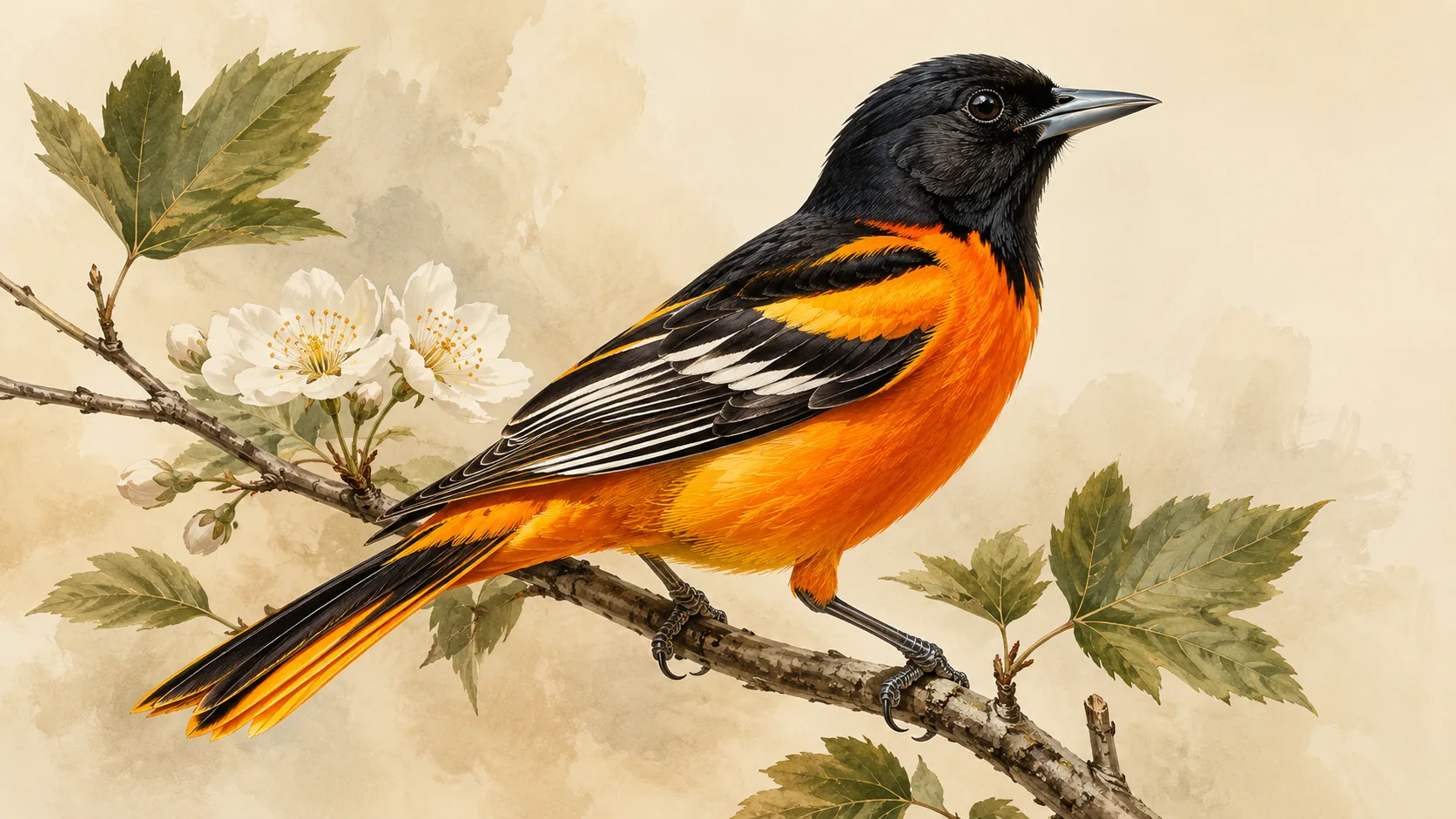
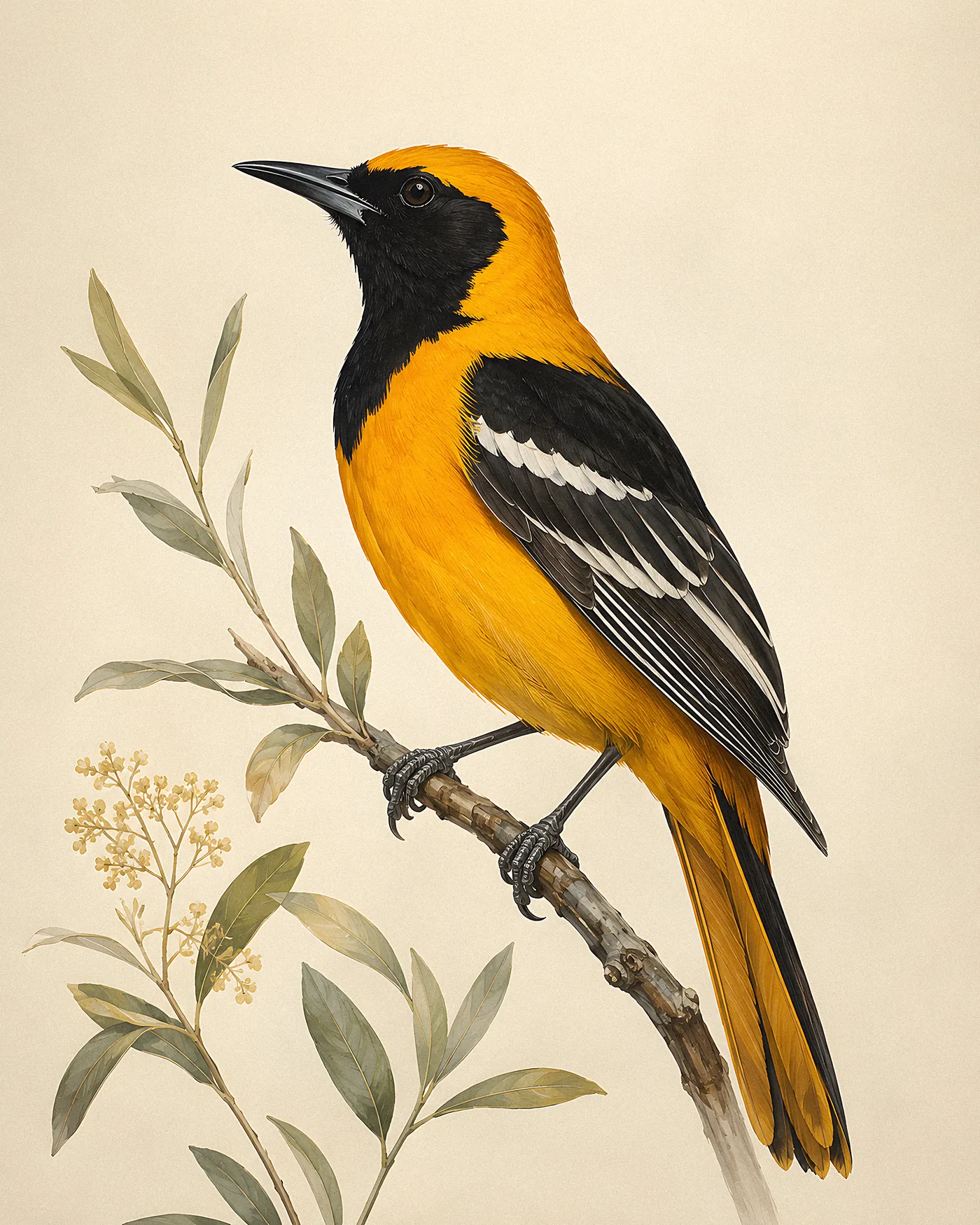
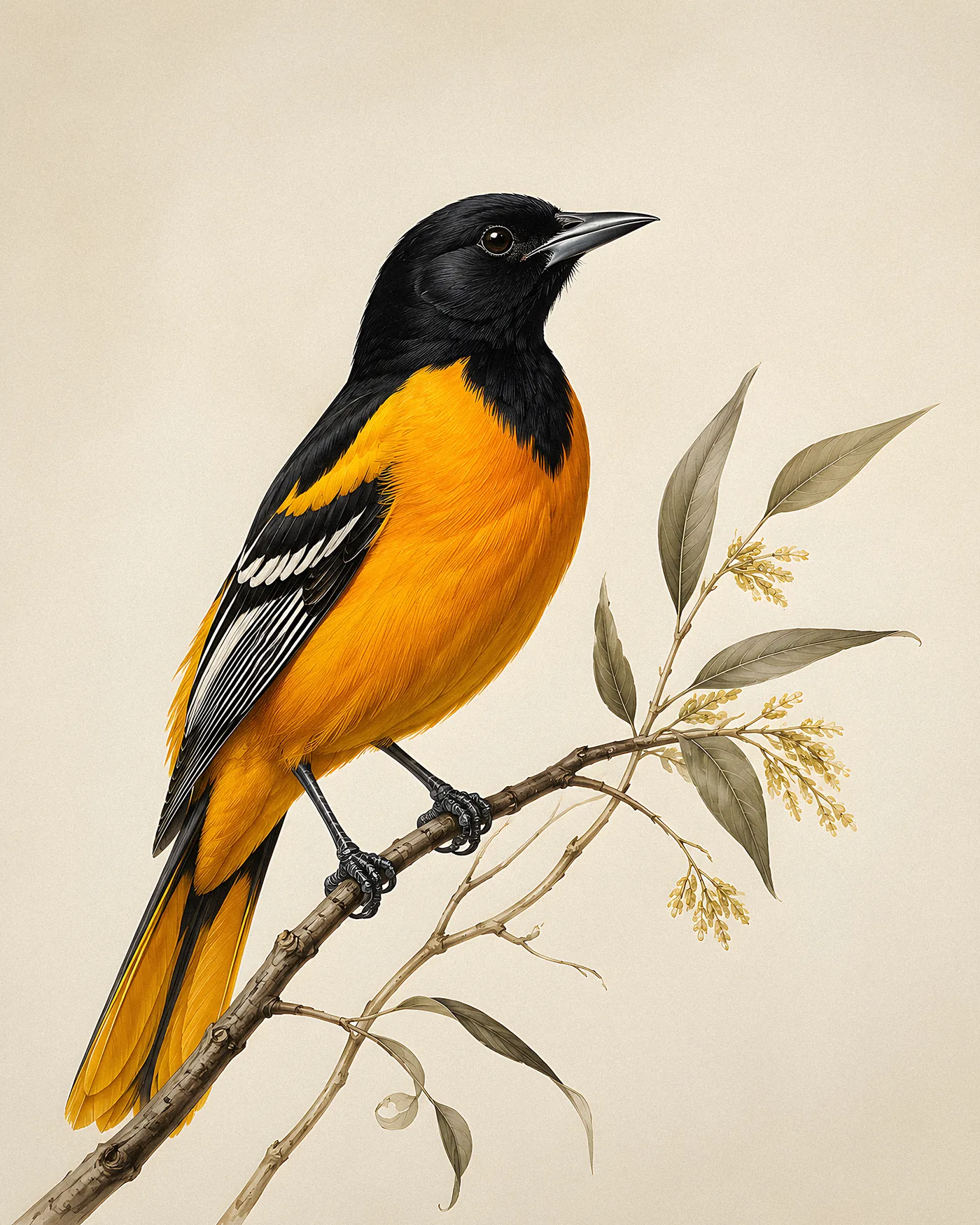
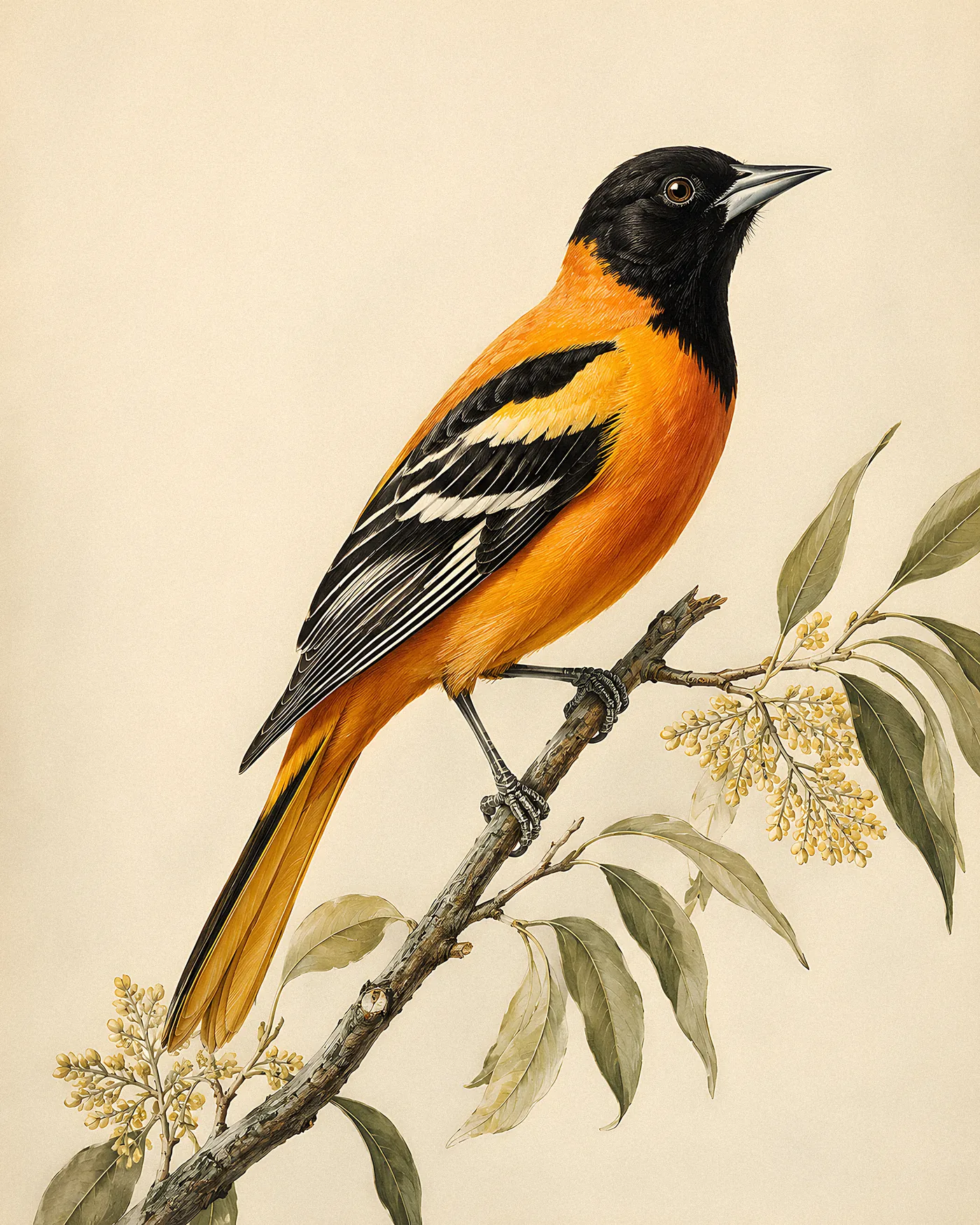
A male Bullock’s Oriole drops into a cottonwood along a creek in the Colorado foothills in early May, and for a moment he looks like a Baltimore Oriole that has been redrawn from memory. The orange is there, the black is there, but the arrangement is wrong. The face is open orange, not hooded in black. A neat black line runs back through the eye like a pencil stroke. And the wing carries a large white panel, not a thin bar. This is the oriole of the American West, and for most of the twentieth century science could not decide whether it was its own bird at all.
The Bullock’s Oriole is the Baltimore’s western counterpart, and the story of how the two were split, lumped, and split again is one of the better arguments in North American ornithology.
What he looks like
The breeding male is bright flame-orange below and on the face, with a black crown, a black throat patch, and a sharp black line through the eye that the Baltimore lacks entirely. His back is black, his tail orange with a black centre, and the defining mark is the wing: a large white patch across the coverts rather than the Baltimore’s single slim wing bar. Seen from across a field, that block of white is the quickest way to name him.
The female and immature are a different bird, and the source of much squinting. She is grey-backed and washed with yellow-orange on the head, throat and breast, fading to pale grey-white on the belly, with two thin white wing bars. She is plainer than a female Baltimore, greyer below, and the contrast between her yellowish front and grey rear is itself a field mark. First-autumn males resemble her, slowly acquiring the black throat and bold wing patch over their first year.
What he sounds like
The song is shorter and more abrupt than the rich whistling of the Baltimore, a hurried mix of harsh and musical notes, often written as a rattling kip, kit-tick, kit-tick, whew, wheet. It lacks the smooth flute quality of its eastern cousin. Both sexes sing. Cornell Lab notes that while the male has the sweeter voice, the female is often the more persistent singer, defending the territory and the nest with a longer repertoire than her mate.
The common call is a dry chatter, used in alarm and in contact between a pair, and both adults will rattle and dive at a squirrel or jay that ventures too near the hanging nest.
Range and habitat
Icterus bullockii is a bird of the open West. It breeds from the eastern foothills of the Cascades east across the Great Plains to the Dakotas, Kansas and north-central Texas, north to British Columbia and south into Sonora and Durango in Mexico. It favours open deciduous woodland, riparian corridors of cottonwood and willow, oak savannah, orchards and well treed towns, the same edge-and-water habitat its eastern relative prefers, transplanted to a drier country.
It is a long-distance migrant. By midsummer the birds are already drifting south, wintering through Mexico and into northern Central America, from Sinaloa to Oaxaca. They return to the western breeding grounds in spring. Where the Great Plains bring the two species together, Bullock’s and Baltimore Orioles interbreed freely. That overlap is exactly what once persuaded ornithologists to merge them into a single species called the Northern Oriole.
Diet
Summer is built on insects and other arthropods. The Bullock’s takes caterpillars, grasshoppers, crickets, beetles, ants, true bugs, scale insects, leafhoppers and small spiders, gleaning them from leaves, branches and trunks, plucking them from spiderwebs, and snatching them from the air. As the season turns it shifts toward fruit and nectar, taking blackberries, raspberries, cherries and figs, and probing flowers for nectar with its pointed bill.
At feeders within its range it behaves like the rest of the family, drawn to orange halves, grape jelly and sugar water. It forages actively and acrobatically, hanging upside down at the tips of branches to reach the fruit and insects the heavier birds cannot.
Breeding and nesting
The nest is a deep, woven, pendant basket hung from a branch, shorter than the Altamira’s extravagant sleeve but built on the same principle. Unlike the Baltimore, where the female works essentially alone, in the Bullock’s both members of a pair cooperate on construction, though the female still does much of the weaving. They use bark strips, fine grass and plant fibre, often binding in animal hair, and line the cup with down, hair and moss. Cornell Lab gives nest depth at a little under four inches on average.
The clutch is three to six eggs. Both parents feed the young. Cornell records the oldest known wild Bullock’s Oriole as a male of at least eight years and eleven months, recaptured during banding in Colorado.
Lump them, split them, lump them again: the Bullock’s Oriole spent decades as half of a bird that did not exist, until moult and DNA gave it back its own name.
The bird that earned its name twice
The Bullock’s Oriole is worth knowing as more than the western echo of the Baltimore. For a stretch of the twentieth century the two were officially one species, the Northern Oriole, on the strength of the hybrids they produce on the Great Plains. Then breeding biology, the timing of their moult, and finally DNA showed that the hybrid zone is narrow and the two birds remain stubbornly distinct. Cornell Lab reports that a recent genomic study confirmed they will keep their separate identities. They meet, they sometimes mate, and they stay two birds.
For the western birder, that history sits behind every sighting. The open orange face, the black eye-line, the white wing panel: each one is the mark of a species that had to be recognised, mistaken, and recognised again. The IUCN lists it as Least Concern, with broadly stable populations across a wide western range.