Field Guide
Saltmarsh Sparrow
The nest sits eight centimetres above the mud - barely a hand’s width above the high-tide mark. Four eggs, pale green with reddish-brown spots, rest in a cup of woven cordgrass. The female built it within three days of the last spring tide, which tells you everything about how Ammospiza caudacuta - the Saltmarsh Sparrow - has organised its entire existence around the moon.
The tide will return. In roughly 25 days the marsh platform will flood again. The female has that long - no more - to hatch and fledge her young before the next lunar cycle drowns whatever remains in the cup. She will do this alone. No male will help her.
What it looks like
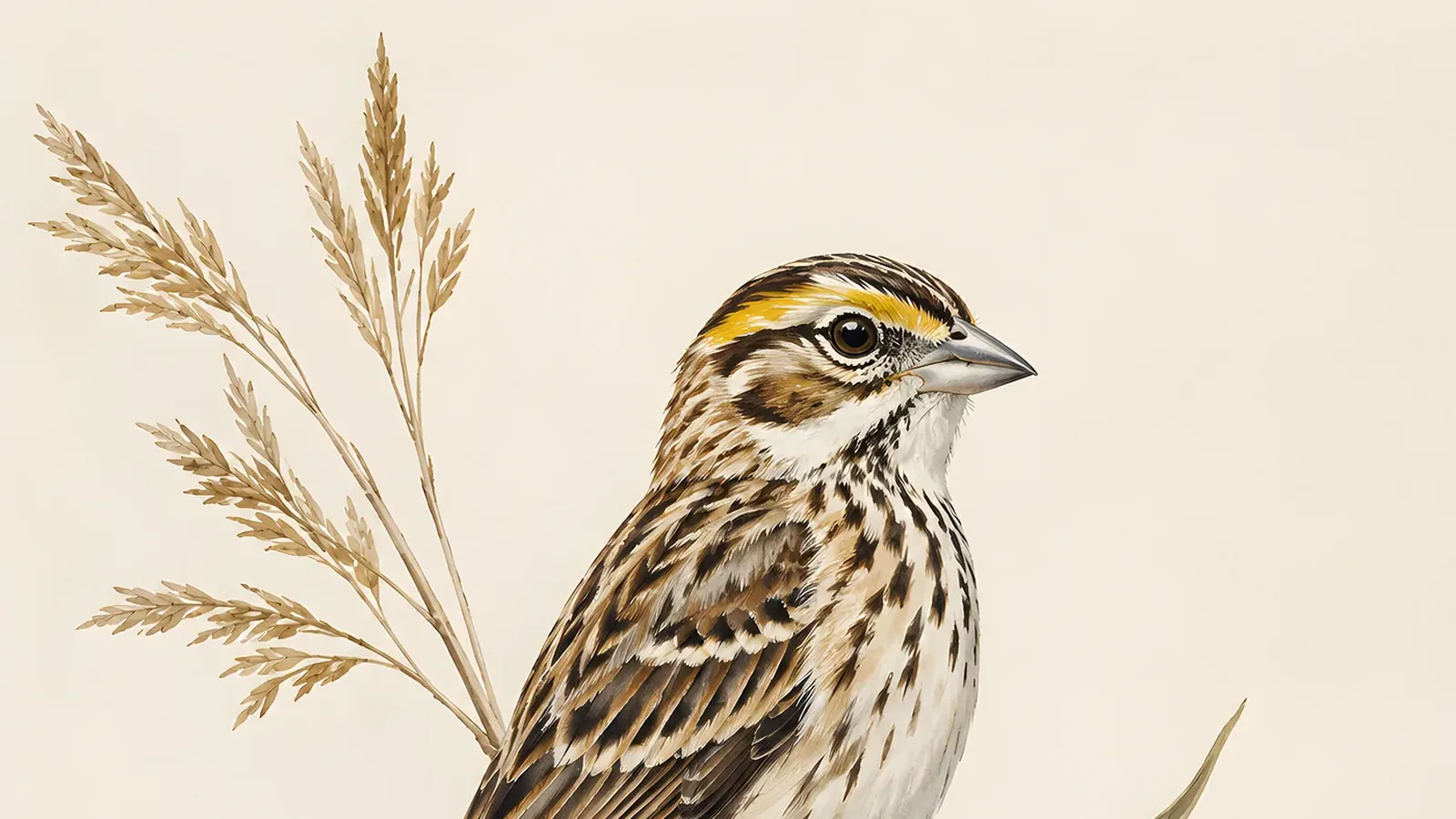
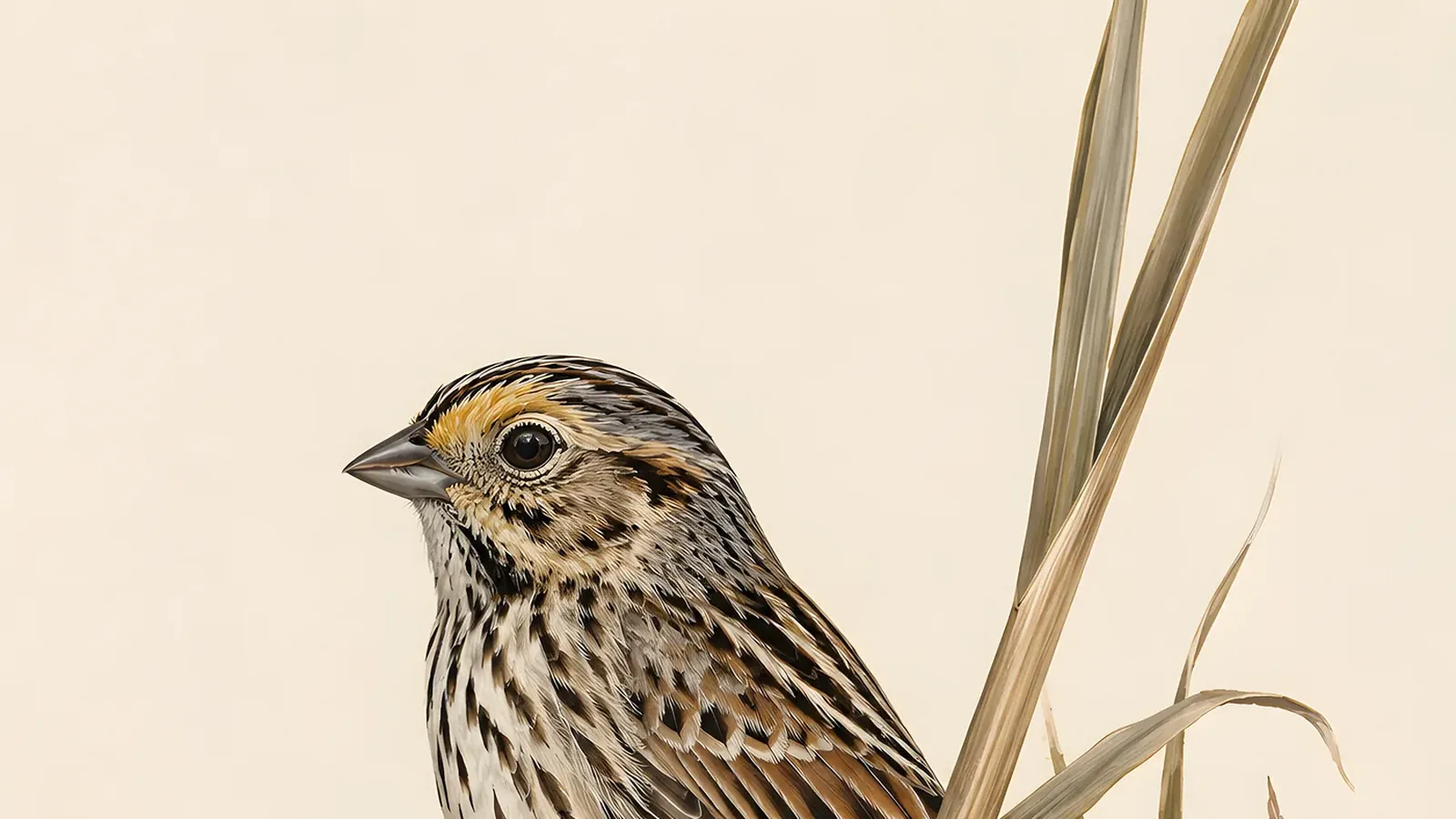
The Saltmarsh Sparrow is a small, compact bird with a short neck and a pointed tail that gives the species its Latin name: caudacuta, “sharp-tailed.” In the hand or a good light, the face pattern is unmistakable. A vivid orange-buff triangle frames each cheek, surrounding a flat grey cheek patch that contrasts sharply with the orange. The median crown stripe is grey, flanked by brown lateral stripes. The nape is grey. The upperparts are brown with pale white back streaking and rusty wing coverts.
The breast and sides are pale orange-buff with bold, well-defined dark brown streaks - heavier and crisper than on any similar species. The belly is white. The bill is slender and slightly longer than that of the Nelson’s Sparrow (Ammospiza nelsoni), which shares the marsh during migration and winter and is the most likely source of confusion.
| Measurement | Value |
|---|---|
| Length | 11-14 cm |
| Weight | 14-23 g |
| Wingspan | 18-21 cm |
| Oldest recorded | 9 years, 2 months |
The separation from Nelson’s Sparrow is a matter of streaking and ground colour. Saltmarsh shows a white belly with bold, defined dark streaks. Nelson’s shows a buffy-orange wash on the breast with fainter, blurrier streaking. The rule in the field: crisp streaks on white - think Saltmarsh.
The tide and the nest
No North American songbird is more precisely governed by a single environmental cycle. Shriver, Vickery, Hodgman, and Gibbs (2007, The Auk) documented that Saltmarsh Sparrows initiate nests an average of 2.9 days after a spring flood tide - versus 10.3 days for the sympatric Nelson’s Sparrow. The difference is not accidental. The full nesting cycle (laying, incubation at roughly 11 days, nestling period at 9-11 days) takes approximately 23-25 days. The lunar tidal cycle runs 26-28 days. The female’s window to succeed is exactly that narrow gap.
When she gets the timing right, she fledges an average of 2.5 young. When she gets it wrong by even a few days, the tide takes everything.
“Only 15% of nests experienced zero flooding events. Average 2.8 flooding events per nest.”
- Bayard & Elphick, 2011, The Auk
Bayard and Elphick (2011, The Auk) monitored 191 nests in Connecticut across three seasons. Only 18% succeeded. Tidal flooding caused 54% of all failures. Successful nests sat just 2 cm higher on average than failed nests - a margin smaller than a pencil eraser. Benvenuti, Walsh, O’Brien, and Kovach (2018, Ecology and Evolution) confirmed that females show plasticity in nest placement across seasons, adjusting height based on recent flooding experience, but the structural limits of the marsh itself leave no room to outclimb the water.
This is not a bird that tolerates saltmarsh. It requires it, in a specific way, at a specific elevation, on a schedule set by the moon. There is no other habitat.
The mating system is equally singular. Hill, Gjerdrum, and Elphick (2010, The Auk) described what they called “the most promiscuous mating system documented in any bird species”: 95% of broods showed multiple paternity. In 35% of nests, every chick in the clutch had a different father. Males form no pair bonds and invest no time in parental care - they spend less than a minute with any given female (Shriver et al. 2007). Females build the nest, incubate the eggs, brood the chicks, and provision the young until independence. Every fledgling this species has ever produced was raised by its mother alone.
What it sounds like
The song is easy to miss. A quiet, rasping, gasping buzz - sometimes phonetically rendered as tup-tup-sheeee - delivered with a wheezy, barely-projected quality that disappears entirely in any wind. Males sing from low perches in the cordgrass or in brief fluttering display flights over the marsh. The call is a sharp, high-pitched tsip or tic, similar to Nelson’s Sparrow and difficult to separate in the field. In the breeding marsh the song is often the bird’s first advertisement of presence, heard before the bird is seen - if it is heard at all.
Range and habitat
The Saltmarsh Sparrow breeds exclusively in tidal salt marshes along the Atlantic coast from southern Maine to Virginia. The largest breeding concentrations are in New Jersey (approximately 33% of the global population), Maryland (25%), and Massachusetts (10%), with smaller numbers in New York, Virginia, Delaware, Connecticut, Maine, Rhode Island, and New Hampshire. According to the Atlantic Coast Joint Venture’s 2020 rangewide survey, the entire global breeding population occupies roughly 160,000 acres of marsh scattered across fewer than 800 sites - all of them tidal, all of them within a few metres of sea level.
The tidal marshes of Connecticut hold some of the longest-studied populations in the range, providing much of the foundational nest-monitoring data that now underpins extinction modelling.
Breeding habitat is dominated by high-marsh communities: Spartina patens (saltmeadow cordgrass) and Juncus gerardii (saltmarsh rush) at elevations that flood less frequently than the low marsh’s Spartina alterniflora beds. In winter, most birds move south to the Carolinas, Georgia, and northeastern Florida, where they occupy the same tidal-marsh habitat type.
The Henslow’s Sparrow offers an instructive contrast: another grassland-marsh specialist with a declining population, but one whose habitat - dry upland fields - does not sit below the eventual reach of the ocean.
Diet
The Saltmarsh Sparrow is primarily insectivorous during the breeding season. It forages in the lower cordgrass stems and wrack lines for grasshoppers, beetles, caterpillars, ants, amphipod crustaceans, small crabs, marine worms, and snails. Nestlings receive a diet composed significantly of soldier fly larvae and pupae, which are abundant in decaying organic matter in the marsh. In winter, seeds of marsh grasses supplement the diet, though invertebrates remain important year-round. Food availability is not considered a limiting factor for the species.
The clock
Field, Bayard, Gjerdrum, Hill, Meiman, and Elphick (2017, Global Change Biology) modelled what rising sea levels mean for a bird whose entire reproductive strategy depends on the gap between two flood tides. They used high-resolution semidiurnal tide projections rather than averaged sea-level values, and what they found was a reproductive tipping point - a flooding frequency at which the 28-day window collapses and successful breeding becomes statistically impossible at the landscape scale. Their projections placed extinction as early as 2035 under some scenarios, with persistence beyond 2060 threatened under nearly all trajectories examined. The timeline was not strongly sensitive to which emissions pathway the models used. The ocean will rise. The marsh platform will not.
Field, Gjerdrum, and Elphick (2016, Biological Conservation) established the second constraint: the species cannot simply retreat landward as the marsh is squeezed by rising water. Coastal development, road embankments, and forest behind the marsh act as hard barriers. The marsh cannot migrate. The bird cannot follow habitat that does not exist.
The Saltmarsh Sparrow is not listed under the US Endangered Species Act as of 2026, despite an ESA listing petition filed by the Center for Biological Diversity in April 2024. USFWS missed the statutory 90-day review deadline, and a federal lawsuit challenging that inaction was filed in February 2026. The IUCN lists the species as Endangered (EN). The 2025 State of the Birds report designated it a Red Alert Tipping Point species - a category reserved for birds with more than 50% population loss over 50 years and steep ongoing decline. The Atlantic Coast Joint Venture estimated the global breeding population at approximately 53,000 individuals in 2016, down 87% from a late-1990s baseline of roughly 212,000. Correll and colleagues documented a 9% annual decline rate, the steepest of any tidal-marsh bird in North America.
The lunar cycle has not changed. The bird evolved to use the one interval the tide reliably provides. What is changing is the tide itself - not its timing, but its reach. Each year the spring floods climb a little higher. Each year the margin between a successful nest and a drowned one narrows by a fraction of a centimetre.
The female that builds her cup in the cordgrass this June does not know this. She builds above the last waterline, as her mother did, as the species has done for however long it has existed in these marshes. She waits for the tide to tell her when to start. The question that Field et al. put into peer-reviewed language in 2017 is one the bird has been answering on its own for millennia: how much time is there between one flood and the next? The answer, at this point, is less than there used to be.