Field Guide
Bachman's Sparrow
Dawn over a burned pine flat in the longleaf pine flatwoods of Georgia. The bark of the longleaf trees is black at the base from a winter fire. Wire grass is pressing back through the ash, pale gold and fine as hair. Then, from a palmetto clump at the edge of the trees, comes a single long clear whistle - sweet, crystalline - and then a falling trill that dissolves into the morning. The bird does not show itself.
Peucaea aestivalis - Bachman’s Sparrow - is the sparrow most people drive past, which is a shame, because its song is one of the best on the continent.
The paradox is simple: plain to look at, extraordinary to hear, living in a habitat most people never visit. The longleaf pine savanna, shaped by fire into something open and grass-floored, has lost roughly 97 percent of its historical extent, according to the US Fish and Wildlife Service. The sparrow went with it.
What it looks like
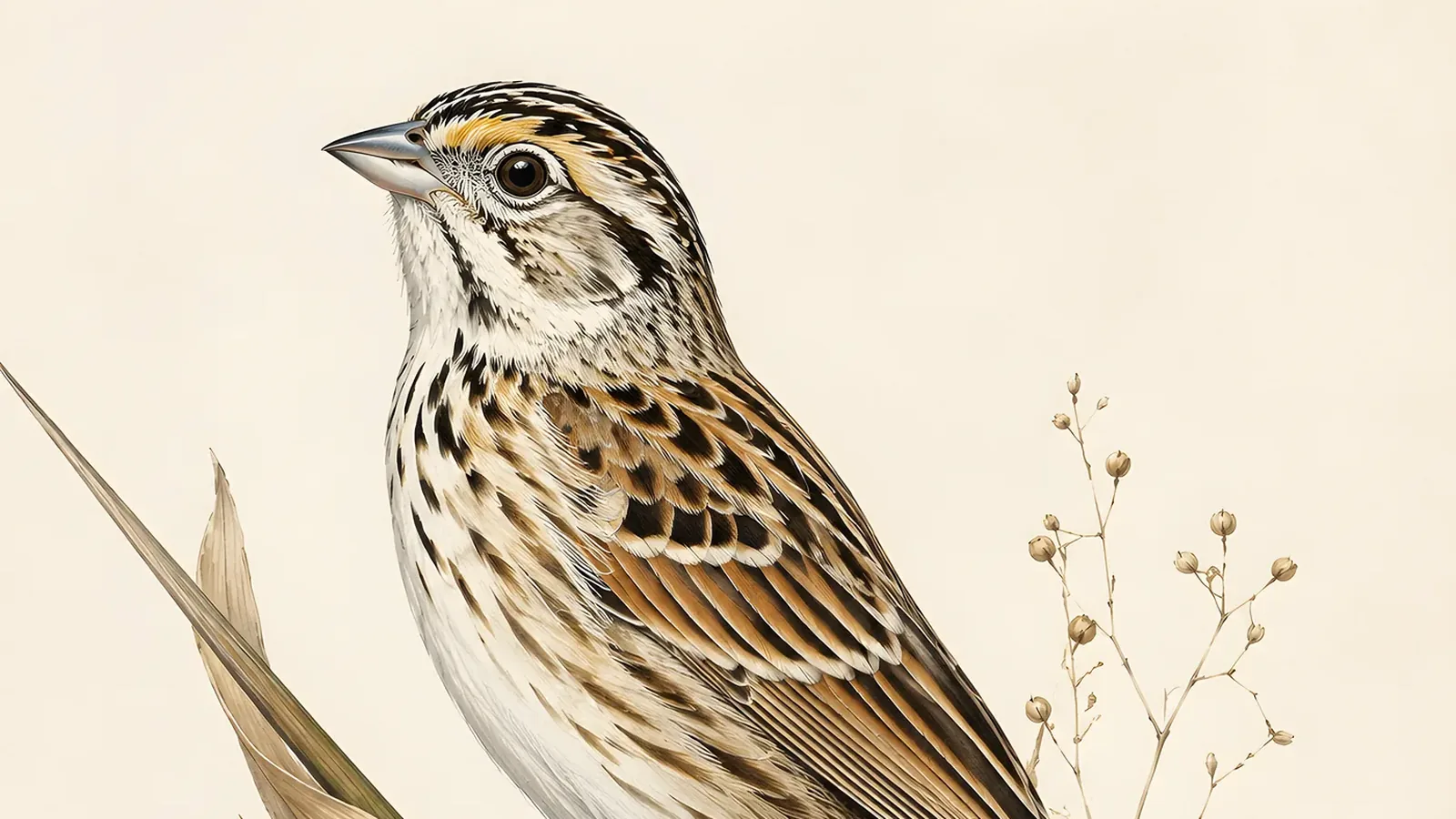
Adult Bachman’s Sparrows run 13 to 15 cm in length and weigh between 18 and 28 grams - heavy for a sparrow, which is partly a function of the long broad tail and deep chest. Wingspan spans 18 to 20 cm. The build is large-bodied and round-headed, with the tail often held slightly cocked. The overall impression is of a warm reddish-brown bird with few obvious marks.
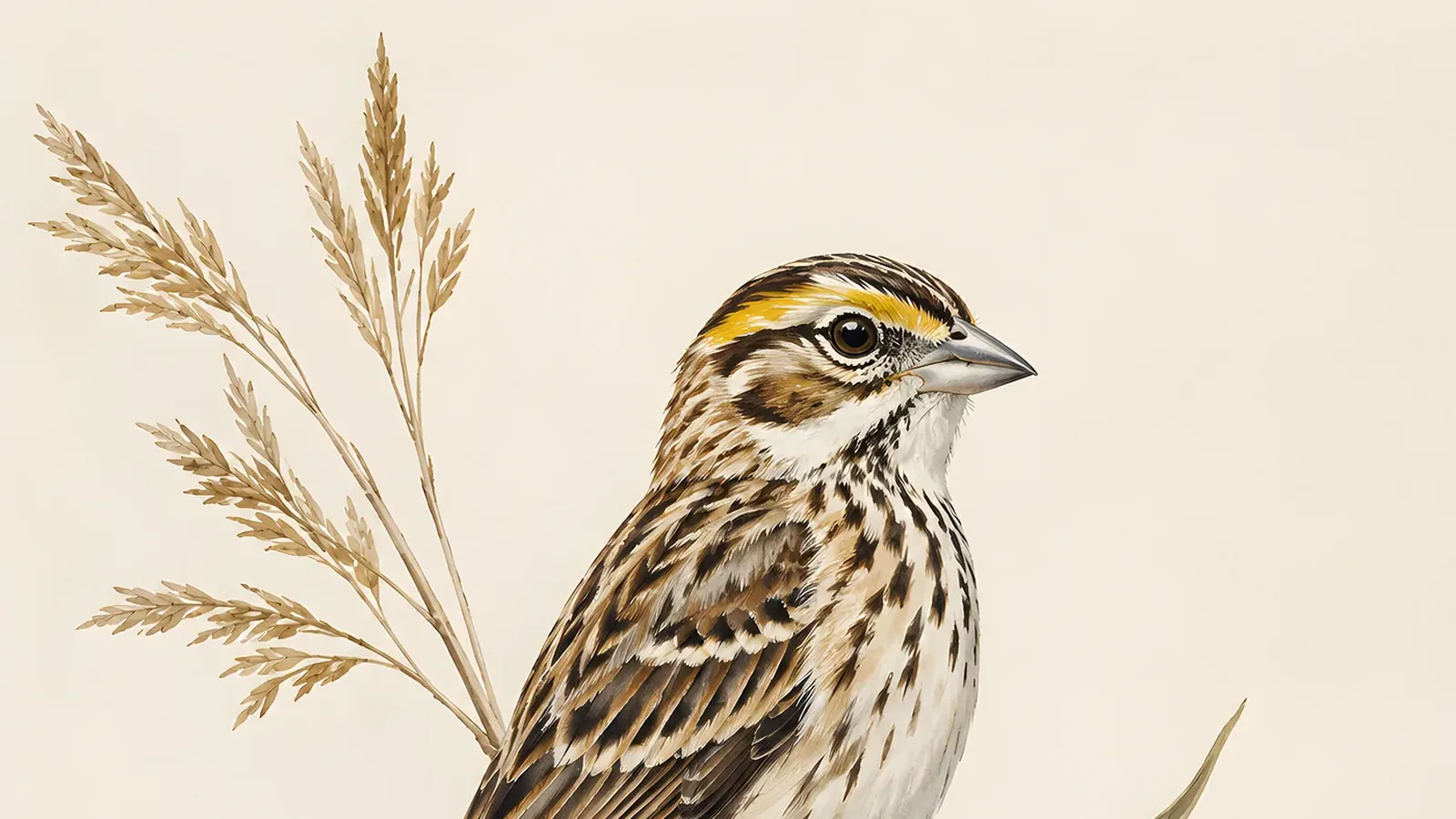
The Audubon Society’s field guide describes it as “relatively plain brown with a reddish tinge and few obvious markings,” which is accurate but undersells the richness of the plumage. The crown is streaked reddish-brown and gray, with a gray supercilium. The back is warm rufous-brown with darker shaft streaks. The face is gray-brown, plain and unlined. The underparts are buffy-white, notably unstreaked below, which separates this species from most of its relatives at a glance. The tail is rounded and long.
In bright morning light, perched on a pine branch above wire grass, the bird glows briefly warm reddish-brown before dropping back into cover. No wing bars, no eye ring, no bold facial pattern. This is a sparrow designed for the ground, not the eye.
| Measurement | Range |
|---|---|
| Length | 13 - 15 cm |
| Weight | 18 - 28 g |
| Wingspan | 18 - 20 cm |
| Oldest known | at least 3 years 11 months (USGS Bird Banding Lab) |
The song
The song is the whole point. The Audubon Field Guide describes it as “a clear, sweet whistle followed by a trill on a different pitch” - which is the field mark that matters. It is a two-part performance: one long introductory note, pure and unhurried, then a brief musical trill that drops in pitch and fades. The effect is luminous. The delivery is unhurried. The bird often sings the same song from the same perch for several minutes, which is fortunate, because finding the singer in wire grass and scattered palmettos is not a trivial task.
Males begin singing in early spring and continue well into summer, concentrated at dawn and dusk. Unlike most secretive sparrows, a male Bachman’s will mount a low pine branch to sing - often the only time the species is easy to observe. Each successive song shifts slightly in pitch. The overall impression is of a single clear note resolving into a fast musical trill. It is not a complex song. For a small brown bird in a grassy understory, it is a beautiful one.
“A clear, sweet whistle followed by a trill on a different pitch.” - National Audubon Society Field Guide
Range and the fire-kept pinewoods
Bachman’s Sparrow ranges from central Florida north through Georgia, the Carolinas, Alabama, and Mississippi, west into eastern Texas. Isolated populations persist in Tennessee and Missouri. Most birds are year-round residents, with movement at the northern edges only.
What matters is not the geographic shape of the range but what it is drawn on. The longleaf pine ecosystem once covered roughly 37 million hectares across the southeastern coastal plain. By the late 20th century, logging, agricultural conversion, and a century of fire suppression had reduced it to fragments. The sparrow’s range contracted accordingly. Birds that once bred north to Illinois and Pennsylvania - expanding in the early 1900s onto abandoned farmland - have been gone from those states for decades.
Cerame and colleagues (2014, PLoS ONE) documented the genetic consequences of this history. Studying 226 individuals across 11 sites, they found remarkably little genetic structure across the entire range - a global FST of just 0.012, indicating high gene flow even across fragmented landscapes. Their interpretation was significant: high dispersal ability may itself be an adaptation to ephemeral, fire-mediated habitats. A bird whose home can vanish in a few years without burning needs to be able to move.
The recovery of longleaf pine has been slow and uneven. Where prescribed burning has resumed on a regular cycle - every two to three years, approximating the natural fire-return interval - Bachman’s Sparrow returns. Tucker, Robinson, and Grand (2006, Wilson Journal of Ornithology) found that reproductive indices were significantly higher in the first three years following a controlled burn (mean 3.8) compared to four or more years post-burn (mean 2.0). The sparrow does not merely tolerate fire. It requires it.
The species shares this dependency with the red-cockaded woodpecker, another longleaf pine specialist. Where red-cockaded woodpeckers are found, Bachman’s Sparrows are often nearby - both require the same prescription: frequent low-intensity fire to keep the hardwood midstory in check and the native wiregrass growing. They are companions in a system that exists only when fire is allowed to do its work.
The IUCN Red List rates the species Near Threatened, reflecting documented decline across Breeding Bird Survey data since 1966. The Audubon Society estimates the global population at roughly 170,000 birds - small, for a species whose habitat once stretched unbroken across the southeastern coastal plain.
Diet
Bachman’s Sparrow feeds almost entirely on the ground, working slowly through litter and wire grass in a limited home area. During the breeding season, insects dominate: beetles, caterpillars, and grasshoppers, along with spiders. Seeds from native grasses take over through autumn and winter. The bird forages by shuffling through leaf litter with short hops, occasionally pausing with head tilted to examine the ground.
It walks when it could fly, and flushes reluctantly - pressed, it runs through grass rather than taking to the air. The impression is of a bird more closely related to a mouse than a sparrow.
Breeding
Nest-building begins in late April across the core range. The nest is placed on the ground, built by the female from dry grasses and lined with finer material, typically concealed beneath a clump of wire grass or at the base of a small shrub. A distinctive feature of many Bachman’s Sparrow nests is a partial or complete dome of woven grass over the entrance - an unusual structure among North American sparrows that may reduce detection from above.
Clutch size is three to four eggs. The female incubates alone for 12 to 14 days. Young fledge at nine to 10 days, before they can fly well, remaining in dense ground cover for several weeks. Tucker and colleagues (2006) found that breeding productivity declined steeply in sites that had gone more than three years without fire: wire grass thins, hardwood shrubs close in, and the territory becomes unsuitable. Two broods per year are typical.
Henslow’s sparrow follows a similar pattern of fire-mediated habitat dependency in northern grasslands, but winters in habitat much like what Bachman’s occupies year-round.
The name
John James Audubon described the species for science in 1834, naming it for Reverend John Bachman of Charleston, South Carolina - an ordained Lutheran minister who spent 56 years at St. John’s Lutheran Church and was among the most accomplished naturalists of his generation. Bachman collected the first specimen in South Carolina in April 1832 and sent it to Audubon. He later wrote the text for Audubon’s work on North American mammals.
The naming is apt. Bachman worked in the most biologically diverse region of temperate North America, in close proximity to the longleaf pine country the sparrow calls home. The species named for him has stayed there.
The bird was for many years called the Pinewoods Sparrow, which is the better field description. Either way, the subject is the same: a small, secretive, reddish-brown bird with a long tail and an improbable voice, living on fire-maintained savanna, singing from the lower branches at dawn, vanishing into the wiregrass before you have quite made out its shape.
The longleaf pine ecosystem is one of the most endangered in North America. Where it survives - actively managed with fire, opened back to sky and wiregrass and the smell of char - so does this sparrow. That is not a coincidence. It is the whole story.