Field Guide
Scissor-tailed Flycatcher
The bird drops off the fence wire before you have fully registered it - a pale grey sliver that opens into something longer, stranger, and more extravagant than any perched view suggested. Two black tail feathers, each tipped white, stream out behind in a deep fork that may extend 23 centimetres past the wing-tips. The bird courses low over the Oklahoma grassland, banks, and lands on the next post down the line. The tail folds. The wire goes still.
Tyrannus forficatus - the Scissor-tailed Flycatcher - carries the longest tail relative to body size of any North American passerine, and it uses that tail. It does not merely possess it.
What it looks like
The adult male runs 28 to 38 centimetres from bill tip to the end of those outer tail streamers, with females measuring slightly shorter and carrying correspondingly shorter tails. Weight falls between 32 and 54 grams - comparable to a house sparrow in body mass, though nothing in the sparrow’s silhouette prepares you for the scissortail’s proportions. Wingspan is 38 to 43 centimetres.
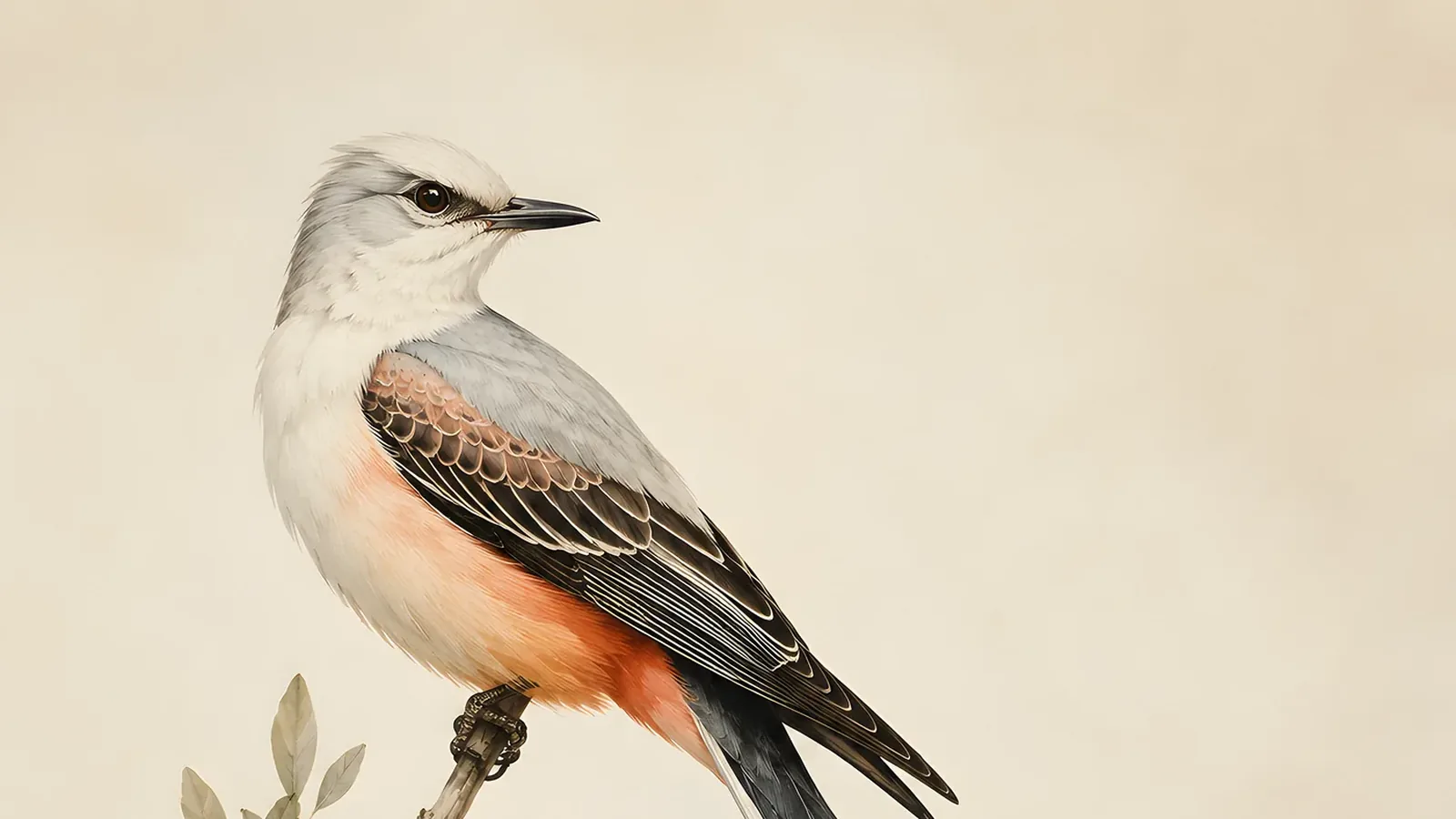
The body itself is understated, which is the point. Crown, nape, and back are pale pearl-grey. The face and breast are white. The wings are dark sooty-black with subtle white edging on the secondary feathers. This restraint makes the colour that matters read more clearly: the flanks, belly, and underwing coverts are washed in a warm salmon-pink, bright enough in good light to register at distance. Beneath the closed wing at the shoulder sit scarlet red coverts - a hidden blaze that flashes open in flight or when the bird raises its wings in alarm. A small scarlet patch on the crown performs the same trick, invisible at rest and exposed when the bird is agitated.
The tail is black above and white below, deeply forked. The outer two feathers do the work. In males they may reach 22 centimetres, nearly equalling the rest of the bird. In females they run 15 to 18 centimetres. Regosin and Pruett-Jones (2001, The Auk, vol. 118) measured a tail-length dimorphism ratio of 1.48 between sexes - the highest documented for any North American passerine - and found assortative mating by tail length, with longer-tailed males paired with females who began clutch initiation earlier in the season.
Juveniles have shorter, slightly forked tails and yellowish-pink rather than salmon underparts. They resemble a Western Kingbird in overall shape - which is no accident. The scissortail belongs to Tyrannus, the same aggressive kingbird genus, and it behaves accordingly.
| Measurement | Range |
|---|---|
| Total length | 28-38 cm |
| Tail (male) | up to 23 cm |
| Weight | 32-54 g |
| Wingspan | 38-43 cm |
| Lifespan (wild) | 3-7 years; record 10.9 years (USGS Bird Banding Lab) |
| IUCN status | LC - Least Concern |
The tail and the sky dance
The scissortail’s tail is the raw material of its courtship, and the male treats the spring sky as a performance space.
Shortly after arriving on the southern Great Plains in April, males begin what field observers have long called the sky dance. The bird climbs to roughly 30 metres, then plunges in a series of erratic V-shaped dives while working the tail open and closed and producing a rolling, cackling call. Backwards somersaults mid-dive have been documented. The male rises and falls, zig-zags, and circles while the long streamers flare with each turn. The Audubon Society’s field guide describes it as “an aerial ballet of incomparable grace” - language that is, for once, not disproportionate.
The function is well established. Regosin and Pruett-Jones (2001) conducted two breeding seasons of fieldwork at Fort Sill, Oklahoma and showed that tail length in males correlated with the timing of clutch initiation by their mates: longer-tailed males obtained mates that began laying earlier, which translates directly into higher seasonal reproductive success. The tail is not ornament without cost. Growing and carrying a 23-centimetre fork requires metabolic investment, and flying with it - let alone performing aerobatics with it - demands real physical competence. The females assessing those dives are reading something real.
The scissortail is also, in the direct Tyrannus tradition, an aggressive defender of its nest. It will pursue, harass, and physically strike hawks, crows, ravens, and other raptors that venture near the territory. The scientific name Tyrannus (tyrant) is not metaphor. A barn swallow diving on a cat is cautious by comparison.
What it sounds like
The common call is a sharp, flat pik or kik, given frequently in flight. The alarm sequence escalates to a rapid kee-kee-kee-kee, flat and insistent. The song is a sputtering, chattering series - pidik pek pik pik pidEEK - loosely resembling the Eastern Kingbird’s rapid chattering but rougher. During the peak of the sky dance, males produce an audible whirring from modified primary feathers while inverted. The overall vocal character is loud relative to body size, which is the kingbird way.
Range and habitat
The core breeding range runs from central Texas north through Oklahoma and into Kansas, extending west to eastern New Mexico and east into Arkansas, Louisiana, and Missouri. Small breeding populations have established in western Tennessee. Vagrant records exist for nearly every US state and southern Canada. The species was formally designated Oklahoma’s state bird in 1951 - a designation that has never required any defence.
Breeding habitat is semi-open grassland and savanna with scattered trees - native prairie, mesquite pasture, ranch country, farmland edges. The birds want open foraging ground and elevated perches: fence wires, telephone poles, and isolated trees all suit. They tolerate small towns and suburban edges where large open lawns adjoin woody margins. Nesting heights run two to nine metres, typically in the outer branches of isolated mesquites, hackberries, or willow oaks. The species avoids dense woodland entirely.
In winter the scissortail moves south through Mexico to Central America, wintering in humid savannas and open agricultural land from southern Mexico south to Costa Rica and occasionally Panama. Elevation on the wintering grounds stays below 1,500 metres. A small population winters in southern Florida and the Florida Keys.
Migration is active from late August through October southbound and from late February through May northbound. Birds migrate at night.
Diet
The scissortail is an insectivore and a specialist in the aerial sally - the classic flycatcher technique of watching from a perch and launching to intercept prey in the air before returning to the same wire or branch. Grasshoppers dominate the breeding-season diet and may comprise more than 50 percent of food taken during summer, per the Oklahoma Department of Wildlife Conservation field guide. Beetles, crickets, dragonflies, robber-flies, wasps, bees, caterpillars, moths, and spiders round out the diet. Small fruits and berries supplement food intake in winter when flying insects are scarce. Indigestible parts - legs, wing cases, exoskeletons - are regurgitated as pellets, a behaviour shared with the owls and shorebirds the bird superficially resembles in nothing else.
Foraging height typically runs from the ground up to ten metres. On warm mornings when grasshoppers become active, scissortails will drop to the ground to take prey, then return immediately to a perch. Peak foraging activity concentrates mid-morning and late afternoon.
Breeding and the roosts
The nest is a bulky open cup, 11 to 15 centimetres in outside diameter, built from plant stems, dried grass, oak catkins, and occasionally human debris - string, paper, cloth - and lined with dried roots, plant down, and cotton fibre. Both sexes build over roughly a week. The female incubates three to six eggs (typically four to five), cream-white with dark red-brown blotches, for 12 to 17 days. Fledging follows in 14 to 17 days. The pair may raise two broods per season, though a second brood is more likely when the first fledges early.
The roost behaviour before southward migration is the species’ most social performance. Beginning in late August, scissortails gather each evening in trees - most often mature riparian trees along streams, sometimes shade trees in small towns. Numbers build slowly through September, reaching peaks of 100 to 1,000 birds at a given roost. More than 1,000 birds have been recorded at single sites. The birds fan out at dawn to forage and return before dusk. Roost sites are traditionally faithful - some in Oklahoma and Texas have been used continuously for more than 20 years, according to state wildlife records. Through October, the number returning each night diminishes as birds begin their southward flight. By late October the wires are empty.
A bird that builds its courtship around a tail it has to carry, that performs backwards somersaults at 30 metres to prove it can, and that defends its fence post against red-tailed hawks - this is not a delicate grassland passerine. It is a kingbird that happens to be beautiful. The tail is the display. The display is the argument. The argument is about competence.
The scissortail’s population is estimated at 9.1 to 9.5 million birds by BirdLife International, and its IUCN status is Least Concern (LC). North American Breeding Bird Survey data (Sauer et al. 2007) document a minor annual decline of approximately 0.3 percent in Texas between 1980 and 2006, and Partners in Flight (2019) assigns the species a Continental Concern Score of 11 out of 20 - reflecting a 31-percent population decrease between 1966 and 2014 linked to habitat loss, agricultural intensification, and pesticide reduction of insect prey. The grasslands that give the scissortail its stage are themselves contracting. The sky dance goes on, for now, over pasture that is still there.