Field Guide
Western Tanager
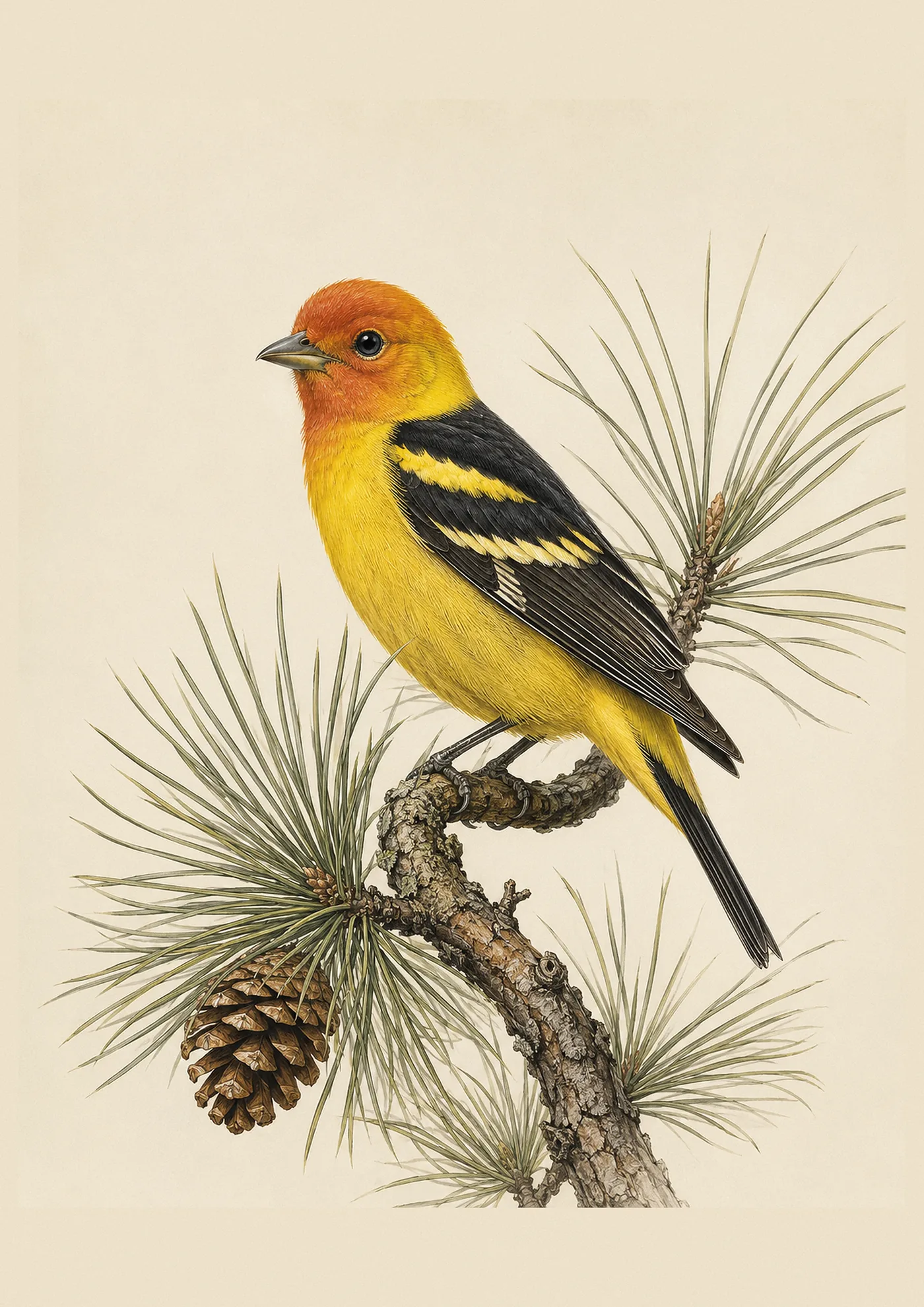
The Western Tanager looks like it took a wrong turn out of the tropics. A flame-red face. A body the colour of a lemon. Black wings and back. It is the most northerly-breeding of all the tanagers, and yet it carries the brightest colours of any songbird you are likely to meet in a western pine wood.
You hear the wood before you find the bird. Then a movement high in the canopy, and there it is.
How to know it
The breeding male is unmistakable.
- A bright red head, deepest at the face, fading as the season wears on.
- A clear yellow body and rump.
- Black wings, back, and tail, with two pale wing bars.
The red is not pigment the bird makes itself. It comes from rhodoxanthin, a rare pigment the tanager takes in through its diet, most likely from insects that have fed on plants. No other North American bird gets its colour quite this way.
The female is far quieter. Yellow-green above, yellow below, with grey-tinged wings and the same two wing bars. The first-autumn male sits somewhere between the two, his head only lightly washed with orange.
Range and habitat
This is a bird of the open conifer forest.
It breeds across the mountain West, from the spruce and fir of western Canada down through the pine and Douglas-fir of the United States, and into the highlands of Mexico. It favours the higher, cooler woods, often where conifers mix with a few aspens or oaks.
Come autumn it leaves entirely. The Western Tanager is a true long-distance migrant, wintering from Mexico down to Costa Rica. For a bird that nests further north than any other tanager, it keeps faith with the tropics every winter.
Behaviour
It feeds high and feeds quietly.
Through the breeding season it is mostly an insect eater, taking wasps, beetles, and ants, often by flycatching, launching from a perch to snatch prey in mid-air. In late summer and on migration it turns to fruit and berries, which is when garden birdwatchers in the West sometimes get a brief, startling visit.
For all that colour, it can be hard to see. It moves slowly through the tops of tall conifers, and the green of the female blends into the needles almost completely.
Voice
The song is a series of short, burry phrases, rising and falling, often compared to an American Robin with a sore throat. Hoarser. Less polished. Each phrase pauses before the next.
The call is the easier tell: a dry, rattling pit-er-ick, three notes that give the bird away long before you find the colour in the canopy.