Field Guide
Northern Saw-whet Owl
October, 2 a.m., somewhere in the spruce ridge above the Delaware Water Gap. A mist net has been strung across a logging road. A playback speaker repeats one note every half second - a soft, high toot. From the darkness comes an answer, then a thump of feathers against mesh. The bander switches on a red headlamp. In the net, a bird the size of a clenched fist hangs motionless, regarding him with eyes the colour of school-bus paint. It does not struggle. It rarely does.
This is Aegolius acadicus, the Northern Saw-whet Owl - a cat-faced, bowling-ball-headed little predator that for most of its history was believed to be uncommon, stationary, and largely unknowable. The banding records now say otherwise. Tens of thousands of them pass through in the dark each autumn, mostly between mid-October and mid-November, following ridge lines south through Pennsylvania, New Jersey, Maryland, and into the forests of the southeastern United States. They move at night, in silence, and they are invisible unless you run a net and a speaker and stay awake past midnight to meet them.
What it looks like
The Northern Saw-whet Owl is one of the smallest owls in North America, measuring 17 to 22 centimetres from bill to tail - close to the length of an American robin - and weighing between 65 and 151 grams. Females average substantially larger than males, a pattern common across the raptors. The wingspan runs 42 to 57 centimetres.
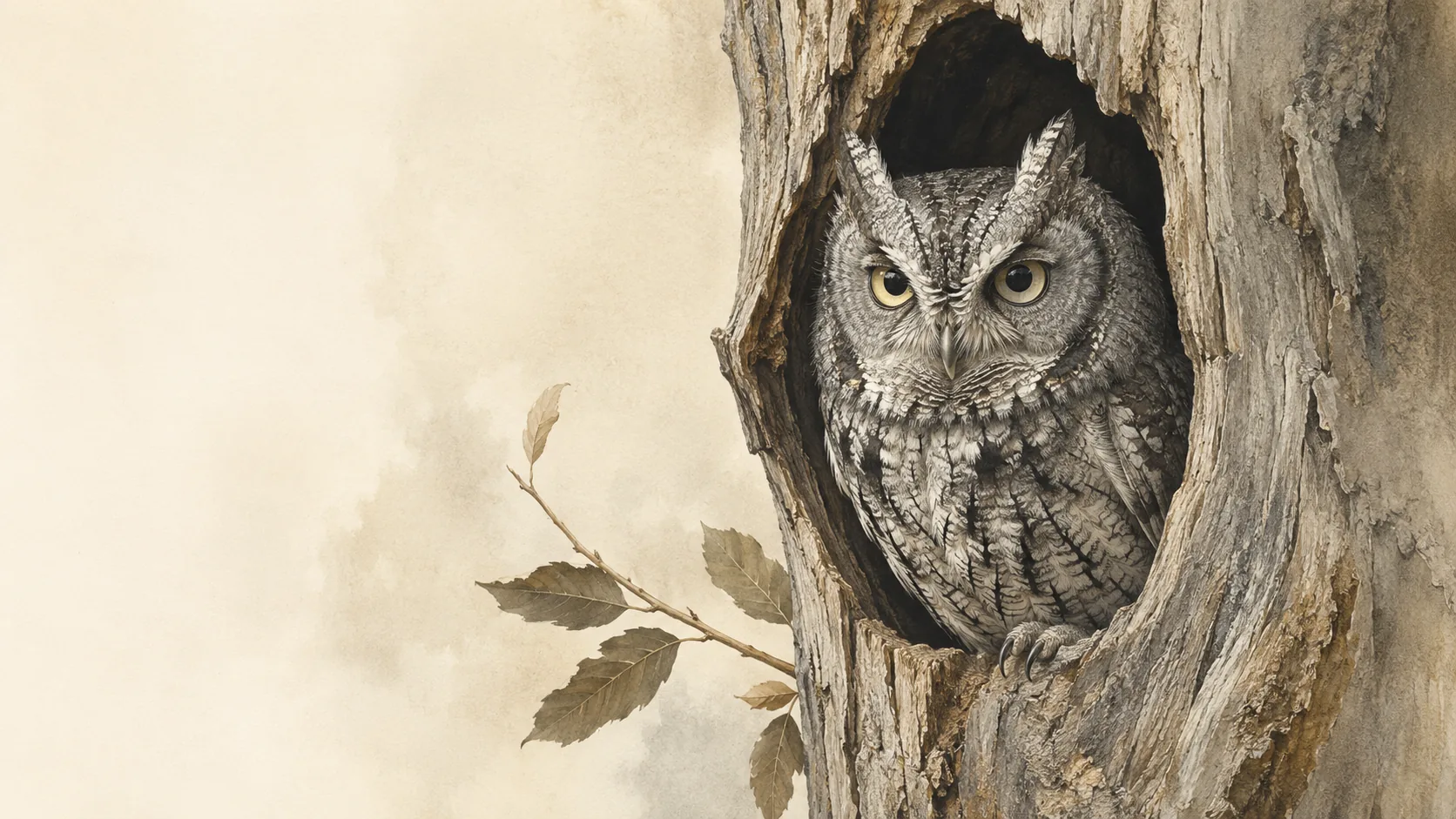
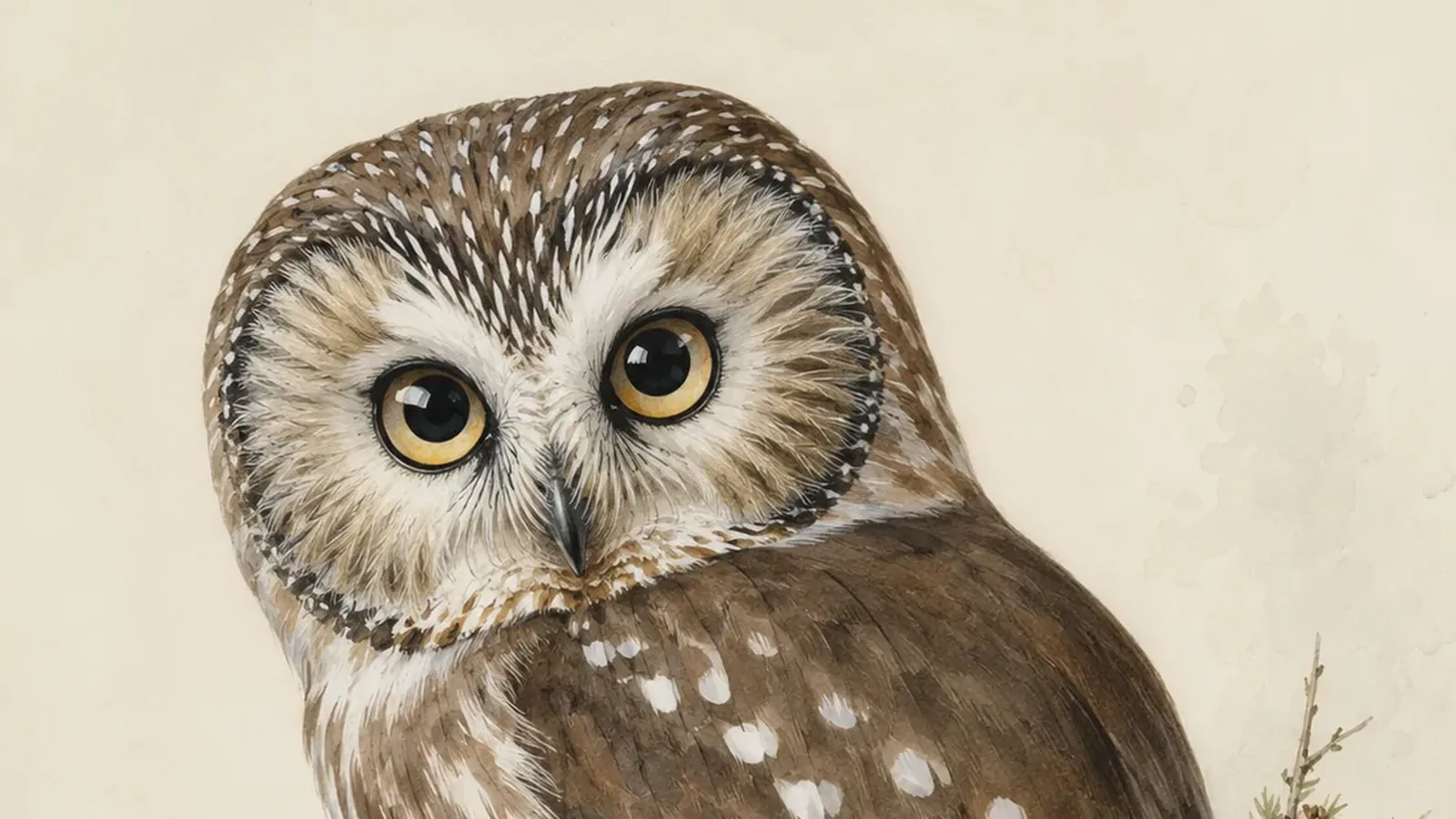
The head is the thing that stops people. It is disproportionately large even for an owl, round and flat-faced, without ear tufts, giving the bird what ornithologists have been calling a cat-like appearance since Audubon’s time. The facial disc is pale - whitish, with a faint brown frame - and the eyes are a saturated, almost cartoonish yellow. The bill is dark gray, hooked, smaller than it looks. Birds held in the hand feel absurdly light: feathers account for a large fraction of what you are holding.
Adults are brown above, with white spots on the scapulars and wing coverts that produce a neat row of dots visible in flight. Below, the breast and belly are white, streaked longitudinally with rufous-brown. The facial disc centre is white, radiating fine dark streaks. Juvenile birds, fledged in their first summer, wear a very different plumage - dark brown above, unmarked tawny-orange below - that makes them look almost like a different species. This juvenile plumage is kept until the first complete moult in late summer, and birds in this transitional state regularly confuse observers in the field.
The species has no close lookalike that presents serious difficulty once you have seen both well. The eastern screech-owl is slightly larger, has prominent ear tufts and a strongly barred belly, and comes in gray and rufous colour morphs. The saw-whet is unmarked tawny below as a juvenile, cleanly streaked as an adult, and always earless.
| Measurement | Range |
|---|---|
| Length | 17-22 cm |
| Weight | 65-151 g |
| Wingspan | 42-57 cm |
| Wild lifespan | up to 7 years |
| IUCN status | Least Concern |
The name and the whistle
John James Audubon did not coin the name, but he recorded it. In his Ornithological Biography (1839) he noted that in Massachusetts the bird was known locally as the “saw-whet owl,” and he described how its call resembled the sound of a saw being sharpened on a whetstone - that rasping, rhythmic scrape that was a common sound in any nineteenth-century workshop. The primary advertising call of the male is a monotonous, repeated toot: a single whistled note, soft and high, delivered at roughly two beats per second. It sounds nothing like a saw. But one of the owl’s alarm calls - a rapid, ascending series of notes with a harsh edge - does carry something of that metallic quality, and the name, once attached, stuck.
The advertising call is extraordinary not for its complexity but for its persistence. Males begin calling in late February and continue through the breeding season, often running for hours without pause. There is no variation, no embellishment. The same note, at the same pitch, at the same interval, deep into the night. Writers have described it as monotonous, even maddening. Ornithologists have used it as the basis for luring the birds into mist nets: broadcast a recording of the call and the owls fly in.
The male’s advertising call - a single tooted note at two beats per second, repeated for hours without variation - is one of the most insistent sounds in a North American spring night, and most people who hear it in the dark cannot identify it.
Cornell University’s All About Birds characterises the call as a repeated too-too-too, running continuously and sometimes so prolonged that observers assume it must be a mechanical sound. It is the acoustic opposite of the Great Horned Owl’s resonant, spaced hoot. Where that call asserts presence, the saw-whet’s repetition seems to dissolve into background noise after a while, which may explain why the bird remained so poorly known for so long.
The hidden migration
For most of the nineteenth and early twentieth centuries, the Northern Saw-whet Owl was classified as rare to uncommon across much of its range, a resident or short-distance wanderer of conifer forests, seldom seen and apparently not migratory in any organised sense. Birders occasionally flushed one from a roost in winter. Banders caught them rarely. The literature was thin.
Two naturalists began revising that picture in 1910. Percy Taverner and Bradshaw Swales, working Point Pelee in Ontario in October of that year, found twelve saw-whet owls in a single afternoon in a small patch of thicket. The following morning, every owl had gone. It was confirmation of directed movement - not wandering but migration, arriving and departing on a schedule. The observation sat in the literature for decades without prompting systematic investigation.
Systematic investigation began in 1994. Dave Brinker, Scott Weidensaul, and Steve Huy organised a coordinated banding network - Project Owlnet - that eventually grew to more than 100 stations across Canada, the United States, and Mexico, all running the same protocol in the same autumn window and sharing their data. The scale of what they found overturned a century of assumption.
In the autumn of 1995 alone, Brinker and colleagues banded more than 5,900 migrant Northern Saw-whet Owls at stations across eastern and central North America, with a disproportionate concentration moving down the ridge systems of New Jersey, Maryland, and Virginia (Brinker, Duffy, Whalen, Watts, and Dodge, 1997, published in the proceedings of the second International Symposium on Owls of the Northern Hemisphere). That was one year. During irruption years - which the network found occur roughly every two years in eastern North America - single stations have taken more than 100 birds in a single night.
A 2024 study by Craik and colleagues, published in Ornithology (volume 141, issue 2), analysed nine seasons of banding at a Nova Scotia stopover site and documented a predictable alternation between irruption and non-irruption years, with irruption years correlating with elevated breeding abundance the previous summer. The mechanism driving the movement is now understood to be production, not starvation: in years when small mammal prey is abundant and breeding success is high, more juveniles enter the population and more birds migrate. The owl is not fleeing hardship. It is a population dispersing after a good year.
The birds move almost entirely at night, between one and four hours after sunset. Radio-tagged females studied by Craik et al. (2024) stopped for an average of 2.7 days at the Nova Scotia site before continuing south. Individual birds banded at Smithsonian Environmental Research Center in Pennsylvania have been recovered more than 1,500 kilometres away in Canada, establishing that these are genuine long-distance migrants, not local wanderers. The entire migration passed for a century without being detected because it happened in darkness, in silence, to birds that look like chunks of bark when they roost.
What it eats
The saw-whet is a specialist in small mammals at close range. Deer mice (Peromyscus spp.) and red-backed voles (Myodes gapperi) constitute the bulk of the diet across most of the range. The Cornell All About Birds account adds shrews, jumping mice, bog lemmings, and house mice as regular prey, with the occasional small bird taken during migration. Insects fill in when mammals are scarce.
The bird hunts by perching low - typically within two metres of the ground - and waiting. Its hearing is acute and its skull shows the slight asymmetry common to highly auditory owls, placing one ear slightly higher than the other so that sounds arriving from below are lateralised differently than those arriving from the level. This allows the bird to triangulate prey in complete darkness. When a mouse moves in leaf litter, the owl drops onto it feet-first, usually killing immediately with the talons.
Larger prey is cached. A saw-whet that catches a mouse too large to eat in one sitting will wedge it in a branch fork and return to it later. In freezing temperatures, cached mice freeze solid. There are documented accounts of roosting owls incubating frozen prey between their feet to thaw it before consuming it. The bird is small but not inefficient.
Range and habitat
The Northern Saw-whet Owl breeds across a broad band of North America: from the maritime provinces of Canada west through the boreal forests to Alaska, south along the Appalachian chain into the mid-Atlantic states, and through the Rockies and Cascades south into central Mexico. A separate coastal population occupies the Pacific lowland forests from California into British Columbia. Across this range the species shows a consistent preference for dense conifers, particularly stands of fir, spruce, pine, and hemlock with closed canopies that offer both nesting cavities and the dense daytime roosting cover the bird requires.
In winter, the distribution shifts south and the habitat tolerance broadens considerably. Birds wintering in the mid-Atlantic states or the southeast United States use mixed and deciduous woods as readily as conifers. The requirement is not for any particular tree species but for thickets dense enough to conceal a roosting owl. In deciduous woodland in winter the bird tucks into clusters of ivy or dense holly, pressing close to a trunk, eyes half-closed, relying on its streaked brown pattern against bark. The Cornell All About Birds guide notes that patient observers who check these spots can sometimes walk within two metres of a roosting saw-whet before it wakes and moves.
In Minnesota, Michigan, and the upper Great Lakes region, the species is a year-round resident and common breeder, and the autumn banding stations in those states regularly document the passage of Canadian birds moving through. The boreal forest edge is the productive zone: enough conifer density to breed, enough forest to hunt, and corridors south when winter closes in.
Breeding
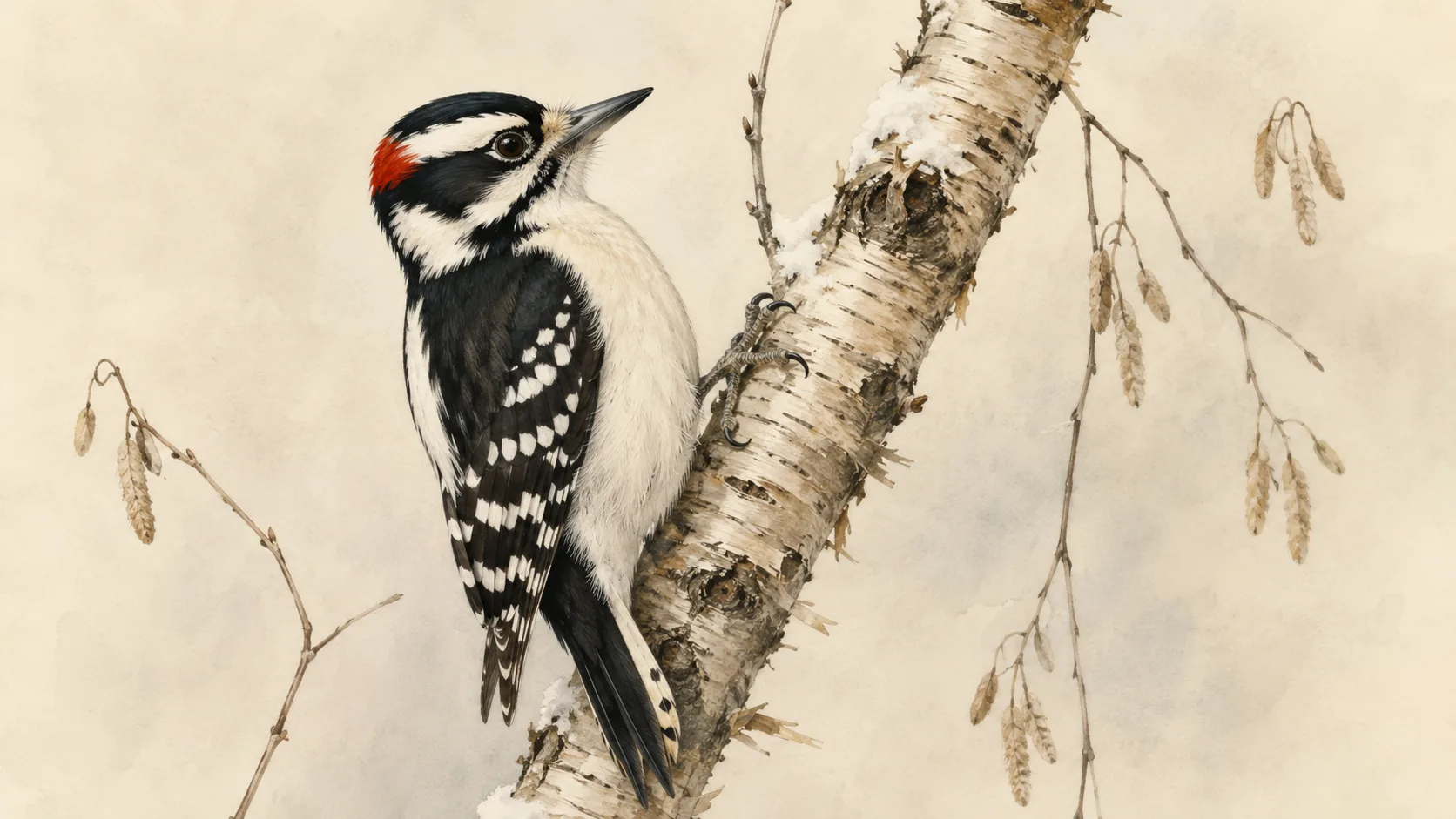
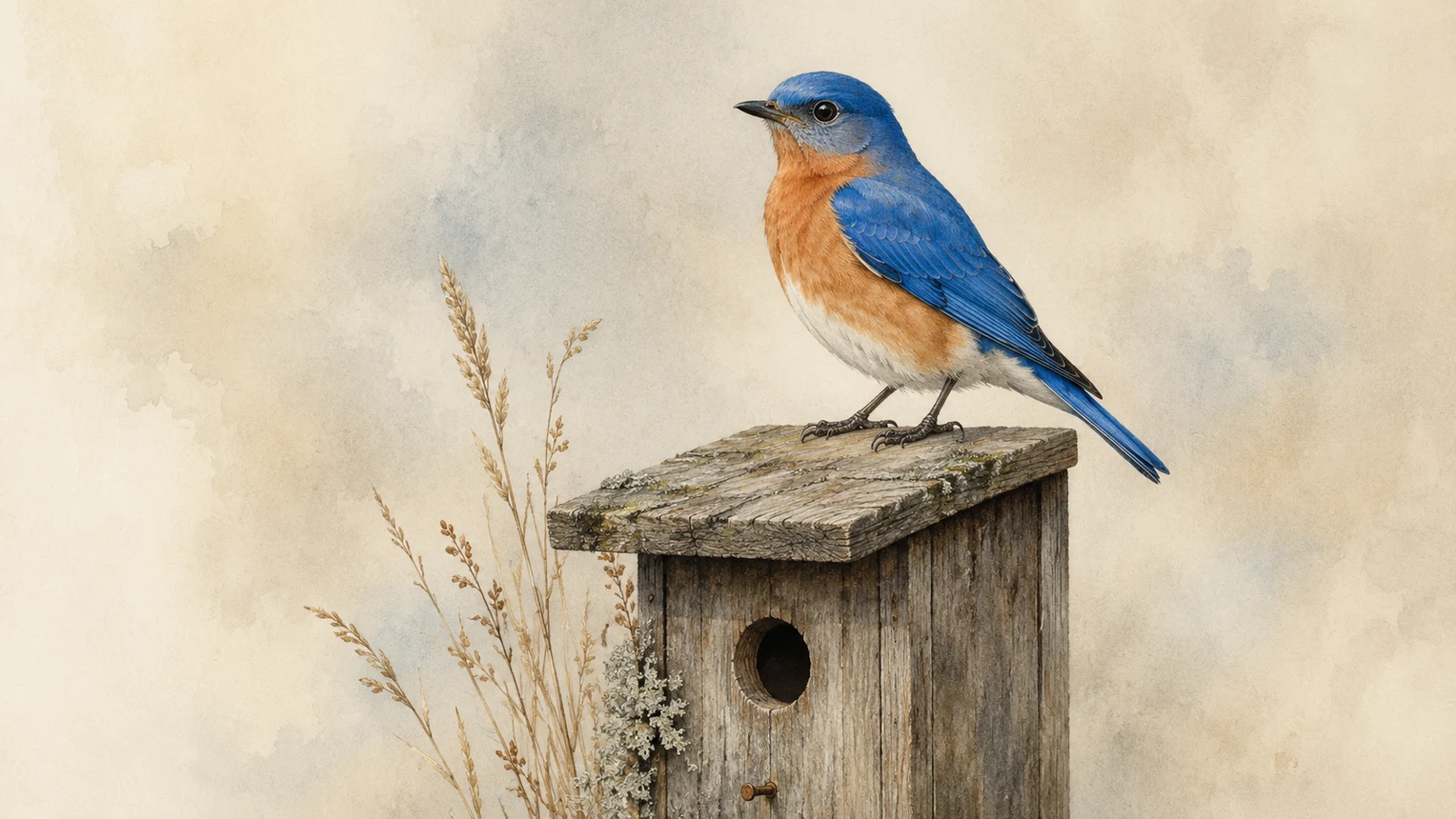
Breeding begins early. Males are calling by late February in the southern parts of the range, and the first eggs may be laid in March. The nest is invariably a cavity - a natural hollow, an old Northern Flicker hole, an old Hairy Woodpecker hole, or a nest box of the appropriate dimensions. The female selects the site. The male brings food during incubation.
Clutch size runs four to seven eggs, laid at two-day intervals. Incubation lasts 26 to 28 days and is performed entirely by the female, who begins incubating before the clutch is complete, so the eggs hatch at different times and the nestlings are staggered in size. A 1978 study of saw-whet breeding biology found an average clutch of 5.7 eggs in monitored nest boxes, with 78 per cent of nesting attempts producing fledglings, and successful nests averaging 4.2 fledglings each. The male hunts through the entire nestling period, delivering prey to the nest entrance, and the female tears it into portions small enough for the youngest birds.
Chicks fledge at four to five weeks but remain dependent on the parents for another six to eight weeks after leaving the nest. Males are occasionally polygynous in years of high prey abundance, maintaining territory with a second female while the first is still attending large nestlings - a pattern documented by the Animal Diversity Web for the University of Michigan, which notes that the first clutch must be well advanced before the male shifts attention.
The species is not tied to old-growth forest for breeding but does require cavities, and cavities require old trees. Nest-box programmes have expanded breeding range and density into managed forests that would otherwise lack suitable holes. In the northeastern United States, where Northern Flicker populations have declined and large-diameter snags are often removed, the availability of artificial boxes may be a meaningful factor in local breeding success.
The Northern Saw-whet Owl is listed as Least Concern on the IUCN Red List, reflecting an estimated population of roughly two million individuals and a large, stable range. It is protected under the U.S. Migratory Bird Treaty Act and listed on CITES Appendix II. Project Owlnet’s 25-year data set has revealed no consistent population decline at the network scale, though local reductions in boreal breeding habitat remain a concern over the longer term.
What banding has taught us, above all, is that the saw-whet’s apparent rarity was a failure of observation rather than a fact about the bird. Each autumn, unseen, the forest empties of them into the dark, and they stream south past every ridge and river gap in the east. The night is full of owls that no one thought were there.