Field Guide
Northern Mockingbird
On a warm April night in central Texas, a male Mimus polyglottos - the Northern Mockingbird - sings from a telephone wire under the full moon. He has been at it since midnight. By 3 a.m. he will have cycled through sequences that sound like a Carolina Wren, a Blue Jay alarm call, a car alarm on the next street, and something that may or may not be a Red-tailed Hawk. He is unmated. Cornell’s Birds of the World notes that unmated males sing more than mated ones, and sing most intensively at night, with activity peaking around the full moon. The singing is not random. It is an audition that could last the whole breeding season.
This is the thesis of the Northern Mockingbird: it is a bird whose singular talent is also its central life strategy. The size of a male’s repertoire matters. The complexity of his sequences matters. And because he keeps adding phrases year after year, an older male with a vast library has a measurable advantage over a young bird who has barely begun.
What he looks like
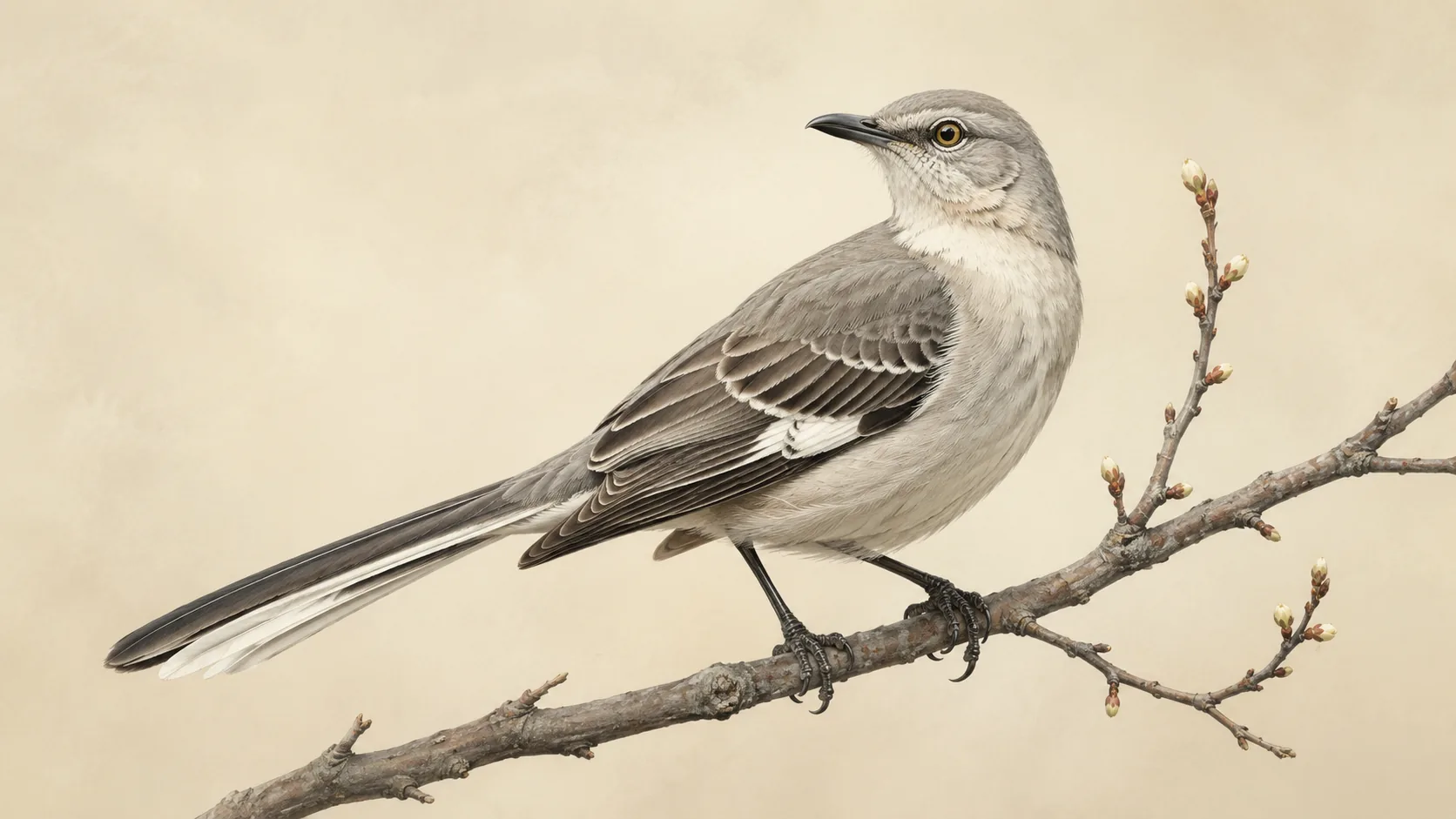
The mockingbird is a slim, long-tailed bird, 21 to 28 centimetres in length, weighing 40 to 58 grams, with a wingspan of 31 to 38 centimetres. He is pale gray above and whitish-gray below, unadorned in a way that makes the field marks easy to miss until he moves. Two white wing bars and large white wing patches flash into view when he flies, a signature almost impossible to confuse once seen. The outer tail feathers are white, visible as the long tail fans during display or aggressive flight. The bill is slightly curved and slender, the legs long for a bird his size.
Males and females wear identical plumage. Juveniles show faint spotting on the breast. In any perched view the bird reads as quiet gray and white, which makes his voice all the more startling.
Voice
The mockingbird’s call is one of the most complex vocal performances of any bird on the continent. Cornell’s Birds of the World records that a male’s repertoire often contains more than 150 distinct song types, and that this number changes during his adult life, typically increasing with age. He acquires songs by imitation, copying other bird species, non-avian animals, mechanical sounds, and other mockingbirds. Each phrase in a sequence is repeated three or more times before the bird switches to the next phrase without pause, producing a continuous, flowing song that can run for minutes without repetition.
The sources for imitation are wide. Documented sequences include phrases borrowed from Blue Jays, Carolina Wrens, American Robins, Northern Cardinals, and Eastern Towhees. In suburban and urban environments, males incorporate car alarms, squeaky hinges, and dog barks. The bird adds new material throughout breeding seasons and retains it across years. An older male, returning to the same territory in April, may carry a library built over a decade of listening.
Both sexes sing, but the male’s performance during the breeding season is the more intensive. The nighttime singing of unmated males is well documented and can be a source of considerable disturbance to neighbours within earshot.
The Northern Mockingbird does not have the most beautiful voice in an eastern garden. He has the most ambitious one.
Range and habitat
The Northern Mockingbird is a year-round resident across much of the United States, from California through the Plains states and across the entire South and East, extending north into the Great Lakes region and southern New England. Its range has expanded northward over the past century, a shift linked to suburbanisation and the planting of fruiting shrubs in residential areas. The species is also resident in Mexico, Central America, and parts of the Caribbean.
Habitat preferences run to open or semi-open country with scattered shrubs and trees: suburban gardens, parks, hedgerows, roadsides, agricultural edges, and scrubby second growth. Dense closed-canopy forest is avoided. The bird is frequently found in areas where multiflora rose - an invasive shrub - has established itself, because it provides both nesting cover and winter fruit. The Audubon Society field guide notes the species benefits from such plantings, which has made suburban and disturbed landscapes genuinely productive territory.
Diet
The Northern Mockingbird eats approximately half insects and half fruit across the year, shifting the balance with the season. In spring and summer, when insects are abundant, it takes a wide range of arthropods from the ground, often running a few paces, stopping, and pivoting suddenly in a movement that may startle hidden prey into motion. In autumn and winter, fruit and berries become the main staple, with holly, pokeweed, pyracantha, and dogwood among regularly used food plants. The species is a year-round defender of fruit-bearing shrubs, holding winter foraging territories separate from the breeding territory claimed in spring.
Breeding and nesting
The breeding season typically runs from March through August across most of the range. Males claim territories and sing to attract females, with the quality and size of the song repertoire playing a documented role in mate choice. The nest is a bulky open cup built by both sexes in a shrub or low tree, typically one to three metres above the ground, constructed of twigs and lined with softer material.
Clutch size is two to six eggs, with three or four being the common count. Incubation lasts approximately 12 to 14 days and is performed by the female alone. Nestlings fledge at around 12 days. Cornell’s NestWatch program records two or three successful broods per season as typical, though pairs may attempt up to four or more in a long breeding season. The male takes primary responsibility for feeding the fledglings from the first brood while the female begins incubating the next clutch, a division of labour that allows the overlapping schedule to function.
Territorial behaviour
The Northern Mockingbird is among the more assertive resident birds in North American gardens. Both sexes defend territories year-round, though the male’s territory is primarily a breeding claim and the female may hold a separate winter foraging territory. Intruders are challenged with an escalating series of calls, wing-flashing displays, and direct physical chases. The wing flash - a slow raising and spreading of the wings to expose the white patches - is directed at both rival mockingbirds and at other species. Its function in interspecific encounters is debated. The leading interpretation is that it startles insects into movement, making ground foraging more productive, but the display is also deployed in situations with no prey nearby, which complicates any single-purpose reading.
A 2023 paper in Scientific Reports (Levey et al.) confirmed that wild mockingbirds distinguish reliably between individual humans they have learned to associate with threats, responding more intensely to people who have previously approached their nests than to unfamiliar passersby. The finding aligns with the general corvid-and-mimid pattern of individual recognition, and it is another indication that this bird’s cognitive life runs deeper than the song performance alone might suggest.
What the repertoire is for
The common reading of mockingbird mimicry is that it is deceptive: the bird impersonates a hawk to clear a feeder, imitates a wren to confuse a rival. The evidence for deliberate deception is thinner than the anecdotes. What the evidence does support is that a large, varied, continuously updated repertoire is attractive to females and intimidating to rival males. The mockingbird is not tricking anyone. He is demonstrating, at extraordinary length and volume, that he has been paying attention to the world around him for longer than anyone else in the neighbourhood.
A bird who has lived eight or ten years in the same territory in Tennessee or Georgia carries a record of every species that has moved through that patch of habitat. His song is, in a sense, an ecological log. The vireos, the thrushes passing through in May, the jays and wrens who hold territories nearby - all of them are present in his repertoire, filed away during seasons the female at the nest had not yet hatched. Whether she values it for that reason or simply responds to the length and unpredictability of the sequence, the outcome is the same: the oldest singer with the biggest library tends to hold the best territory and attract a mate first.
Listen to a mockingbird in the hour before dawn. What you are hearing is not mere imitation. It is accumulated experience, played back at the speed of song.