Field Guide
Orchard Oriole
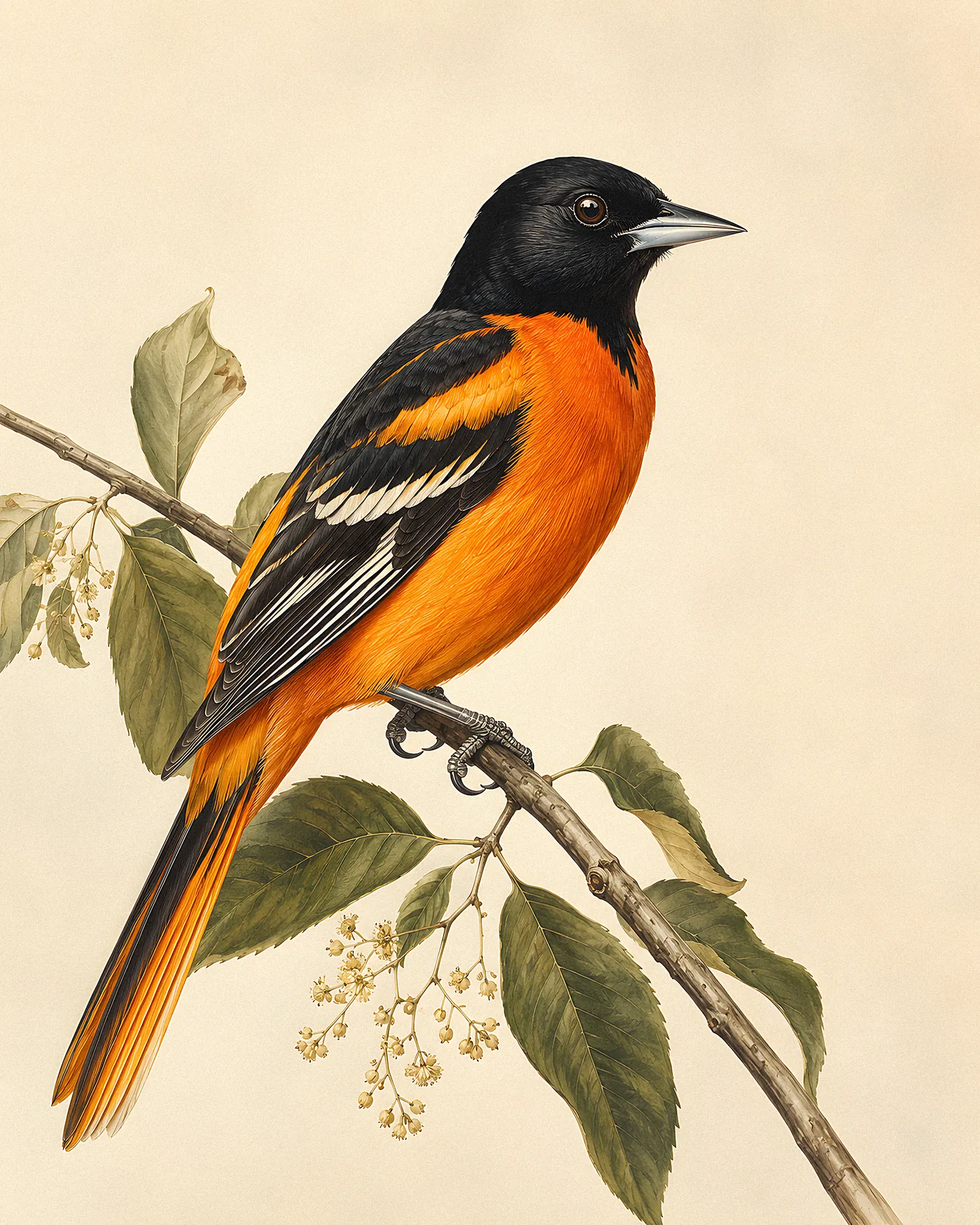
In an old apple orchard in Tennessee in May, a small dark oriole works through the blossom, and the colour is wrong for the family. Where the Baltimore burns orange, this bird is the deep red-brown of a chestnut just out of its husk, set against a black hood. It is the smallest oriole on the continent and the only one dressed in this brick-red livery, a bird so distinct that the people who named it reached for the Latin spurius, false, as if the colour itself were a counterfeit of the orange they expected.
The Orchard Oriole is the understated member of the family, smaller, darker and quieter than its relatives, and easy to overlook in exactly the hedgerows and orchards it likes best.
What he looks like
The adult male is unmistakable once seen, because no other North American oriole shares his palette. The hood, back, wings and tail are black; the breast, belly, rump and shoulder are a deep chestnut, a dark brick-red rather than orange. A single thin white or chestnut wing bar crosses the black wing. He is small and compact, the smallest icterid in North America, closer to a warbler than to the chunky Baltimore in heft.
The female is olive-green above and yellow-green below, plain and unmarked except for two white wing bars, and she reads as a generic small yellow bird until the slim oriole bill gives her away. The first-spring male is the famous puzzle: he looks like the female but adds a neat black bib on the throat and face, a one-year plumage that often gets mistaken for a different species entirely. He can breed in this in-between dress before the full chestnut arrives.
What he sounds like
The song is a fast, bright, tumbling warble, musical and run together, often compared to the song of a Purple Finch for its speed and richness. It comes in a hurry, a cascade of whistled and burry notes that ends almost before it has registered. The male sings most insistently through spring, from a perch in the open or buried in a leafy crown.
The common call is a sharp chuck and a dry chatter. The overall impression is of a quicker, busier voice than the leisurely whistling of the Baltimore, fitting a smaller, more restless bird.
Range and habitat
Icterus spurius breeds across the eastern and central United States, from the Great Plains east to the Atlantic and south into Texas and northeastern Mexico. It likes semi-open country with scattered deciduous trees: orchards, hedgerows, farmland edges, riverside groves, parks and the shrubby margins where wood meets field. It is a bird of edges and openings rather than deep forest, and as the name promises, it has a long association with orchards.
It is a true long-distance migrant, and an early one. Orchard Orioles leave the breeding grounds remarkably soon, many departing by midsummer, and winter from western Mexico south through Central America to northern Colombia and Venezuela. The species is sometimes loosely colonial, with several pairs nesting close together in a single grove, a sociability unusual among the orioles.
Diet
Summer is mostly insects. The Orchard Oriole takes caterpillars, beetles, grasshoppers and a wide range of other insects, along with spiders, gleaned from foliage and gathered through the canopy. As the season advances it adds berries and, like the rest of the family, nectar, probing flowers and visiting feeders for fruit and sugar water within its range.
It is a quick, active forager, working through blossom and leaf, and on the wintering grounds it is known to feed at flowering trees in numbers, taking nectar and the insects the flowers attract. Its small size lets it work the outer twigs and blossom clusters that heavier orioles bend down.
Breeding and nesting
The nest is a woven hanging pouch in the oriole tradition, but a shallower one than its relatives build, a neat cup-like basket rather than a deep sleeve. The female weaves it from grass and plant fibre, often using long green grass blades that dry into the finished structure, and lines it with fine grass and plant down. It typically hangs in the fork of a horizontal branch, frequently lower than a Baltimore’s nest, and sometimes in a clump of Spanish moss.
The clutch is usually four to six eggs. Where the species nests in loose colonies, several of these pouches may swing from trees within sight of one another. Both parents feed the young, and the whole cycle runs fast, in keeping with a bird that is already heading south while other orioles are still feeding chicks.
Early naturalists called it spurius, the false oriole, because a chestnut bird could not be the real thing. The smallest oriole in North America wears the one colour the family was not supposed to allow.
The understated oriole
It is easy to walk past the Orchard Oriole. It is small, it is dark, it skulks in blossom and hedgerow, and it leaves so early that many birders have packed away the idea of orioles before this one has even finished nesting. The brilliant Baltimore gets the attention; the chestnut Orchard gets the second look, if it gets one at all.
That is the case for paying it the first look instead. It is the smallest of its kind, the only one in chestnut rather than orange, the one that nests in companionable little groups and slips south in the heat of summer. The IUCN lists Icterus spurius as Least Concern, with a wide range and large population. The name calls it false. It is nothing of the sort. It is simply the oriole that decided orange was optional.