




A single Barn Swallow, ringed in Britain, was once recorded completing the 12,000-kilometre flight from Johannesburg to northern Europe in 34 days. That is not a species record. That is an ordinary bird doing what the species does.
Hirundo rustica is the most widely distributed swallow on earth. It breeds across Europe, Asia, and North America. It winters in sub-Saharan Africa, South America, and South Asia. The annual journey from a British farmyard to a South African reedbed and back is, by any reasonable measure, one of the more extraordinary feats in the animal kingdom - and most people in the UK notice it only when it fails to arrive. The Barn Swallow’s absence, in a late spring, is felt before its presence ever quite registers.
That is the swallow’s particular condition: it is everywhere and overlooked.
What she looks like
She is 15 to 20 centimetres long and weighs around 17 to 20 grams - lighter than a UK £1 coin. The wingspan runs 32 to 34 centimetres. The Animal Diversity Web records lengths up to 19.9 cm; the British Trust for Ornithology puts average adult weight at just under 20 grams.
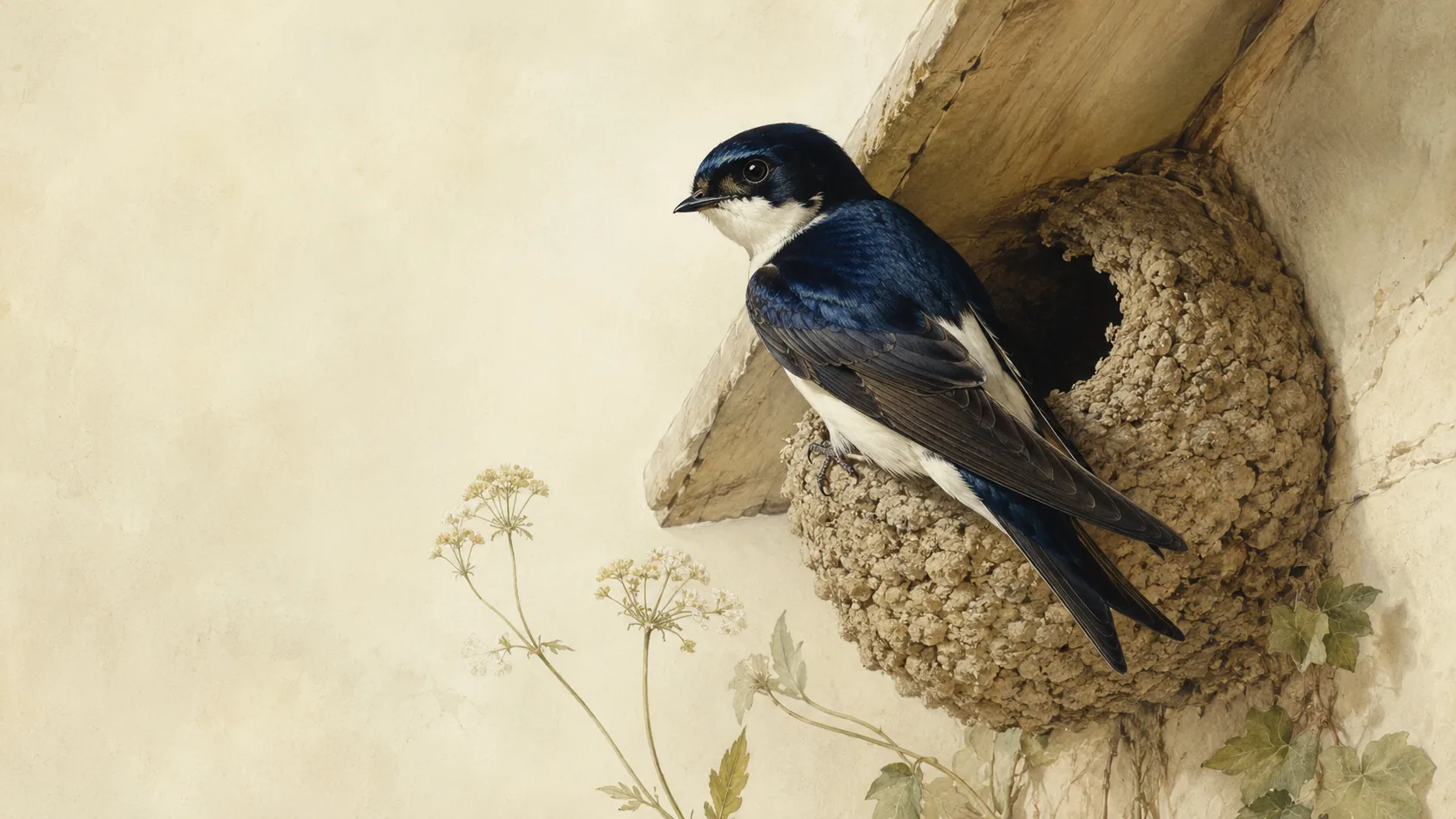
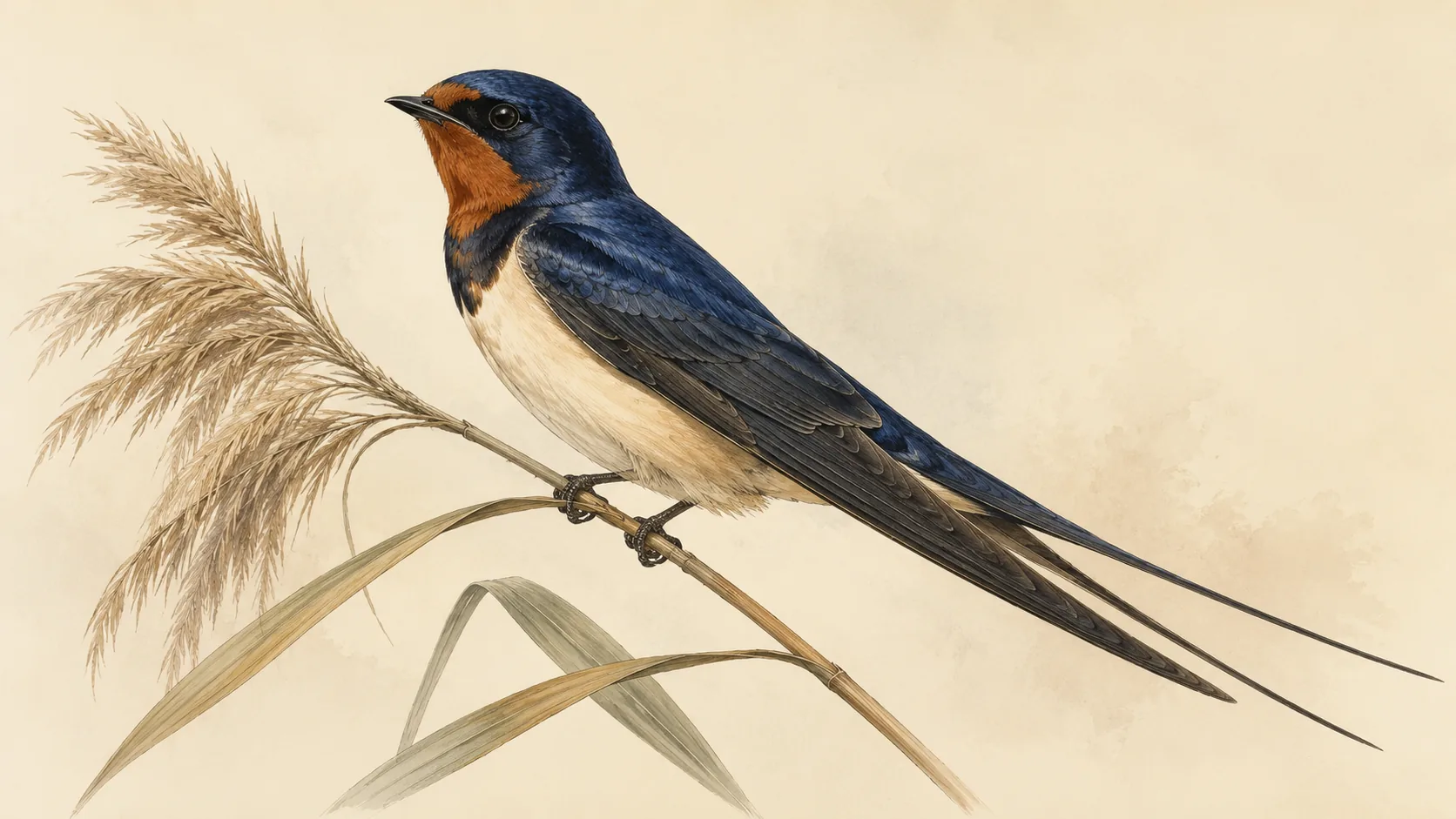
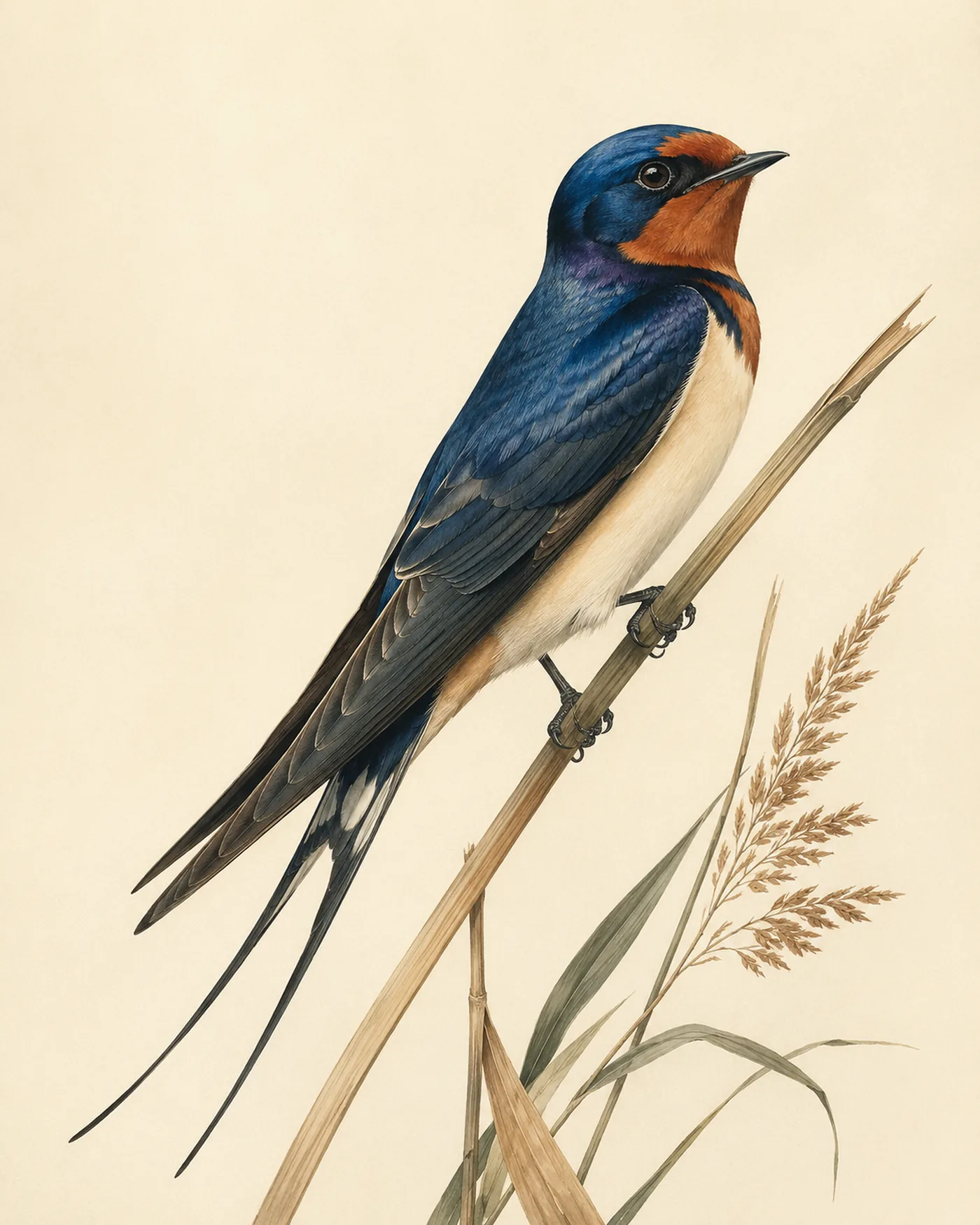
The back and wings are metallic blue-black. The forehead and throat are chestnut-red, sharply separated from the white or cream underparts by a dark blue-black breast band. The tail is the diagnostic feature: deeply forked, with long outer streamers extending beyond the central feathers in adults. The streamers are longer in males than females - a difference the females themselves measure and use. Males and females share the same basic pattern; she chooses him partly on the length and symmetry of those tail wires.
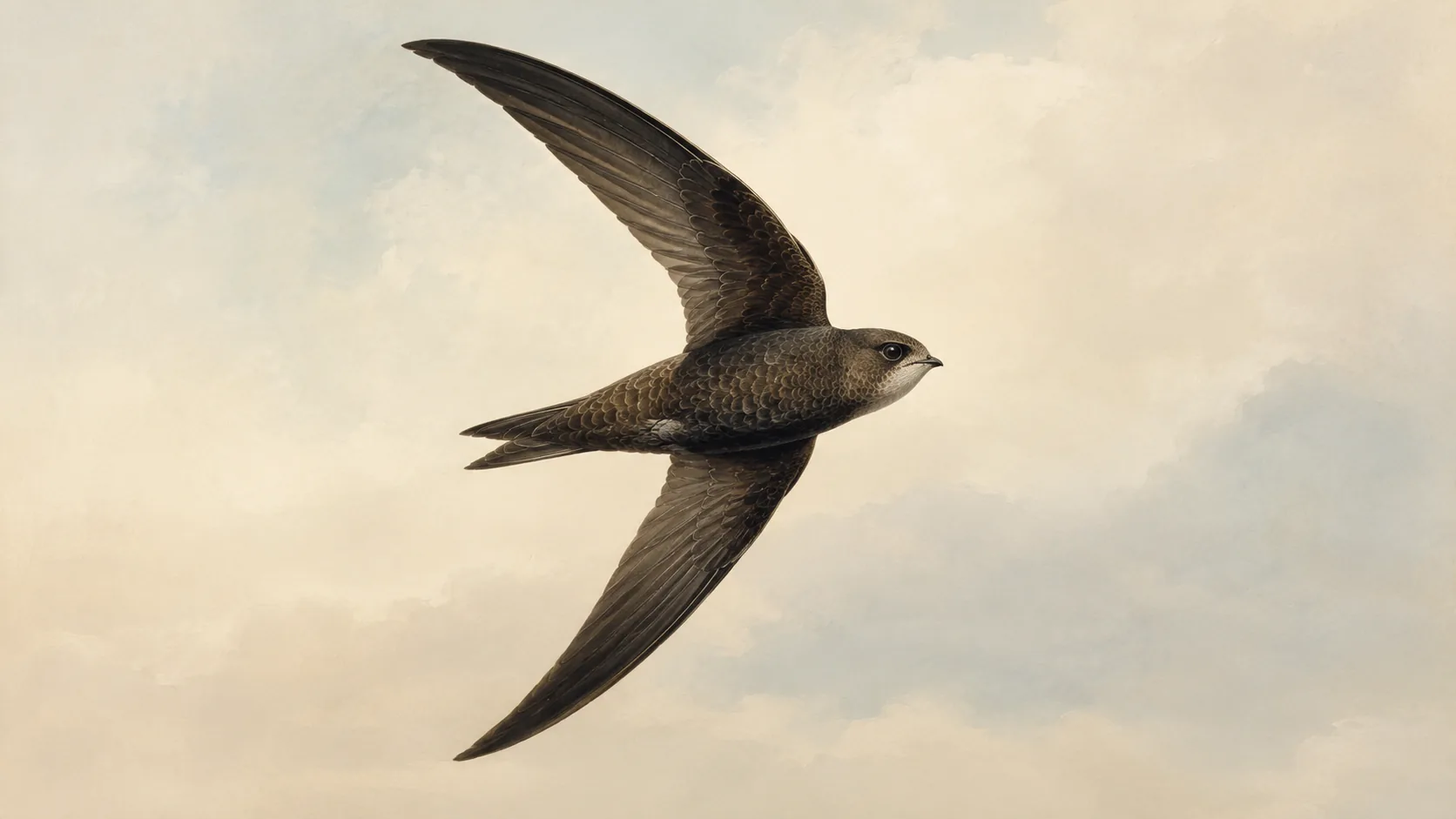
In flight, the silhouette is scythe-like. The wings are long and curved, the head small, the fork of the tail closing and fanning with each change of direction. The Woodland Trust describes the wings as appearing “curved and slender when perched.” Swift has a screaming, anchor-shaped silhouette and never perches on wires. House Martin has a white rump, a shallower fork, and a much shorter tail. Sand Martin is brown above with a breast band but no forked tail streamers. Among the four, the Barn Swallow is the one with the long tail wires.
What she sounds like
The call is a quick, liquid twit-twit or witt, often given in flight. The song is a long, rambling twitter - pleasant, domestic in character - delivered from a wire or roof beam. It carries no great distance and is easy to miss against the background noise of a working farm.
More diagnostic than the song is the flight call given near the nest when a predator approaches: a sharp, insistent sifit-sifit that tightens as the threat closes in. Other small birds respond to it. In the compressed acoustic world of a barn interior, it is one of the more alarming sounds in rural Britain.
Range and habitat across the year
The Barn Swallow is a summer visitor to Britain and Ireland, arriving from April and departing by October. The BTO records it as present in 95 per cent of 10-kilometre squares across Britain and Ireland during the breeding season and fewer than 10 per cent of squares in winter - which is to say it is, in practical terms, absent. It winters in sub-Saharan Africa, with the bulk of the British and European population moving south through Iberia and across the Strait of Gibraltar, then down the length of the continent.
The favoured breeding habitat is open farmland with access to water - pasture, meadows with grazing livestock, field margins, rivers, and ponds. The association with livestock is not incidental. Cattle and horses disturb the soil and dung, producing the flies and other flying insects on which the swallow feeds exclusively. The BTO notes that the 25 per cent decline in UK breeding numbers between 1995 and 2023 tracks closely with the intensification of arable farming and the loss of mixed livestock operations, particularly in eastern England. In the west and north, where pasture remains, populations are more stable.
Before departing in autumn, swallows gather in large pre-migratory roosts - often in reedbeds - sometimes numbering in the thousands. These roosts, a familiar sight over wetlands in late September, represent the entire UK breeding season compressed into a few acres of phragmites.
Diet
The Barn Swallow eats nothing but flying insects, caught entirely in the air. Flies, aphids, beetles, wasps, moths, and winged ants all appear in the diet. Cornell Lab’s Birds of the World records the species as hunting low over fields and water, often within half a metre of the surface, snatching prey in the bill mid-flight. There is no other feeding method. The swallow never lands to forage and never visits a garden feeder.
This is the constraint that makes population trends so directly legible: if flying insects decline, swallows decline. The Wildlife Trusts and BTO both note that the reduction of insect abundance across the UK - linked to pesticide use, habitat loss, and pollution - is the primary pressure on the species. The Barn Swallow is, in that sense, an insect-abundance indicator with wings.
Breeding and nesting
The nest is a cup of mud pellets and dried grass, lined with feathers. Both sexes build it, pressing wet mud into the chosen surface with bill and breast, letting it dry, and adding more. Cornell’s Birds of the World notes that the shift from natural cave-nesting to artificial structures - barns, bridges, garages, open sheds - was virtually complete by the mid-twentieth century. The birds now almost never nest on natural substrates in Britain. They need an open structure they can enter freely; a closed building is useless to them.
Females lay four to five eggs per clutch and typically raise two broods between May and August, sometimes three. The incubation period is 13 to 15 days. Fledglings leave the nest at around 20 days old. In a behaviour documented in modern fieldwork, young from earlier broods sometimes remain at the nest site and help feed the chicks of later broods - what ornithologists call cooperative breeding, unusual among passerines and suggestive of a social complexity that the bird’s streamlined silhouette does not obviously advertise.
The tail, the mate, and the measure of quality
The Barn Swallow is one of the most-studied species in the science of sexual selection, largely because of work by the Danish biologist Anders Moller beginning in the 1980s. Moller’s experiments showed that females preferred males with longer, more symmetrical tail streamers, and that tail length correlated with parasite load - specifically, with the bird’s resistance to feather lice and blood parasites. A male with long, symmetric streamers was advertising genuine immunological quality. The tail is an honest signal because it is genuinely costly to grow and maintain.
This work became central to the theory of ‘good genes’ sexual selection - the idea that female choice is not arbitrary preference but a mechanism for selecting heritable quality. The Barn Swallow did not make the theory, but it provided some of the cleanest evidence for it, and the species appears in a significant portion of the empirical literature on the subject.
The swallow arrives each April as proof that twelve thousand kilometres of migration and a Saharan crossing are within the reach of a bird that weighs less than two coins. It leaves each autumn unremarked. The account of what it actually does runs considerably ahead of the notice it receives.