
In late June, when most of the neighbourhood songbirds have already hatched a clutch and are halfway through a second, the male Spinus tristis is still building his nest. He is not slow. He is exact. He has been waiting for the thistles.
The American Goldfinch is the strictest vegetarian in the North American passerine world. He and she feed their nestlings nothing but regurgitated seed - no caterpillars, no grubs, no spider eggs as a supplement. This matters for a particular reason: brown-headed cowbirds, which lay their eggs in other birds’ nests and let the host parents raise the young, routinely target late-season nesters. But cowbird chicks cannot survive on a diet of pure plant seed. They die within three days. The goldfinch’s stubborn granivory is, in effect, a parasite defense that looks like a dietary limitation. Cornell Lab of Ornithology’s All About Birds notes this plainly: goldfinches are among the strictest vegetarians in the bird world, and the cowbird knows it.
The thistle waits for no bird, but the goldfinch has learned to wait for the thistle.
What he looks like
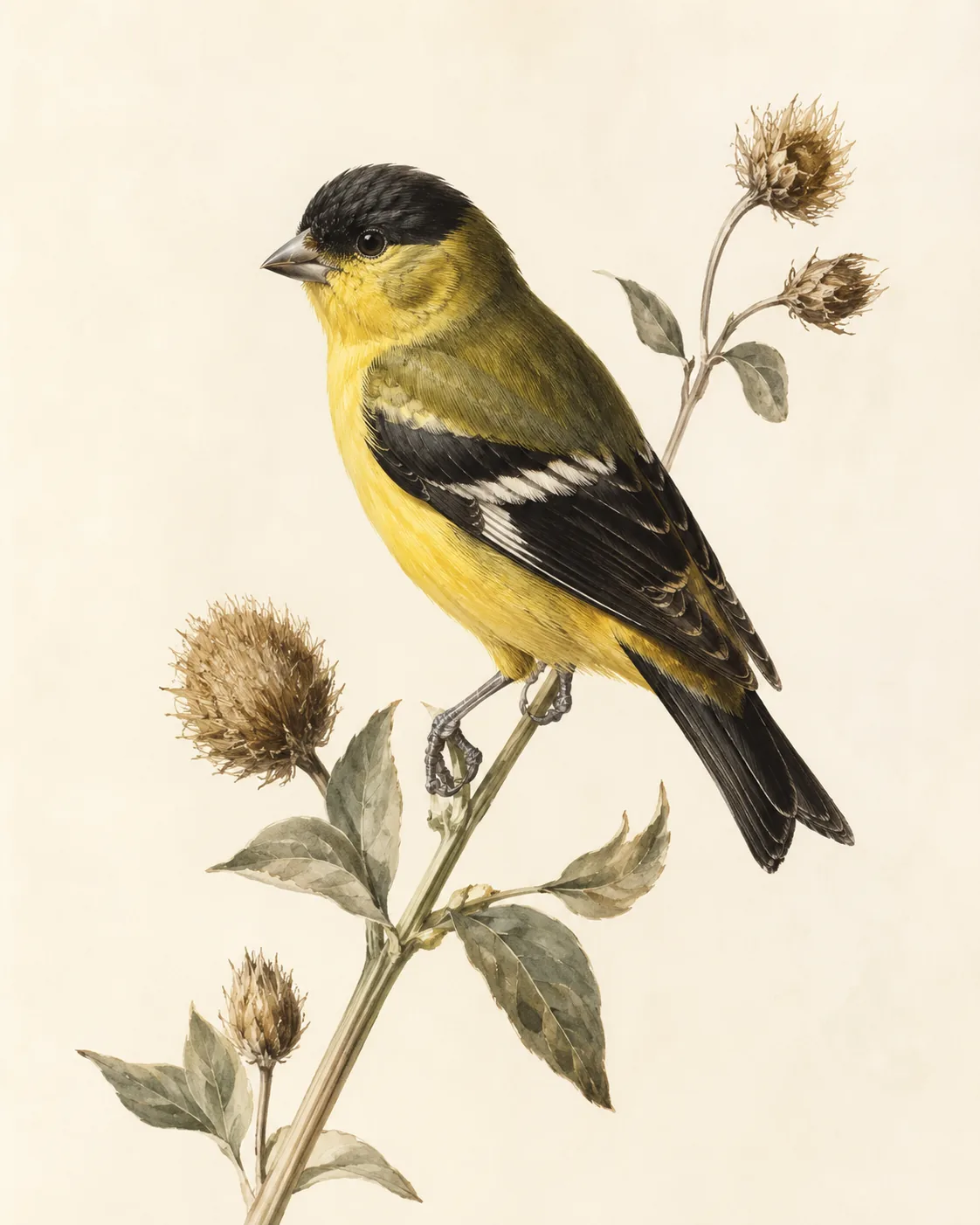
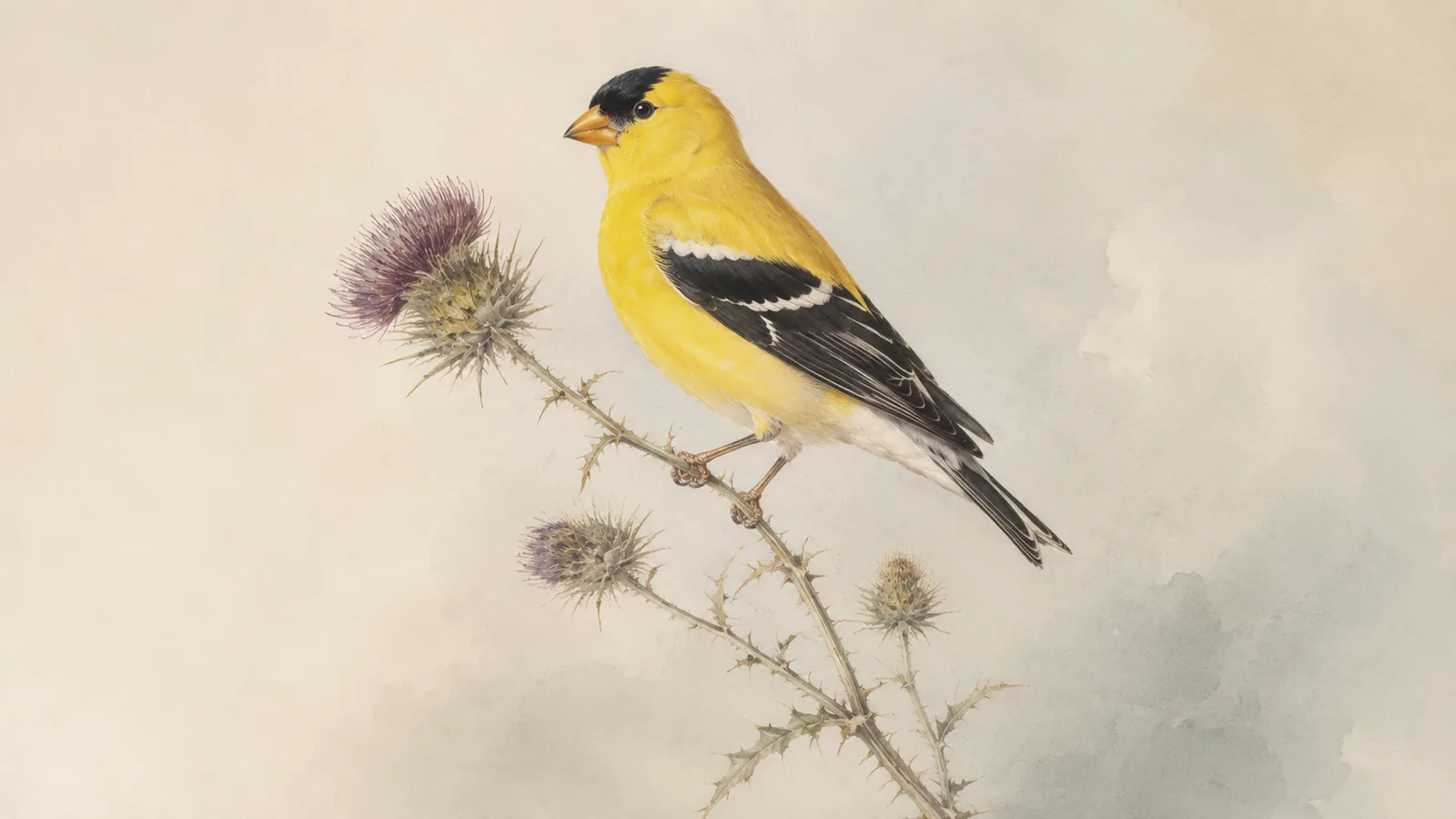
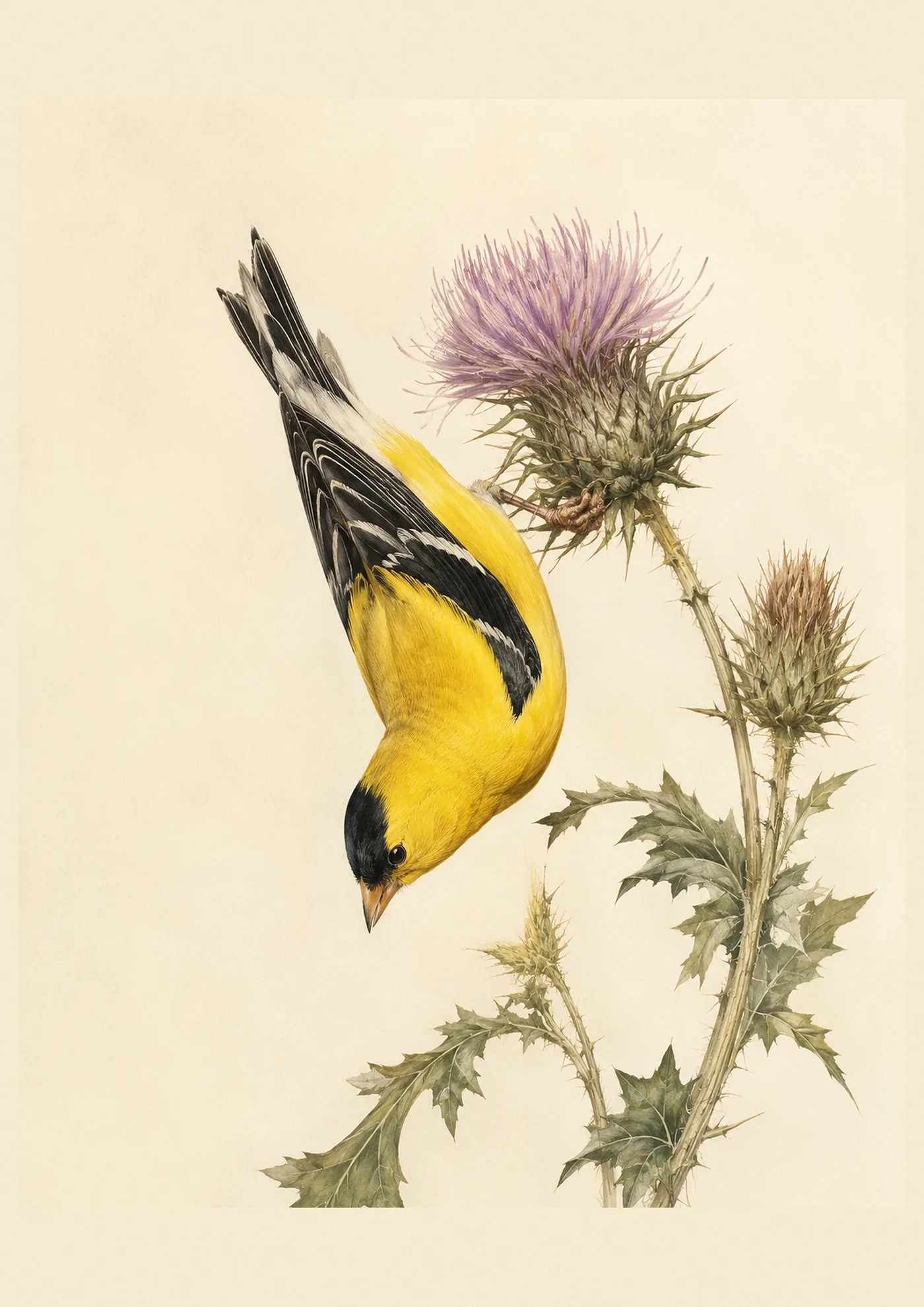
A breeding male is 11 to 13 centimetres long and weighs as little as 11 grams - roughly the weight of three pennies. His back is lemon yellow, his forehead carries a sharp black cap, and his wings are black with two crisp white bars. The bill is pale orange-pink, conical, and built for splitting seed husks. He is small enough to grip and rotate a thistle seedhead while feeding, which he does with gymnastic ease.
The female is yellow-green above, pale yellow below, with the same dark-winged pattern in a slightly duller register. She has no black cap. In winter, both sexes turn the colour of dry grass: warm olive-buff with faint buff wing bars, the yellow all but gone. A February goldfinch at a thistle feeder looks like a different bird from the one that was there in July.
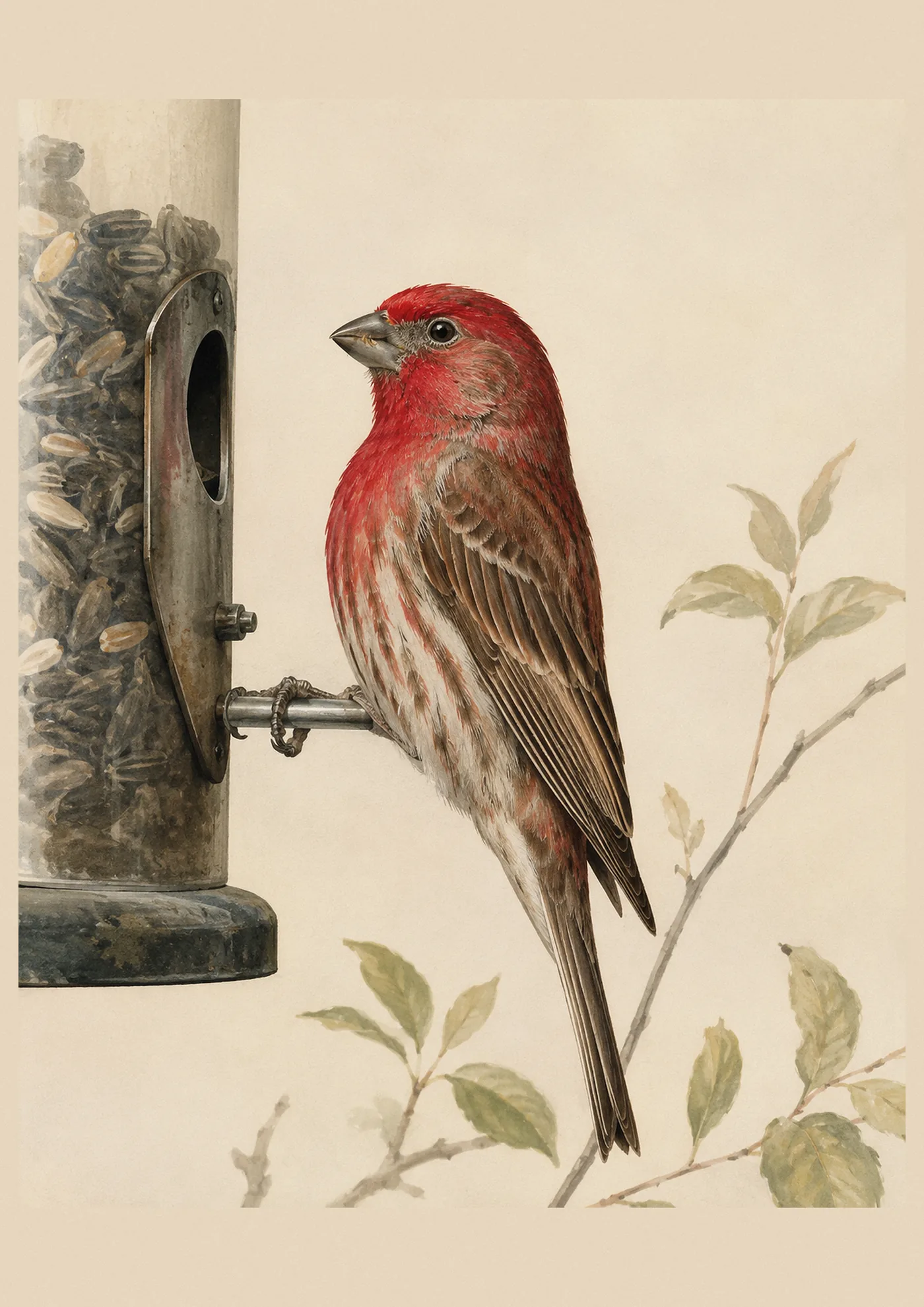
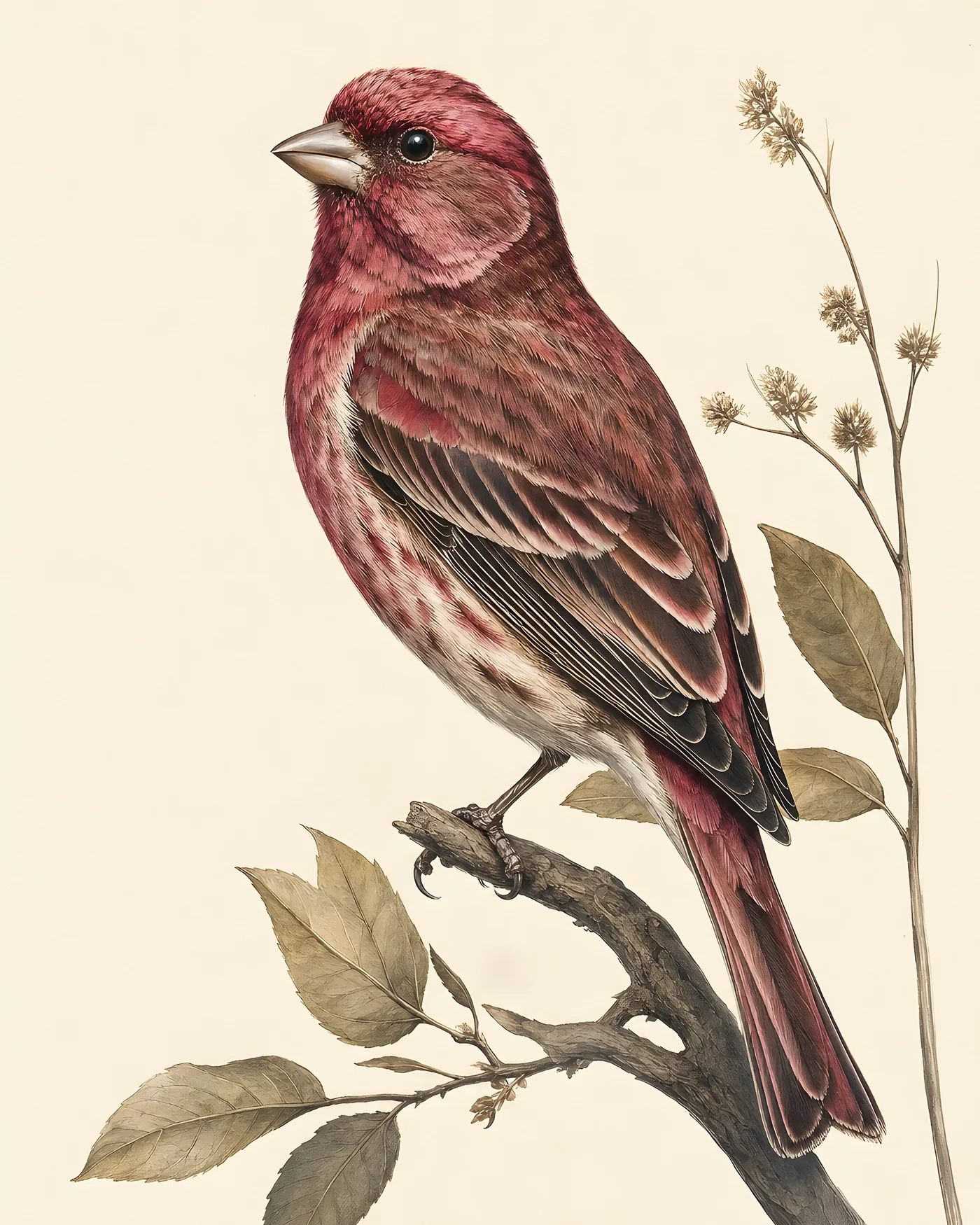
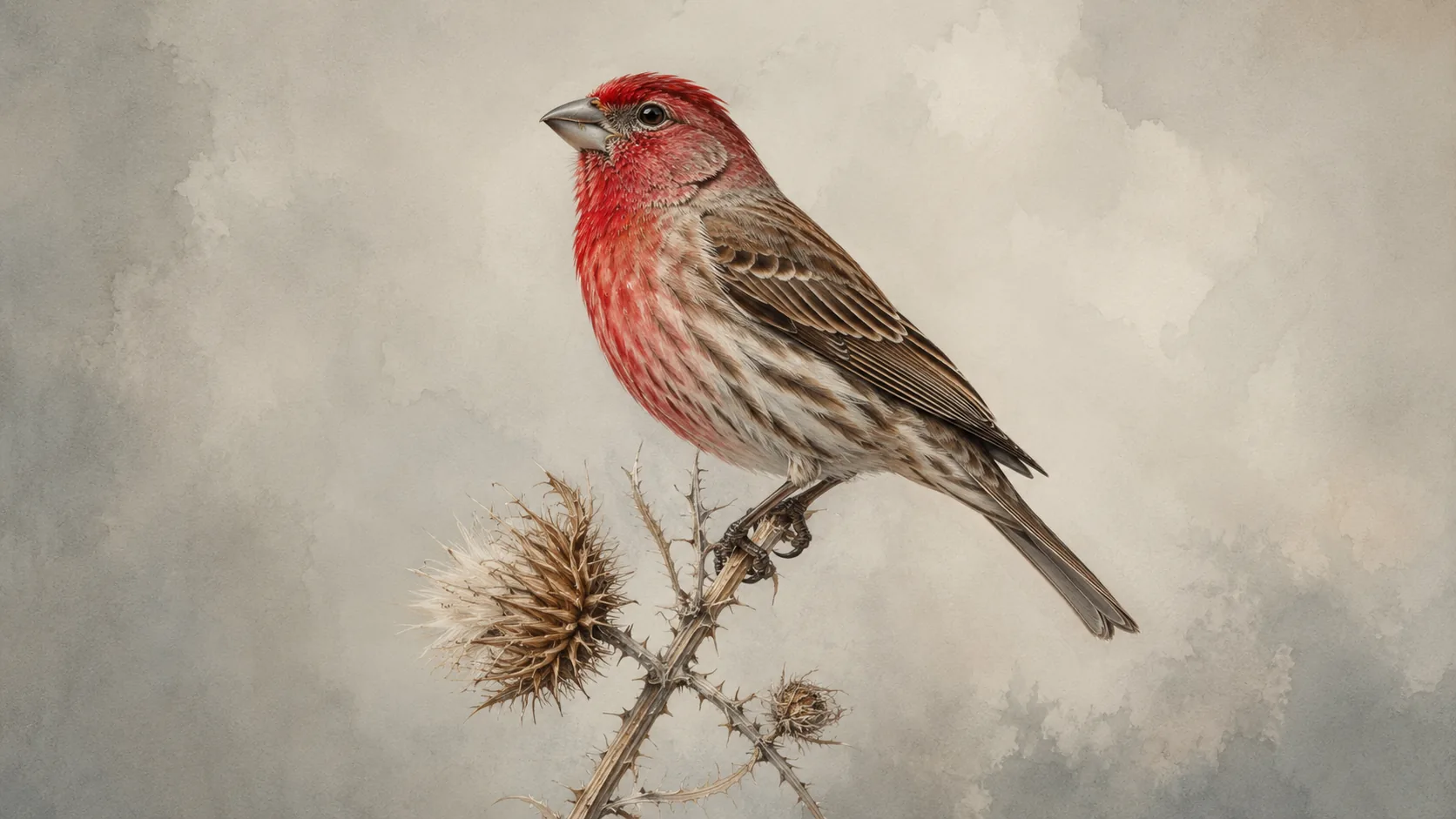
The species that can cause confusion are few. The Lesser Goldfinch, present across the western half of the continent, is smaller with a darker back and green (not yellow) in the female’s plumage. House Finch males are streaked red, never solid yellow. Yellow Warbler males approach the breeding male’s yellow but are slimmer, shorter-billed, and streaked with rust on the chest.
Voice
The contact call is a four-syllable phrase that birders reliably transcribe as po-ta-to-chip, delivered in flight, with a buoyant cadence that matches the bird’s undulating wingbeat. The song is a long, wheezy, canary-like outpouring of trills and twitters; the male sings it from an exposed perch or on the wing. Animal Diversity Web documents six distinct call types, from the flight contact call to short chip notes between foraging pairs.
The call carries through weedy fields and suburban gardens where the bird spends most of its time. Learn it and you will start hearing goldfinches everywhere - in the overgrown lot by the supermarket, above the community garden in September, over the highway verge still thick with goldenrod.
Range and habitat across the year
The goldfinch is a year-round presence across most of North America below the boreal treeline, ranging from southern Canada through all of the continental United States and into northern Mexico in winter. Some populations are genuinely migratory, moving south from Canada and the northern states when cold compresses the seed supply. Others, particularly in the mild-winter South, stay put and are joined by northern birds.
Habitat is any open or semi-open ground with weedy plants in it: old fields, roadsides, stream edges, forest clearings, suburban gardens. The goldfinch does not need trees for food, only for shelter and, in nesting season, for the placement of his cup. He is most visible in late summer when thistle, goldenrod, and sunflower heads are ripe, and the birds move through them in loose, calling flocks. In winter, the flocks are larger and more nomadic, moving between feeders and weed patches in ways that Cornell Lab describes as closely tied to local food supply.
Diet
Nearly exclusively seeds. Thistle and other composites (sunflower, aster, goldenrod) form the core of the diet. Birch, alder, and elm seeds are taken when available. Insects are swallowed only accidentally while foraging, according to Cornell. The bill is specialised: short, conical, with enough leverage to crack the papery husks of small seeds.
At feeders, nyjer (sometimes marketed as thistle) seed fills a purpose-built tube feeder. The goldfinch will also take hulled sunflower hearts. He grips the feeder port with both feet and works methodically, eating with his head down, his back to the wind, his black wings folded like a delta kite.
Breeding and nesting
Nesting begins in late June and peaks in July and August, weeks after most songbirds have finished. The female builds the nest alone: a tight, deep cup of plant fibres and spiderwebs, lined with the soft down of thistle and cattail, woven so densely that it holds water. The construction takes about six days. The nest sits in the fork of a deciduous shrub or tree, rarely above 10 metres.
She lays four to six eggs, pale blue to white. She incubates alone for about 12 to 14 days, fed by the male throughout. Chicks fledge at around 11 to 17 days. Experienced pairs may attempt a second brood if the season is long enough; most pairs raise one.
The late nesting is not a consequence of the bird being a slow-developing species. It is a deliberate timing, calibrated over evolutionary time, to the seed head. The nest lining is made of thistle down. The food is thistle seed. The nest cannot go up, and the young cannot be fed, until the thistle blooms. The goldfinch has built his entire reproductive calendar around a single plant family.
The double moult
Among cardueline finches, the American Goldfinch is alone in moulting twice per year. Most finches moult once, after breeding, and wear that plumage for 12 months. The goldfinch moults in late summer, into the subdued olive-buff winter plumage, and again in late winter through early spring, into breeding yellow. Cornell’s Birds of the World notes this as a distinguishing feature of the species: two complete cycles of feather replacement per year, requiring a sustained investment of protein and energy.
The spring moult is where the courtship stakes are paid. Male carotenoid pigmentation - the yellow brightness - is derived directly from dietary sources. A male who has had access to carotenoid-rich seeds through the winter arrives at the spring moult brighter than a male who has not. Cornell research notes that colour in breeding males correlates with foraging ability. The female, choosing, is reading the feathers as a record of the preceding winter.
What the timing means
Most accounts of the goldfinch describe him as a late nester and leave it there. But the lateness is not arbitrary. It threads through everything: the moult calendar, the food supply, the parasite-proofing, the nest materials. Pull any one of those threads and the others move.
The goldfinch has committed, more completely than almost any other North American bird, to the annual cycle of a single plant family. The thistles are his. The goldenrod is his. The weedy margins of farms and roadsides and suburban lots - those are his range. The IUCN lists the species as Least Concern, with a wide distribution and large population. But Audubon field records note localised declines in areas where weed-management and herbicide use have reduced the availability of native seed-producing plants.
The goldfinch does not eat the weed. He eats the seed the weed makes. Keep the weedy edges of things, and the goldfinch stays. Clear them, and one spring the po-ta-to-chip call no longer comes from the goldenrod. The bird did not go far. He went wherever the thistle went.