Field Guide
Black-billed Magpie
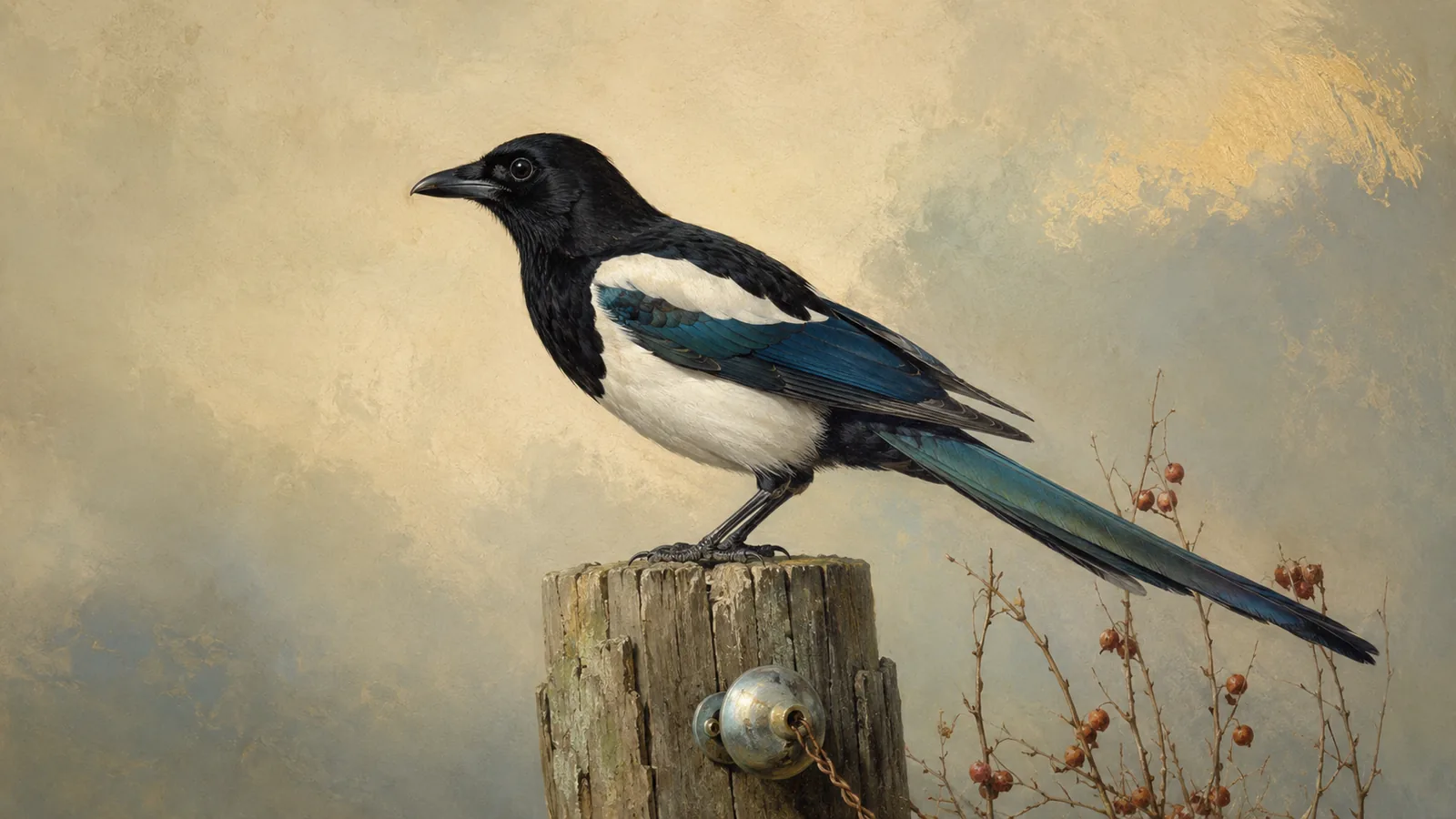
A fencepost on the eastern slope of the Montana foothills. A bird the size of a small crow lands on it, and the tail - long, tapered, shifting through bronze and green as the light moves - doubles the bird’s apparent length. It turns its head once, takes in the cattle in the pasture below, and launches forward with two wingbeats and a glide. The white wing patches flash. The call comes back: a staccato, nasal mag mag mag that carries two hundred metres in the still morning air.
Pica hudsonia, the Black-billed Magpie, is one of the most immediately recognizable birds on the North American continent. It is also one of the most consistently underestimated. Much-maligned by farmers who resent its boldness at carcasses, celebrated in Indigenous tradition as a companion of the hunt, catalogued by Lewis and Clark as entering their tents to steal food - this is a bird with a long and complicated relationship with people. It builds a roofed house. It buries its food and remembers where it put it. Under defined circumstances, it gathers around its dead and appears to mourn.
The thesis of this account is simple: Pica hudsonia is a brilliant bird. It is time to stop describing it as a pest.
What it looks like
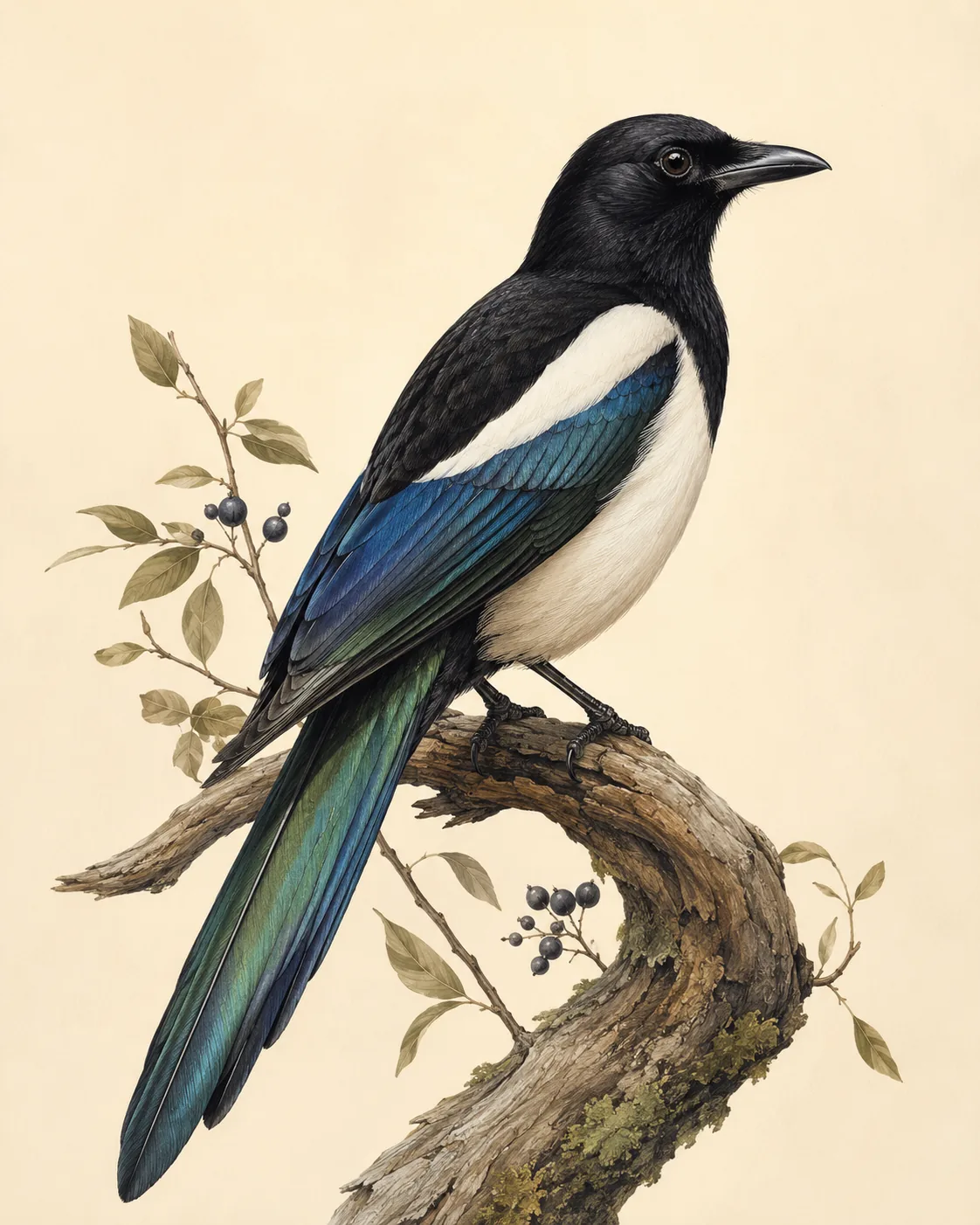
The Black-billed Magpie is 45 to 60 centimetres long from bill tip to tail tip, and the tail accounts for roughly half of that. The Audubon Society Field Guide records wingspan at 56 to 61 centimetres and weight at 145 to 210 grams - a bird heavier than a Northern Flicker, lighter than an American Crow.
The basic pattern is stark: a black head, breast, back, and tail, a white belly and flanks, and white patches on the inner primaries that blaze in flight. But the word “black” does the wings and tail a disservice. At any angle that catches direct light, the flight feathers and the long graduated tail are iridescent - shifting from bronze to green to blue-green depending on the angle, a structural colour produced by microscopic layers in the feather barbs rather than pigment. The bill is black and heavy for a corvid of this size, slightly curved at the tip.
The tail is the defining feature. It is graduated - the central feathers longest, the outer ones progressively shorter - giving a diamond or wedge shape in flight that no other North American bird replicates. In a perched bird the tail often droops at a downward angle from the body, reinforcing the impression of a creature always slightly off-balance, always about to tip forward.
The sexes are similar in pattern. Males average slightly larger.
The roofed nest
No other North American bird builds a structure quite like it.
The nest of Pica hudsonia is a dome - a large globe of sticks and branches, roughly 90 centimetres high and 60 centimetres wide, with a mud or dung base, a cup lined with grass, rootlets, and animal hair, and - the detail that stops people - a roof. A proper roof of interlaced sticks assembled over the cup, leaving side entrance holes rather than an open top. The Audubon Society Field Guide describes it as “a huge globular canopy of sticks about three feet in diameter, with entrance holes on either side.”
Both sexes build, starting in February, and the process takes 40 to 50 days. The male collects the exterior sticks. The female shapes the inner cup and mud base. The finished structure is used by one pair in a breeding season and then frequently appropriated by owls, kestrels, or other cavity-seeking species in subsequent years - a second ecological service delivered involuntarily.
The nest is usually placed in a thorny shrub or the lower canopy of a cottonwood or willow near water, though pairs in the suburban West have adapted to building in ornamental plantings and hedgerows. Clutch size runs from five to nine eggs, typically six. The female incubates alone for 16 to 21 days. Both parents feed the young, which fledge after 24 to 30 days. The Cornell Lab of Ornithology’s All About Birds records the oldest confirmed wild individual as at least nine years and five months, recaptured in Saskatchewan in 2021.
The intelligence and the funerals
Corvids as a family have been accumulating cognitive credentials for decades. Pica hudsonia is no exception.
The bird caches food - burying surplus insects, carrion, and grain in small ground depressions, then relocating the caches days or weeks later. This requires not only memory for location but episodic-like memory for what was hidden and when. Research published in Psychonomic Bulletin & Review by Magnotti, Wright, Katz, and Kelly (2017) found that Black-billed Magpies performed at the same level as Clark’s Nutcrackers - the corvid most celebrated for spatial memory - on abstract-concept learning tasks, and outperformed both primates and pigeons tested with the same exemplars. The study used same/different matching tasks to evaluate abstract rule extraction: the magpies were not performing a memorized trick. They were applying a concept.
More arresting is what happens when a magpie finds one of its own kind dead.
In 2009, the ethologist Marc Bekoff published observations of four magpies gathered around a dead conspecific. One bird approached and gently pecked at the body. Another did the same. One flew off, returned carrying grass, and laid it beside the corpse. A second bird did the same. Then all four stood in apparent stillness for several seconds before leaving, one by one. Bekoff published this in Emotion, Space and Society (volume 2, issue 2, pages 82-85), noting with appropriate caution that he could not claim certainty about internal states. What he could claim was the behaviour: gathering, touching, placing material, standing vigil. He called it a “magpie funeral” and acknowledged the term was interpretive. Other researchers reported similar observations in ravens and crows after the paper appeared.
Whether the birds are “mourning” in any sense a human would recognize is genuinely unknowable. What is not unknowable is that they are doing something specific and deliberate around their dead - something that required them to stop, approach, and act. That is worth noting without either overclaiming it or dismissing it.
| Measurement | Value |
|---|---|
| Total length | 45 - 60 cm |
| Weight | 145 - 210 g |
| Wingspan | 56 - 61 cm |
| Nest diameter | approx. 90 cm |
| Clutch size | 5 - 9 eggs (typically 6) |
| Incubation | 16 - 21 days |
| Fledging | 24 - 30 days after hatching |
| IUCN status | Least Concern |
What it sounds like
The standard call is a rapid, nasal mag mag mag or yak yak yak - flat to slightly rising, carrying well across open ground. The Audubon Field Guide transcribes it as a “harsh, rasping” series with a querulous quality. At closer range the bird produces softer conversational chattering, and observers have noted that pairs in proximity to each other maintain an almost continuous low-level commentary that suggests the calls carry social information beyond simple alarm.
The alarm call has two registers: a steady rattling series for a distant threat, a faster, higher-pitched staccato for something close. Both carry across a pasture with ease. The voice is not musical in the way of thrushes, but it is expressive in a way that rewards attention.
Range and habitat
Pica hudsonia is a bird of western open country - rangeland, sagebrush plains, riparian corridors of cottonwood and willow, the edges of conifer stands, and the margins of farmland. It avoids unbroken forest and treeless desert. The Animal Diversity Web records the range as extending from northwestern Alaska through the prairie provinces of Canada south to northern Arizona, New Mexico, and western Texas, with elevations documented up to 3,000 metres.
It is largely resident year-round. There is some altitudinal movement in winter but no long-distance migration.
The bird’s relationship to large mammals defines much of its ecology. Before European settlement, Pica hudsonia followed bison herds across the Great Plains, gleaning ticks and insects from the animals’ backs and scavenging kills. Lewis and Clark encountered magpies on the 1804 to 1806 Expedition and recorded them entering the expedition’s camp to steal food. When bison were eliminated from the plains in the 1870s, the magpie pivoted to cattle - as it had always done, the same behaviour, a different host species. That adaptability is a recurring theme.
In Wyoming and Colorado ranch country today, magpies are a fixture on horseback rides and cattle yards, landing on livestock to pick ticks and flies from hide and open wounds. The relationship is not purely parasitic - tick removal benefits the host - but it is not without risk to the cattle either, and the bird’s reputation in agricultural communities reflects that ambiguity.
Diet and breeding
Pica hudsonia is omnivorous with a strong insect component - more consistently insectivorous than most of its corvid relatives. The Audubon Society Field Guide records grasshoppers, caterpillars, flies, and beetles as dietary staples, alongside carrion, small rodents, songbird eggs and young, grain, and seasonal fruit. The insect emphasis matters in summer, when the bird hunts on foot through short grass with the deliberate, head-down searching posture shared by most corvids feeding terrestrially.
Food is cached in small depressions, covered with a leaf or clod of earth. Surplus from a bison or cattle carcass, gleanings from a granary, beetles found on a dung pile - all go into the cache system, which the bird returns to over days and weeks. The precision of cache retrieval depends on spatial memory that experimental research has confirmed is genuinely sophisticated rather than merely incidental.
Breeding begins in late winter. Pairs appear to be monogamous across seasons, with males guarding females closely during the pre-laying period. Nest construction starts in February and the first eggs are typically laid in March or April. The female incubates alone. The male delivers food to her at the nest. Young are fed by both parents through the nestling period and for several weeks post-fledging, reaching full independence at roughly 70 days.
The Eurasian Magpie - Pica pica - is the Old World counterpart, nearly identical in appearance and behaviour, with a range covering most of Europe and temperate Asia. The two were long treated as a single species. Genetic analysis separated them in 2000. The distinction matters less to the birds than it does to taxonomists.
A magpie lands on a dead magpie and places a sprig of grass beside it. We cannot know what this means to the bird. We can know that it is not random. The gap between those two statements is where the interesting questions live.
The Black-billed Magpie is common enough that familiarity has blunted attention to it. The fence-post bird is easy to overlook, its mag mag mag easy to tune out. But look at it in morning light - the tail catching green, the white patches flaring as it lifts off - and consider what it is actually doing in the world: building a roofed structure with two doors, caching food it can find again six weeks later, gathering around its dead with apparent purpose. This is not a nuisance bird. It is a corvid at full stretch. The Great Plains are lucky to have it.