Field Guide
Eastern Screech-Owl
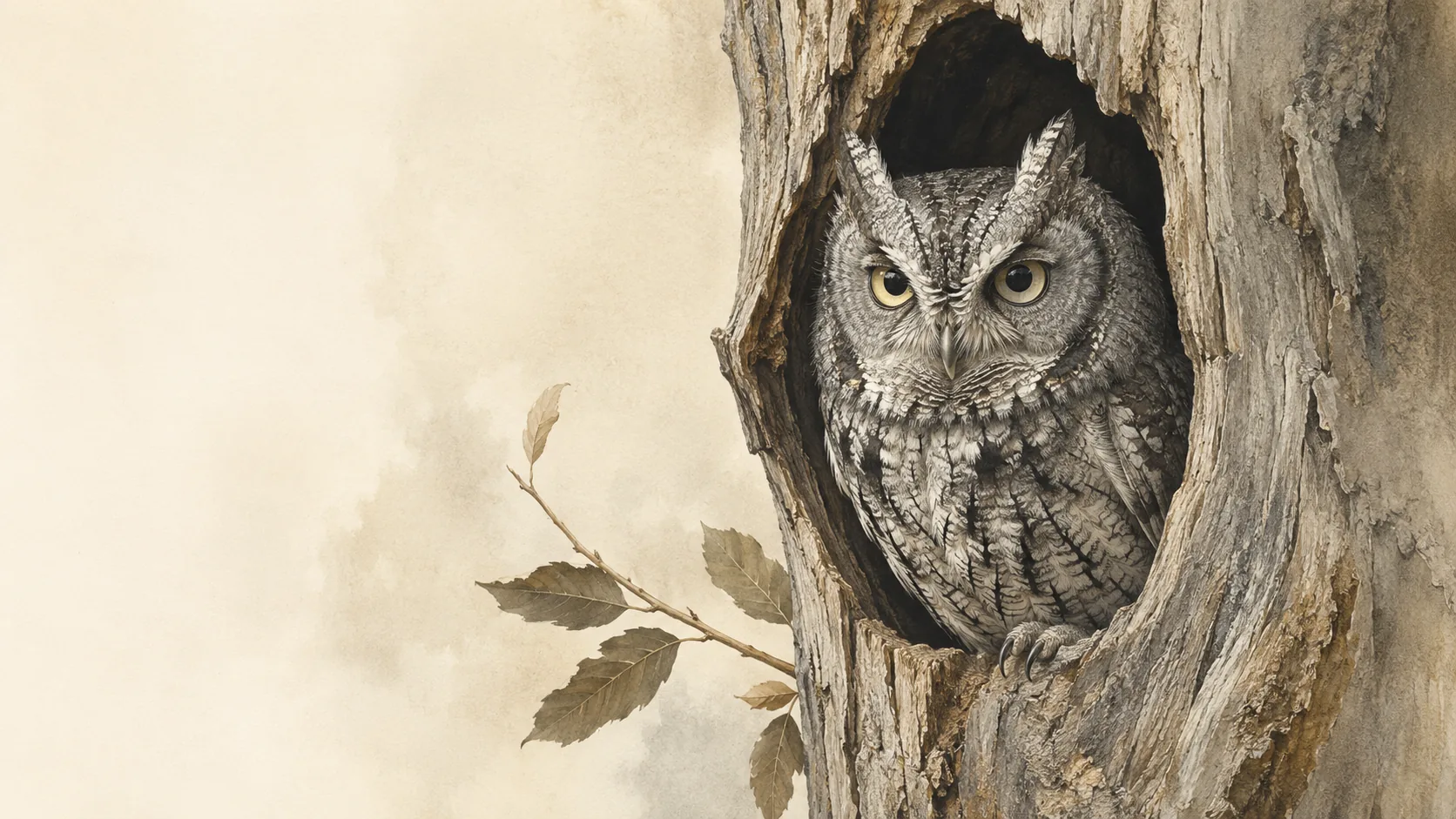
A late April night in a Virginia suburb. The dogwoods are still in bloom. In the hollow of a red maple that the homeowners have been meaning to have trimmed for three years, five owlets sit shoulder to shoulder, waiting. Their mother has been gone for 40 minutes. She returns in silence, carrying nothing that looks like prey. It is a snake - alive, wriggling, about 18 centimetres of Texas blind snake that she drops into the wood-chip debris at the base of the cavity before the owlets can intercept it. The snake buries itself. The owlets settle. In the dark below them, the blind snake is eating the fly larvae and parasitic insects that would otherwise eat the owlets.
This is Megascops asio, the Eastern Screech-Owl, and it is the most interesting small raptor on the continent. Not because of what it hunts, though the diet runs to beetles, moths, crayfish, small frogs, and occasionally bats. Not because of how it hunts, though the flight from a low perch is precise enough to take a mouse in leaf litter by sound alone. Because of what it knows. The Audubon field guide notes the blind-snake behaviour specifically. Cornell’s Birds of the World records it as documented behaviour across the species’ range. A 1987 study by Baylor University biologists Frederick Gehlbach and Robert Baldridge, published in Oecologia, found that owl chicks in nests containing live blind snakes grew faster and fledged in better condition than those in nests without them. The owl did not learn this from a parent demonstrating the technique in the way a corvid might. It is a behaviour that has accumulated over deep time, selected for in a cavity nester that had to solve the parasite problem without the option of a cleaner nest.
That is the thesis this bird earns: the Eastern Screech-Owl is more ecologically sophisticated than its suburban reputation suggests, and its apparent ordinariness - it is common, adaptable, unfussy about habitat - conceals an animal that repays close attention.
Identification and appearance
The screech-owl is a small owl, 16 to 25 centimetres long, weighing 121 to 244 grams, with a wingspan of 46 to 61 centimetres. Females are slightly larger than males, which is standard for raptors. The Cornell All About Birds pages note that birds from the northern end of the range average larger than those from Florida, where the smallest populations occur.
Two colour morphs exist, and both are common: gray and rufous (reddish-brown). A third brown intermediate form appears less frequently. Neither morph is tied to sex or age. The gray morph is more prevalent in the colder, drier parts of the range; the rufous morph predominates in warmer, moister areas. Both are cryptically patterned with fine dark streaks and bars that render the bird nearly invisible against tree bark. The camouflage is so effective that a roosting screech-owl at the entrance to a tree cavity can be overlooked at arm’s length.
The face is the giveaway when the bird does look at you: yellow eyes, a yellow-green bill base, short ear tufts (which are feather crests, not ears), and a round facial disc that funnels sound toward the actual ear openings, which are slightly asymmetrical, improving directional hearing in three dimensions.
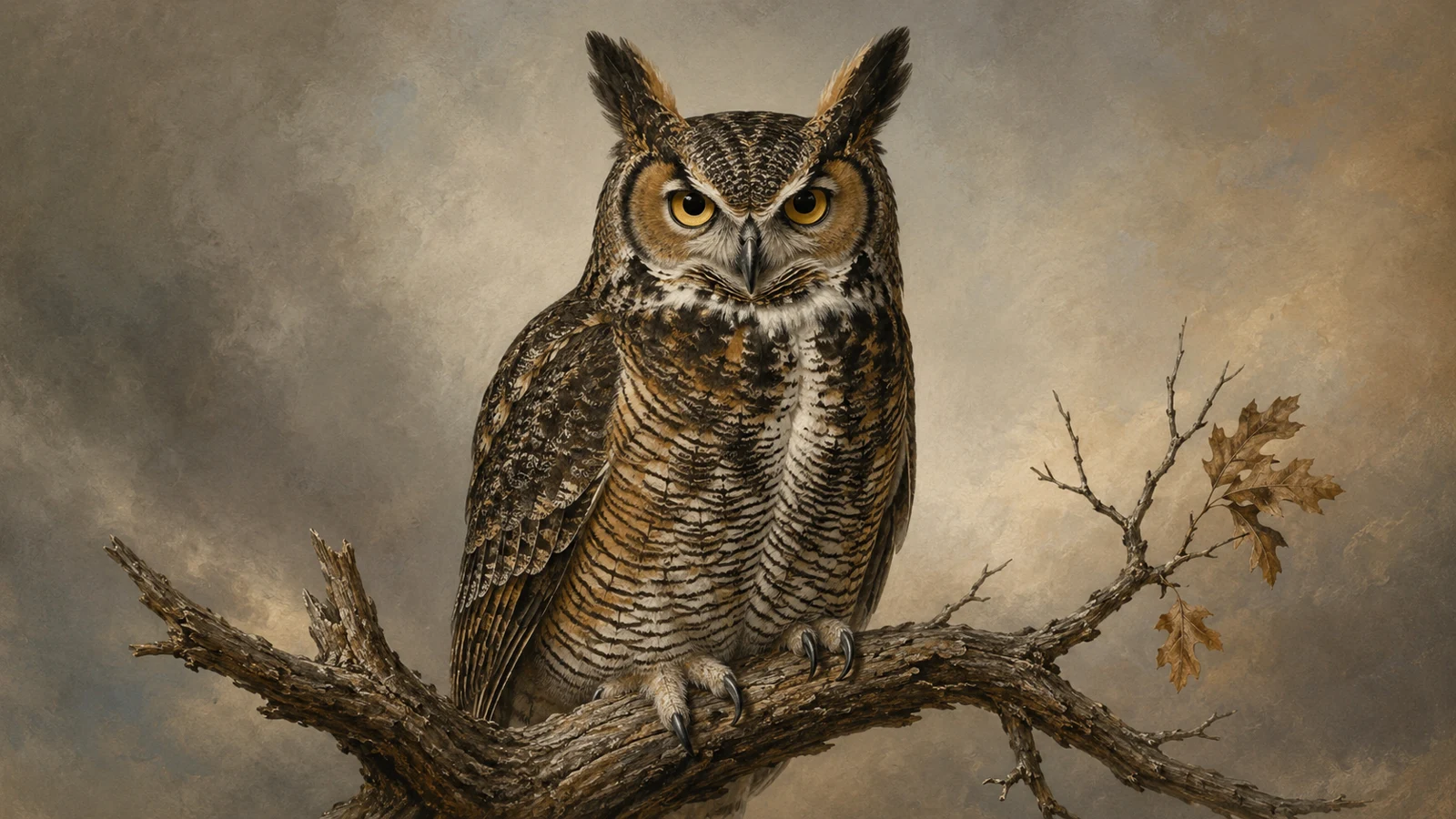
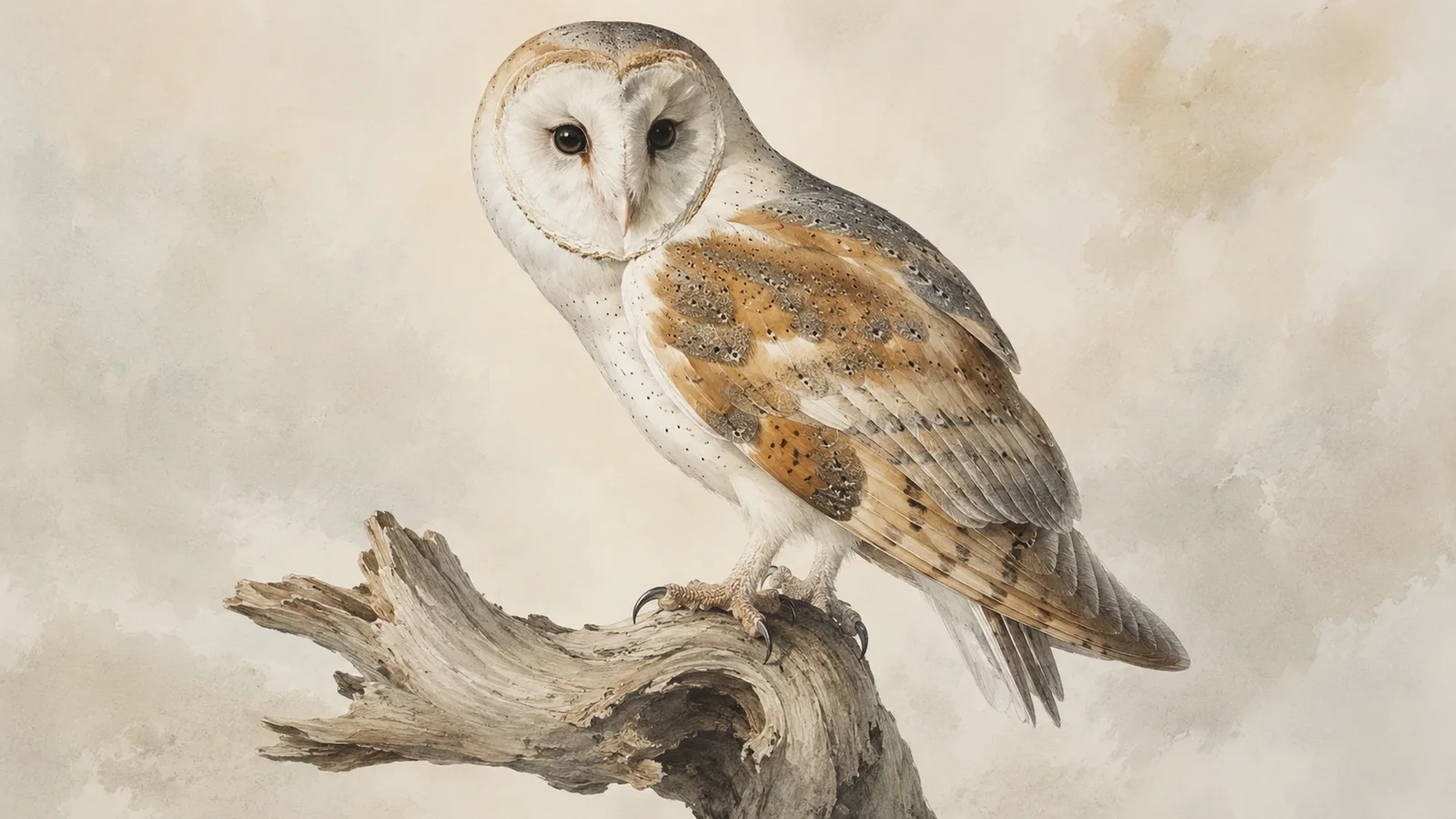
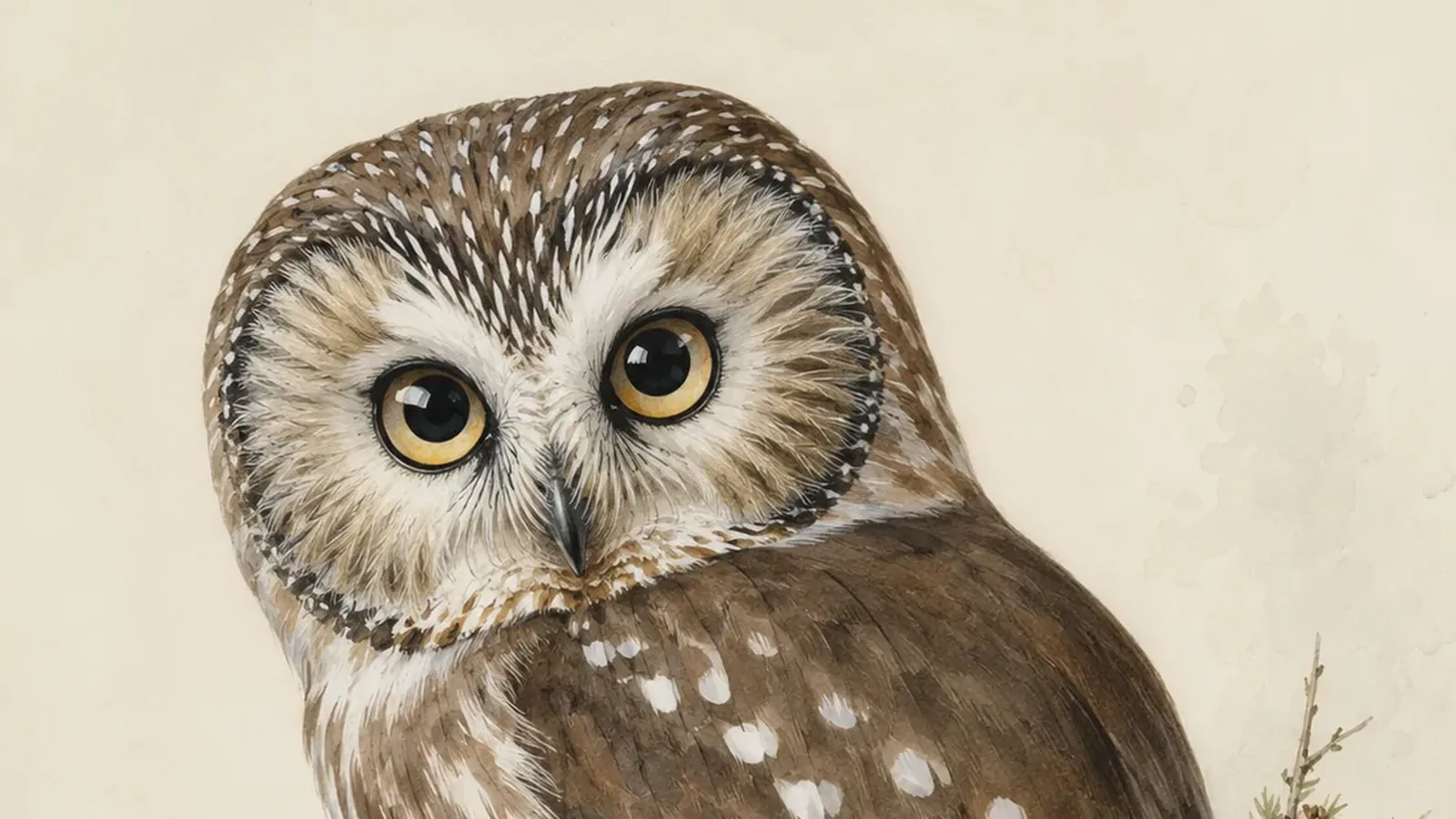
The screech-owl is smaller than the Great Horned Owl by a factor of roughly eight in body mass, smaller than the Barn Owl, and larger than the diminutive Northern Saw-whet Owl, which it can be confused with at distance. The saw-whet lacks ear tufts and has a streaked brown head rather than the streaked-and-barred pattern of the screech-owl.
Voice
The Eastern Screech-Owl does not screech. Audubon’s field guide puts it plainly: the voice features whinnies and soft trills, not screams. The descending whinny is the territorial call - a trembling, hollow sound that carries well through woodland. The long trill is used between mates, between parents and owlets, and as a contact call between pair members. A paired couple will often duet, one answering the other across the territory.
The screech-owl is not a loud bird by owl standards. The Great Horned Owl’s territorial hoot carries a kilometre or more in still air. The screech-owl’s whinny is designed for the smaller scale of its territory, which in good suburban habitat may cover only a few hectares. The bird is vocal mostly from dusk through the first few hours of the night, then again briefly before dawn.
Range and habitat across the year
The Eastern Screech-Owl is a permanent resident. It does not migrate. Cornell’s range maps show it occupying eastern North America from the southern margin of the Canadian boreal forest south through the entire eastern United States into northeastern Mexico, with the western boundary running roughly along the Rocky Mountains. The Great Plains populations thin out west of the Missouri River valley where mature woodland becomes sparse.
It is among the most habitat-tolerant owls on the continent. Cornell’s Birds of the World notes it as often the most common avian predator in wooded suburban and urban environments. It uses hardwood and mixed forest, riparian strips, orchards, parks, cemeteries with mature trees, and residential areas where old trees have cavities or where nest boxes have been installed. It is not a bird of open country or dense conifer forest.
The screech-owl is a year-round cavity user, roosting in the same hole it nests in through winter, sometimes sharing a cavity with a mate. In severe cold, pairs have been observed roosting together in the same box, a behaviour that reduces heat loss.
Diet
The Audubon field guide describes the Eastern Screech-Owl’s diet as the most varied of any North American owl. This is not hyperbole. Documented prey includes large insects - beetles, moths, crickets - small mammals such as mice, voles, and shrews, small birds taken at the roost, lizards, small frogs and toads, earthworms, crayfish, and small fish taken at the water’s edge. The owl hunts primarily by a watch-and-pounce method from low perches, relying on sight and acute directional hearing to locate prey in darkness or in leaf litter.
Cornell’s Birds of the World records the owl as capable of capturing prey by sound alone in total darkness - a capacity it shares with larger owls but that is less expected in a bird this small. The asymmetrical ear openings are the mechanism: the slight difference in arrival time of a sound between the two ears allows the brain to triangulate prey position in three dimensions.
Breeding and nesting
The Eastern Screech-Owl pairs for life. Courtship begins as early as January in the southern parts of the range. Cornell’s Birds of the World records the pair bond as socially and genetically monogamous with high year-to-year mate fidelity.
Nesting takes place March through June. The female selects a cavity - a natural hollow in a tree, an abandoned woodpecker hole, or an installed nest box - and lays three to five eggs, occasionally as many as eight. She incubates alone for approximately 26 to 30 days while the male hunts for her. After hatching, she broods the young and feeds them prey the male delivers. At roughly four weeks the owlets begin appearing at the cavity entrance. At five weeks they fledge, but they remain dependent on the parents for a further eight to 10 weeks.
The choice of nest cavity matters. Larger cavities with established wood-chip floors support the blind-snake behaviour. In nest-box programmes where boxes are installed without debris in the base, the parasite-control function disappears. Nest-box users who add a shallow layer of wood chips before the season begin appears to replicate the natural floor composition the owl would use in an old woodpecker hole.
The smallest common predator in American suburbs
The IUCN lists the Eastern Screech-Owl as Least Concern, a category reflecting a large range and a breeding population estimated at roughly 560,000 individuals by Partners in Flight. The Audubon field guide notes a gradual decline in parts of the range, and North American Breeding Bird Survey data show a population decrease of close to one per cent per year between 1966 and 2019 - a cumulative reduction of around 37 per cent over that period. The mechanism is thought to be loss of old trees with natural cavities, which are replaced in managed landscapes by younger growth that lacks them. Nest-box programmes have partially offset this in suburban areas.
That the species manages population decline while simultaneously being described as the most common avian predator in many suburban woodlands is a comment on how much old-growth cavity habitat has been lost. Where it persists, the screech-owl persists alongside it, hunting by night over the same lawns the homeowners walk by day, mostly unknown to them.
What the blind-snake behaviour tells us, if we take it seriously, is that a bird small enough to fit in a coffee mug has been solving a difficult ecological problem - nest parasitism in a confined cavity - for long enough that the solution is encoded in its behaviour rather than learned in each generation. The owl is not clever in the corvid sense. It is something older than clever.
The Eastern Screech-Owl does not screech, does not migrate, and does not draw attention to itself. It is the most common raptor in the trees above your street, and almost no one who lives there knows it.