Field Guide
Barred Owl
On a humid evening in a Carolina river bottom, before the light has fully gone, a sound rolls out of the cypress that stops every other voice in the swamp. Who cooks for you? Who cooks for you-all? Eight or nine notes, rhythmic, almost conversational, the last one falling away like a question nobody answers. You look for the source and find a large grey-brown shape with a round, earless head and a face turned toward you. The eyes are the surprise. They are deep liquid brown, nearly black, where every other large owl in the eastern woods watches the world through hard yellow.
That dark gaze is the whole character of the bird. Strix varia does not glare. It regards. It is the owl of wet woodland and slow rivers, more often heard than seen, and Cornell Lab notes it is more vocal than almost any other owl on the continent. The forest does not fall silent when it calls. The forest waits.
What it looks like
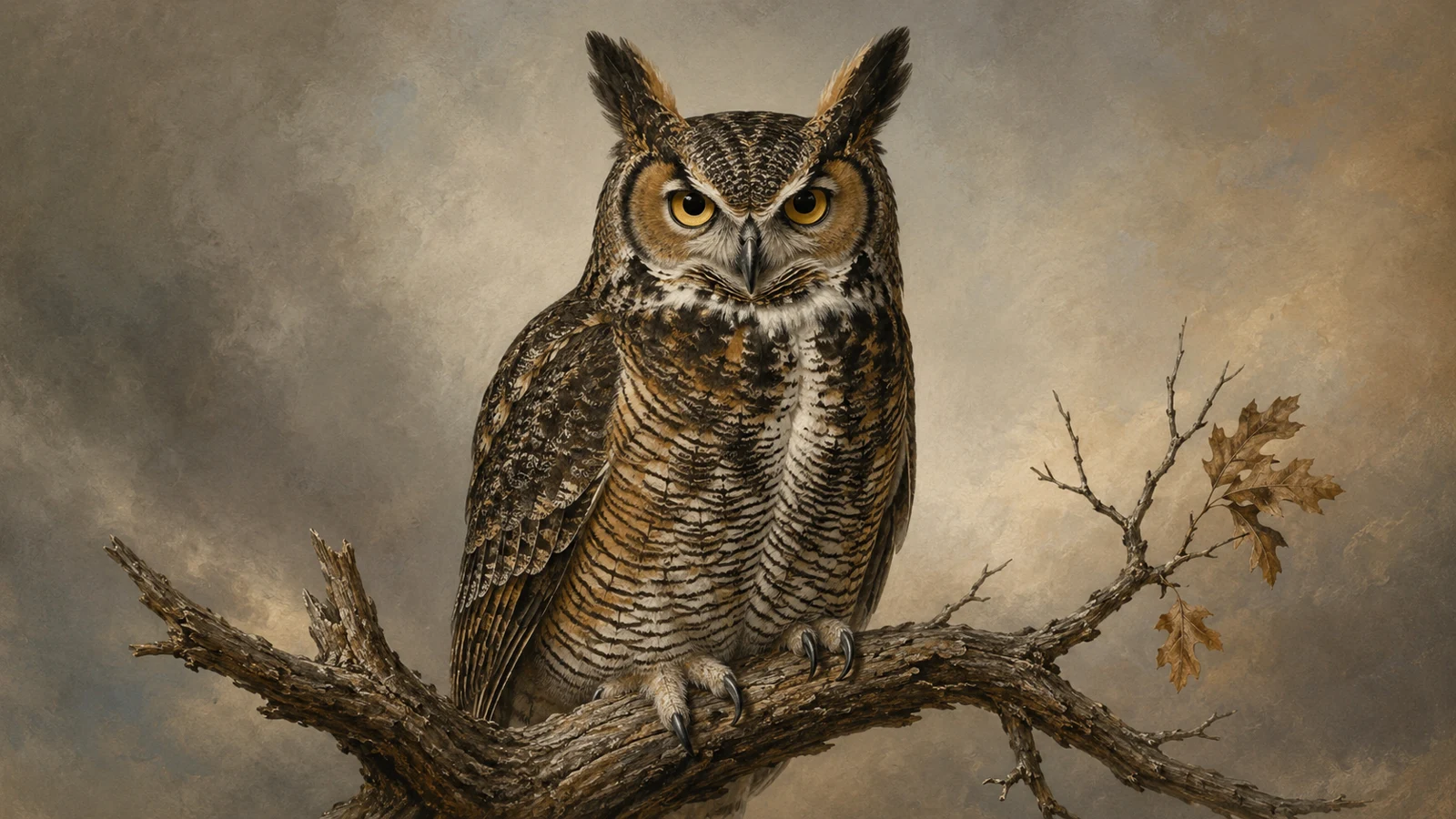
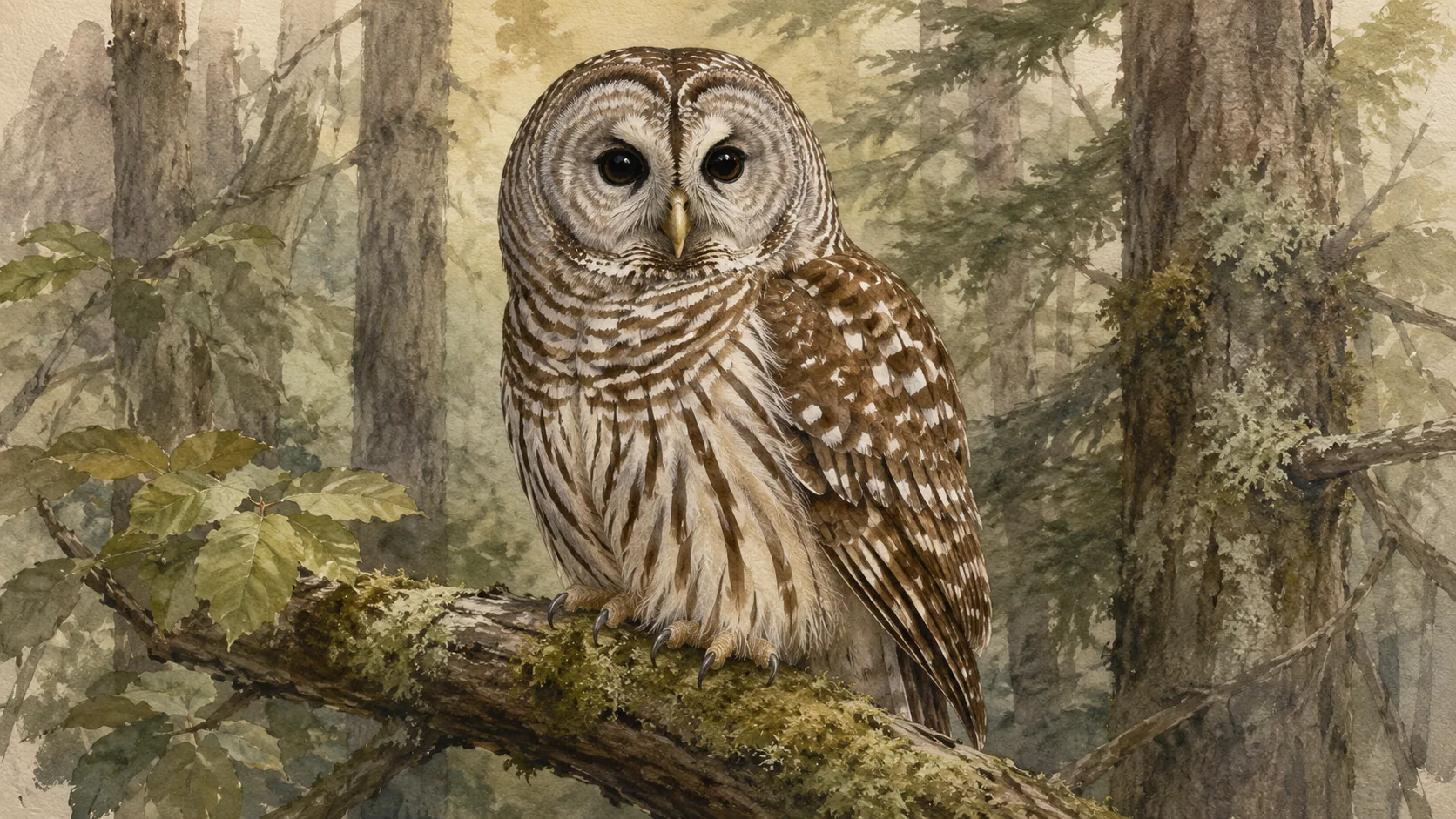
The Barred Owl is large and stocky, round-headed, and entirely without the ear tufts that give a Great Horned Owl its scowl. Cornell Lab gives the length at roughly 43 to 50 centimetres, with a wingspan around a metre, and Audubon records weights from about 470 grams up to a kilo and beyond. The plumage is mottled brown and white. The throat and upper breast carry horizontal barring, while the belly switches to bold vertical streaking, and that two-part pattern is where the name comes from: barred above, streaked below.
The face is a pale grey-brown disc, finely ringed, with no sharp markings to break it. The bill is yellow and half-hidden in feathering. The defining field mark, the one that settles any doubt, is the eye colour: deep brown-black, soft and wet-looking, against the hard lemon yellow of nearly every other big owl in its range.
Males and females wear identical plumage. The difference is size. Cornell Lab notes the female can be up to a third larger than the male, which you will never judge on a lone bird but which becomes obvious when a pair sits together. The silhouette is unmistakable in flight: broad rounded wings, a short tail, a heavy head, and a flight so quiet it seems to be subtracted from the air rather than beating through it.
What it sounds like
The Barred Owl is one of the great voices of the eastern night, and unusually it is willing to use that voice in daylight. The signature call is a series of eight to nine hoots that almost everyone hears as who cooks for you, who cooks for you-all, the final phrase trailing downward into a drawl. It carries far through still woods and is easy enough to imitate that the owl will sometimes answer a passable human attempt.
That single phrase is only the headline. Pairs duet, and the duet escalates. Two birds will trade hoots, then tumble into a rising, manic cackle of caws, gurgles and hollers that has earned the species the folk name of the laughing owl in some places, a sound that can startle anyone who meets it after dark in a swamp. Cornell Lab catalogues a wide range of caws, gurgles and a drawn-out hoo-ah under the broader vocabulary. The bird is talkative, and it does most of its talking at dusk, through the night, and in the grey hours either side of dawn.
Range and habitat
The Barred Owl is a permanent resident, not a migrant. A bird that calls from a stand of bottomland hardwood in March is almost certainly the same bird calling there in November. Its core range covers the eastern United States and into eastern and central Canada, and Audubon and Cornell both document a steady westward expansion through the twentieth century, across the wooded margins of the northern Great Plains and on into the Pacific Northwest.
That expansion is the species’ most consequential modern story. The Barred Owl is bigger, more aggressive and more flexible than the Northern Spotted Owl of the old-growth western forests, and where the two now overlap the Barred Owl displaces it, competing for the same prey and the same nest sites and sometimes interbreeding with it. The Spotted Owl is listed as threatened, and the arrival of the Barred Owl is among the gravest pressures on it. One owl is doing nothing wrong. It is simply doing what it does, in a place it had not previously reached.
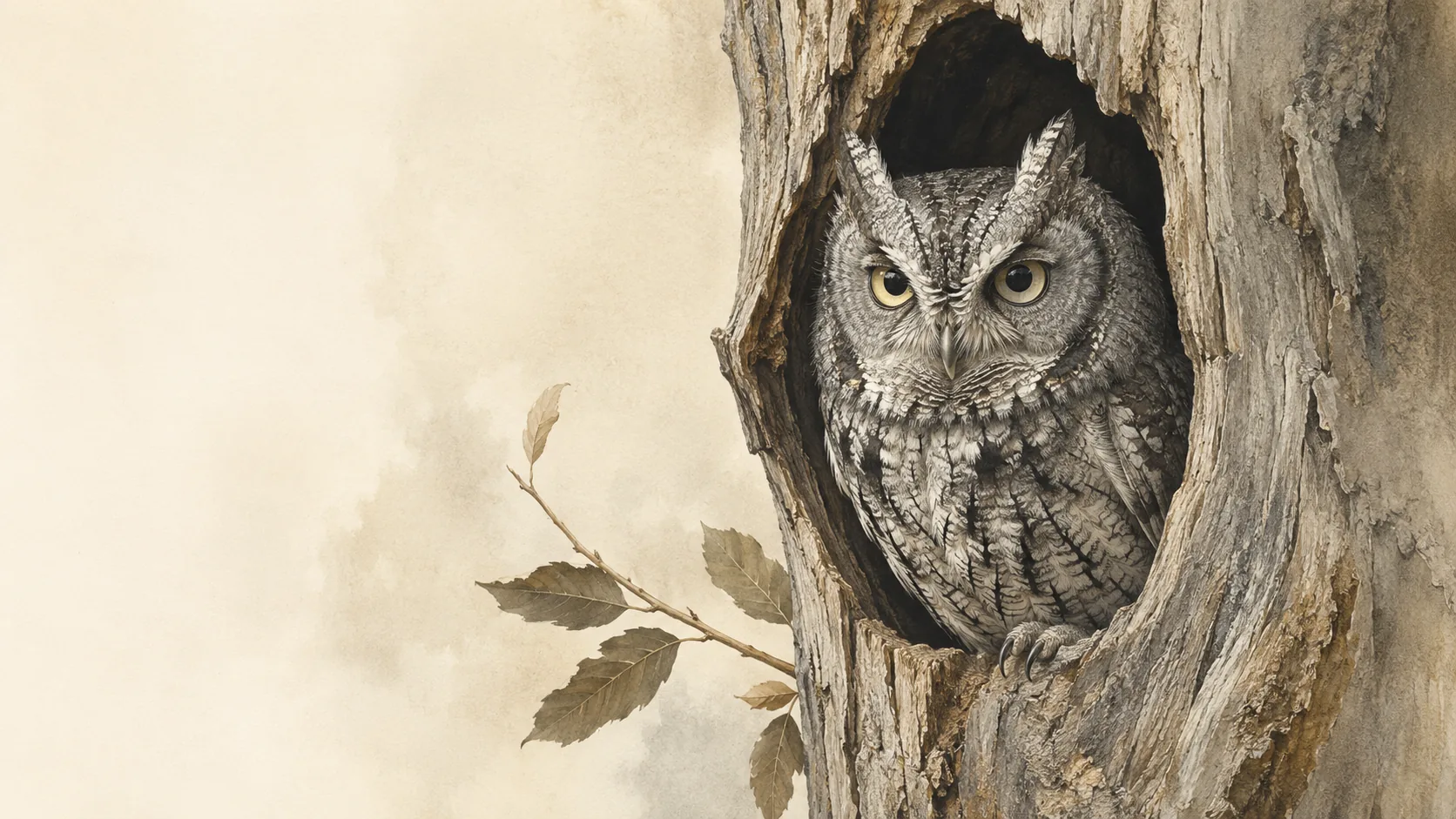
Preferred habitat everywhere is mature, moist woodland: wooded swamps, river bottoms, old riverine timber, and large tracts of forest with big trees old enough to hold cavities. The bird wants water, large trees, and shade.
Diet
The Barred Owl is a generalist that takes whatever the wet woods offer. The bulk of the diet is small mammals: mice, voles, squirrels, chipmunks, rabbits, and the occasional opossum. But the menu runs wider than most owls’. Cornell Lab and Audubon record birds taken up to the size of grouse, along with frogs, salamanders, snakes, lizards, and a surprising amount of aquatic prey.
That last habit sets the bird apart. A Barred Owl will perch on a low branch over slow water and drop onto fish or crayfish, and it will even wade into the shallows in pursuit of them. An owl that fishes is an unusual thing, and it tells you what kind of country this bird belongs to: not dry upland forest but the flooded, root-tangled, frog-loud edges of standing water.
Breeding and nesting
Barred Owls pair early and, Cornell Lab notes, probably mate for life, raising one brood a year. The nest is usually a natural tree cavity, set high in a large tree, though the pair will readily take over the old stick platform of a hawk, crow, raven or squirrel, and will use a nest box of the right size. The same site is often reused year after year.
The female lays a small clutch, typically two to three white eggs. She alone incubates, for roughly four weeks, while the male hunts and ferries food to her on the nest. The young hatch helpless and downy. They climb out onto nearby branches well before they can truly fly, clambering with bill and feet, and take their first real flights at around six weeks. The parents go on feeding them for months after fledging, deep into late summer, while the young birds learn the slow patient business of hunting from a perch.
The bird you hear before you see it
The defining trait of the Barred Owl is not its size or its hunting or even its dark eyes. It is its voice, and its willingness to be heard. Most owls are ghosts. They hunt in silence and vanish by day and you live your whole life beside them without knowing it. The Barred Owl breaks that rule. It calls in daylight after rain, it answers an imitation, it duets and cackles and carries on across a swamp at a volume that demands a response.
This is why it is so often the first owl a person ever knowingly meets. You do not have to find it. It announces itself. And the dark, mild, unhurried face that finally turns toward you across the water is so unlike the fierce yellow stare of the owl of fairy tales that people remember it for years. It is the owl that made an owl real to them.
Almost every other big owl watches the dark through hard yellow eyes. The Barred Owl watches it through soft brown ones, and it will tell you, out loud, exactly where it is.
The oldest known Barred Owl, Cornell Lab records, was at least 26 years and 7 months old, banded in North Carolina in 1993 and recovered, injured, in 2019. The IUCN lists the species as Least Concern, and Audubon estimates a population in the millions and broadly stable. It is, for now, a bird in no trouble at all. The trouble it causes the Spotted Owl is the harder story, and it is not the Barred Owl’s to answer.