Field Guide
Dunlin
At Bodega Bay on a November afternoon, the tide is running out fast. Along the receding waterline, a compact flock of small waders works the wet sand in a tight, rolling wave - advancing as the water retreats, pausing to probe, advancing again. The flock is perhaps 200 birds. They move as a single organism. From fifty metres they look identical, grey-brown above, pale below, heads down. You raise the binoculars and notice the bills: drooped at the tip, like a finger bent at the last joint. Dunlin.
The Dunlin is not a bird that announces itself. It is simply there, in numbers, on almost every productive tidal flat in the Northern Hemisphere.
What it looks like
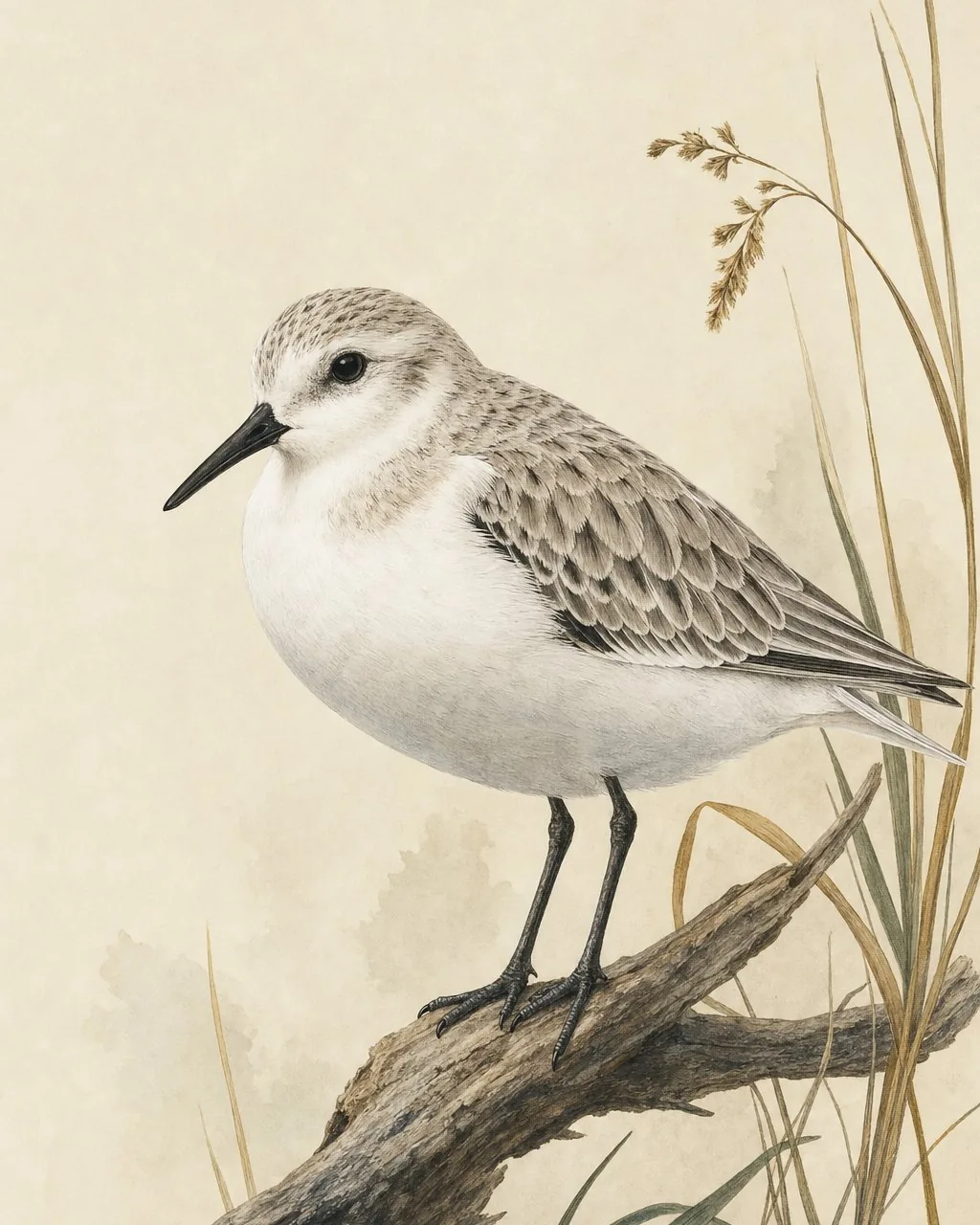
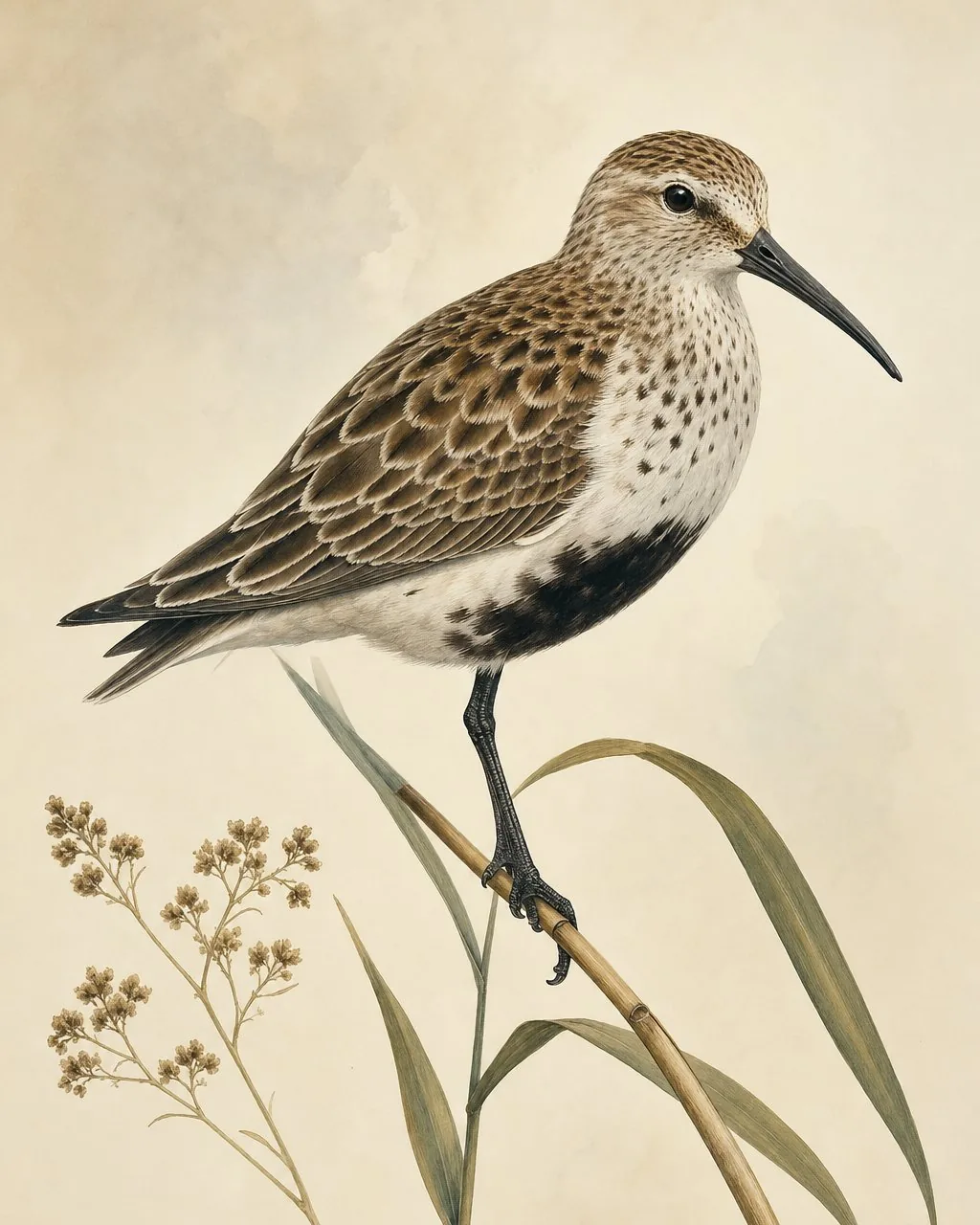
A small, compact wader with a distinctive bill. The bill is medium-length, black, and droops clearly at the tip - a feature that separates it from most confusing species at any reasonable range. The body is round and the legs are short, giving the bird a slightly hunched, front-heavy posture when feeding.
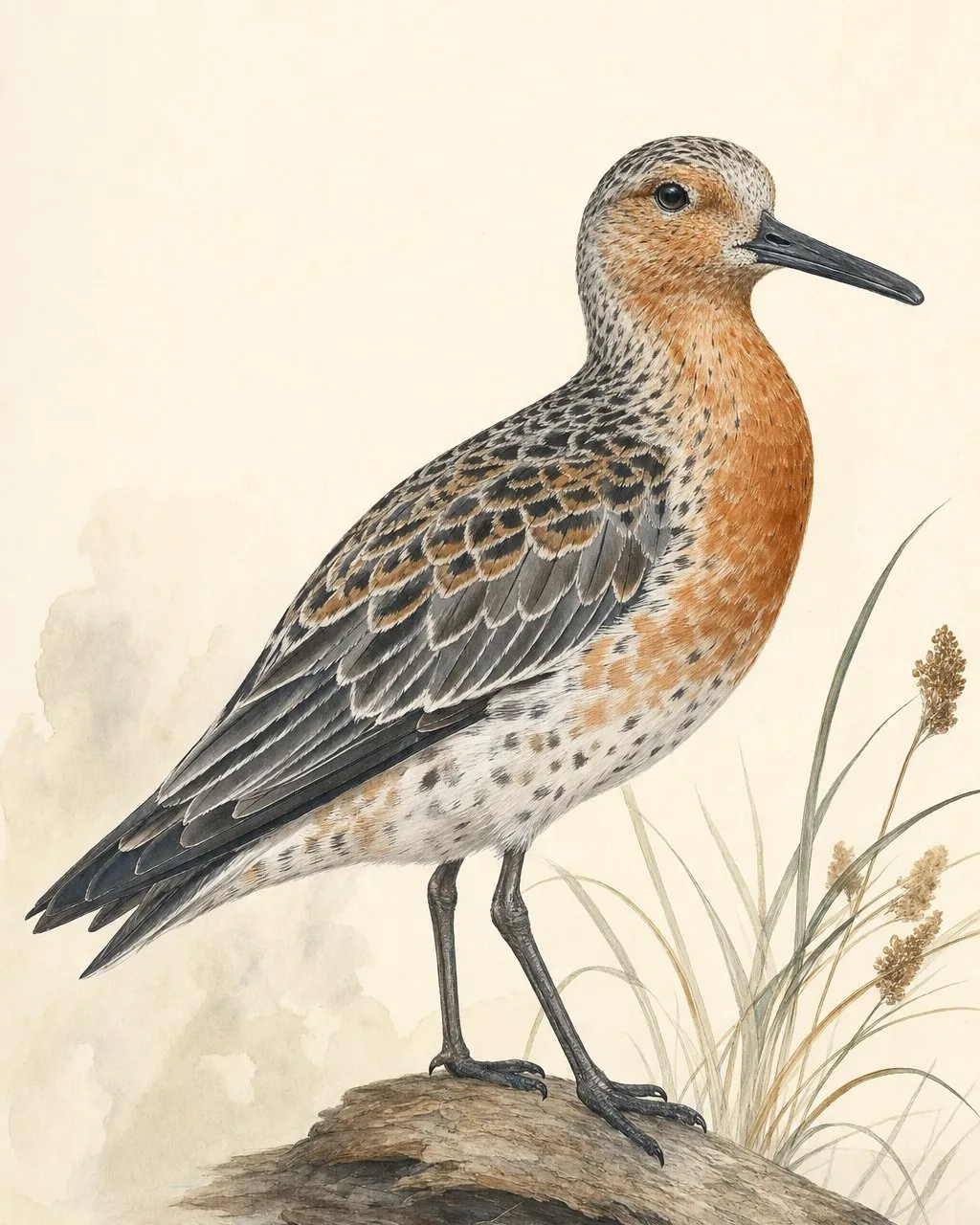
Plumage changes dramatically by season. In breeding dress - seen on northbound migrants in May - the back is a bright rufous, the scapulars and wing coverts spotted black and chestnut, and the belly is marked with a large, clear black patch that runs from the breast down to the vent. This black belly is unique among North American shorebirds of its size. The effect is striking.
In winter the bird is a different thing: grey-brown above, white below, with a faint streaked wash on the breast. Drab but identifiable if you can see the bill shape.
Dunlin vary by subspecies. The birds that winter in North America are primarily arcticola on the Pacific and hudsonia on the Atlantic. European birds belong to other races. All share the drooped bill, though the degree of droop and overall size vary.
| Measurement | Range |
|---|---|
| Length | 16 - 22 cm |
| Weight | 40 - 75 g |
| Wingspan | 32 - 41 cm |
| Lifespan | 4 - 14 years |
“A flock of ten thousand Dunlin turning in unison over an estuary - flashing white one moment, dark the next - is among the most arresting spectacles in coastal birding.”
Voice
A thin, reedy krreep or jeeep, often given in flight, with a slightly raspy quality that distinguishes it from the cleaner calls of sandpipers. Flocks produce a continuous soft chatter. On the breeding grounds the male gives a purring, descending trill in flight display.
Range and habitat
Circumpolar. The Dunlin breeds across the Arctic and subarctic from Alaska to Siberia to Scandinavia, always on wet tundra near pools or coastal marshes. Outside the breeding season it is found on tidal mudflats, sandy beaches and estuaries. It rarely goes inland.
In North America it winters along both coasts and in the Gulf of Mexico. Flocks on the Pacific coast are frequently larger than those on the Atlantic, reflecting the higher density of mudflat habitat on the West Coast.
Globally the Dunlin is one of the most numerous shorebirds, with a world population estimated at four to six million birds. Some populations, however, are declining. The race schinzii, which breeds in Iceland, northern Britain and Scandinavia, has fallen sharply with the loss of wet upland moors to drainage and agricultural improvement. The global IUCN listing remains LC, but regional trends are negative in parts of Europe.
Diet
Invertebrates taken by probing and pecking in soft substrate. Polychaete worms are a primary prey item on mudflats. Small crustaceans, molluscs and insect larvae are also eaten. The sensitive bill tip - packed with mechanoreceptors like those of snipe and Red Knot - allows the bird to detect buried prey by feel, making it an effective feeder in murky conditions and at night.
Dunlin feed in tightly packed groups at the tide edge, moving with the water. The behavior of each bird is semi-independent but the group as a whole tracks tidal opportunity efficiently.
Breeding
Dunlin arrive on the breeding grounds in late May and June. The male displays in low, circling flight with a buzzy, purring song. Nests are shallow scrapes on open tundra, usually on a raised hummock near wet ground, lined with grass and leaves.
The clutch is four eggs, olive-green heavily spotted brown. Both parents incubate for roughly three weeks. The female typically leaves before fledging, as in many shorebirds - the male completes parental care. Chicks are precocial and mobile within hours. They fledge in about three weeks.
Scale and spectacle
The Dunlin’s claim on attention is partly a matter of numbers. At certain estuaries - the Wash in England, the Wadden Sea in the Netherlands, Boundary Bay in British Columbia - tens of thousands gather on high-tide roosts, packed so tightly on the mudflats that the ground itself seems to breathe. When a Peregrine causes the mass to flush, the flock performs coordinated aerial maneuvers that have been studied by physicists trying to understand collective behavior. Each bird responds to its immediate neighbors, and the response cascades through the flock faster than individual visual processing can explain.
The Red Knot faces a more acute conservation crisis, but both species point to the same vulnerability: migratory shorebirds depend on a network of specific sites, and degrading any node in the network causes population-level effects far from the point of damage.
On that Bodega Bay mudflat in November, 200 Dunlin working the receding tide represent something genuinely old. Their ancestors were feeding on these same mudflats when the estuary was forming. The drooped bill and the black belly patch are solutions to problems that predate human memory. They will be here long after the tide has come back in, if we leave the mud alone.