Field Guide
Eastern Bluebird
In 1934, a schoolteacher named Thomas Musselman staked wooden nest boxes along an Illinois county road and created what historians credit as the first bluebird trail in North America. He did this because he had noticed the bird disappearing.
The Sialia sialis - the Eastern Bluebird - is a thrush the size of a large sparrow. It is one of the most written-about birds on the continent, beloved for the male’s blue back and warm orange breast, beloved for what it supposedly symbolises. But the more useful lens is the ecological and historical one. This is a bird that came within range of regional extirpation within living memory and was saved by a citizen-science effort that preceded modern conservation frameworks by decades. That story says more about the bird than any colour description does.
What he looks like and how to tell
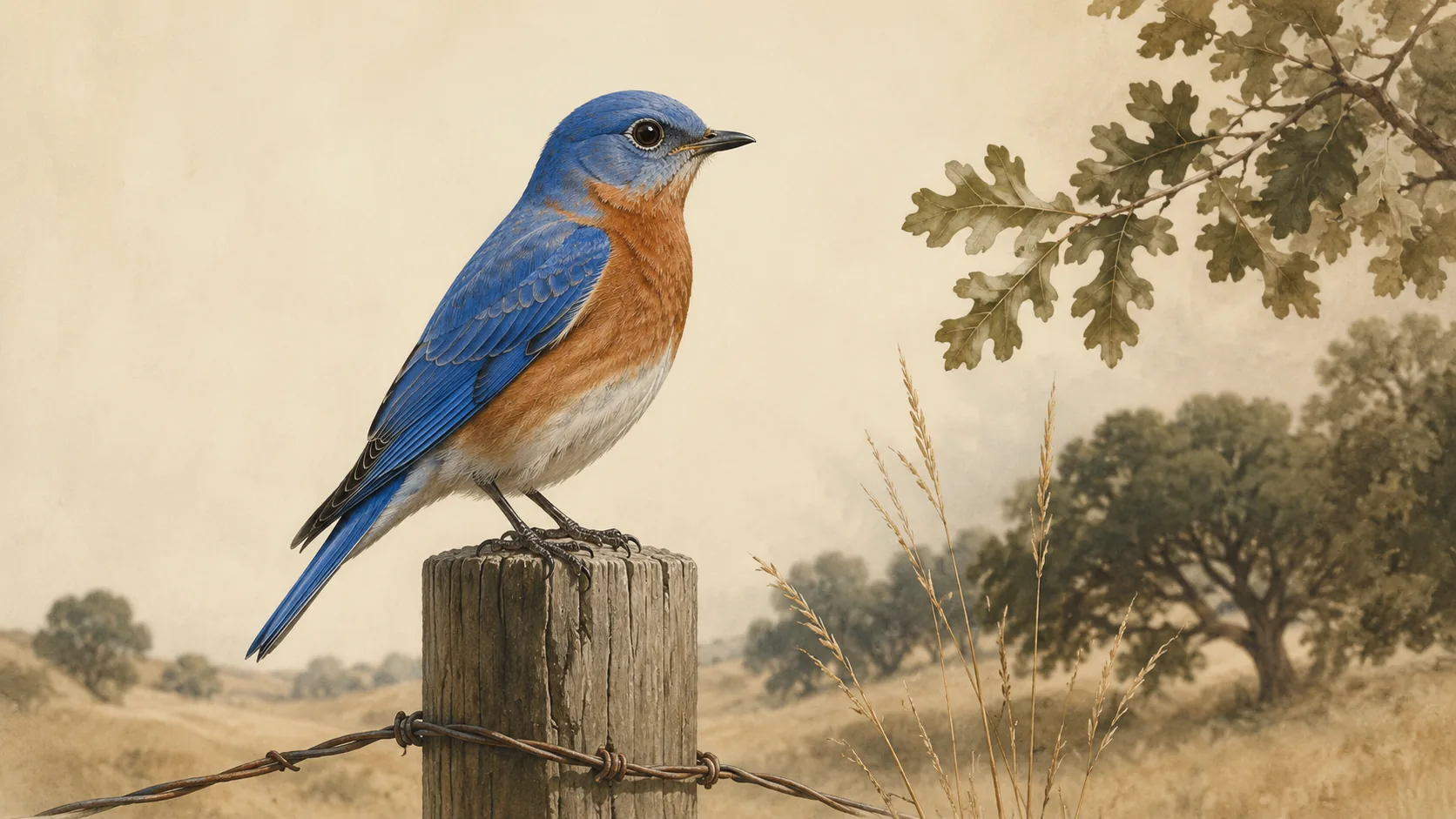
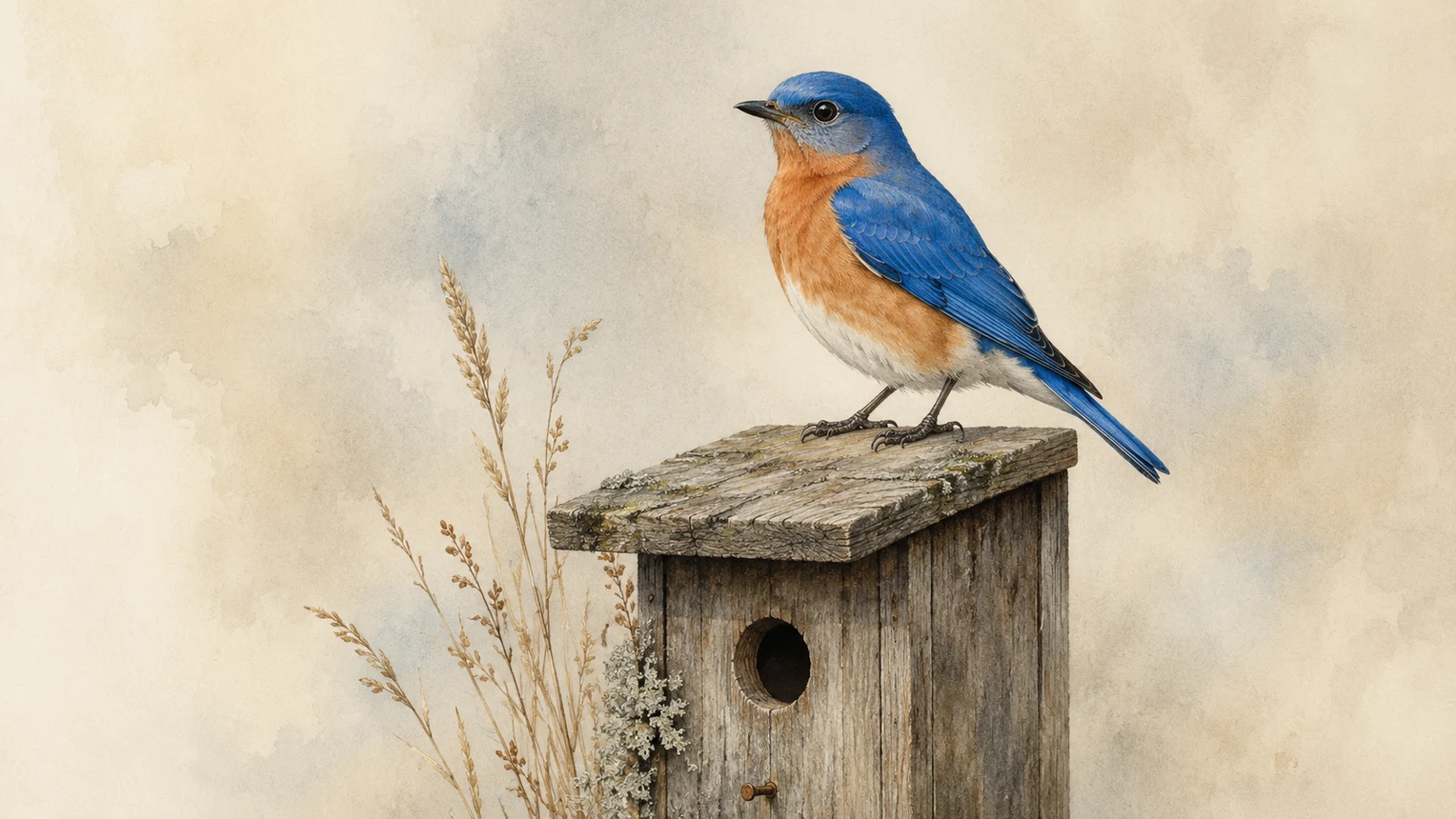
A male Eastern Bluebird is 16 to 21 centimetres long, weighs 27 to 34 grams, and carries a brightness that reads as shocking in open country. His head, back, wings, and tail are a clean royal blue. His throat, breast, and flanks run a warm rusty orange. His belly is white. He is compact in body with a large, rounded head and a short, straight bill.
She is built the same way but dressed differently. The female’s head and back are grey-brown, the blue confined to the wings and tail. Her breast orange is muted - pale, almost terracotta. Juveniles add a further wrinkle: they are spotted and grey, looking nothing like the adults, though traces of blue show in the wing feathers from the start.
The confusion species are limited. Western Bluebird overlaps minimally in range and is similarly coloured, but the male Western shows blue extending onto his throat where the Eastern’s throat is orange. Mountain Bluebird is paler, nearly sky-coloured all over with no orange. Blue Grosbeak is heavier with two rusty wing bars. In the east, at open-country perches and fence lines, the Eastern Bluebird is not commonly mistaken once seen well.
What she sounds like
The Audubon field guide describes the call as a liquid turee or queedle - soft, low-pitched, musical. The song is a mellow warbling phrase that carries well across open fields and does not pierce the way a cardinal’s whistle does. It is a gentle, carrying sound, more felt than heard at distance.
Males sing from elevated perches, fence posts, wires, and the tops of shrubs, mostly in early morning during the breeding season. Females have been documented singing when no male is present, which suggests the song serves a territorial function independent of mate attraction.
Range and habitat across the year
The Eastern Bluebird ranges across the eastern half of North America - from the southern edge of Canada through the Gulf states and down into Mexico and Nicaragua. Northern populations are partially migratory, moving south in response to cold and food scarcity rather than on a fixed calendar. Southern and mid-latitude populations often remain year-round.
The habitat requirement is consistent and specific: open ground with sparse ground cover, scattered trees or fence posts for perching, and cavities for nesting. The species is found in farmland, orchards, open woodlands, suburban parks, golf courses, and meadows with hedgerows. Dense forest does not suit it. It needs to see the ground from a perch and to hunt by sight.
The population decline of the early and mid twentieth century tracked directly onto habitat change and cavity competition. As farmland consolidated, old orchard trees with natural cavities disappeared. House Sparrows and European Starlings - both cavity nesters introduced from Europe - expanded aggressively into the same nest sites. Cornell Lab data from the North American Breeding Bird Survey shows a sustained recovery between 1966 and 2019, which ornithologists attribute largely to the proliferation of nest box trails.
Diet
The Eastern Bluebird hunts from a perch. It sits low - on a fence wire, a low branch, a wooden stake - and watches the ground. When it spots an insect, it drops, takes it, and returns. This is the classic ‘flycatcher from below’ foraging mode, and Cornell’s Birds of the World notes it as the dominant strategy across the active season.
The summer diet runs to roughly two-thirds insects and invertebrates: grasshoppers, crickets, beetles, earthworms, spiders. In winter, when the ground hardens and insects disappear, the bird shifts to berries and fruit. Wild berries from dogwood, red cedar, and wild grapes become the core winter food source. A bluebird in December foraging from a cedar tree is doing exactly what the bird is built to do.
Breeding and nesting
She builds the nest. He guards the territory and brings food. The pattern holds across most of the season.
The female constructs a loose cup of weed stems, grass, pine needles, and sometimes hair or feathers inside whatever cavity she has claimed - a woodpecker hole, a natural tree hollow, or a nest box set to the right entrance diameter. She takes roughly 10 days to complete it. She lays three to seven pale blue eggs, occasionally white, and incubates them for 13 to 16 days. The nestlings fledge 15 to 20 days after hatching.
Two broods per season is typical, and in the southern part of the range three is not unusual. The male feeds the young while the female begins the second clutch. Older nestlings from the first brood sometimes assist in feeding the second - a behaviour that, in North American thrushes, is not rare but is still striking when observed.
The nest box and what it represents
The entrance hole matters. A 38-millimetre (1.5-inch) opening admits an Eastern Bluebird but excludes a European Starling. That single measurement drove the recovery of the species across much of its range.
Thomas Musselman’s 1934 trail was the beginning. The North American Bluebird Society, founded in 1978, codified the nest box design and expanded monitoring to thousands of volunteers across the continent. The result is one of the more complete long-term citizen-science datasets in North American ornithology - continuous records of nest attempt, clutch size, fledging success, and competitor pressure for decades.
The IUCN lists the Eastern Bluebird as Least Concern. That classification is correct as of the current assessment. What it does not capture is the recent past: a bird that lost, in some documented regions, close to 90 per cent of its breeding population across the mid twentieth century, and recovered not through regulatory intervention but through a coordinated human effort that depended on no government programme. The bluebird trail is a piece of conservation history that deserves more attention than it gets.
That recovery is what makes the bird genuinely interesting. The blue is beautiful. The conservation story is worth sitting with.
The Eastern Bluebird did not recover because the habitat improved. It recovered because people built boxes, monitored them, and kept building more. The bird did the rest.