Field Guide
Marbled Murrelet
At 2:30 in the afternoon of August 7, 1974, a tree surgeon named Hoyt Foster was 148 feet up a 228-foot Douglas-fir in Big Basin Redwoods State Park, cutting hazardous branches above a campground, when he found a downy chick sitting on a broad, moss-covered limb. The chick had beige and brown down, a small dark bill, and webbed feet. Six miles of forest and coast separated it from the Pacific Ocean. Foster had never heard of a Marbled Murrelet. Almost no one outside ornithology had, and even within ornithology the bird had kept its most important secret for as long as there had been ornithologists. The chick was the answer to what the National Audubon Society had once offered a $100 reward to discover: the first documented North American nesting site of Brachyramphus marmoratus, the Marbled Murrelet, the last bird on the continent whose nest had never been found.
The mystery had lasted 180 years since the species was first described. The nest, it turned out, had been in plain sight the whole time.
What it looks like
Small. Chunky. Built low to the water.
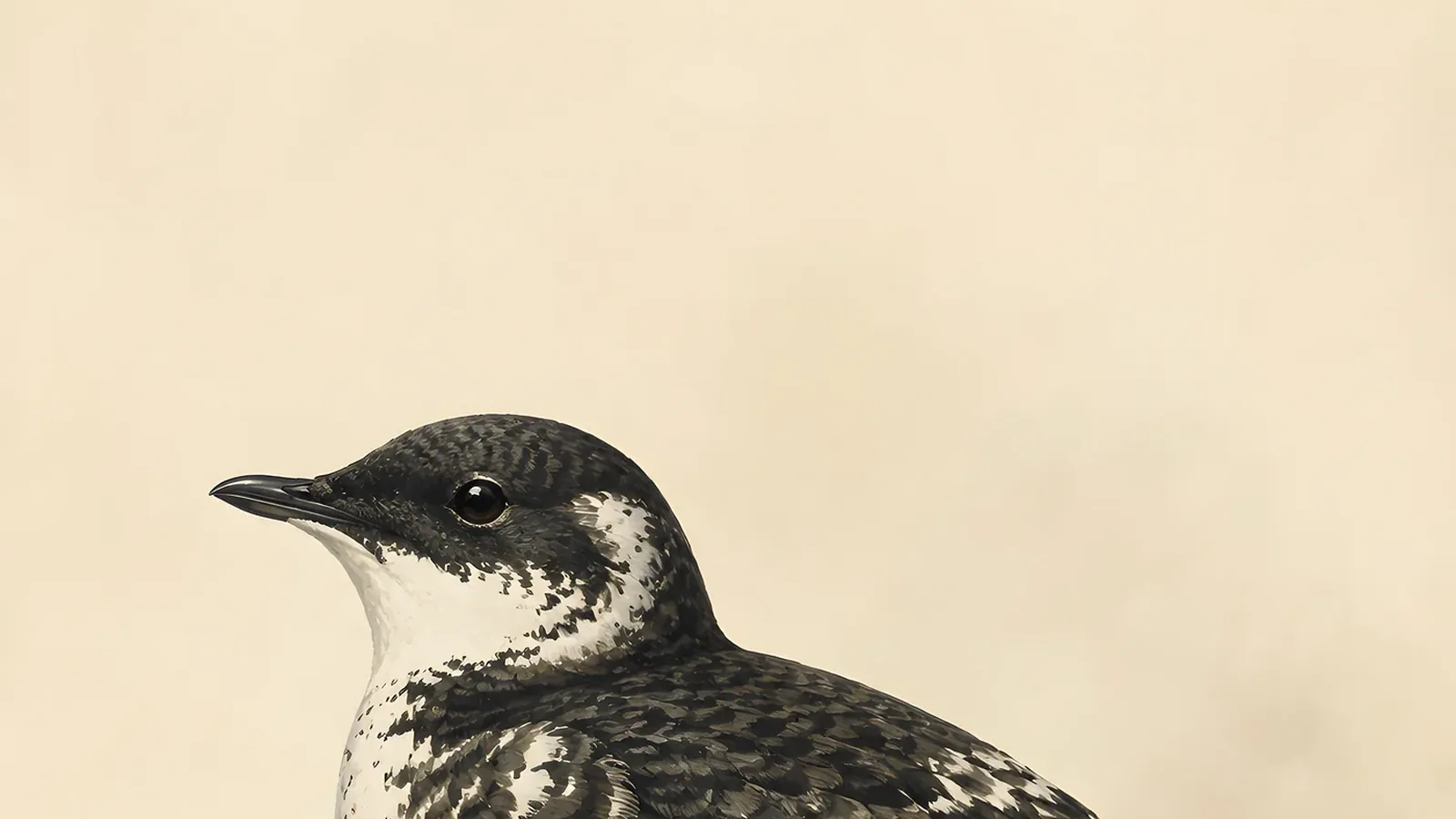
In summer, the Marbled Murrelet is dark brown above and mottled all over - the brown and buff pattern of old bark and lichen that gives the bird its name and renders it nearly invisible against a mossy limb. In winter the plumage shifts to sharp black and white: dark cap, white stripe across the wing, pale below. A white stripe runs along the scapulars like a seam of quartz through dark rock.
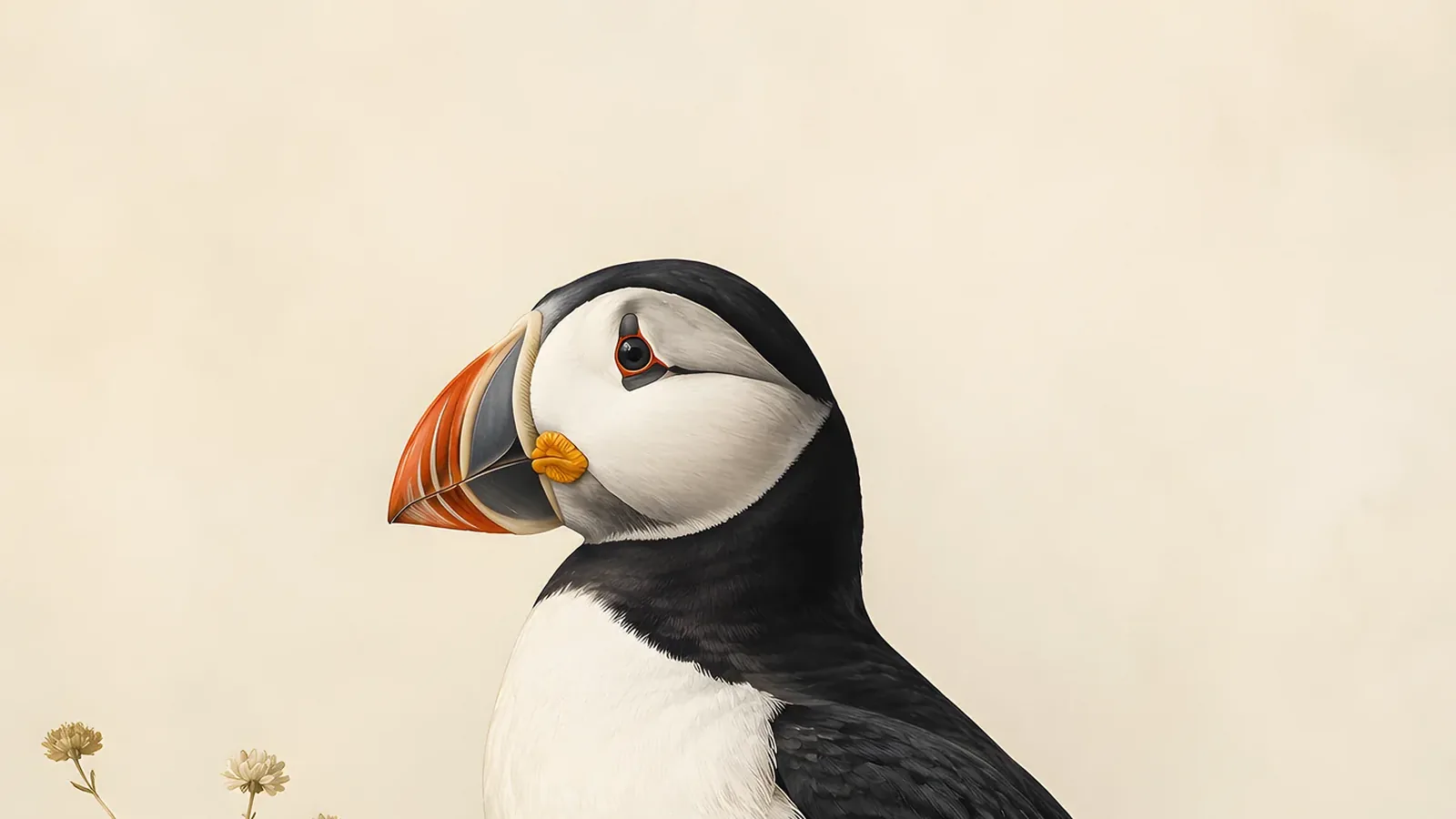
The bill is slender and dark, shorter than a puffin’s and without any colour. The body is torpedo-shaped. The legs are set far back, useful in water, awkward on land.
| Measurement | Range |
|---|---|
| Length | 25-29 cm |
| Weight | 200-250 g |
| Wingspan | 45-50 cm |
| Lifespan (wild) | 10-17 years |
It is a small bird in the context of alcids. The Atlantic puffin is blockier and heavier. The Common Murre, a close relative, stands half again as tall. What the Marbled Murrelet lacks in size it makes up in velocity. The wings are narrow and the wingbeat is rapid - observers describe the bird crossing open sky with the urgency of something late, which it often is, since the daily commute has a tight schedule.
The nest in the canopy
No other North American seabird nests this way.
The Marbled Murrelet does not build a nest. It selects a wide, lichen-softened branch - typically in a Douglas-fir, coastal redwood, or Sitka spruce of 175 to 600 years of age - and lays one egg directly onto the moss and duff already there. The egg is yellowish to olive to blue-green, spotted in browns and lavender. The branch must be broad enough to hold it safely, sheltered enough above that the egg will not blow off in a Pacific storm. Only the largest, oldest conifers grow branches of this calibre. A second-growth stand of 60-year trees cannot offer what the bird requires. This is not a preference. It is a structural dependency. The nest is the branch, and the branch only grows that wide in old forest.
Nesting pairs can travel up to 80 km from the sea to reach their chosen tree. Hamer and Nelson (1995) documented that Washington nest sites were consistently associated with old-growth stands, with no confirmed records in younger managed forest. That association is not habitat selection in the conventional sense - where the bird can choose among options. It is a species that has evolved one reproductive strategy and has no other.
Incubation runs approximately 30 days, shared equally between the two adults in alternating shifts. The chick fledges at around 27 to 28 days after hatching. Then it leaves the branch alone, at dawn, and flies to the sea. It has never touched water.
The mystery and the 1974 discovery
By 1974, North American ornithology was a mature discipline. The nests of every common bird and most rare ones had been found, described, photographed. Nest cards had been filled out. Eggs had been measured. The Marbled Murrelet alone remained unaccounted for.
The theories had been various. Perhaps it nested in rock crevices along cliff faces, like its relatives the Ancient Murrelet or the pigeon guillemot. Perhaps it nested on the ground under coastal shrubs. The birds were observed at sea with fish in their bills, clearly feeding young somewhere. Radio-telemetry studies in the 1970s showed them flying inland at dawn, fast and purposeful, but the forest canopy is dense and a small bird 40 metres up in a redwood is a difficult thing to find.
Foster’s 1974 discovery ended the theoretical phase. The bird was nesting on a mossy limb, hundreds of feet up, in old-growth forest with no colonial roosting, no nest construction, no obvious evidence from below. Once the nest type was known, others were confirmed in California, Oregon, Washington, British Columbia, and Alaska. Looking back, the mystery was not that it took until 1974. The mystery is that anyone ever found it at all.
A life between forest and sea
“The murrelet commutes between two worlds that could not be less alike - the wave-scoured kelp line and the still interior of a two-century-old forest. No other seabird makes this journey. Most seabirds, if they come inland at all, come no further than the cliff above the surf.”
The daily routine during breeding season is among the most unusual of any North American bird. Each adult flies to sea before dawn, dives for small fish - Pacific sand lance, Pacific herring, capelin - returns with a single prey item held crosswise in the bill, and delivers it to the nest tree. The commute is done at low light, fast and low over the tree canopy, and the bird is almost silent on approach. A watcher at the nest tree in the grey half-hour before sunrise can sometimes hear the rapid wingbeat before the bird is visible - a high, thin whistle through the air.
The call is a plaintive keer, keer, keer, given in flight, flat to rising. It is the noise the bird makes crossing the sky between two habitats it cannot live without.
Lorenz, Raphael, and Bloxton (2016, PLoS One, 11:e0162670) tracked 157 radio-tagged murrelets over five breeding seasons in Washington and British Columbia, recording 5,388 marine relocations. The birds foraged an average of 0.95 km offshore and strongly selected areas near sandy beaches where sand lance concentrate in the substrate below. Marine habitat use was directly correlated with proximity to old-growth nesting stands: the birds did not range far at sea when the inland journey was already long. The two habitats are not separate concerns. They are one system.
The old-growth link
The Marbled Murrelet is federally listed as Threatened in Washington, Oregon, and California under the U.S. Endangered Species Act, a status in place since 1992. The IUCN Red List categories the species as Endangered (EN). The Audubon Society and U.S. Fish and Wildlife Service both tie the population decline directly to old-growth logging.
Over 90 percent of the original old-growth coastal forest of California, Oregon, and Washington has been removed, mostly in the 20th century. California’s estimated population has fallen from approximately 60,000 historic birds to around 4,000 today. A 44 percent population loss between 2001 and 2015 was recorded in Washington State alone. The 2016 USFWS critical habitat designation covered nearly 3.7 million acres across the three-state region.
The mechanism of decline is straightforward. Remove the old-growth stands and the nesting substrate disappears. But there is a second, subtler mechanism that Audubon’s 2016 reporting described: forest fragmentation allows corvids - ravens, Steller’s jays, common crows - to penetrate deeper into what remains. These birds are effective nest predators. A murrelet pair whose nest sits in an isolated old-growth grove surrounded by clearcut has no buffer against them. Martin Raphael of the U.S. Forest Service’s Pacific Northwest Research Station noted that fragmentation “could have deleterious effects over the long run if it creates genetic isolation” - an additional pressure on an already stressed population that is already struggling to find suitable nest trees at all.
Breeding
The breeding season runs from mid-April to the end of August. A pair produces a single egg per year. There is no back-up clutch if the egg is lost. There is no second nest tree waiting. This is why population models for the species are so sensitive to adult survival - lose one adult and you lose many future breeding seasons, because the bird lives up to 10 to 17 years and contributes meaningfully across that span. Population demography studies using vital-rate modelling have estimated that stable populations require recruitment of around 0.06 new birds per adult per year and longevity of at least 16 to 17 years - numbers the species cannot meet where nest trees are lost and corvid predation is high.
The egg hatches after 30 days of shared incubation. The chick is covered in spotted down. It is fed on the branch for 27 to 28 days. Then the parents stop coming. The chick sits alone on its limb, 40 metres above the forest floor, and at some point jumps and flies to the sea. It has never been in water. It has no guidance. The instinct is simply there, pointing west.
The argument Brachyramphus marmoratus makes by existing is that a seabird can survive without a cliff face, without a colony, without even a nest - provided the old-growth forest it chose has not been cut down before the egg has hatched. That condition grows harder to meet each decade. The bird’s improbable solution to the problem of where to breed, undiscovered for a century and a half, is now the source of its vulnerability. The tree that made it possible is the same tree we have spent the last hundred years removing.
What saves the murrelet is not just the old forest. It is the old forest standing.