Field Guide
Tufted Titmouse
There is a moment in late winter, in an oak wood somewhere east of the Mississippi, when a small grey bird drops out of the canopy and lands on the back of a sleeping fox. It works quickly. It tugs a beakful of fur from the living animal, and it is gone before the fox has properly woken. The fur is going into a nest.
This is the Tufted Titmouse, and the habit is not folklore. Cornell Lab documents it plainly: titmice line their nests with hair plucked directly from living mammals, and naturalists examining old nests have identified raccoon, opossum, dog, fox squirrel, rabbit, horse, cow, cat, woodchuck, and human hair in the cup. The bird that hammers a sunflower seed at your feeder is, in March, a fur thief with a plan.
What he looks like
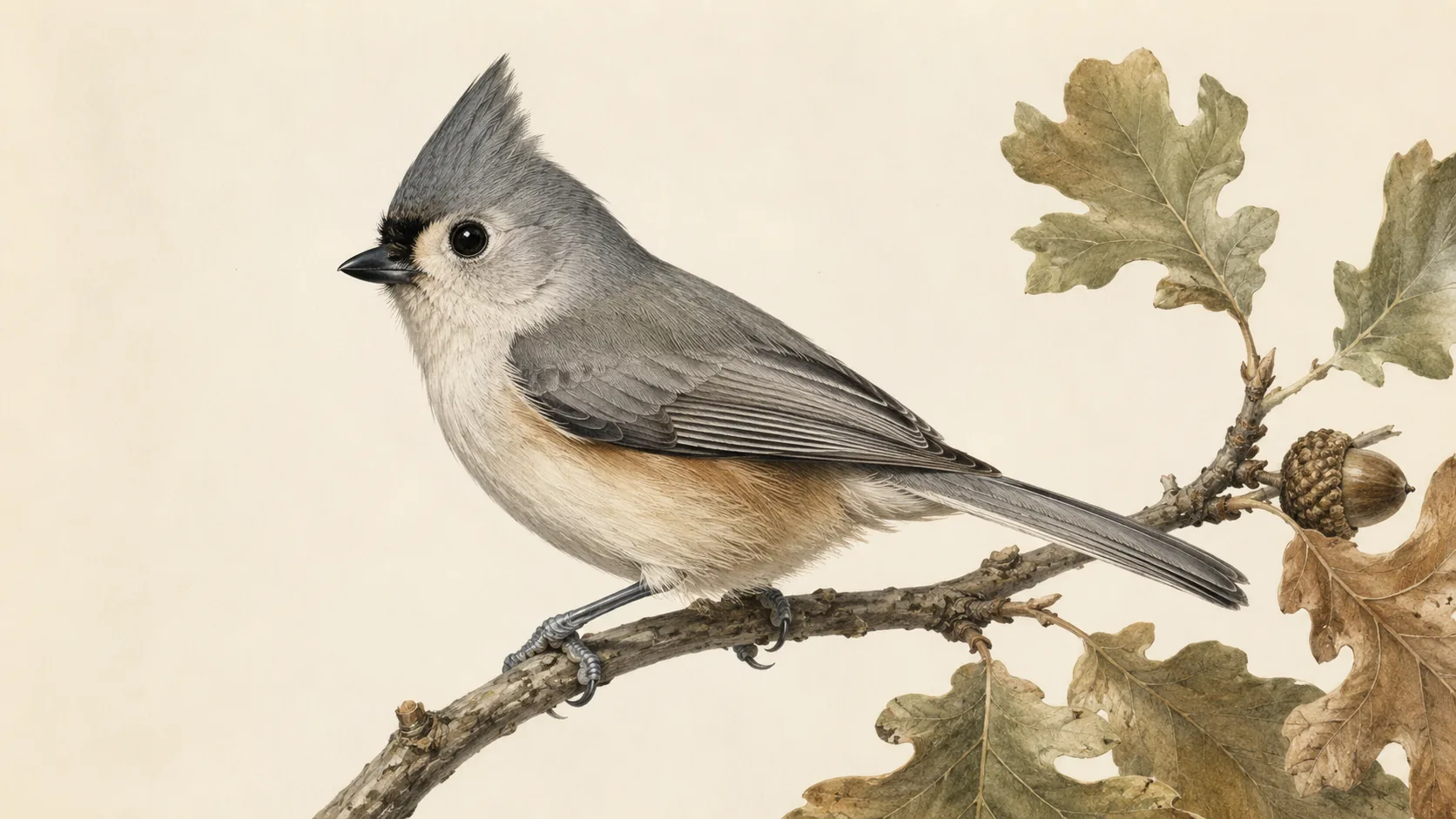
The Tufted Titmouse is plain in the way good design is plain. Clean silver-grey above, soft white below, with a wash of peach-buff along the flanks that catches the eye once you know to look for it. The crest is the signature: a pointed grey peak that rises and falls with the bird’s mood, raised when alert, lowered when at ease. A small black patch sits just above the bill, and the large dark eye, set in a pale grey face, gives the bird its permanently startled, inquisitive expression.
Cornell Lab puts the bird at 14 to 16 centimetres long and 18 to 26 grams, noticeably larger and stockier than the chickadees it often travels with. Males and females are identical in the field. There is no seasonal change, no breeding plumage, no bright male and dull female. What you see in January is what you see in June: a tidy grey bird with a crest and an outsized eye.
The silhouette does most of the identification work. Round body, short stout bill, and that erect crest read instantly even at distance or in poor light. No other small grey bird in the eastern woods carries a crest like it.
What he sounds like
You hear the titmouse long before you see it. The song is a clear, ringing whistle that almost everyone transcribes the same way: peter-peter-peter, repeated from a high perch, carrying well through bare winter woodland. It is loud for so small a bird, and it runs year-round, not confined to the breeding season.
Cornell Lab notes that beyond the whistled song, the titmouse is a vocal and versatile bird. It gives a scratchy, nasal chick-a-dee type call closely related to the chickadee’s, used in contact and in mobbing, and a range of harsh scolding notes when a predator is near. The bird is rarely silent for long. In a mixed winter flock moving through the trees, the titmouse is often the voice keeping the group together.
Range and habitat
Baeolophus bicolor is a non-migratory resident across the eastern United States, from the Gulf Coast north and west to the edge of the Great Plains. The bird you see at your feeder in December is the bird that nested in your wood in May. It does not leave.
What it has done instead is push north. Cornell Lab reports that over roughly the past seventy years the range has expanded steadily into New England and southern Canada, with climatic warming the likely main driver and backyard bird feeders a real assist. A century ago the titmouse was a southern bird. Today it is established in southern Ontario and across the northeast, and the Breeding Bird Survey records a population that has increased, not declined, across that span.
The preferred habitat is deciduous and mixed woodland with a mature canopy, especially where oaks and beeches provide mast. It takes readily to suburban gardens, parks and wooded edges, anywhere with large trees and, ideally, a feeder.
Diet
The titmouse is an insect eater first. Cornell Lab notes that insects make up close to two-thirds of the annual diet, with caterpillars the most important prey through summer, alongside beetles, ants, wasps, stink bugs, treehoppers, spiders and snails. In autumn and winter, when insects thin out, the bird turns to seeds, nuts and berries, acorns and beech nuts chief among them.
At the feeder the behaviour is distinctive and worth watching. The titmouse takes one seed per visit, carries it to a branch, holds it under its feet, and hammers it open with the bill. Cornell Lab notes that in experiments titmice consistently choose the largest seed available. They also hoard: through autumn and winter the bird caches shelled seeds in bark crevices, usually within forty metres or so of the feeder, taking a single seed each trip and often shelling it before hiding it.
Breeding and nesting
The titmouse is a cavity nester that cannot dig its own hole. It depends on natural cavities and, above all, on old woodpecker holes, and it takes very readily to nest boxes. Inside the cavity the female builds a cup of damp leaves, moss and bark, and lines it with the soft material the bird is famous for: hair, fur, wool and cotton, including the fur she plucks from living animals.
Cornell Lab records a clutch that averages around five to six eggs, with a typical range of three to nine. The female incubates for roughly twelve to fourteen days, thirteen being most common. The young leave the nest about fifteen to sixteen days after hatching. Most pairs raise a single brood a year, occasionally two. Young from one year sometimes stay on into the next, helping their parents raise the following brood, an unusual touch of family cooperation for a feeder bird.
The behaviour worth watching
Most small birds at a feeder are doing one thing: eating, fast, before something larger arrives. The titmouse is doing something more deliberate. It assesses the tray, selects the single largest seed, carries it off, and either opens it on a branch or files it away in a bark crevice for later. It is the planner of the winter feeder, working to a longer horizon than the bird beside it.
That same forethought is what sends it onto the back of a sleeping fox in spring. A warm, deep, insulated nest cup is worth the risk of plucking fur from a living predator, and the bird has clearly run the calculation. The fur theft, the seed caching, the choosing of the biggest seed every time: these are not separate quirks. They are one temperament, expressed across the year.
The titmouse is the bird at the winter feeder thinking one move ahead, and in spring it will steal the fur off a fox to prove it.
Whether that adds up to anything we would recognise as cleverness is a question better left open. The behaviour is consistent, and it is its own reward to watch. Sit with a feeder for an afternoon and the titmouse is the bird you end up following, because it is the one that always seems to be deciding something.