Field Guide
Atlantic Puffin
It lands on a rock ledge off Maine with a bill fanned out like a hand of cards. Ten sand lance, each one pinned crosswise, the silver bodies forming a tidy row. The puffin stands there for a moment - that comic-opera posture, bright-footed, white-faced, orange-billed - and then vanishes into a burrow in the turf above.
That image is not decorative. It is the whole animal. Everything about Fratercula arctica - the little brother of the Arctic - is shaped around that specific transaction: catching as many small fish as possible, as far out at sea as necessary, and delivering them alive to a single chick underground.
What it looks like
A stocky, short-winged bird roughly the size of a small pigeon. Body length 28 to 33 cm, weight 310 to 550 g, wingspan 47 to 63 cm. It sits low and square on a rock. In flight the wings beat at up to 400 times per minute just to keep the bird level - the same rapid cadence it uses to fly through water rather than air.
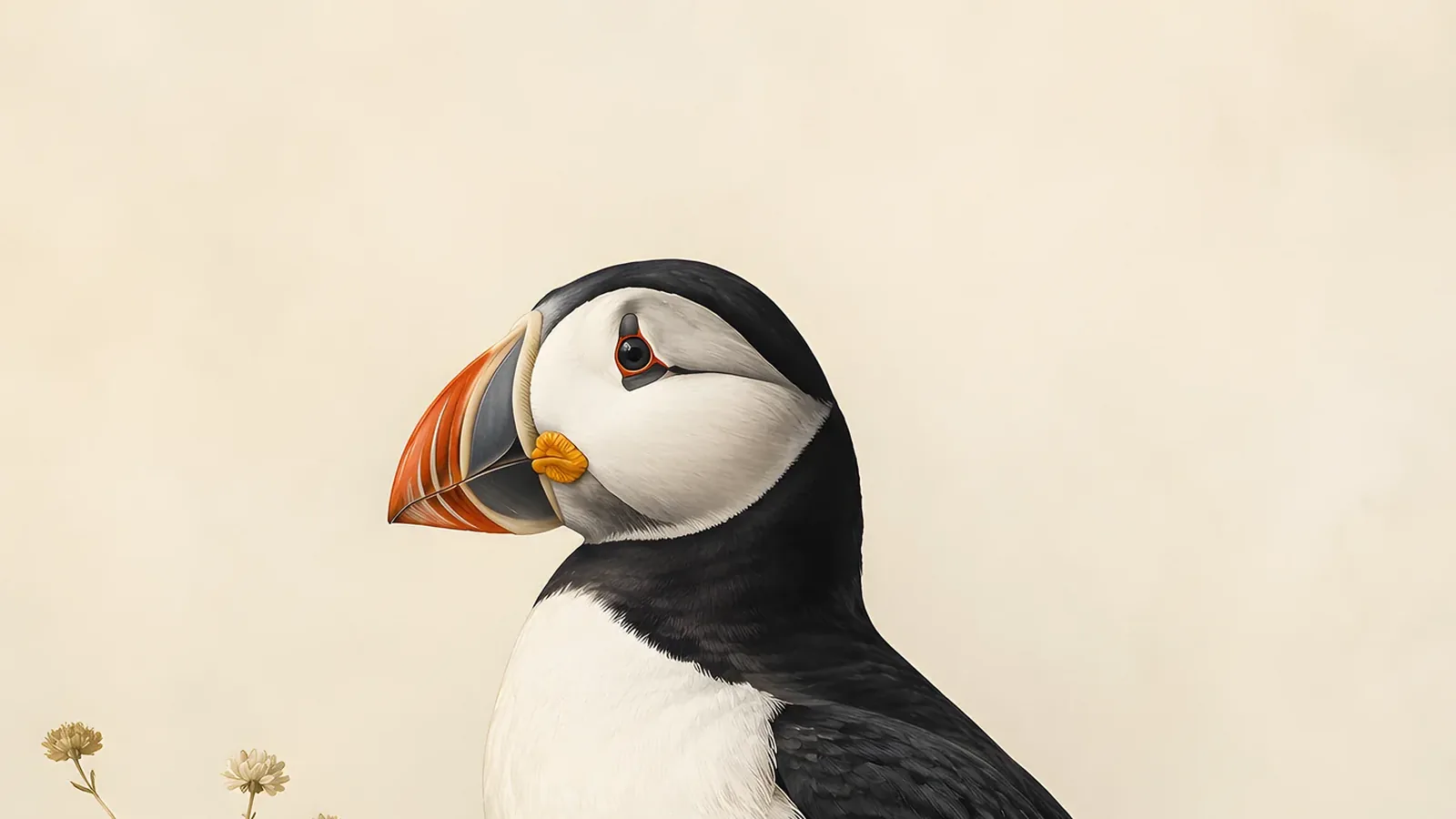
In breeding plumage the contrast is absolute. The upperparts are jet black. The underparts are pure white. The face is white with a pale grey mask around each eye. A thick black collar separates the white chest from the white face. The legs and webbed feet are vivid orange-red.
Winter brings a quieter version of the same bird. The face darkens to sooty grey-black. The bright bare-part colours fade. The puffin spends its non-breeding months far out at sea and rarely shows itself to anyone, which is why most people carry only one image of the species in their minds: the summer bird, standing on a cliff in Norway or Iceland or on Seal Island off the coast of Maine.
The bill
The bill is the thing. In summer it is large, laterally compressed, and almost semicircular in profile. The outer half is orange-red. The inner half is slate blue-grey. A yellowish crescent divides them. The whole structure is decorated with additional ridged plates and a bright yellow rosette at the gape.
What is less obvious is that none of that colour is permanent. The bill’s decorative plates and the coloured tip are seasonal ornaments. After the breeding season, the puffin sheds them. What remains through winter is a smaller, narrower, noticeably duller bill - pointed rather than triangular in profile, dark-based, with little of the summer’s drama.
“Both the strong tongue and the roof of the mouth are heavily lined with backward-angled spines.” (BirdNote / AskNature)
Those spines are the engineering solution that makes the bill extraordinary for reasons beyond its colour. Each fish caught is pressed against the spiny palate and held by the tongue. A second fish can then be caught without the first being released. And a third. The bill’s unique gape structure allows the upper and lower mandibles to meet at different angles - the bill opens wide while the spines hold existing fish in place against the roof. In this way the puffin can carry an average of ten fish per trip, according to data gathered at Maine colonies by Audubon’s Project Puffin. Individuals have been recorded carrying more than 60. The fish are typically sand lance (Ammodytes spp.), herring, capelin, or sprat - all small, slender, and adapted to being pinned sideways in a row.
A life at sea
The puffin is at sea for most of its life. It comes ashore for one purpose - breeding - and returns to the open ocean the moment the chick fledges, not touching land again until the following spring.
At sea it is a diver. It can go down to approximately 60 metres, using its wings to fly underwater just as it flies through air, and it typically stays submerged for 20 to 30 seconds per dive. Its primary prey across the breeding season are small schooling fish - sand lance above all. A 2024 study by Kennerley, Clucas, and Lyons in Frontiers in Marine Science found that sandlance and Atlantic saury dominated the chick diet, while adults consumed a broader range including lower-lipid prey, suggesting adults are selectively delivering the highest-quality food to the burrow.
| Measurement | Range |
|---|---|
| Length | 28-33 cm |
| Weight | 310-550 g |
| Wingspan | 47-63 cm |
| Typical lifespan | 30+ years |
| Record longevity | 41 years (banded, Norway) |
| Average fish per bill load | ~10 |
| Incubation period | 39-45 days |
| Fledging age | 38-44 days |
Iceland holds roughly 60 per cent of the world’s breeding Atlantic Puffins, according to the National Geographic Society. Norway, the Faroe Islands, the United Kingdom, Greenland, and the coast of Newfoundland hold most of the remainder. The global population is estimated at around six million individuals, but the trend is downward. The species is listed as Vulnerable (VU A4abcde) on the IUCN Red List - a status reflecting projected declines linked to prey shifts driven by warming seas, bycatch in gillnet fisheries, and pollution.
The puffin is long-lived for a bird of its size. Most do not attempt to breed until age five. The oldest recorded individual, banded as a chick in Norway, reached 41 years.
What it sounds like
The Atlantic Puffin is not a songbird. On the water, at sea, it is silent. In the burrow it produces deep growling moans, low murmurs, and a sound the Cornell Lab of Ornithology’s All About Birds describes as resembling a muted toy chainsaw. These calls are exchanged between mates in the dark of the tunnel. They do not carry far. A colony of puffins, from a distance, sounds quieter than you expect.
It is not a cheerful bird performing for tourists. It is an efficient offshore foraging machine that happens to grow ornamental plates on its bill once a year.
Burrows and breeding
Puffins nest in burrows. The male excavates with bill and webbed feet, digging a tunnel typically 70 to 110 cm long into soft turf on cliff-top islands or in earthen slopes above rocky shores. The nest chamber at the end may be lined with grass or feathers. One egg is laid. Both parents incubate it, tucking it under a wing against the body, for 39 to 45 days.
The chick hatches covered in dark down. Both parents provision it throughout the chick-rearing period, arriving with bill-loads of fish and dropping them on the burrow floor for the young bird to sort through. After 38 to 44 days the chick fledges alone at night, flying out to sea without its parents - and does not return to land for two to three years.
Puffins show strong site fidelity. A pair will return to the same burrow year after year. The bond is more accurately described as a bond to the burrow than to each other - but in practice the same pair reunites at the same site, season after season.
Project Puffin
Puffins were common on the islands of Maine until the 19th century. Feather hunters and egg collectors finished them off. By the early 20th century they were gone from all but a few remote rocks. The common loon survived on the freshwater lakes inland. The puffin did not survive the offshore islands where it needed to breed.
In 1973, a 28-year-old Audubon naturalist named Stephen Kress began translocating puffin chicks from Newfoundland to Eastern Egg Rock, a seven-acre island six miles off the Maine coast. He fed the chicks by hand, dug artificial burrows, and waited. Nine hundred and fifty-four chicks were relocated. Most fledged. Puffins do not return to breed until age five, so the wait was long.
The first translocated puffin reappeared on June 12, 1977. But birds were not staying. Kress developed what he called social attraction: carved wooden decoys placed on the rocks, audio recordings of colony sounds played on the island. The birds, returning from sea, saw what appeared to be a functioning colony and chose to remain. On July 4, 1981, a puffin was observed delivering fish to a burrow at Eastern Egg Rock.
Today approximately 1,300 breeding pairs nest across five Maine islands. Seal Island, 21 miles off Rockland, holds roughly 600 pairs. The technique Kress developed has since been applied to at least 64 seabird species in 17 countries, including the Bermuda petrel and the Chinese crested tern.
A seabird colony is, in one sense, a piece of information: a signal to returning birds that a site is safe and occupied. Remove the birds and the information disappears. The decoys replaced the information long enough for the first pioneers to commit. An animal that lives 40 years and raises one chick per season has no margin for that kind of erasure. The puffin’s clown face is not the joke. The joke is that it took wooden decoys and a patient ornithologist to bring it back.