Field Guide
Turkey Vulture
Gas engineers working for Union Oil Company of California once had a problem: finding invisible leaks in buried natural gas lines across open country. Their solution was to add a trace of ethanethiol - a sulfur compound that smells of rotting flesh - to the gas, then watch the sky. Where Cathartes aura began to circle and drop, the pipe was leaking. The Turkey Vulture had become a precision instrument.
That story, which Audubon naturalists have repeated for decades, contains the whole argument about this bird. It is not, as the squeamish often dismiss it, merely a creature of unpleasant habits. It is the only bird in North America with a developed enough sense of smell to locate a carcass concealed beneath a forest canopy - and that single biological fact reshapes how its entire life must be understood.
What it looks like
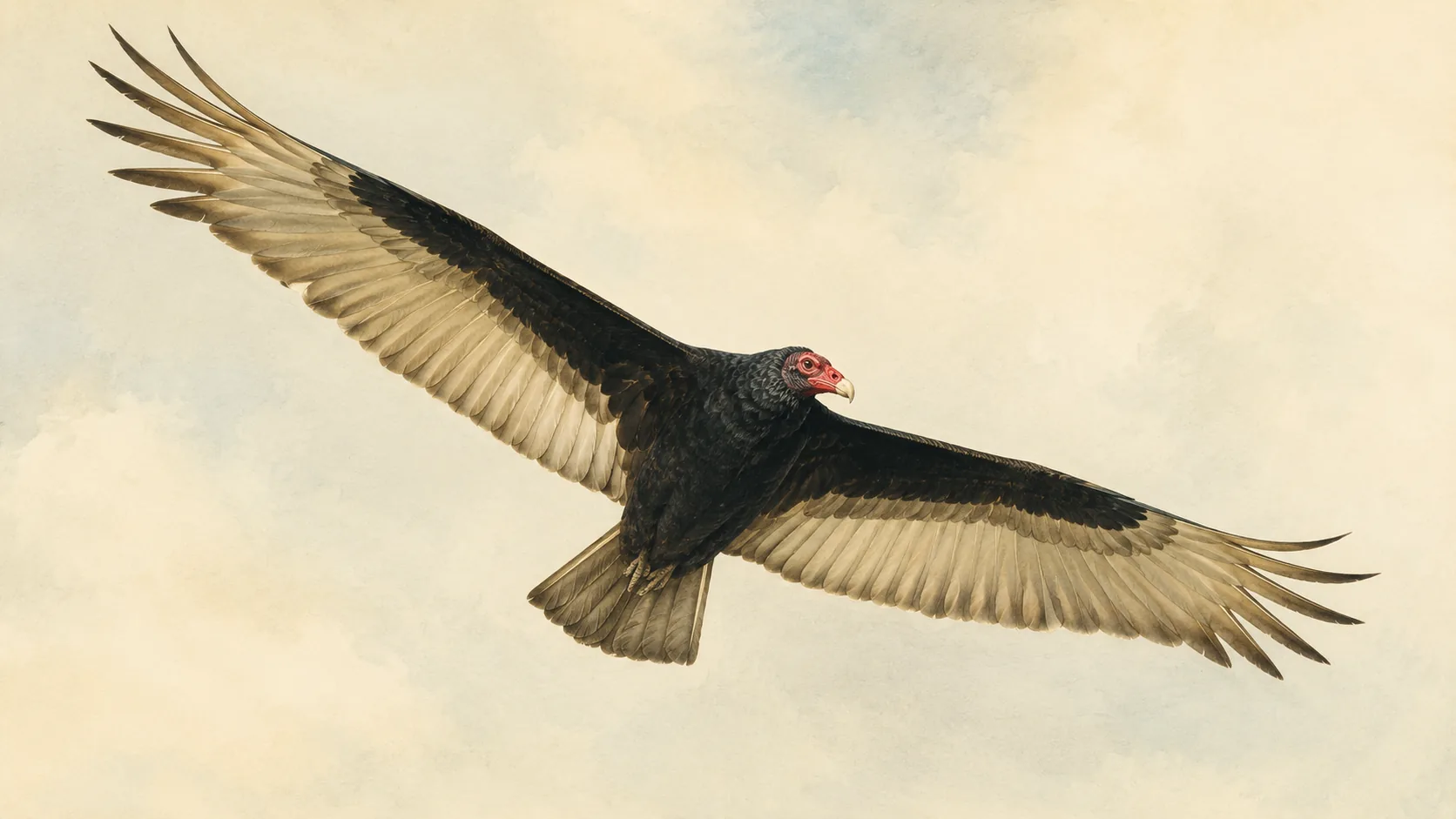
An adult Turkey Vulture is 64 to 81 centimetres long with a wingspan of 160 to 183 centimetres - large enough to be confused with an eagle when soaring high overhead, but immediately different in posture. Where an eagle holds its wings flat and level, the Turkey Vulture carries its wings in a shallow V, a dihedral angle that causes it to tip and rock side to side in thermals, never perfectly steady. That distinctive wobble, visible at great distance, is the first field mark.
At closer range the separation is unambiguous. The body is brownish-black overall. The underside of the wings shows a strong two-tone pattern: black wing-linings contrasting with pale grey flight feathers, giving the bird a two-colour underwing that no North American eagle reproduces. The tail is long and slightly rounded. The head is bare and red in adults, grey in juveniles. The bill is hooked and ivory-coloured.
In flight the Turkey Vulture holds its head small and low relative to the body, which gives a silhouette quite unlike the head-forward profile of large raptors. Perched, it looks hunched and heavy-shouldered, the bare red face visible as a point of colour against the dark plumage.
Males and females are identical in the field.
The nose, examined
Most birds navigate by sight and sound. Cornell’s Birds of the World notes that Turkey Vultures can locate carcasses hidden beneath vegetative cover, including dense forest canopies, a task that rules out vision and hearing as primary cues. The olfactory bulb - the brain structure that processes scent - is significantly larger in this species than in the Black Vulture, its close relative, which forages by vision and tends to follow Turkey Vultures to food rather than find it independently.
The practical range of the nose is difficult to measure in open field conditions but the evidence from pipeline detection and controlled experiments with hidden carrion is consistent: the bird tracks chemical plumes downwind, working concentration gradients the way a hunting dog works a scent trail. What it is tracking is the volatile compounds produced by microbial decomposition in the first day or two after death - the window when carrion is still relatively fresh by vulture standards.
This matters ecologically. A body hidden in dense woodland might stay undetected for days if scavengers depended on sight. The Turkey Vulture’s olfactory reach means nothing stays hidden long.
Voice and behaviour in the roost
It is nearly mute. The syrinx - the vocal organ that gives most birds their voices - is vestigial in the Turkey Vulture. What sound it makes is produced by expelling air: hisses when threatened, low grunts between individuals. At communal roosts, which can hold anywhere from a handful of birds to several thousand, the conversation is largely silent. Wing posture and body orientation carry the social load instead.
Communal roosts persist year-round where the population is resident. In the mornings, birds spread their wings and face the sun before departing - a thermoregulatory behaviour sometimes called sun-basking - which also serves to dry damp plumage. Departure is leisurely. Turkey Vultures are thermal hunters and wait for rising air columns to develop before committing to flight.
Range and the year’s movement
The species breeds from southern Canada to Tierra del Fuego in Chile, one of the widest ranges of any New World bird. The IUCN lists the species as Least Concern with apparently stable populations. In North America the northern populations are migratory: birds that summer in Canada and the northern states move south through the United States and into Central and South America each autumn, with the western subspecies meridionalis accounting for millions of migrating individuals.
The southern and coastal US populations are largely year-round residents. The range has expanded northward over recent decades, a pattern associated with increasing road kill, warmer winters, and habitat change at the forest edge. Hawk Mountain Sanctuary in Pennsylvania counts Turkey Vultures among its most numerous autumn migrants - thousands pass per day in peak September flight.
Habitat is broad: open country, roadsides, farmland, forest edge, and open woodland. The bird avoids dense unbroken forest as foraging habitat (though it can smell into it) and heavy urban development. It is one of the most widely distributed large birds on the continent.
Diet and the ecosystem role
Carrion is the whole diet under normal conditions. Animal Diversity Web notes a preference for recently dead animals - animals dead one to two days - though the tolerance for advanced decomposition is higher than in most scavengers. The digestive system is adapted to neutralise pathogens that would kill other animals: stomach acid strong enough to destroy anthrax and botulinum toxin. A Turkey Vulture eating a rabid animal is a sanitation service, not a vector.
Occasional consumption of decaying plant matter, live insects, and fish has been documented but represents a small fraction of foraging observations.
The ecosystem case for this bird is straightforward. Carcasses are a concentrated source of pathogen load - leptospirosis, salmonella, brucellosis. A large mammal carcass left to decompose without scavengers is a weeks-long infection source for groundwater and neighbouring animals. Turkey Vultures, by consuming and chemically neutralising that material in hours to days, reduce transmission risk across the landscape. The IUCN notes this sanitation function explicitly. The catastrophic loss of Old World vultures in India during the 1990s - caused by diclofenac poisoning in cattle - produced a documented outbreak of rabies and anthrax in wildlife and feral dogs. The New World has not experienced an equivalent collapse, and the Turkey Vulture’s stable population is, among other things, a public health asset.
Breeding and nesting
Pairs form loose bonds but do not build nests in any conventional sense. Nesting sites are cavities and sheltered recesses: hollow logs, cliff crevices, rock caves, abandoned buildings, dense thickets at ground level. The female lays one to three eggs directly on the substrate, with no nest construction beyond occasionally scraping together leaf debris. Both parents incubate, trading off over a 34 to 41 day period. Chicks are covered in white down at hatching and are fed by regurgitation. Fledging takes 70 to 80 days - a long developmental period that reflects the energy demands of growing a bird this size.
Breeding in the eastern US runs roughly March through June. Adults defend the nest site by regurgitating semi-digested carrion on intruders - a defense that is extremely effective and which requires no elaboration.
Thermals and the art of not working
A Turkey Vulture in full soar is using almost no energy. The wide wings and light wing-loading allow it to ride columns of rising warm air - thermals - with minimal flapping, covering large distances at low metabolic cost. On cold still mornings when thermals have not yet developed, it sits. It waits. The economy of its hunting method is matched to the unpredictability of its food: carrion appears sporadically and in no pattern the bird can control, so the system that works is one that covers maximum ground at minimum expense.
When thermals are running and the nose is working, a Turkey Vulture is covering tens of kilometres at treetop height, following chemical gradients down to whatever died in the night. The pipeline engineers understood this. They had read the landscape correctly.