Field Guide
Common Loon
There is a sound that means summer on a northern lake. A long, rising wail that carries across the water at dusk and lifts the hair on your arms. That is the Common Loon. Once you have heard it, you never forget where you were standing.
How to know it
A big, low-riding waterbird. Heavier than it looks.
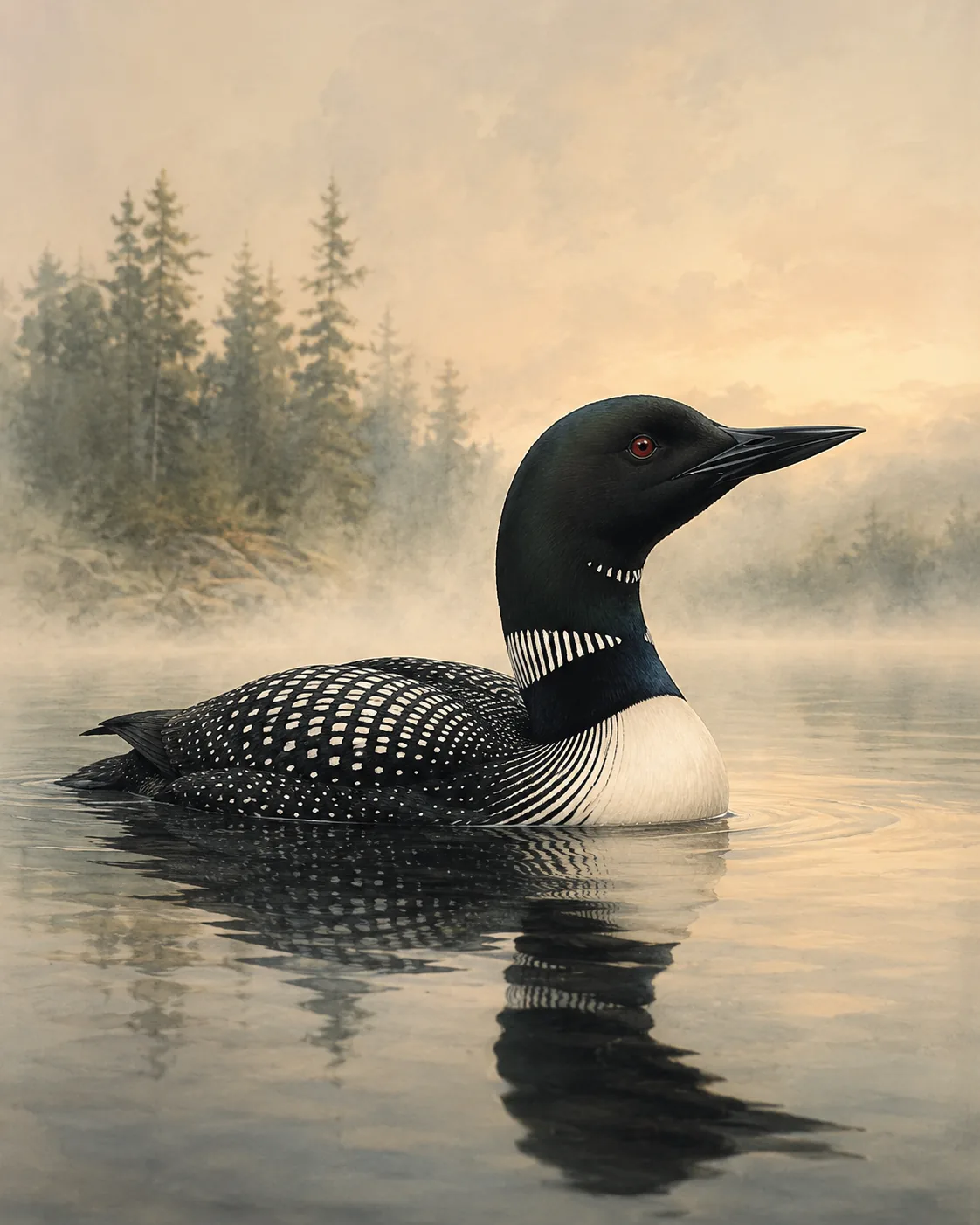
In breeding dress it is unmistakable. A glossy black head with a faint green sheen. A back chequered in clean white squares. A collar of fine vertical stripes at the throat, like a band of ivory pinstripes. The bill is a straight grey dagger, held level. The eye is a deep cardinal red.
In winter the bird trades all of that for plain grey-brown above and white below. Quieter. Easy to overlook on a cold coastal bay.
Size puts it between a large duck and a small goose. It sits deep, with little of the body above the waterline.
Range and habitat
In summer, clear forest lakes across Canada, Alaska and the northern United States. It needs cold, clean water with fish it can see and a quiet shore to nest on.
In winter it moves to the sea. You will find it then along both American coasts, on bays and sheltered inlets, and across into Iceland and Greenland.
It is faithful to good water. A pair will return to the same lake year after year.
Behaviour
The loon is built to dive, not to walk. Its bones are dense, unusual among birds, which lets it sink and chase fish underwater. It can go down forty metres and stay under for a minute or more.
Those legs sit far back on the body. Perfect for swimming, useless on land. A loon comes ashore only to nest, and even then barely.
Take-off is a labour. It runs across the surface for many metres, wings beating, before it finally lifts. A loon needs a long stretch of open water as a runway, which is why a calm lake at first light is its home ground.
Voice
Four calls, and each one means something.
The wail is the long, mournful note that travels furthest, used to find a mate across the water.
The tremolo is a wavering, almost laughing cry, given in alarm. People call it the loon’s laugh, though there is nothing happy in it.
The yodel belongs to the male alone, a rising territorial call no two birds give quite the same way.
And the hoot, soft and close, is the quiet word between a pair and their young.
Hear all four on one still evening, and you understand why this bird haunts the northern imagination.