Field Guide
Louisiana Waterthrush
A spring morning in the West Virginia highlands. The stream is fast, cold, and loud enough that you feel it before you see it. Then, at the gravel edge where the water shallows over a ledge, a small brown bird is walking. Not hopping. Walking. Its entire rear end pumps steadily up and down - once, twice, again - while it tilts its head and probes the underside of a submerged leaf with a thin bill. A caddisfly larva comes loose. The bird swallows it in one movement and keeps walking, teetering as it goes.
This is Parkesia motacilla, the Louisiana Waterthrush. It is a wood-warbler. Nothing about its appearance or behaviour makes this obvious.
What it looks like
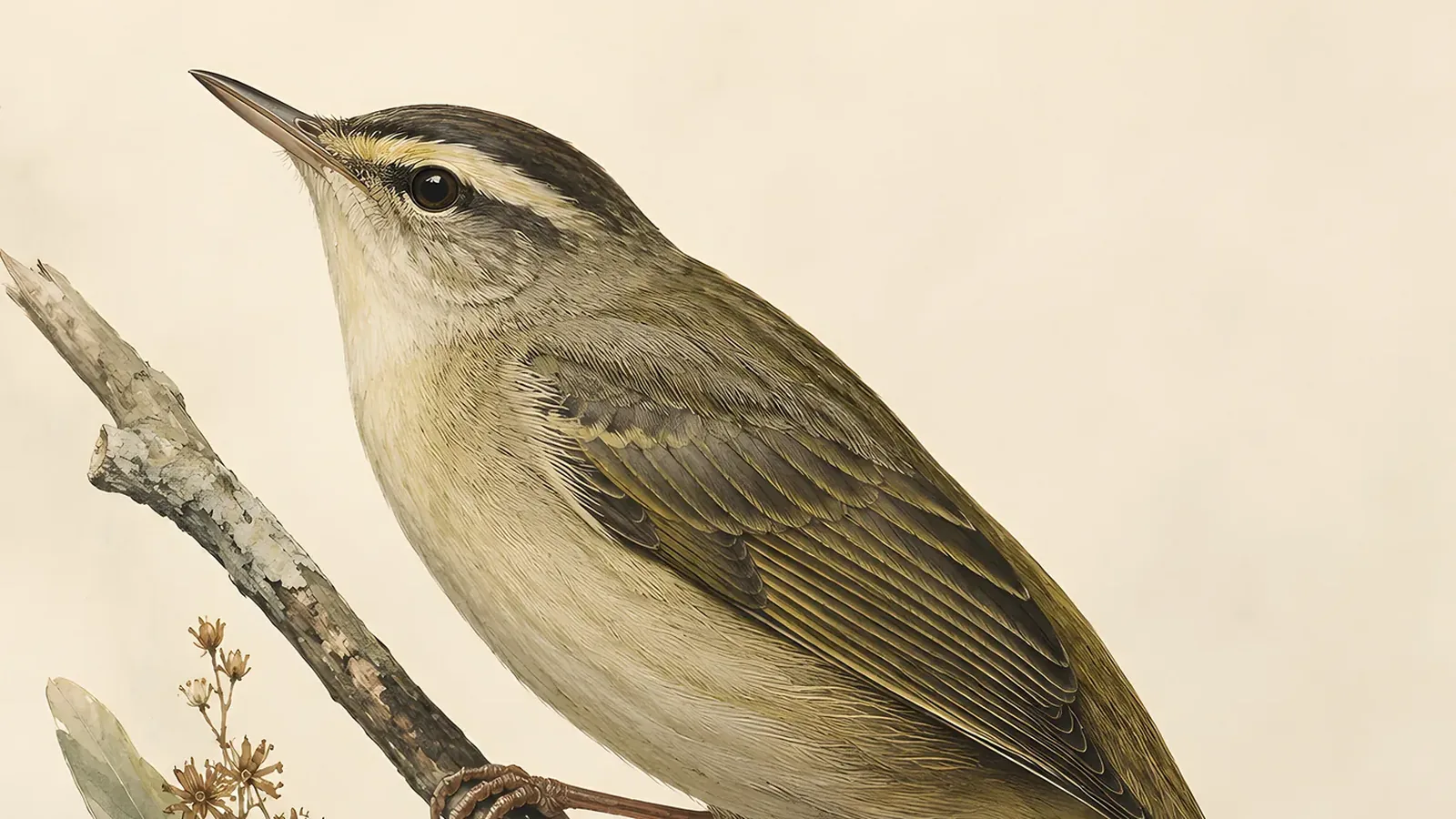
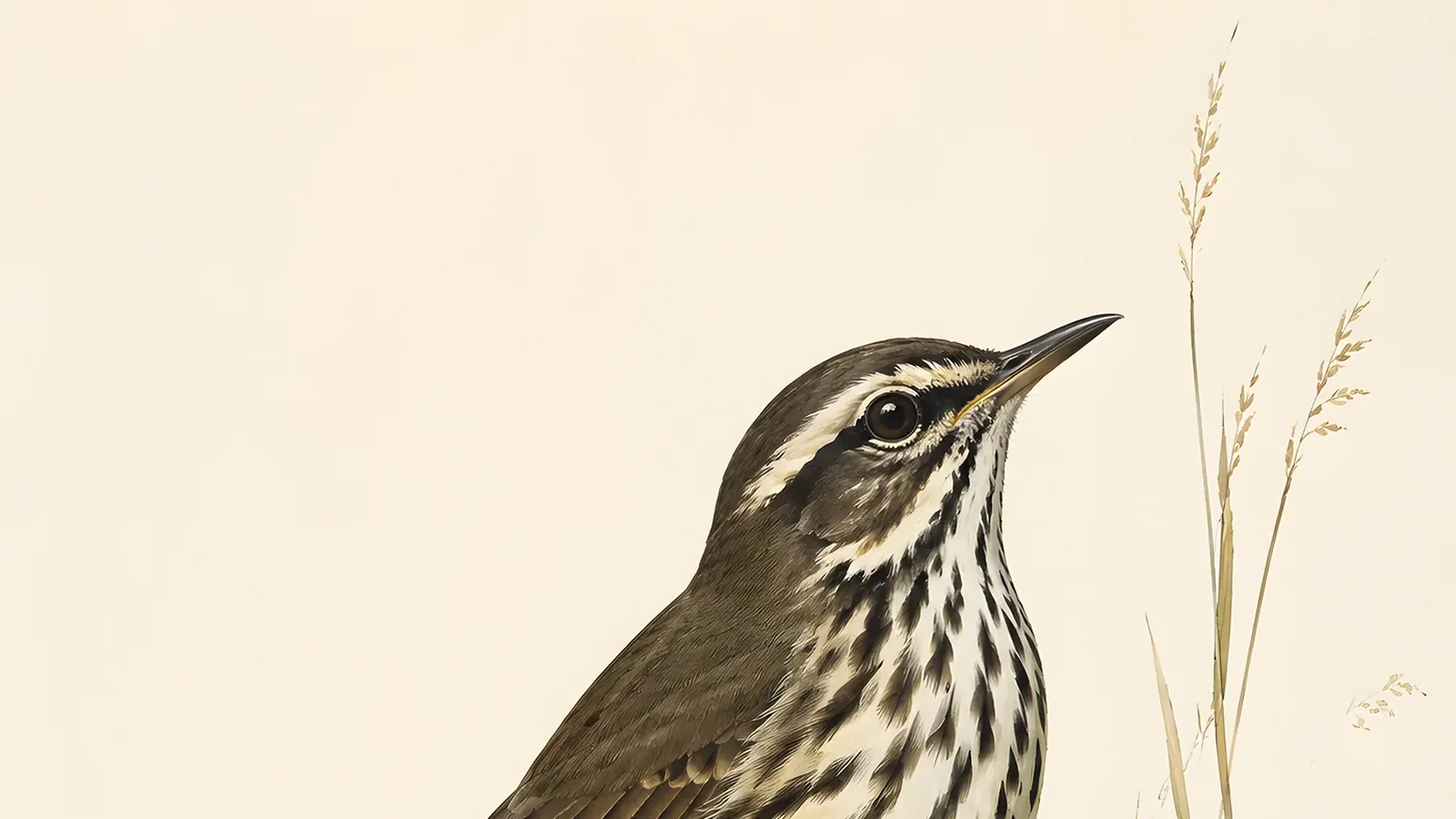
Parkesia motacilla is a compact bird, 14 to 17 cm long and weighing 18 to 23 grams, with a wingspan of 22 to 27 cm. The upperparts are plain dark olive-brown, the head showing no field marks beyond a single bold stripe. That supercilium - white, broad, starting at the bill and sweeping behind the eye - is the first thing you register and the surest way to name it. On the Northern Waterthrush the supercilium is narrower and often tinged buff. On the Louisiana it is white and wide, particularly behind the eye where it flares slightly.
| Feature | Louisiana Waterthrush | Northern Waterthrush |
|---|---|---|
| Supercilium | Broad, bright white, flares behind eye | Narrower, often buffy |
| Throat | Plain white, unstreaked | Finely streaked |
| Flanks | Washed pinkish-buff | Buff to yellowish |
| Breast streaking | Sparse, concentrated on sides | Dense across breast |
| Bill | Slightly larger | Slightly smaller |
| Habitat (breeding) | Running water, rocky streams | Slow swamps, bogs |
The underparts are white with a faint pink-buff wash on the flanks. Breast streaking is sparse and runs down the sides rather than across the full chest. The throat is plain white with no streaking - a key distinction from its close relative. The bill is thin, dark, and longer than you expect on a warbler. Legs are pinkish. A standing bird holds itself horizontal and low, looking less like a warbler than like a small sandpiper.
The sandpiper warbler
The bobbing is constant. At all seasons, at stream edges and in winter riparian woodland, the bird pumps its rear body up and down in a fluid teetering motion. It moves its ankle joints, not its tail, so the whole rear of the body dips rhythmically with each step. The species name motacilla is taken directly from the Latin word for “tail-wagger,” the same root that names the wagtails of the Old World.
Watch one working a riffle. It walks into the shallows - actually wading, its legs submerged to the ankle - and flips submerged leaves with the bill. This is the characteristic foraging move. A caddisfly larva, a mayfly nymph, a small stonefly - these are what it is after. Ephemeroptera, Plecoptera and Trichoptera: the three orders of aquatic insects that ecologists call EPT, and that are among the most pollution-sensitive invertebrates in freshwater ecosystems. The Cornell Lab of Ornithology notes that the Louisiana Waterthrush selects larger prey than the Northern Waterthrush and shows a particular preference for caddisfly larvae.
Beyond the insects, it takes small crayfish, salamanders, minnows, earthworms on occasion, and during poor years on acidified streams it ranges further from the water to take camel crickets, moths and wolf spiders. That substitution, documented by Trevelline et al. (2018, PeerJ), carries costs - terrestrial prey is less nutritious and obtained at greater predation risk.
The foraging style is shared by almost nothing else in the warbler family. The closest analogue in North American birds is the unrelated American dipper, which wades and dives in fast western streams. The dipper and the waterthrush evolved their walking-on-water habits on separate continents from separate ancestors, arriving at the same strategy by convergence. The dipper dips. The waterthrush teeters. Both are committed to moving water.
What it sounds like
The song announces its arrival before the bird is visible. Three or four slurred whistled notes - loud, clear, slightly descending - followed by an accelerating tumble of shorter, bubbly phrases. Ornithologists describe it as one of the strongest songs relative to body size among the wood-warblers. You hear it from 200 metres through stream noise.
Silcock et al. (2021, PLOS ONE) identified three geographically distinct song types across the breeding range, differing in the structure of the introductory notes. Type B, with downstroke-only notes, predominates in recently glaciated regions, while Types A and C concentrate in unglaciated southern and Appalachian areas - evidence, the authors argue, of separate subpopulations shaped by Pleistocene isolation.
The call is a sharp, metallic chink, similar to a waterthrush chip but with a slight rise. The species is one of the louder birds in a spring Appalachian forest and can be detected at range by song alone during territory surveys.
The stream-quality bird
The Louisiana Waterthrush has become one of the most studied avian bioindicators in eastern North America. The logic is direct: the species nests on the banks of headwater streams and feeds almost exclusively on EPT invertebrates - organisms that require cold, well-oxygenated, chemically stable water to complete their larval stages. Where the water is clean, EPT taxa are abundant and the waterthrush thrives. Where the stream is acidified, polluted by mine drainage or degraded by agricultural runoff, EPT taxa decline and so does the bird.
Mattsson and Cooper (2006, Freshwater Biology, 51:1941-1958) formally demonstrated the relationship, showing that Louisiana Waterthrush territories and the results of habitat assessments served as cost-effective indicators of instream biotic integrity - meaning a single morning’s territory survey could predict the results of a full macroinvertebrate biological assessment.
Trevelline et al. (2018, PeerJ, 6:e5141) added the dietary mechanism. On streams with mean pH of 6.46 or lower, EPT availability fell to a fraction of levels on unacidified streams. Nestling and adult waterthrushes on those streams showed statistically significant increases in dietary richness - a measure not of abundance but of desperation, the birds taking whatever they could find once their preferred prey was gone.
Frantz, Wood and Merovich (2018, PLOS ONE, 13:e0206077) tracked the species across a West Virginia watershed as shale gas development expanded from 2008 to 2015. Daily nest survival rates were lower in disturbed territories. Territory density declined over the study period. The authors concluded that disturbed territories functioned as borderline sink habitats - birds attempting to breed there contributed fewer young than were needed to sustain local numbers without immigration from healthier streams nearby.
The pattern is consistent enough that the Louisiana Waterthrush is now routinely built into stream-condition monitoring programmes in the central Appalachians and mid-Atlantic states. Its presence is a good sign. Its absence where habitat looks right is a question worth asking.
Range and habitat
The Louisiana Waterthrush breeds across the eastern United States, from southern New England west to eastern Kansas and Nebraska, and south through the Appalachians into Georgia and Alabama. It is absent from the coastal plain and from the higher reaches of mountains.
The breeding habitat is specific. Fast-flowing, gravel- or cobble-bottomed woodland streams in mature deciduous or mixed forest. Not ponds. Not slow swampy drainage. Not open streamsides. The bird needs shaded, rocky riffles where leaf packs accumulate and EPT larvae concentrate, and it needs enough riparian forest to sustain territories that can run 300 to 600 metres along a stream bank.
In Pennsylvania and Kentucky, where much of the core research has been conducted, territories average 400 metres of stream, with birds defending long narrow strips of riverbank rather than the conventional circular woodland territory of most songbirds.
In winter the species withdraws to northern Mexico, Central America, the Caribbean and the northern edge of South America. On wintering grounds it continues to prefer running water and forested stream edges, sometimes using coastal mangroves when inland streams are unavailable.
Breeding
The Louisiana Waterthrush is one of the earliest wood-warblers to arrive on breeding grounds. Males reach the Gulf Coast by mid-March - weeks ahead of most warblers - and push northward to reach the Great Lakes region by mid-to-late April. The early arrival is tied to territory establishment: males sing immediately on return and begin defending stream stretches before leaves have opened on the canopy trees.
Nests are built on the ground, tucked into stream banks. The typical site is a hole or cavity in a cut bank, an overhanging root mass, or a cleft in a rock face close to running water. Both sexes build over four to six days using leaves, moss and grass. The nest is a shallow cup, always well concealed, almost always within a few metres of the stream edge.
In forty years of stream surveys in West Virginia, I have found the bird’s nest by watching where the female disappeared from, not by searching. You never find it directly. The bank swallows it whole. - (field journal, Frantz, 2018 study area notes)
Clutch size is three to six eggs, typically five. The female incubates for 12 to 14 days. Young leave the nest at about 10 days, before they can fly well, and continue to be fed by both parents for a further week. One brood per year. Pairs do not re-nest after a failed first attempt unless it fails very early in the season. The global population is estimated at 450,000 mature individuals (BirdLife International, 2019), and IUCN rates the species Least Concern, with the population up roughly 34 percent since 1970.
That broad stability at the species level conceals sharp local declines where stream quality has fallen. The waterthrush does not distinguish between an acid-polluted headwater and a chemically buffered one by looking at it. It does so by trying to breed there.
The bird that arrives in March at a clean, cold, rocky Pennsylvania or Kentucky stream - before the wood-warblers, before most of the spring migrants - is doing what the family almost never does: walking on water, flipping leaves, teetering steadily at the interface between two worlds. A warbler. A wading bird. A measurement.