Field Guide
Worm-eating Warbler
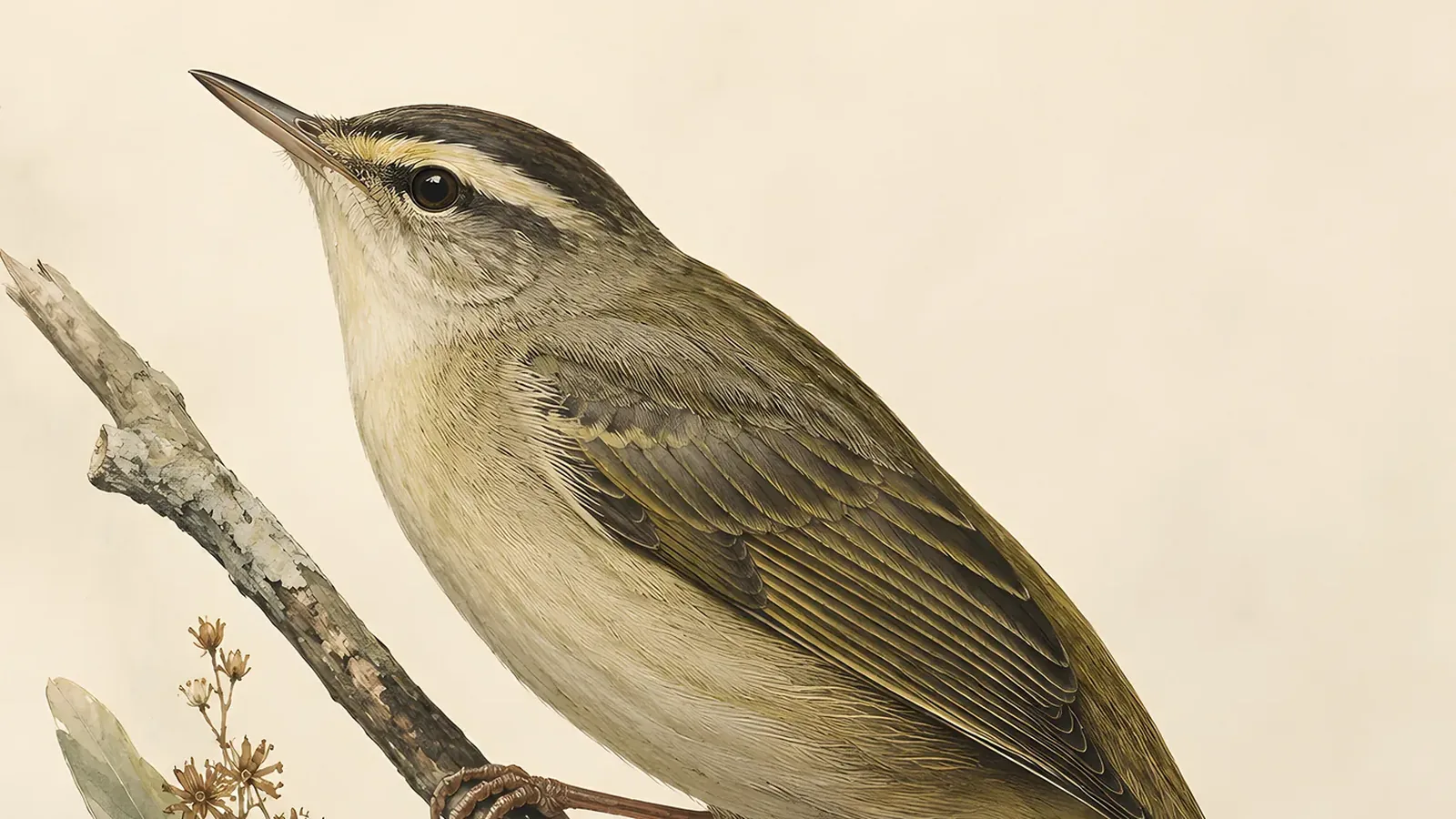
Freeze the scene: a wooded hillside in West Virginia, May, the canopy just leafing out. Down in the understory, a small olive-brown bird with a boldly striped head works a cluster of dead beech leaves still caught in a fork of rhododendron from last autumn. The bird is not hopping from branch to branch the way most warblers do. It is probing - methodically, deliberately - as though it knows something is in there. It does. Helmitheros vermivorum, the Worm-eating Warbler, is the warbler of the wrong name and the right instinct.
What it looks like
Helmitheros vermivorum measures 11 to 13 cm and weighs between 12 and 14 grams, fitting comfortably in the palm. The wingspan runs 20 to 22 cm. It is not a bird of flash.
The head is the field mark: four bold alternating stripes of black and warm buff run from base of bill to nape. The central crown stripe is buff, flanked by two black lateral stripes, then a broad buff supercilium, and another black stripe through the eye. No other eastern warbler carries exactly this arrangement. Below the head the bird fades to plain olive-brown on the back and wings. The underparts are clean buff, unmarked. The bill is notably heavy for a warbler, blunt and pointed, built more for levering open rolled leaves than for picking insects off flat surfaces.
Males and females appear identical in the field, which is uncommon among wood-warblers. The juvenile plumage is similar but slightly duller.
| Feature | Detail |
|---|---|
| Length | 11 - 13 cm |
| Weight | 12 - 14 g |
| Wingspan | 20 - 22 cm |
| Head pattern | Four stripes, black and buff |
| Back | Plain olive-brown |
| Bill | Heavy for a warbler |
| Sexes | Alike |
The dead-leaf specialist
The name promised earthworms. The bird delivers something far stranger.
Russell Greenberg’s foundational studies of this species showed that over 75 percent of foraging maneuvers on the breeding grounds from May through early August target live foliage - but during the non-breeding season in the Caribbean and Central America, that figure reverses, with over 75 percent of foraging directed at dead, curled leaves hanging in the understory (Greenberg 1987, The Condor 89:158-168). The bird is not simply looking wherever food happens to be. It is exploiting a microhabitat that almost no other small insectivore bothers with.
Tropical dead leaves harbor larger arthropods that use them as daytime shelters - concealed, stationary, and available only to a bird willing to probe rather than glean. The Worm-eating Warbler probes. It works hanging clusters with its heavy bill, inserting it into the rolled curl, prying apart leaf layers. The technique requires skill. Greenberg’s 1987 developmental study in Ecology found that hand-raised juvenile warblers visited dead leaf clusters nearly three times as often as any other microhabitat type before they had ever fed themselves - a strong innate preference, refined into full competence through practice.
On the breeding grounds the diet centres on caterpillars - smooth caterpillars, geometrid larvae, the kinds that rest motionless on leaf surfaces or inside the furl of a leaf. Beetles, ants, grasshoppers, and spiders fill out the list. Nestlings receive moths and grubs. Earthworms appear nowhere in the published diet literature.
“The most specialized search and attack behaviors are associated with feeding at dead and live curled leaves.” - Greenberg, 1987, The Condor
No other regularly breeding North American warbler has carved this niche so completely. The Swainson’s warbler shares some affinity for dense understory and ground-level foraging, but works the leaf litter from above rather than investigating suspended clusters. The Worm-eating Warbler is alone in the hanging dead leaves.
The wrong name
The common name dates at least to Mark Catesby’s 1729 Natural History of Carolina, where Catesby called it the “Worm-eater” on the mistaken premise that it ate earthworms. The error stuck, baked into the English name through Audubon’s era and into modern field guides.
The scientific name is no clearer. Helmitheros derives from the Greek for “worm hunter” - the same false premise, Latinized. Vermivorum simply means “worm-eating” again, in Latin. The bird’s name, at every level, describes a behavior it does not exhibit.
What it actually hunts are larvae of moths and butterflies, soft-bodied and cryptic, which most birds overlook in favor of easier surface prey. The warbler that the nineteenth century decided was chasing earthworms across the forest floor is instead peering into the architecture of dead leaves for some of the most camouflaged prey in the understory.
What it sounds like
The song is a dry, fast trill - thin and mechanical, easy to mistake for a Chipping Sparrow or a Pine Warbler. All three species produce an unbroken stream of similar notes. The Worm-eating Warbler’s version is typically shorter, slightly faster, and has a drier, more buzzy texture than either. The Audubon field guide describes it as resembling the Chipping Sparrow’s song but faster and more insect-like.
In practice, habitat helps. A dry trill coming from low in the dense understory of a steep forested hillside is far more likely to be a Worm-eating Warbler than a Chipping Sparrow, which prefers open edges and lawns. A Pine Warbler singing from high in a pitch pine can almost always be ruled out by elevation alone. The tricky case is in mixed habitat at a forest edge, where all three can appear. There the Worm-eating Warbler’s shorter song and lower position in the shrub layer usually distinguish it.
Males also produce a varied, musical flight song during courtship, quite different from the simple trill - a performance rarely described in popular field guides but documented in detailed species accounts.
Range and habitat
The Worm-eating Warbler breeds in a moderately sized band across the eastern United States, from southern New England and New York south through the Appalachians to northern Georgia and Alabama, and west to Missouri, Arkansas, and Louisiana. Core breeding density lies in the central and southern Appalachians and in the Ohio River Valley.
On the breeding grounds it is a specialist of mature deciduous forest on slopes. Flat-terrain forest will not do. The bird requires terrain - the kind of hillside, ravine bank, or steep gully that produces the dense understory of mountain laurel, rhododendron, and young hardwood saplings it depends on. Research in southern Indiana found that steep, southwest-facing slopes within mature forest were the strongest landscape predictors of occurrence, and that leaf-litter depth at the nest site was the single most important microhabitat variable (Avian Conservation and Ecology, 2018). The bird is sensitive to forest fragmentation. It needs large unbroken tracts and has been estimated to require between 52 and 850 acres of intact woodland for successful nesting.
The winter range extends from central Mexico and the Caribbean south into Central America and the northern edge of South America, always in dense forest understory or thickets - conditions that offer the hanging dead-leaf clusters the bird depends on from September to April.
Migration is largely nocturnal. Fall movement begins early, with many birds departing the breeding grounds in August. The species is IUCN Least Concern with a population estimated at roughly 780,000 individuals. Numbers are considered stable but locally the species has disappeared from areas of forest clearing and suburban sprawl into former woodland.
Breeding
The female builds the nest entirely on her own, placing it directly on the ground, typically pressed against the base of a sapling or shrub on a hillside and concealed under a mat of dead leaves. Nest material documented by Wynia and Bednarz (2021, Ecology and Evolution 11:4996-5000) includes skeletonized leaves and moss stems, lined with deer hair, pine needles, or grass - material that blends the structure into the leaf litter so completely that nest-finders typically step over it.
The clutch runs three to five eggs, white with brown spots. The female incubates alone for 13 days. Young fledge at around 10 days - unusually quick for a ground-nesting species, likely an adaptation against predation. There is one brood per year. The oldest wild Worm-eating Warbler on record was a male recaptured at a Connecticut banding station at eight years and one month of age (Cornell Lab of Ornithology, banding records).
Brown-headed Cowbird parasitism is a documented pressure, and forest fragmentation increases exposure, as cowbirds penetrate forest interiors more easily in broken patches. This, more than direct habitat loss, may be limiting certain populations at the northern edge of the range.
The picture that emerges is a bird with a very specific address: old-growth hardwoods on a hill, dense at the knees, with last year’s leaves still hanging where the wind left them. Take that away and the Worm-eating Warbler has nowhere to be. The name got the diet wrong for three hundred years. What it got exactly right, without knowing it, was the obsession with leaves - just dead ones, and hanging up rather than lying down, with caterpillars inside that nobody else thought to look for.