Field Guide
Loggerhead Shrike
An eastern lubber grasshopper hangs on a fence barb at the edge of a Florida pasture. It has been there since yesterday. It is bright yellow and it is dead, and those two facts are related: the grasshopper was too toxic to eat fresh, so the bird that killed it pushed the body down onto the wire and flew away. Now it waits. By tomorrow the defensive compounds that make Romalea guttata lethal to most vertebrates will have degraded enough that the bird will return, tear off the head and abdomen, and eat. The wire is a larder. The larder is a solution to a chemistry problem that took millions of years to evolve.
The bird is Lanius ludovicianus - the Loggerhead Shrike - and it is a songbird. Not a hawk, not a falcon, not a shrike-in-name-only. A genuine passerine, perched on the same branch of the evolutionary tree as sparrows and warblers, equipped with feet that cannot properly grip and crush living prey. The Loggerhead Shrike solved this problem by developing a bill like a falcon, a killing technique like a predator, and the patience to run a larder.
What it looks like
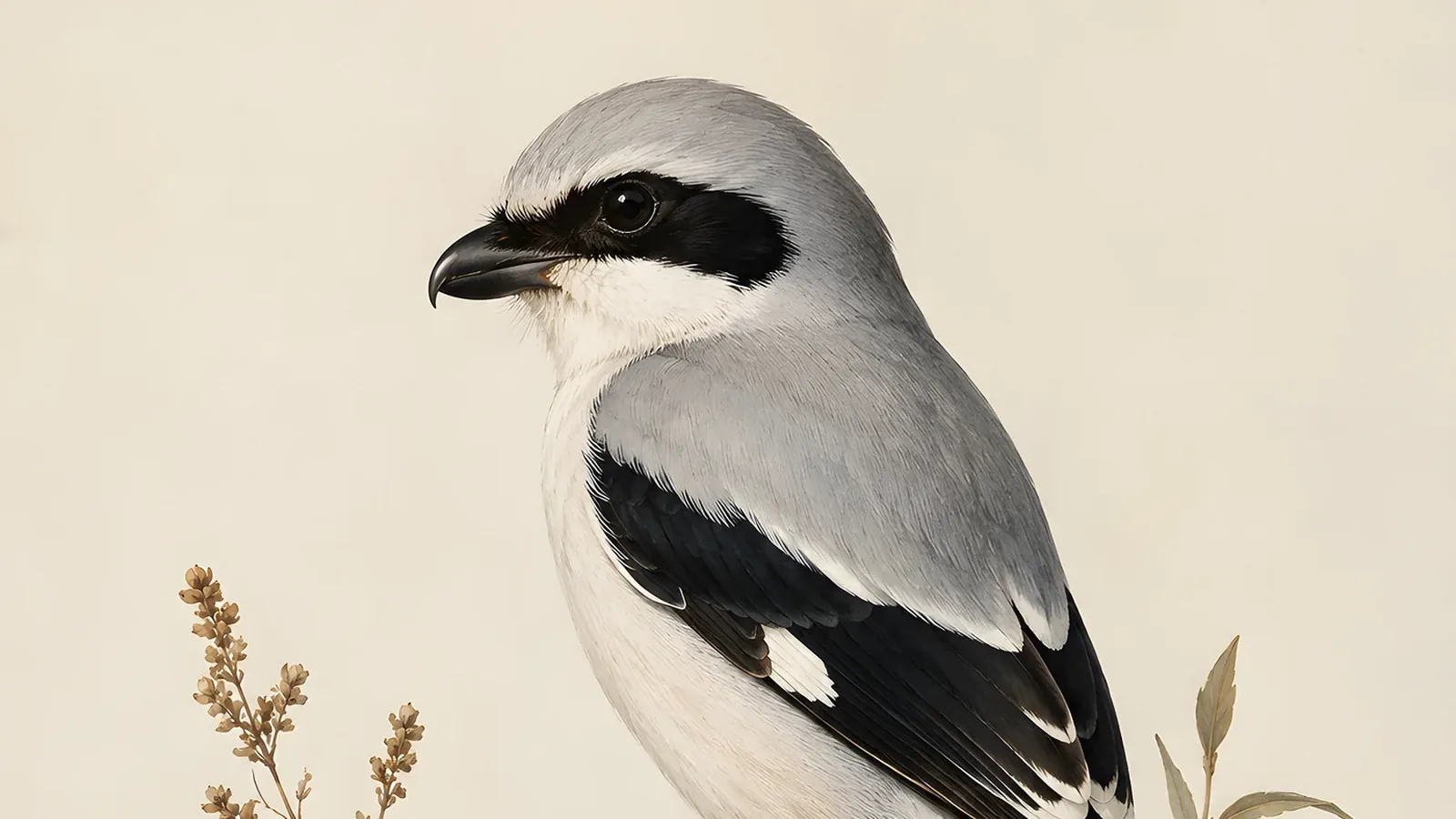
The Loggerhead Shrike is 21 to 24 centimetres long and weighs 45 to 51 grams, making it roughly the size of an American Robin but far more compact in silhouette. The wingspan runs 30 to 33 centimetres. Both sexes wear the same pattern: pale gray above, white to pale gray below, with a broad black mask that runs across the face and over the bill, giving the bird a bandit look that is not entirely misleading. The wings and tail are black with white markings that flash in flight. The outer tail feathers are broadly edged white, visible as the bird banks and turns over open ground.
The bill is the give-away. It is hooked and heavy, distinctly raptorial, with a notched tip - the tomial “teeth,” projections of the keratin rhamphotheca - that have no equivalent in any other North American songbird. The feet are unimpressive: standard passerine feet, nothing like the talons of a Cooper’s Hawk or a Merlin. This mismatch between armament and grip defines the whole ecology of the species.
| Measurement | Range |
|---|---|
| Length | 21 - 24 cm |
| Weight | 45 - 51 g |
| Wingspan | 30 - 33 cm |
| Wild lifespan | Up to nearly 12 years (record: 11 yr, 9 mo) |
The butcher bird
The common name is older than the field guides. Butcher bird, after the butcher’s habit of hanging cuts of meat on hooks. The shrike impales large insects, lizards, small mammals, and small birds on thorns, woody stems, or barbed wire. The impaling behavior serves at least three functions. First, it provides the physical anchor the bird needs because its feet cannot hold prey still while the bill works on it - a raptor grips with talons and tears with the bill, but the shrike has only the bill. Second, it allows the bird to cache food and return later, turning a single kill into a multi-day resource. Third, and most precisely documented in the research literature, it allows toxins to degrade.
Yosef and Whitman (1992, Evolutionary Ecology, vol. 6, pp. 527-536) tested 21 bird and lizard species against the eastern lubber grasshopper. All gagged, regurgitated, or died. Loggerhead Shrikes in peninsular Florida caught lubbers, impaled them, and returned only after the bodies had aged one to two days. The shrikes then consumed the head and abdomen but discarded the thorax where the defensive glands are concentrated. The impaling behavior, originally an adaptation for anchoring prey, turns out to be precisely what allows a bird to eat something that would kill anything else in the pasture.
This is the defining argument of the Loggerhead Shrike: it is a bird that solved, by behavior, a problem that most predators never even encountered.
The bill and the kill
The killing method is not simple stabbing. Sustaita, Rubega, and Farabaugh (2018, Biology Letters, vol. 14, article 20180321) filmed Loggerhead Shrikes dispatching vertebrate prey at high speed. The birds seized prey in the bill and then performed rapid axial head-rolling movements at frequencies averaging 11 Hz and angular velocities of roughly 57 radians per second. The resulting cervical torque - approximately 0.022 Newton-metres - substantially exceeds the force required to rupture stabilizing ligaments in rodent cervical vertebrae. The tomial projections on the upper bill are positioned precisely to slip between the cervical vertebrae and damage the spinal cord during these rotations.
The Loggerhead Shrike can kill prey weighing up to 206 percent of its own body mass. A 50-gram bird dispatching a 100-gram mouse. Without talons. The technique is the compensation.
The Loggerhead Shrike does not lack what a hawk has. It found a different way to the same end, and then went further, building a larder with the surplus.
In open country with good fence lines - Texas ranch land, Oklahoma prairie, California grasslands - a shrike territory can accumulate an impressive number of cached kills across a season. Males impale prey at higher rates around courtship and nest-building, and females choose males with larger larders. The larder is not merely food storage. It is a proxy for hunting competence.
What it sounds like
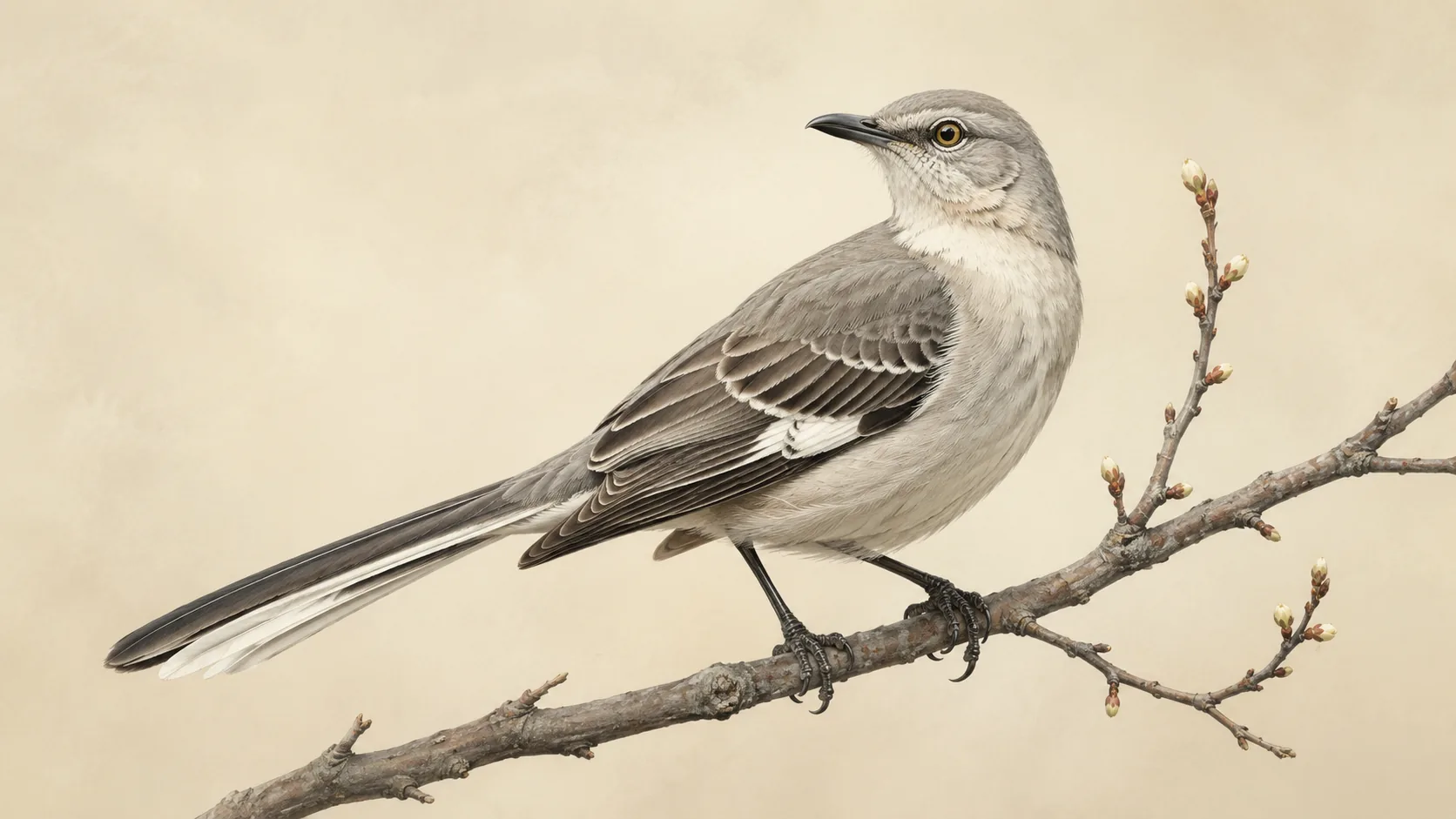
The Loggerhead Shrike’s voice is a surprise on first hearing. It has the vocal range of a northern mockingbird filtered through a rougher temperament. The song is a rhythmic sequence of short trills, buzzes, rasps, and clear whistling notes, repeated in loose phrases, both sexes capable of territorial song. The calls include sharp, grating chirps and shrill whistles. The Audubon Field Guide describes the overall effect as “a variety of harsh and musical notes and trills; a thrasher-like series of double phrases.”
The song does not carry the sustained elegance of the mockingbird or the precision of a wood-thrush. It is functional. Males sing from exposed perches, and both sexes give the rasping alarm call when approached near a nest. In the scrub and pasture habitats where the bird hunts, a calling shrike on a fence wire is a common sound that takes time to distinguish from the ambient static of a warm-weather afternoon.
Range and the decline
The Loggerhead Shrike breeds across a wide band of North America, from the southern edges of the Canadian prairie provinces through most of the United States south into central Mexico. It is the only shrike resident year-round in the continental United States. Northern populations migrate, southern ones often do not. The IUCN Red List rates the species Least Concern globally, but the global rating conceals a serious and still poorly understood contraction.
The North American Breeding Bird Survey has recorded declining trends in 52 of 53 states and provinces within the species’ range. Chabot, Hobson, Van Wilgenburg, Perez, and Lougheed (2018, Ecology and Evolution) found a range-wide decline of approximately 3.18 percent per year since the 1960s, with migratory populations falling faster than sedentary ones. The species is now listed as threatened or endangered in 14 US states and is endangered in Canada, where the eastern subspecies (L. l. migrans) numbered fewer than 55 breeding pairs at the low point of its population.
Pesticide loading in the prey base - particularly organochlorine accumulation during the DDT era - is the most frequently cited driver, compounded by habitat changes: the removal of hedgerows and fence-line vegetation, the conversion of hay meadows and pastures, and the suburbanisation of open land. The decline is not fully explained. The shrike needs short vegetation for hunting, scattered thorny shrubs and fence lines for caching, and enough insect and small vertebrate prey to justify the energetic cost of a larder system. All three requirements have become harder to find across much of its former range.
Breeding
Breeding begins early in spring, with males establishing territories on open ground with good perch density. Nest placement tends toward dense, often thorny shrubs or small trees at heights of roughly 1.5 to six metres. The nest is a bulky open cup of twigs, grasses, weeds, and bark, lined with plant down, feathers, and hair - well insulated, well hidden below the outer canopy of the shrub.
The female incubates a clutch of five or six eggs (range four to eight) for 16 to 17 days. The male hunts and caches prey throughout incubation, supplying the female and defending the territory. Nestlings fledge at 17 to 21 days and receive parental care for another three to four weeks. Second broods are regular across the southern range, and in the warmest areas - coastal California, peninsular Florida - some pairs attempt three.
The largest recorded wild Loggerhead Shrike lived nearly 12 years. A 12-year-old shrike sitting on a Texas fence has spent more than a decade learning which cacti hold a grip, which fence barbs are stable, which grasshoppers in which counties need to age before they are safe to eat. The larder is the visible evidence of that knowledge. Everything impaled on those wires is a record of where the bird has been paying attention.
The decline matters partly because this is an unusual life, built on a behavioral repertoire that most predators never developed. The tomial tooth, the head-roll, the cache on barbed wire, the wait for the toxin to go out of the grasshopper - these are not simple adaptations. They are layered solutions, each one tuned to the constraints imposed by the others, in a bird that the field guides still classify, correctly and somewhat astonishingly, as a songbird.