



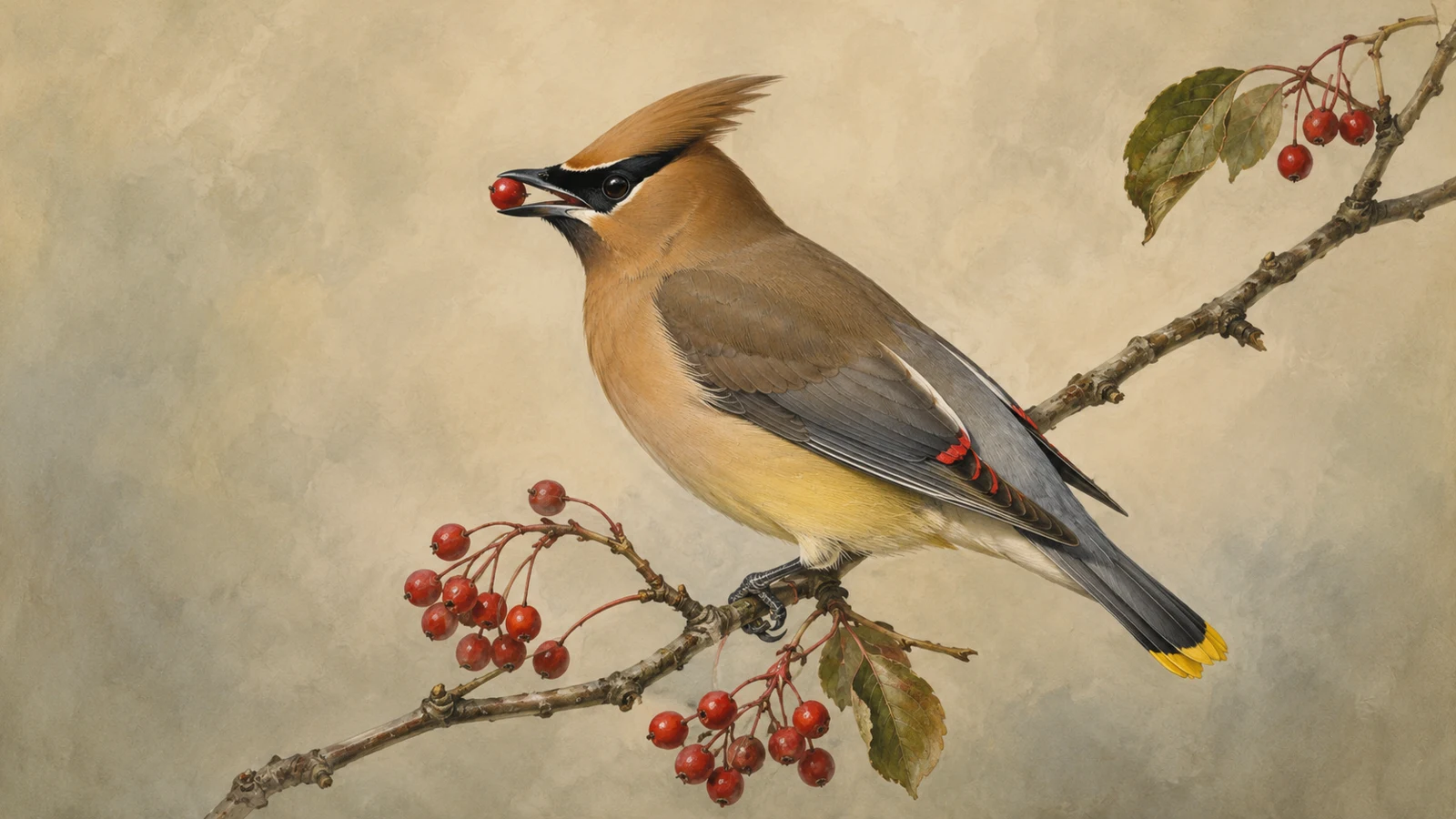

A line of Cedar Waxwings sits on a branch in February, shoulder to shoulder in the cold. One bird picks up a berry. It nudges the bird beside it. That bird takes the berry in its bill, then passes it to the next. The berry travels four or five birds down the line before someone finally eats it. Ornithologists have watched this happen repeatedly. No one has fully explained it.
That berry-passing ritual is the strangest and most documented social behaviour in Bombycilla cedrorum, and it is the right place to start with this species - because the Cedar Waxwing is, at first glance, an easy bird to pass over in a field guide. Medium size. Quiet for most of the year. Found across most of North America. But look closer and it is one of the continent’s most ecologically specialised songbirds: a fruit-eating nomad that has organised its entire life, from its refusal to defend territory to its late-summer breeding schedule, around the unpredictable geography of ripe berries.
What she looks like
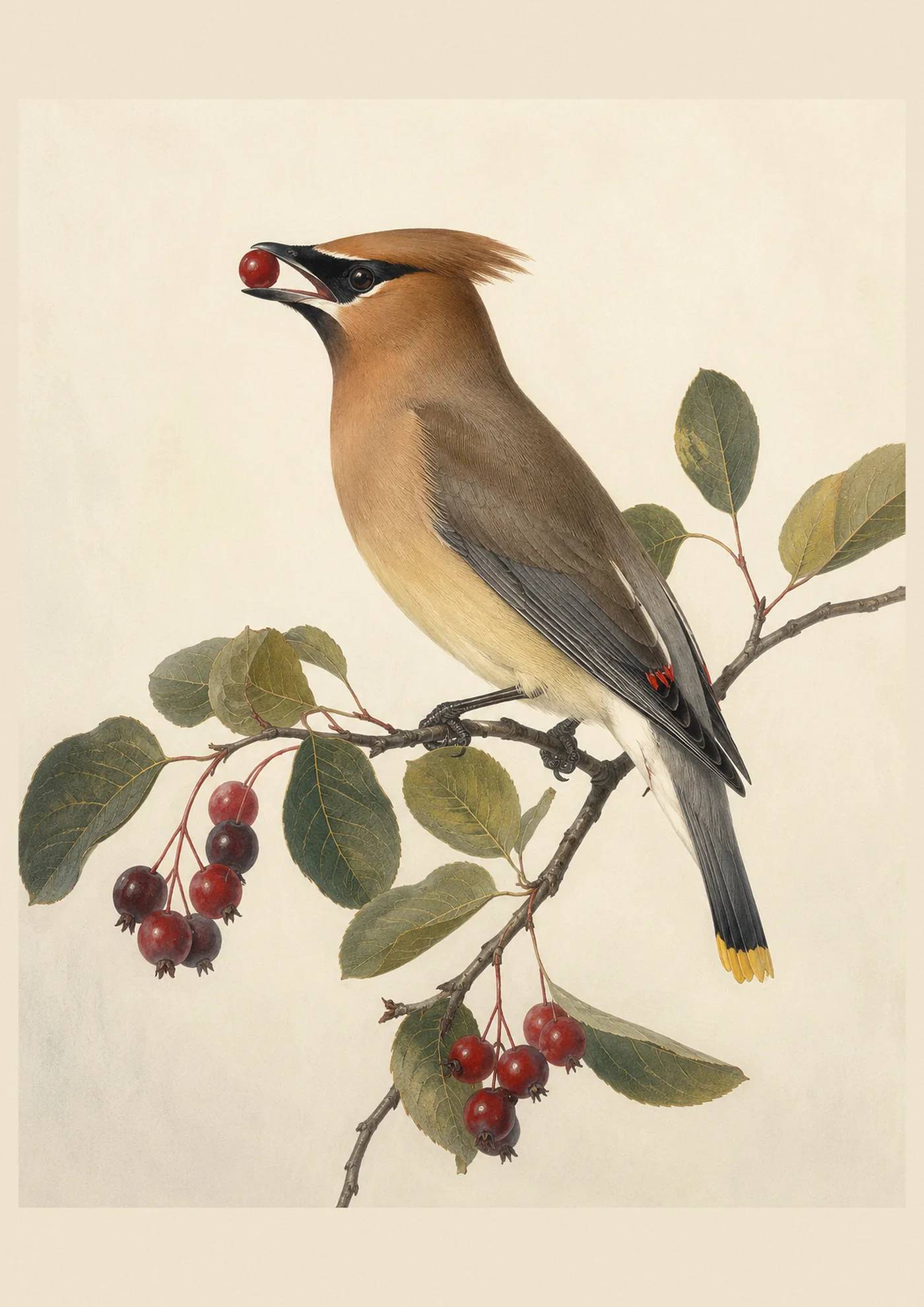
The Cedar Waxwing is 14 to 17 centimetres long, weighs around 32 grams, and carries itself with a tidiness that makes most other songbirds look dishevelled. The plumage is grey-brown on the back, warming to a pale cinnamon on the chest, then fading through yellow to white on the lower belly. A narrow black mask runs from the bill through the eye, edged in white below. The crest is short but present, more of a swept peak than a cockatoo spike.
Two details set the waxwing apart from everything else at the feeder. The first is the tail tip: a bright yellow band, as though the tail were dipped in paint. The second is the waxy red droplets at the tips of the secondary flight feathers - small, glossy, and the source of the common name. The function of those red tips is contested. Audubon’s field guide notes they are more numerous in older birds, which has led to the hypothesis that they signal age and condition to prospective mates, though the evidence remains incomplete.
Males and females are nearly identical. Juveniles show streaked underparts and a less well-defined mask, but retain the diagnostic yellow tail band from their first feathers.
What she sounds like
The Cedar Waxwing is not much of a singer. The primary call is a high, thin trill - a sound somewhere between a whistle and a hiss - that carries well through winter air without resembling any other species on the continent. Cornell’s Birds of the World describes the call as a “high-pitched zeee,” often given continuously as a flock moves through a fruiting tree. When a flock moves, the calls overlap and layer into a soft roar that is unmistakable once learned.
There is no complex song. No territorial declaration. No dawn chorus performance. The vocal repertoire is functional: keep-up calls, contact notes, and soft sounds exchanged between paired birds. A species that does not defend a territory has less need for a warning broadcast.
Range and the year
The Cedar Waxwing breeds across southern Canada and the northern United States, extending south into the Appalachians and the Pacific Northwest. Wintering birds spread across the entire lower 48 states and push south through Mexico into Central America. The Audubon field guide notes that “both breeding and wintering areas may change from year to year, depending on food supplies” - an honest description of a species that does not read its own range maps.
Unlike most songbirds, which hold a fixed territory and return to the same patch each year, the Cedar Waxwing follows fruiting trees. Cornell’s Birds of the World identifies the species’ nomadic movement and lack of territoriality as direct consequences of relying on locally superabundant fruit crops that are “unpredictable in space and time.” A tree heavy with serviceberries in June is stripped bare in a week; the flock moves on. The bird that was in your Ohio garden in November may be in Tennessee by January, or still in Ohio, depending on what the hawthorns are doing.
The habitat preference runs to edges: forest margins, streamsides, overgrown fields, the hedgerow between a farm and a wood. Any place where fruiting shrubs crowd against taller trees. Suburban gardens with ornamental crabapples, pyracantha, and mountain ash have become important feeding grounds, and cedar waxwings use them heavily from October through March.
Diet
The Cedar Waxwing is one of the few North American songbirds capable of living almost entirely on fruit. In winter, berries and small fruits make up the near-total diet. In summer, the bird adds insects - caught in short aerial sallies from exposed perches, often above water - and some plant material. The Audubon field guide lists juniper, dogwood, and wild cherries as important sources, alongside serviceberry, mulberry, and raspberry. Cedar berries, which gave the bird half its common name, are taken heavily in late autumn and winter.
The dependency on fruit has one well-documented hazard. In late winter and early spring, overwintered berries ferment as temperatures rise. Waxwings eating from these supplies can accumulate enough ethanol to become visibly disoriented. A 2010 incident in Harris County, Texas, documented by the National Wildlife Health Center, involved approximately 50 Cedar Waxwing deaths; berries recovered from a nearby shrub tested at 800 parts per million ethanol by wet weight - enough to produce intoxication in the birds. The annual Audubon coverage of this phenomenon notes that fermentation toxicity is most common in the weeks when thawing of overwintered fruit begins in earnest. The birds are not doing anything unusual; they are eating what they always eat, in a season when the chemistry has shifted without warning.
Breeding and nesting
The Cedar Waxwing’s breeding season is unusually late for a North American songbird, typically running from July through September. The timing tracks the peak abundance of summer berries rather than the insect hatches that govern the calendar of most other passerines. A late fruiting year means a late nesting season.
Courtship involves the male passing food items - berries, flower petals, or insects - to the female during a synchronised hop-and-bow display. The berry-passing behaviour seen in perched flocks is thought to be an extension of this same transfer ritual, though whether it functions as pair-bond reinforcement or something else remains an open question.
Nests are loose cups of grass, plant fibre, and twigs, typically placed six to 50 feet up in a tree, often near a forest edge or over water. The female lays two to six pale blue-grey eggs, lightly spotted. She incubates alone for 11 to 13 days. Both parents feed the nestlings, starting with insects for the first several days and transitioning to fruit as the chicks grow. Fledging takes a further 14 to 18 days. The pair may raise a second brood in a good berry year.
Uniquely among North American songbirds of its size, the Cedar Waxwing does not defend a nesting territory. Pairs breed in loose proximity to other pairs when a fruiting area supports it. Cornell’s Birds of the World notes this directly: the absence of territorial behaviour is tied structurally to fruit dependence, because a species feeding on superabundant and spatially patchy resources has nothing to gain from excluding conspecifics.
The berry-passing, reconsidered
Return to that line of birds on the February branch, passing a berry back and forth. The most widely cited explanation is that it is a derived form of the courtship food-transfer, retained in non-breeding social contexts. A second possibility is that it functions as a form of priority-signalling - the bird who eventually swallows the berry is establishing something about rank without conflict. A third is that it is play, or simple over-application of a hardwired reflex. The Animal Diversity Web account at the University of Michigan notes the behaviour without resolving it. Cornell’s Birds of the World treats it as documented but unexplained.
What the behaviour points to is a bird more socially complex than its quiet, undistinguished field-guide appearance suggests. The Cedar Waxwing does not announce itself. It does not hold territory. It does not build an intricate nest or perform an elaborate song. What it does - with apparent precision and consistency - is coordinate with other individuals around a shared, perishable resource. The berry passes down the line. The line holds together. In late winter, with the fruit nearly gone and the flock intact, that coordination is the point.
The Cedar Waxwing has organised its entire life around fruit: the wandering, the late breeding, the silence, the sociability. The berry on the branch, passed from bill to bill, is not a curiosity. It is the species in miniature.