Field Guide
Gentoo Penguin
A Gentoo Penguin walks up the beach on a Falklands morning carrying a small stone in its bill. It picks its way through a colony of several hundred birds, all of them stood on neat mounds of pebbles, and stops in front of one particular penguin. It lays the stone down at her feet. If she accepts it, the two will build a nest of thousands more stones just like it, and defend the pile through the breeding season with a ferocity out of all proportion to its size. The whole courtship of this species can begin with a single carefully chosen pebble.
Pygoscelis papua is the third-largest penguin alive, after the Emperor and the King, and the largest of the three brush-tailed penguins of the genus Pygoscelis. It is also, by a clear margin, the fastest. Where the King Penguin is built for the long deep dive and the African Penguin for the warm inshore chase, the Gentoo is built for speed, and it is the most adaptable and, for now, the most fortunate of the southern penguins in this field guide.
What it looks like
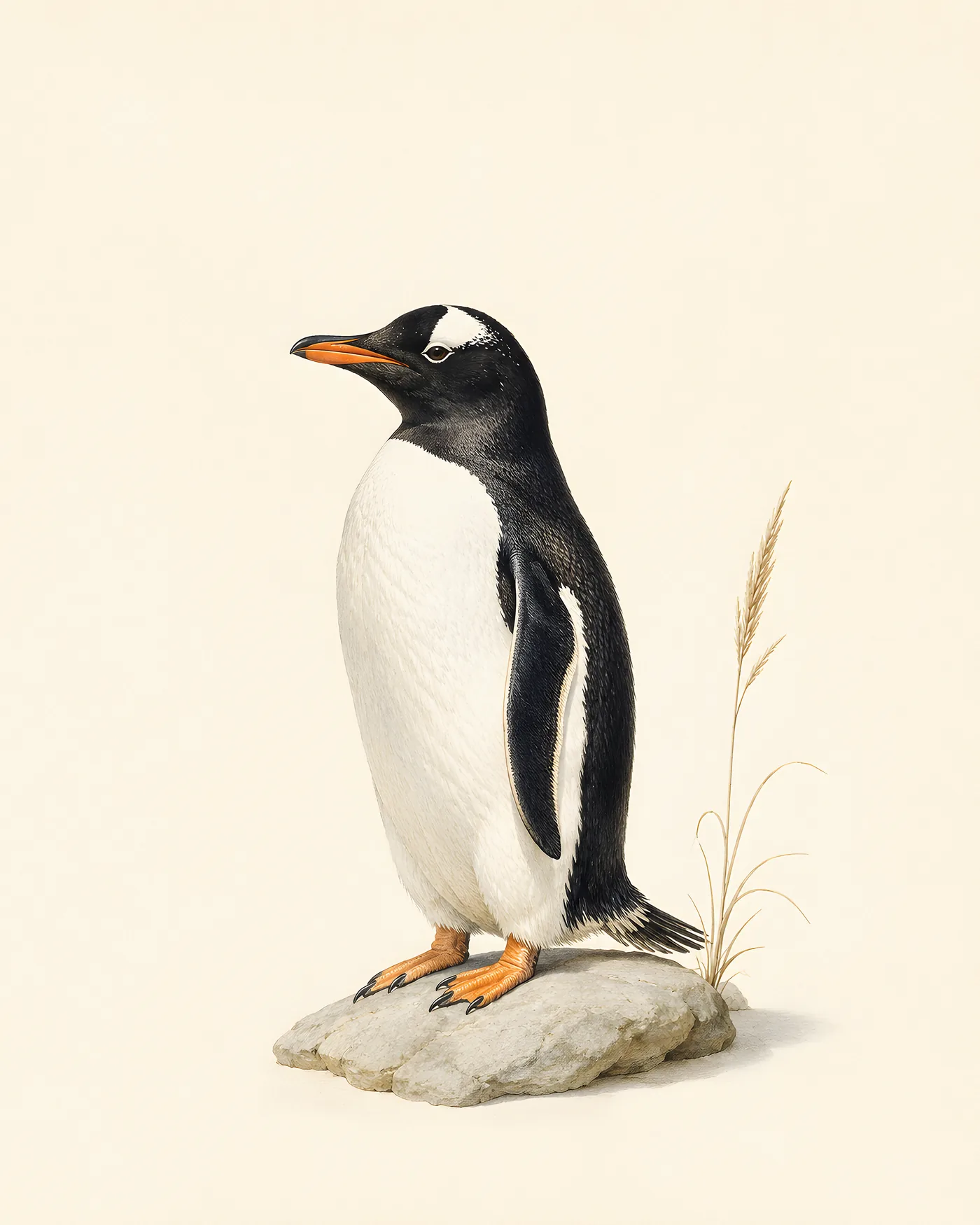
An adult Gentoo stands 70 to 90 centimetres tall and weighs anywhere from about 4.5 to 8.5 kilograms, the weight swinging widely across the year as birds fatten before moult and fast through the nesting period. It is a tall, upright bird with a long tail of stiff feathers that sticks out behind and sweeps the ground as it walks, a feature shared with its close relatives the Adelie and the Chinstrap.
The field marks are easy. The back is blue-black, the underparts white, and across the top of the head runs a broad white patch that joins over the crown like a bonnet, with a small white triangle above each eye. The bill is bright orange-red, and the feet are a matching orange. Britannica notes that no other penguin combines the white head-band with the orange bill, so even at distance a Gentoo is hard to mistake for an Adelie or a Chinstrap sharing the same shore.
What it sounds like
The Gentoo is a trumpeter. The main display call is a loud, braying, donkey-like honk, given with the head thrown back and the bill pointed at the sky, often by both members of a pair in a coordinated duet at the nest. Cornell’s Birds of the World describes the call as a key part of pair-bonding and of defending the pebble nest against neighbours. At the nest the birds also use a quieter hiss and a sharp call of alarm. A Gentoo colony is loud, but it is a more conversational, less frantic clamour than the dense scream of an Adelie rookery.
Range and habitat
Gentoo Penguins are circumpolar in the subantarctic and along the northern Antarctic Peninsula. The Falkland Islands and South Georgia hold large populations, with further colonies on the South Shetlands, the Antarctic Peninsula, Kerguelen, the Crozet Islands and other subantarctic islands. They favour ice-free ground: low, sheltered coastal flats, tussock grass and gravel beaches, rather than the sea ice that other species depend on.
That preference for open ground is part of why the Gentoo is faring comparatively well. As the Antarctic Peninsula warms and sea ice retreats, the ice-loving Adelie has declined in many areas while the more flexible Gentoo has spread south into newly ice-free ground, even as some long-established colonies further north have fallen. It is one of the clearest cases of a polar bird redrawing its own map as the climate shifts.
Diet
The Gentoo is a generalist, and its flexible diet is the second reason for its success. It feeds on a mix of Antarctic krill, other crustaceans, small fish and squid, with the balance shifting by location: more krill in the far south, more fish in the warmer waters of the Falklands. It is an inshore forager that mostly hunts close to the colony in relatively shallow water, returning to feed chicks daily, which spares it the long ocean journeys that constrain the King.
Underwater it is exceptional. The Gentoo is the fastest swimmer of any penguin, recorded at speeds around 36 kilometres an hour in short bursts. Its rigid, powerful flippers and torpedo-shaped body let it run down fast prey and outrun predators such as leopard seals and sea lions, which take a heavy toll at the colony edge.
Breeding and nesting
The pebble is the centre of Gentoo family life. Pairs build a circular nest of stones, sometimes more than a thousand of them, and the stones are valuable enough that birds will steal them from a neighbour’s nest the moment it is unguarded, a constant low-level theft that runs through every colony. Presenting a stone is also part of courtship, and a male offering a good pebble to a female is a recognised opening move of the breeding season.
The female usually lays two eggs, and Britannica records an incubation of roughly 34 to 37 days shared by both parents in alternating shifts. Unusually among penguins, the Gentoo often raises both chicks rather than losing one, helped by the short, productive foraging trips that keep the chicks well fed. The young gather into loose creches as they grow, then fledge after about three months. Many pairs return to the same colony, and often the same nest site, year after year.
A penguin holding its ground
The Gentoo is the rare good-news story among the southern penguins, and it is worth being precise about why. The IUCN currently lists the species as Least Concern, with a global population in the hundreds of thousands of pairs and an overall trend that has been broadly stable, even increasing in parts of its range. Where the African Penguin is collapsing and the Yellow-eyed Penguin is among the rarest birds on earth, the Gentoo is, for now, secure.
A penguin whose courtship begins with a single stone is also the fastest swimmer of its kind, and the one best placed to outrun a warming world.
That security should not be read as immunity. The picture is regional, not uniform. Some northern colonies, including those on Bird Island at South Georgia, have fallen sharply over recent decades as local prey has shifted, and the species remains exposed to the same pressures squeezing its relatives: changes in krill abundance, disturbance at colonies and the steady warming of the Southern Ocean. The Gentoo’s flexibility has bought it room the ice-dependent penguins do not have. It has not bought it certainty.