Field Guide
Fork-tailed Flycatcher
The tail arrives before any other impression registers. Two long black streamers hang below a fence wire on a South Texas morning in October, and the bird attached to them - a compact white-and-grey body with a neat black cap - seems almost beside the point. The tail bends in a slight breeze, opens into a fork a foot long or better, and the mind goes quiet. This is a tropical kingbird that has no reason to be here. It is, in the ornithological shorthand, a vagrant. Something went wrong in its navigation, or right, depending on your sympathies with wandering.
Tyrannus savana, the Fork-tailed Flycatcher, is one of the most-watched accidental visitors in North American birding. The genus name tells you exactly what it is: a tyrant flycatcher, aggressive, conspicuous, and comfortable on an exposed wire. The species name, savana, tells you where it belongs.
What it looks like
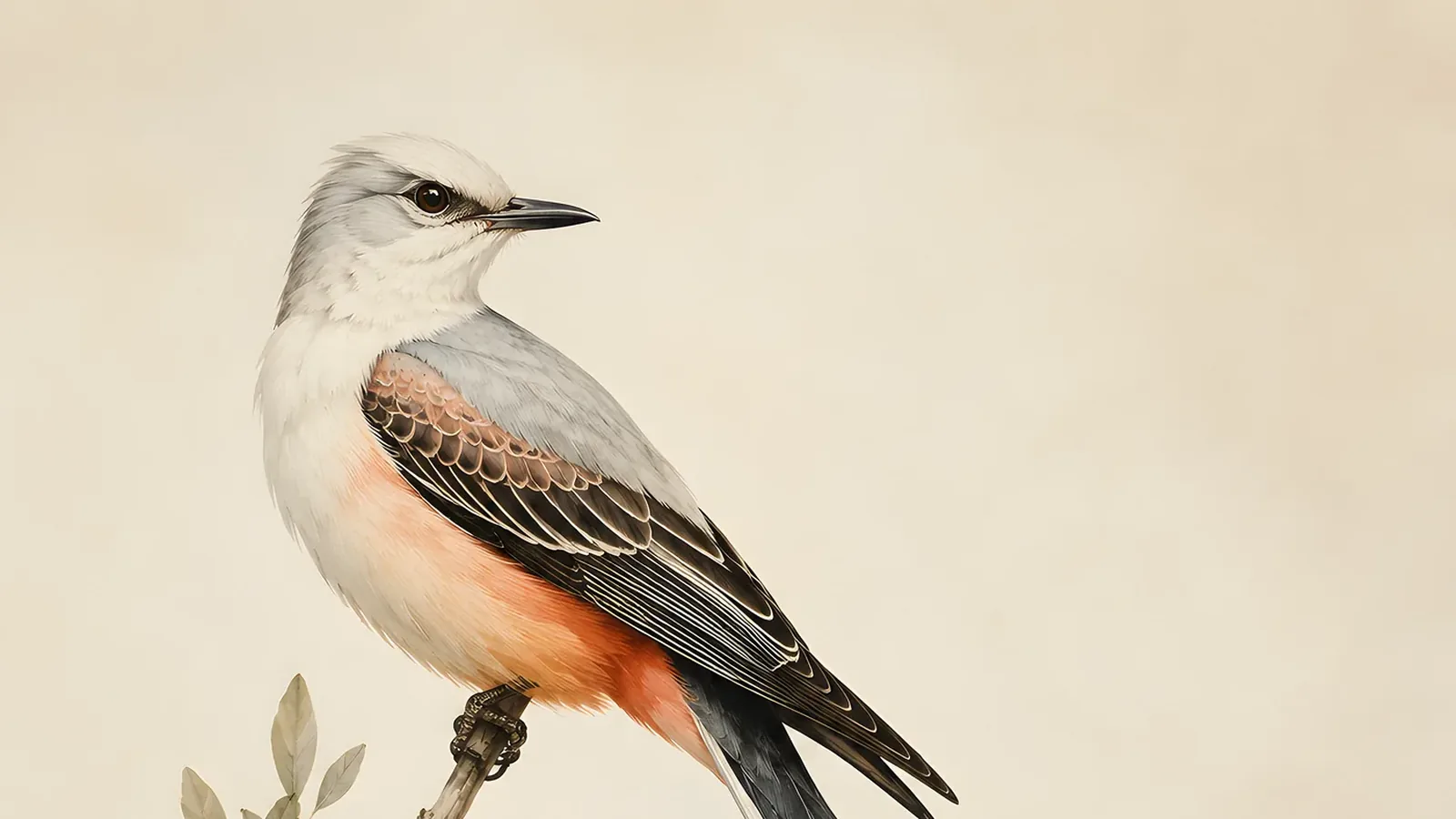
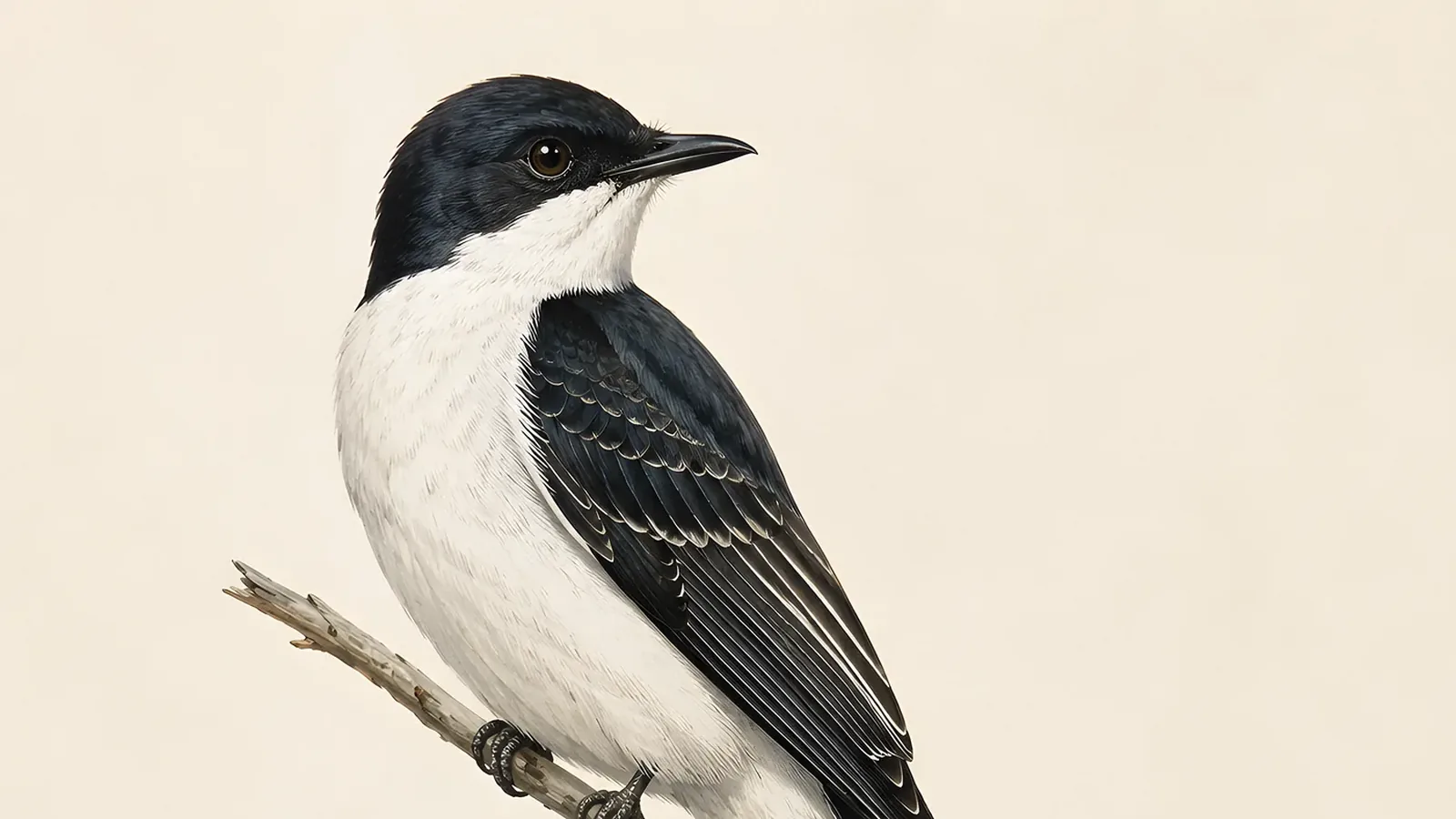
Tyrannus savana is a study in binary contrast. The adult male carries a solid black cap from the bill to the nape, a crisp white throat and breast, pale grey upperparts, and dark wings. The underparts stay clean white. Buried under the black cap is a yellow crown patch - concealed at rest, briefly visible when the bird is agitated or displaying. Females and immatures share the same cap and underpart pattern but are overall slightly duller in the grey tones.
Body length alone - excluding the tail - runs perhaps 15 to 17 centimetres, comparable to a large sparrow. Total length for adult males reaches 37 to 41 centimetres because of what hangs behind. The outer tail feathers are dramatically elongated and deeply forked, often exceeding the combined head-and-body length. Weight is 28 to 32 grams - light for a bird that makes transcontinental journeys. Wingspan extends 35 to 38 centimetres.
| Measurement | Range |
|---|---|
| Total length (male, incl. tail) | 37-41 cm |
| Total length (female) | 28-30 cm |
| Weight | 28-32 g |
| Wingspan | 35-38 cm |
| IUCN status | LC - Least Concern |
The closest comparison in North American birding is the scissor-tailed flycatcher, a closely related Tyrannus that breeds on the southern Great Plains. The scissortail has salmon-pink flanks and a paler, less saturated black on the cap, and its outer tail feathers are white-tipped rather than uniformly black. The Fork-tailed Flycatcher is a deeper, crisper monochrome. Seen together they are immediately separable. Seen alone in an unexpected location, either can stop traffic.
The tail
The tail of an adult male Tyrannus savana is one of the more improbable structures in the Tyrannidae, a family not short of showmanship. The two elongated outer rectrices are flexible, bend perceptibly in wind, and trail behind the bird in flight as a deep fork. In a direct headwind the bird looks as though it is being unwound from behind.
The fork serves multiple functions. In territorial disputes between males, the tail contributes to the visual signal of size and dominance - a role documented in related long-tailed tyrant flycatchers across South America. In flight the elongated streamers produce a characteristic undulating silhouette at distance, making the species identifiable by jizz alone once the shape is in memory.
Females have the same tail structure but proportionally shorter streamers - typically 28 to 30 centimetres total length versus the male’s 37 to 41. Juvenile birds have short tails that only hint at what will develop, which creates identification challenges when autumn vagrants turn out to be first-year birds carrying modest forks.
A fence wire holding a Fork-tailed Flycatcher is performing a function the fence wire was not designed for. The bird treats it the same way it treats a savanna shrub - as an elevated point from which to command a field of view. It does not especially care that the field in question is in New Jersey in November.
The famous vagrant
The Fork-tailed Flycatcher reaches North America the same way most vagrants do: something goes wrong, or goes differently, during migration. McCaskie and Patten (1994, Western Birds, vol. 25) conducted the foundational review of the species’ status in the United States and Canada, examining over 100 accumulated reports and accepting 94 records as valid. Their analysis established that the nominate subspecies (T. s. savana) and, to a lesser extent, the more northerly subspecies monachus account for virtually all North American occurrences. Sightings cluster in fall - September through November - along the Atlantic coast and in the interior East, though records exist from coast to coast and from Florida north to southern Canada.
The mechanism is austral migration in reverse. The southern South American population breeds in austral spring (October to March) and migrates north toward the equator for the South American winter, heading into Venezuela and Colombia. Some individuals overshoot their destination by a wide margin, continuing northward into Central America, Mexico, and occasionally the Caribbean and the United States. A few may ride weather systems that accelerate the journey. The result is a kingbird standing on a utility wire in Texas or Massachusetts looking, by its own standards, perfectly calm.
MacPherson, Jahn, Murphy, Kim, Cueto, Tuero, and Hill (2018, The Auk, vol. 135) tracked 16 individuals with light-level geolocators across 2009-2012 and found that rainfall - not temperature - was the primary environmental cue driving seasonal distribution in the nonbreeding period. Birds tracked toward the equator during austral winter were following the rainfall gradient northward, an orientation that, if over-run, deposits a bird far outside its intended range. The navigational error is environmentally logical even when geographically extreme.
Numbers of North American records have grown steadily since McCaskie and Patten’s 1994 baseline. eBird (Cornell Lab of Ornithology) now carries several hundred accepted records from across the eastern United States, with new autumn arrivals drawing counts of dozens of observers at coastal watch sites. The Fork-tailed Flycatcher is now expected, in the sense that one appears almost every fall somewhere east of the Mississippi.
Range and migration
The permanent range of Tyrannus savana runs from southern Mexico and Belize south through Central America and across South America to Argentina, Uruguay, and southern Brazil. Northern populations in Mexico and Central America are largely sedentary. Southern populations, particularly in Argentina and southern Brazil, are fully migratory austral migrants, breeding at latitudes equivalent to the northern United States and spending the austral winter near the equator.
Jahn and Tuero (2013, Neotropical Birds Online, Cornell Lab of Ornithology) detailed the species account across its full range, documenting the north-south population divide and the substantial migratory distances covered by southern breeders. The nominate subspecies can move 3,000 kilometres or more between breeding grounds in the Pampas and nonbreeding areas in the Orinoco basin. These are not birds with a weak migratory impulse. The ones that overshoot into North America are running a well-developed migration engine past its intended stop.
Habitat across the range stays open. Savannas, pastures, seasonally wet grasslands, and agricultural margins are the core. The species will use mangroves along coasts and riparian scrub at field edges. Elevation extends to 4,100 metres in Andean foothills. What the bird consistently avoids is closed forest. It needs a perch above open ground and space to fly out and return.
Diet
Foraging technique is the standard flycatcher sally: watch from an exposed perch, launch on a flying insect, capture it in the air, return to the same wire or branch. The prey list is broad - beetles, wasps, bees, dragonflies, termites during swarming events, flies. During the nonbreeding season, when flying insects become less predictable, the Fork-tailed Flycatcher shifts partly to fruit, supplementing its insect intake with small berries. The same dietary flexibility shows up in wintering birds tracked from geolocator studies, which spend nonbreeding months in wetter, more productive habitats than their dry-season breeding grounds.
Vagrant individuals in North America continue to forage in exactly the same way - picking a prominent perch, watching a field or thicket edge, launching after whatever is flying. A bird appearing at a coastal hawk watch in October will feed on the available insects without apparent concern about its geography.
Breeding
Breeding timing varies by latitude and subspecies. In Belize and Colombia, nesting runs roughly February through May. In Argentina and southern Brazil, the season falls in austral spring and summer - October through March. Clutch size is two to four eggs, with three being the most common count. Incubation runs approximately 14 days. Both parents provision nestlings, with fledging at 13 to 16 days post-hatch and full independence around 30 days. Like most Tyrannus species, the Fork-tailed Flycatcher is fiercely territorial around the nest, pursuing much larger birds and delivering strike-and-retreat attacks against raptors, corvids, and anything else that passes too close.
Males establish territories on open perches and display to females with posturing, tail-spreading, and rattling vocalizations. The hidden yellow crown patch is exposed during aggressive encounters and courtship. Nests are small open cups placed in the outer branches of isolated trees or shrubs, constructed from grasses and plant fibers, typically two to five metres off the ground.
The bird’s success across such a vast range - southern Mexico to Argentina - reflects a combination of habitat generalism and a diet that tracks the available insect base. The species is not in trouble. It has more savanna than it needs, and it is finding some of it in the wrong hemisphere by accident.
Most birds that turn up in North America are healthy individuals in good condition. They feed, rest, and behave like birds that know what they are doing. The error, if it is one, was navigational, not physical. And the question the vagrant poses - how far is too far, how wrong is wrong enough to matter - is one the bird seems entirely untroubled by.