Field Guide
Florida Scrub-Jay
Stand on a sand ridge in central Florida in late September and one of them will land on your outstretched hand. It is not tame. It is calculating. Aphelocoma coerulescens has been landing on the hands of field researchers at Archbold Biological Station since 1969, and it has been working out whether you are useful for at least as long. The bird drops off your knuckles after a second, bounces to a low oak branch, cocks its head, and returns to sentinel posture: body upright, long tail held level, scanning over the flat grey-green scrub in every direction at once.
That posture is not incidental to its life. It is central to it. The Florida Scrub-Jay lives in a world flat enough that a hawk can arrive from any angle, in a habitat that has no canopy to hide under, on a peninsula where every scrub-oak thicket sits on land developers have wanted since the 1950s. The bird has answered all of this by becoming, among other things, a family animal. It does not raise its young alone.
What it looks like
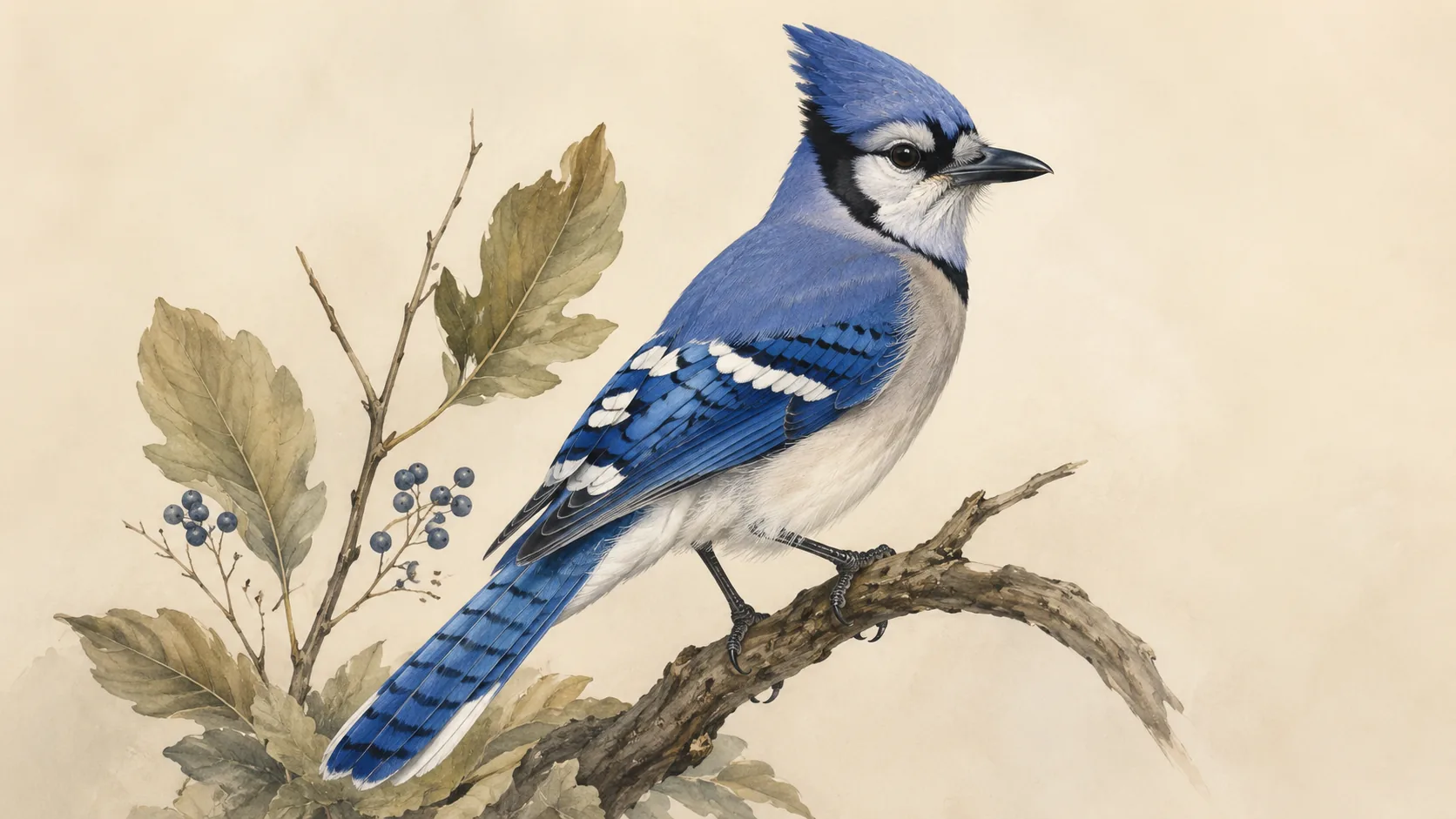
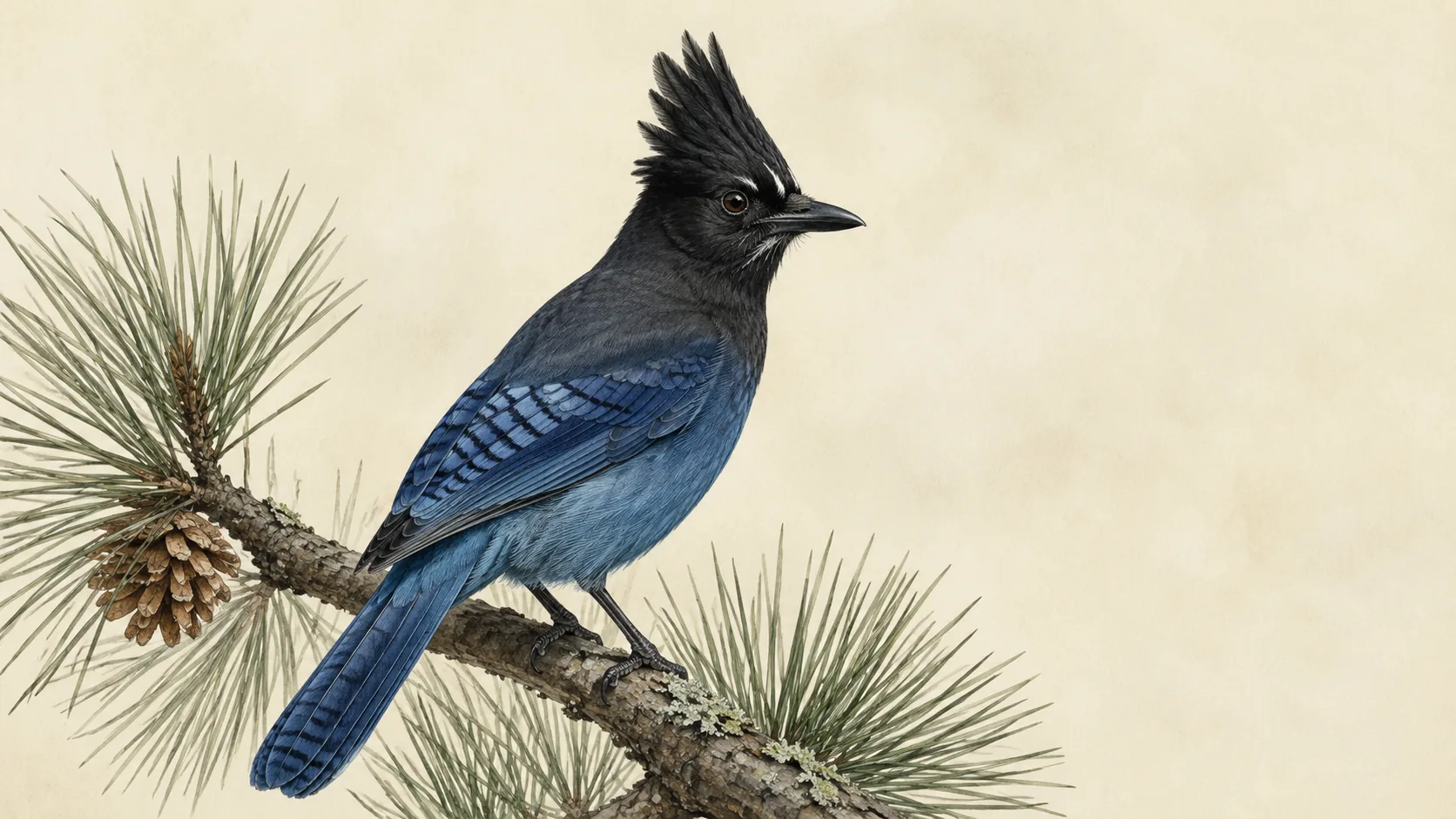
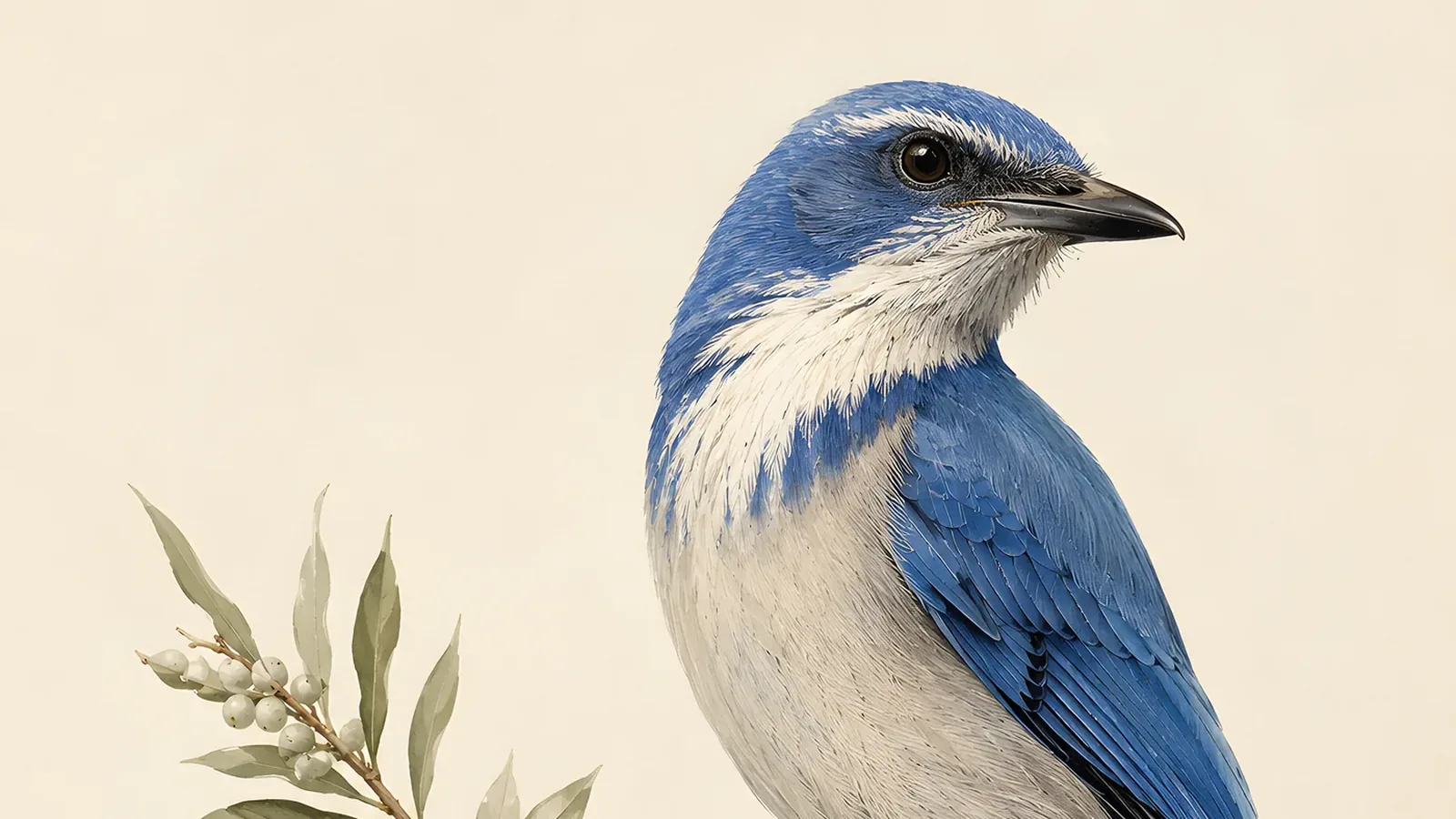
Aphelocoma coerulescens is a blue and gray corvid with no crest - the bare round head immediately separates it from the crested Blue Jay and from Steller’s Jay of the West. The back is washed gray. The wings and tail are a clean, unbarred blue, a shade deeper and more uniform than the Blue Jay’s patterned plumage. A narrow blue necklace curves across the upper breast, where it meets a pale gray-white throat and underparts. The forehead is a washed blue-white. There is no white in the wing, no barring, no bold markings of any kind. It is a simpler bird in coloration than its corvid relatives, which makes it easier to watch and harder to mistake.
Body length runs 23 to 28 centimetres. Weight ranges 66 to 100 grams, with an average near 80 grams. Wingspan spans 33 to 36 centimetres. Males and females are visually identical. Juveniles wear a brownish wash across the head and back through their first months, gradually acquiring the full adult pattern through the first winter. The oldest banded birds on record at Archbold have reached 11 years, though the median age of death in the wild population runs closer to four or five.
Florida’s only endemic
No other bird in North America has a range this small that is also this absolute. Aphelocoma coerulescens lives in Florida and nowhere else. It is not a northern bird that winters south. It is not a wanderer that occasionally crosses state lines. It does not appear on any county checklist outside the state’s borders. Its entire global range - every individual of the species, every nest, every roosting bird - sits on the Florida peninsula, concentrated on the ancient sand ridges of the central highlands and the coastal flatlands from Flagler County south to Collier and Palm Beach counties.
This is not always how it was. Fossil evidence places the species on sand ridges throughout the southeastern United States during cooler Pleistocene periods. As the climate warmed and the open scrub contracted southward, the species contracted with it. What remains is a relict population on relict habitat. There is no other population to draw from if this one fails.
Helpers at the nest
The cooperative breeding system of Aphelocoma coerulescens is among the most thoroughly documented in ornithology. Glen Woolfenden began a continuous study of a color-banded population at Archbold Biological Station in Lake Wales, Florida, in 1969. More than five decades and 6,000 individually tracked birds later, the Archbold project stands as one of the longest continuous studies of any bird in the world. The central finding - detailed by Woolfenden and John Fitzpatrick in The Florida Scrub Jay: Demography of a Cooperative-Breeding Bird (Princeton University Press, 1984) - is simple in statement and complex in implication: Florida Scrub-Jays do not breed as pairs. They breed as families.
A breeding pair is assisted by one to six non-breeding helpers, almost always their own offspring from prior seasons. These helpers are not bystanders. They defend territory, stand sentinel against raptors, carry food to the nest, and feed nestlings directly. In years with larger helper groups, more nestlings survive. Woolfenden and Fitzpatrick showed that the behaviour is an ecological outcome as much as a social one: scrub territories are scarce, young birds cannot disperse into vanishing habitat, and staying home to help is the viable alternative to not breeding at all.
“Each year about half of the pairs are assisted by one to several nonbreeding helpers … young birds remain in the home territory and help their parents rear the offspring of subsequent years.” - Woolfenden and Fitzpatrick, 1984
The finding did not confirm the kin-selection model that theorists had predicted. Habitat limitation, the authors argued, was the primary driver - a case of long-term data revising a clean theoretical prediction.
The fire-kept scrub
| Habitat feature | Detail |
|---|---|
| Soil type | Deep, ancient sand - former Pleistocene coastal dunes |
| Dominant plants | Scrub oaks (Quercus spp.), sand pine, rosemary |
| Canopy height needed | Below one to two metres (jays abandon taller scrub) |
| Fire return interval | Every five to 15 years to maintain open structure |
| Current habitat extent | Severely fragmented - most patches under 50 hectares |
Florida scrub is not forest. It is open, low-growing shrubland of scrub oaks, sand pine, and rosemary on ridges of deep white sand - former Pleistocene coastal dunes, now among the most fire-dependent plant communities in the eastern United States. The soil is almost sterile. It drains instantly. What has accumulated across hundreds of thousands of years is a community of plants and animals adapted to periodic fire and chronic drought - and among them, this one jay.
Fire is the mechanism that keeps the habitat usable. Without periodic burns, scrub oak grows too tall, the canopy closes, and the jays disappear with the open patches. Archbold researchers report that territories are abandoned when scrub exceeds roughly 20 years without fire. The Florida Natural Areas Inventory records natural fire return intervals of five to 30 years under lightning ignition. Modern fire suppression has broken that cycle and replaced it with overgrown scrub between roads, shopping centres, and subdivisions.
The acorn caching connects the bird directly to the habitat’s future. DeGange, Fitzpatrick, Layne, and Woolfenden (1989, Ecology 70: 348-356) documented that individual Florida Scrub-Jays cached between 6,500 and 8,000 acorns each in the fall of 1974. Only about one-third were ever recovered. The forgotten rest was left in the sand. Many germinated. A Florida Scrub-Jay family is, among other things, an oak planting crew working the same territory across generations.
What it sounds like
The Florida Scrub-Jay does not imitate hawks - unlike the Blue Jay, it works with its own sounds, and the territory-level communication those sounds support matters most in a flat, open landscape where predators are visible at distance.
The most frequent call is a hoarse, rolling queep or quay-quay-quay, given in series from a high exposed perch. In flight the call shifts to a rapid, scratchy shreep. Close contact between group members produces softer gurgles and hiccup-like notes, including a mechanical hiccup from females who bob with the bill tilted skyward. The alarm call, fired from the top of an exposed shrub at the appearance of a raptor, is a sharp repeated scold that recruits every bird in the territory within seconds. Sentinel duty rotates through the family group, and in a habitat without cover, that coordinated response is the only defence that reliably works.
Breeding and decline
Breeding begins in early March and can extend to late June, with most clutches laid between March and May. The nest is a cup of twigs lined with fine rootlets, built low in a scrub oak, typically less than two metres above the ground. Clutch size runs three to four eggs. Incubation lasts 17 to 18 days, performed by the female. Fledging follows 16 to 21 days after hatching. In pairs with helpers, nestling survival rates are measurably higher than in unaided pairs.
The federal Threatened listing under the U.S. Endangered Species Act came in 1987. The listing reflected a population already in steep decline from habitat loss, with scrub development accelerating across the central Florida ridge. Partners in Flight now estimates the global breeding population at approximately 7,500 to 9,300 individuals - down more than 90 percent from pre-European settlement levels. The 2025 State of the Birds report designated the Florida Scrub-Jay a Red Alert Tipping Point species, meaning it has lost more than 50 percent of its population in the past 50 years and is showing continued steep decline. On the IUCN Red List the species is assessed as Vulnerable (VU).
The math is not comfortable. The bird needs scrub. Scrub needs fire. Fire on the Florida peninsula now requires deliberate management on parcels surrounded by development. The largest remaining populations exist on military installations and conservation lands where prescribed burning has continued. Where burning has lapsed, the jays thin out within a decade, then disappear entirely.
What more than half a century of Archbold data shows is that the bird itself is resilient when the habitat holds. The cooperative system - families, helpers, shared sentinel duty - is calibrated for a landscape of scarce, patchily distributed territories. That is what scrub has always been. The problem is that the land the biology was shaped for is being sold by the acre.
That sentinel posture on the sand ridge - the upright body, the level tail, the unwavering scan - is not the posture of a bird in crisis. It is the posture of a bird still watching. Whether the territory will still be there in another 50 years of research is the open question on which the whole cooperative system depends.