Field Guide
Lesser Prairie-Chicken
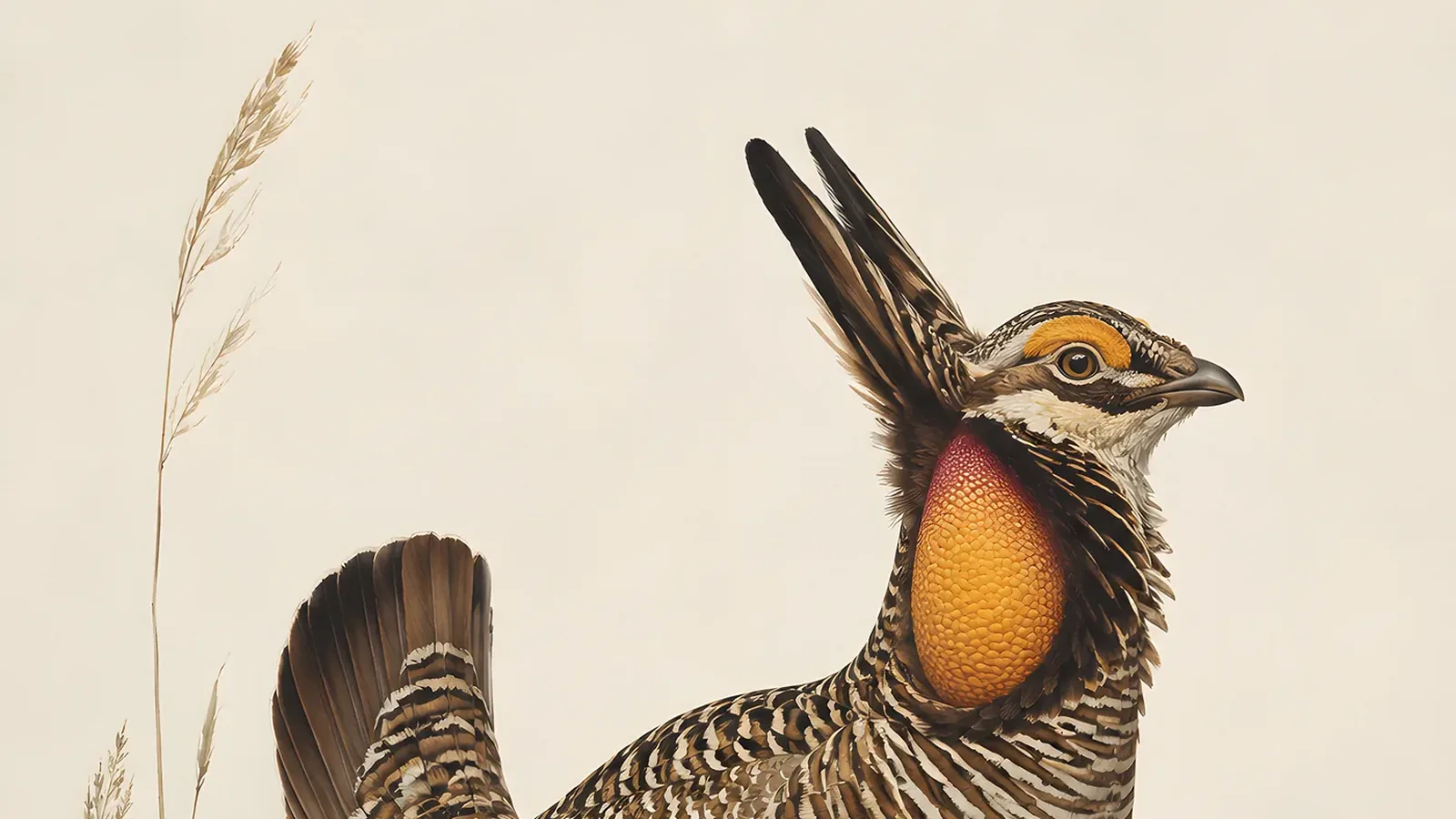
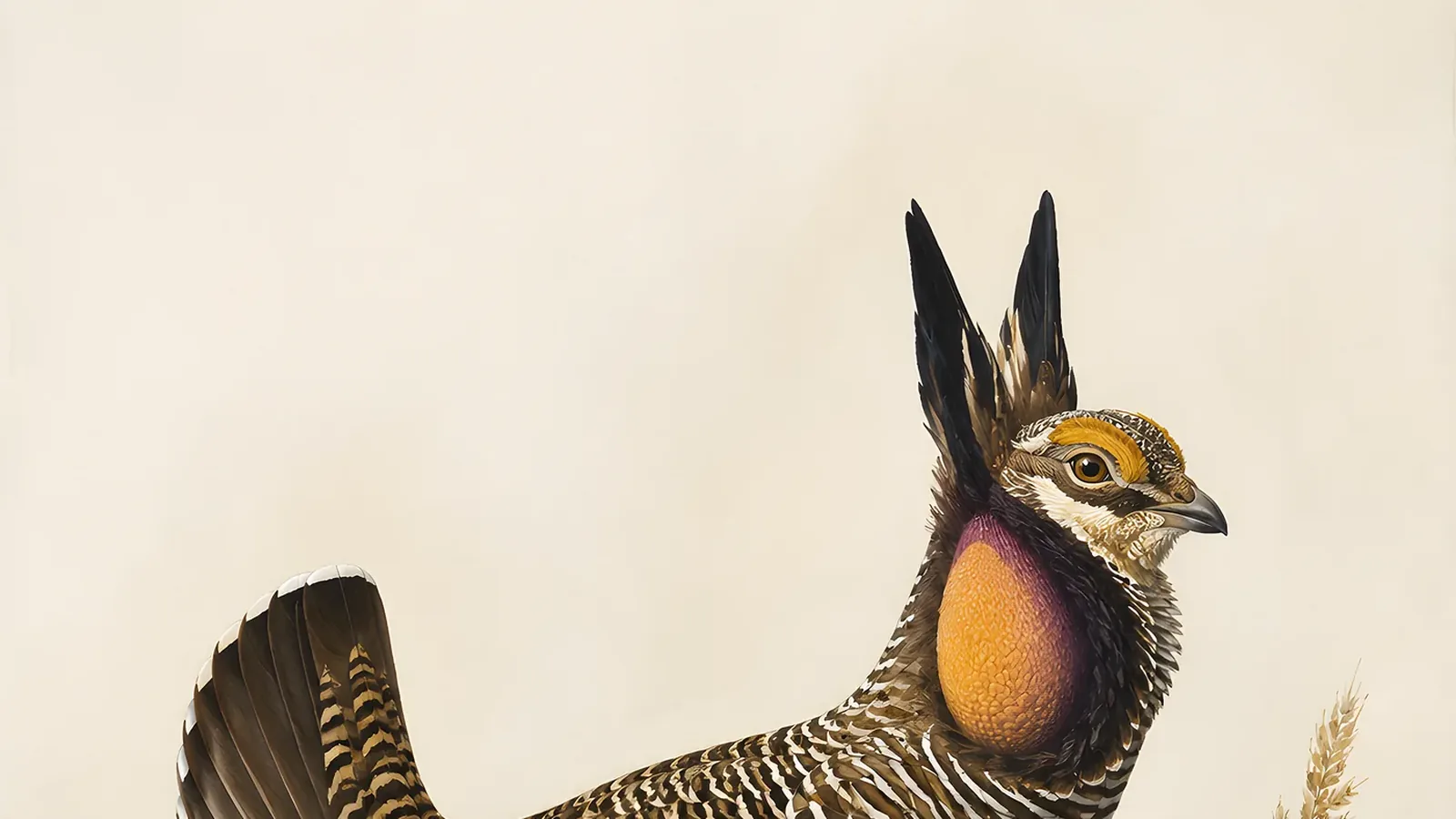
The shinnery oak is barely knee-high and the sand is still cold when the males arrive. A flat, open rise in the Texas Panhandle or the sand hills of western Kansas - somewhere the brush thins to nothing and the line of sight is long - and there they are at first light, five or six birds stamping in place, raising their black pinnae like small antennae, and then rearing back as the reddish sacs along the sides of their necks balloon outward and the air rolls from their chests in a low, pulsing gobble.
Tympanuchus pallidicinctus, the Lesser Prairie-Chicken, is doing what it has done on this same patch of ground for as long as there has been a shinnery oak prairie to do it on. The question hanging over this particular morning is whether anyone other than a court reporter and a petroleum lawyer will be around for the one after that.
What it looks like
T. pallidicinctus is smaller and paler than its near relative the greater prairie chicken. Body length runs 38 to 41 centimetres. Weight falls between 700 and 800 grams in most individuals, with males at the higher end of the range. Wingspan reaches approximately 63 to 70 centimetres. Both sexes wear dense barring in pale buff and brown, the pattern washed to a sandier, more bleached tone than the Greater Prairie-Chicken - appropriate for a bird that spends its life on sandy-soil prairie and benefits from blending into the colour of bare sand between clumps of oak.
The male carries two sets of display equipment. The pinnae - elongated dark feathers above each eye - erect vertically in display and lie flat in repose. The neck sacs, which in the Greater Prairie-Chicken run orange, are distinctly reddish in pallidicinctus. This is the most reliable field separator when the two species are compared side by side. Males also show a yellow-orange supraorbital comb above each eye that flushes and swells when aroused. The tail is short and rounded. In flight the bird is fast and straight, with quick wingbeats interrupted by flat-winged glides.
Females lack air sacs and have smaller combs and more subdued pinnae. Their barring runs finer, the general effect paler than a hen Greater Prairie-Chicken encountered in comparable light. Female camouflage in shinnery oak habitat is close to perfect.
| Measurement | Range |
|---|---|
| Body length | 38 - 41 cm |
| Weight | 700 - 800 g |
| Wingspan | 63 - 70 cm |
| Lifespan (wild) | 1 - 5 years |
The lek
Males begin gathering on leks in late February, while the oak scrub is still leafless and wind cuts across the sandy flats. Leks are traditional - the same low ridge or bare clearing used year after year - and males establish territories on them that correlate with mating success. Central positions belong to dominant males. Peripheral males display continuously and breed rarely.
The full sequence is unmistakable. The male drops his wings, fans his short tail upward, raises the pinnae to vertical, inflates the red neck sacs, stamps his feet in rapid bursts, and delivers a call that the Audubon Society describes as “various cackling and clucking notes” with a “booming call during courtship” - often rendered as a rolling, three-syllable gobble that carries well over a mile on a still dawn. Females move through the lek, observe, and choose. Most copulations go to one or two central males.
Peak mortality in females occurs during May and June - the nesting and early brood-rearing window - when females tending nests or prefledged chicks face heightened exposure to predators. Hagen, Pitman, Sandercock, Robel, and Applegate (2007, Journal of Wildlife Management, vol. 71) documented that females involved in nesting showed lower daily survival than non-nesting females, with 59 percent of recorded deaths attributable to mammalian predation. Conservation attention to the nesting season, they concluded, is the single most important intervention for sustaining populations.
Clutch size runs six to 14 eggs - buff to cream with fine olive-brown speckling. Incubation lasts 22 to 28 days, carried out by the female alone. Chicks are precocial, capable of short flights within two weeks and full independence by 12 to 15 weeks. Approximately 65 percent of birds do not survive their first year. Maximum documented lifespan is 13 years, though two to five is the realistic wild range.
Telling it from the Greater Prairie-Chicken
Three marks separate pallidicinctus from its larger cousin in the field. First, overall body tone: the Lesser is paler, more sand-coloured, with less contrast in the barring. Second, the neck sacs: reddish in the Lesser, orange in the Greater. Third, size and geography: where the two coexist along the Kansas-Oklahoma interface, the Lesser is perceptibly smaller, lighter on the wing. In areas where only one species is likely, geography does most of the work - the Lesser belongs to sandy, mixed-grass and shrub-steppe habitat, the Greater to taller, moister tallgrass prairie.
Voice is similar in structure but the Lesser’s gobble is slightly higher in pitch and often rendered as a more rapid sequence. Both species respond to each other’s calls, which complicated early range surveys before the two were reliably distinguished.
Range and habitat
The present range of T. pallidicinctus is a fragment of what it occupied before the plough. The species holds on in southeastern Colorado, southwestern and south-central Kansas, the Oklahoma panhandle and adjacent counties, the Texas panhandle, and eastern New Mexico. These five states represent the entire world distribution of the species.
The foundational habitat is two-part. Sand sagebrush prairie - Artemisia filifolia on deep, wind-deposited sand - characterises the western portion of the range. Shinnery oak prairie - dominated by Quercus havardii, a sprawling, rhizome-spread oak that rarely exceeds one metre in height - covers the eastern and southern portions. Both are on sandy soil. The birds require open lek sites with short or sparse vegetation, taller cover for nesting, and sufficient insect density in summer to sustain growing chicks. They also need those elements within a few kilometres of one another. Fragmented parcels that provide only one element are effectively worthless.
In winter, birds move into denser cover and aggregate in larger foraging flocks, working seeds, acorn masts, and waste grain from field edges. During summer heat, shinnery oak canopy provides shade that sandy bare ground cannot - a detail that becomes critical for chicks and brooding females during July and August on the southern plains.
The American Bird Conservancy estimates that the species’ range has contracted by 92 percent since the mid-nineteenth century. Where the birds once occupied a continuous belt of mixed-grass and shrub-steppe from Kansas south to the Llano Estacado, they now persist in scattered, disjunct populations increasingly separated by cropland, energy infrastructure, and converted pasture.
The listing fight
No North American bird has spent more time in court, relative to its size, than T. pallidicinctus. The case is a masterclass in how the Endangered Species Act works - and how it fails.
In 2014, the U.S. Fish and Wildlife Service listed the Lesser Prairie-Chicken as threatened across its entire range. A federal court in the Western District of Texas vacated that listing in 2015, ruling against the procedural basis of the decision. The Fish and Wildlife Service declined to appeal, and protections lapsed in 2016.
A new petition arrived in 2016. After six years of review, the Service listed two Distinct Population Segments under the ESA in November 2022: the Northern DPS (Colorado, Kansas, and the northern Oklahoma and Texas portions of the range) as threatened, and the Southern DPS - the smaller, more isolated Texas and eastern New Mexico birds - as endangered, noting that the Southern DPS had fallen to as few as 5,000 individuals, with survey counts dipping toward 1,000 in drought years. The rule took effect in March 2023.
Texas and the Permian Basin Petroleum Association sued. In August 2025, the U.S. District Court for the Western District of Texas vacated the 2022 rule, finding that the Service had “failed to provide sufficient justification” for the two-DPS structure and that the error “taints the findings so significantly that a full reconsideration is warranted.” Both listings were formally removed from the Federal List of Endangered and Threatened Wildlife by February 2026. The Service’s reconsideration deadline runs to November 2026.
“The lesser prairie-chicken’s range has shrunk by 92 percent since the 1800s.” - American Bird Conservancy, 2024.
Meanwhile, the threats that drove all three listing attempts have not paused for litigation. Wolfe, Patten, Shochat, Pruett, and Sherrod (2007, Wildlife Biology, vol. 13) documented that fence and power line collisions were the second-most frequent cause of mortality after predation - and that was before the Permian Basin’s utility pole density reached its current levels. Lawrence et al. (2021, Journal of Wildlife Management) demonstrated directly that increasing utility pole density associated with oil and gas development reduces Lesser Prairie-Chicken breeding season survival, with stronger effects on males. Every new well pad, every new transmission line, is infrastructure that remains long after the price of oil has moved on.
The IUCN lists T. pallidicinctus as Vulnerable (VU), with a decreasing population trend. Current estimates from five-state aerial surveys run to approximately 28,000 to 38,000 individuals, with wide variation driven by drought years that can collapse counts by more than half in a single season.
Breeding
The breeding cycle anchors to the lek, but the sequence extends well past it. Mated females move away from the display ground to nest in denser grass or at the base of shinnery oak shrubs, where overhead cover breaks a predator’s line of sight from above. The nest is a shallow scrape in the sand, lined with grass and a few contour feathers.
Incubation begins in April and runs 22 to 28 days. The female turns the eggs and broods through the temperature extremes of the southern plains spring, when a cold front can follow a 35-degree afternoon within 24 hours. Hatching success is sensitive to both extremes: hard rain during hatch kills chicks that cannot thermoregulate, and drought reduces the grasshopper density on which chicks depend in their first weeks.
Chicks transition from insects to seeds and plant material as they grow. By late summer, juveniles travel with their mother in loose family groups that eventually coalesce into larger flocks for winter. Birds that survive their first year carry most of what the population will do next spring.
The bird is not mysterious in its needs. It requires native shortgrass prairie on sandy soil, with adequate shrub cover, close to intact lek habitat, and with grasshoppers in the summer. It does not adapt well to row crops. It does not nest in corn or winter wheat. It avoids wind turbines and power lines. Every landscape decision that removes native cover or adds vertical structure is a decision against the species.
The Southern Great Plains did not lose 92 percent of its prairie-chicken habitat by accident. It lost it by deliberate conversion - plough, drill, and pivot irrigation - and the courtroom has become the last lek for a bird that once held the ground by sheer numbers alone.
The next reconsideration decision arrives in November 2026. The males on the sand hills will be displaying in February regardless.