Field Guide
Painted Redstart
In Ramsey Canyon in the Huachuca Mountains of southeastern Arizona, the creek runs cold even in June. The sycamores lean over the water on white limbs and their broad leaves make pools of shade on the rock. It is the kind of canyon that makes you lower your voice. Then a small bird drops from a branch, fans a tail edged with startling white, and a moth that was clinging to the bark takes panicked flight. The bird is already moving. It cuts left through the shadow, closes on the moth in open air, and is back on its branch in under a second, tail still spread, head cocked, watching.
Myioborus pictus - the Painted Redstart - is a warbler that lives by manufactured panic. It is also, by any measure, the most brilliantly coloured bird a casual visitor to these mountains is likely to see.
What it looks like
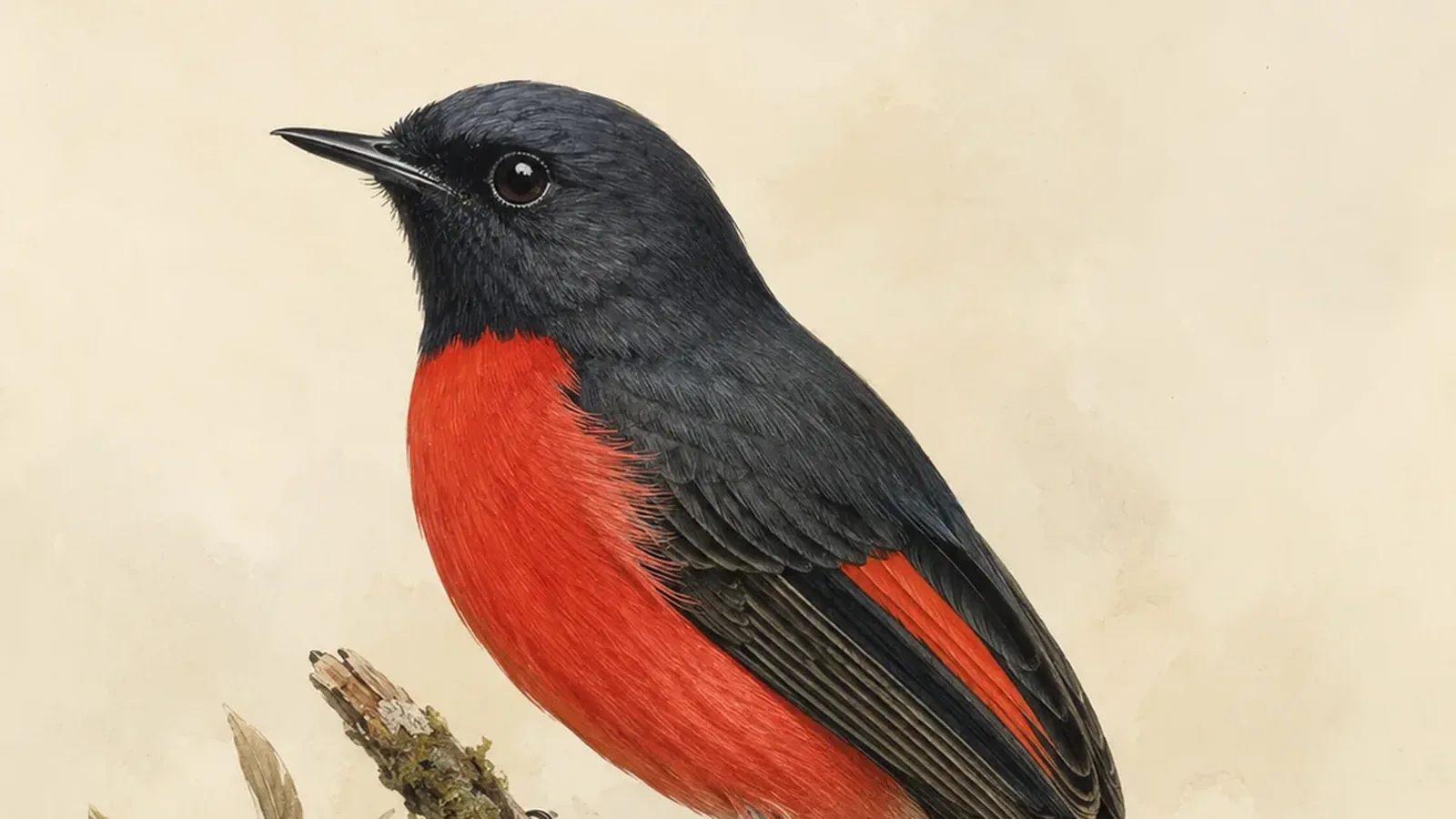
The Painted Redstart carries three colours and wears them without compromise. The body, head, back, and wings are glossy black - not sooty, not brownish, but the dense black of fresh ink. Across the lower breast runs a patch of vivid red, the kind of red that reads across a shaded canyon. The wings carry broad white patches on the secondary coverts, visible at rest and spectacular in motion. The outer tail feathers are white, framing the spread tail with a clean border that is visible from any angle.
What makes this bird exceptional among North American warblers is that both sexes look alike. There is no drab female to learn separately, no confusing first-year plumage. The bird you see on a June afternoon in a pine-oak canyon is the bird in the field guide, male or female, and it looks exactly this way.
| Measurement | Range |
|---|---|
| Length | 13 - 15 cm |
| Weight | 8.5 - 11.3 g |
| Wingspan | 20 - 23 cm |
| Max recorded lifespan | 6 years, 7 months (banded, Arizona) |
The tail is long relative to body size, which is not an accident. The tail is a tool. Cornell Lab of Ornithology documents a maximum confirmed longevity of six years and seven months from banded Arizona individuals, though the average wild bird lives considerably less.
Hunting by flash
Most wood-warblers are gleaners. They work through foliage, scanning surfaces, picking off insects at rest. The Painted Redstart does something different, and a long series of field experiments has established exactly how it works.
The bird spreads its tail and drops its wings simultaneously, flashing the high-contrast white patches against the black body. The sudden visual stimulus - a burst of white appearing in an insect’s peripheral field - triggers an involuntary escape response: the insect jumps or takes flight. The redstart was already watching. It sallies into the open air, intercepts the flush, and takes the prey mid-flight.
This is the finding of Jabłoński (1999), who tested the mechanism with field experiments in the Huachuca Mountains. Using artificial redstart models with tails in various positions, he showed that spread-tailed models elicited escape responses in arthropods far more often than closed-tailed models. When he covered the white patches with black dye on real birds, chase frequency dropped. The white patches on black wings and tail are not decoration. They are the working part of the foraging apparatus. The full paper - “A rare predator exploits prey escape behavior: the role of tail-fanning and plumage contrast in foraging of the painted redstart” - appeared in Behavioral Ecology, volume 10, pages 7 through 14.
The bird also creeps along trunks and mossy rock faces in a way that is more nuthatch than warbler, peering into crevices, occasionally tapping bark. It forages at every level, from the ground to the canopy, and visits hummingbird feeders to drink sugar water in winter.
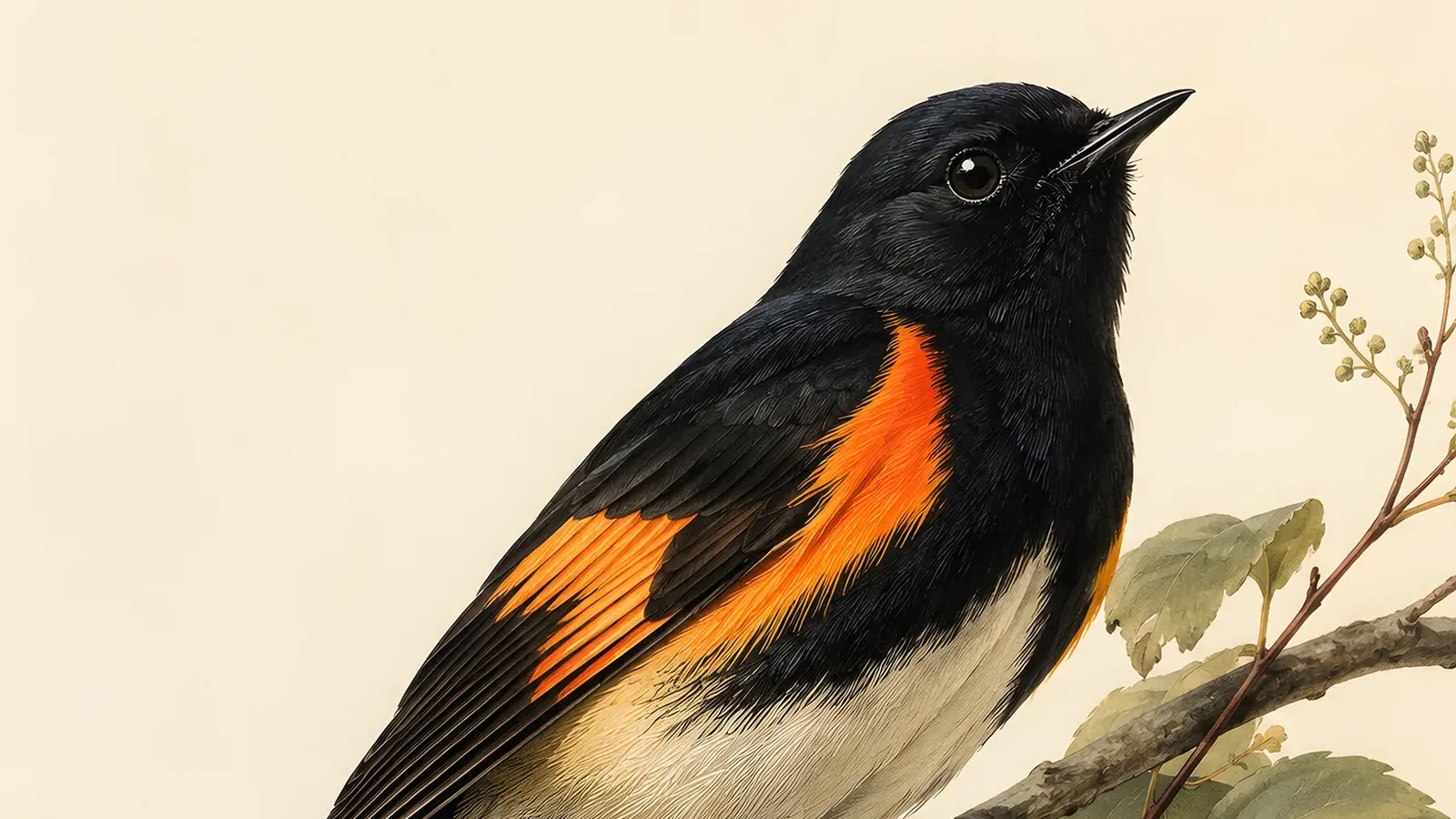
The American redstart hunts the same way - fanning vivid orange or yellow patches to flush prey, then chasing. The two species are not closely related: the American Redstart belongs to genus Setophaga, the Painted Redstart to Myioborus. The strategy evolved independently, twice, within the same warbler family. That is convergence, and it says something about how reliably the flush-and-pursue approach pays off in forest edge and canyon habitats.
Both sexes fan, both sexes chase, and both sexes sing - which makes the Painted Redstart unusual in a family where song is almost exclusively male.
The sky islands
The Painted Redstart reaches the United States only in the mountains of the extreme Southwest, and only in a narrow elevational band within those mountains. It is a bird of what ecologists call the Madrean sky islands - the ranges of southeastern Arizona and southwestern New Mexico (the Chiricahuas, the Huachucas, the Santa Ritas, the Peloncillos) where Mexican pine-oak woodland climbs peaks high enough to support a temperate fauna separated from the Sierra Madre by miles of desert basin.
Ganey, Block, Sanderlin, and Iniguez (2015), studying nesting ecology across the Madrean Sky Islands, found that Painted Redstarts concentrated in riparian forest, oak-pine woodland, and pine-oak forest, at lower elevations than the closely related Red-faced Warbler. The bird wants canyon bottoms - places where a permanent stream runs through sycamores and alders under a canopy of oak and pine. Most breeding in Arizona occurs between 1,500 and 2,300 metres. The nest goes on the ground: a cup of grasses and bark strips tucked under a rock or into a root tangle on a steep bank, almost always near running water. Their full study appeared in the Western North American Naturalist, volume 75, number 3.
Most of the population is resident through the year. In the United States, some birds descend to lower elevations in winter, but the species does not make the long-distance migrations characteristic of most North American warblers. Its life is geographically contained - these canyons, this altitude band, this mountain chain extending south through Mexico into Guatemala and Nicaragua.
What it sounds like
The song is a rich, chanting phrase, typically rendered as weeta weeta weeta wee or cheery cheery cheery chew, with the final note dropping. It is louder and more full-bodied than the thin, high-pitched songs of most warblers, and it carries through canyon noise. The bird often sings from the open, not hidden in foliage, and that habit together with the plumage makes it one of the easier southwestern warblers to locate.
The call is a sharp cheereo - single, bright, useful for detecting the bird when it is working behind boulders or deep in a root system along the stream bank.
Because both males and females sing, a mated pair in a canyon canyon can produce antiphonal song - two birds answering each other - which is rare enough in the family Parulidae to be worth noting when you hear it.
Diet
The diet is dominated by adult and larval insects: caterpillars, flies, beetles, and small moths taken by the flush-and-pursue method or gleaned from bark and rock. Jabłoński noted that prey items flushed and chased tended to be larger than prey pecked off substrates - the chase technique targets bigger prey, which rewards the energy cost of the aerial sally.
In summer, Kenn Kaufman (in Lives of North American Birds, 1996) notes the species takes tree sap along with insects. Visits to nectar feeders are recorded regularly in Arizona canyon towns like Madera and Ramsey, where the bird will drink sugar water and accept peanut-butter suet mixes alongside the hummingbirds.
Breeding
The breeding season runs April through June. The female builds the nest alone, lining the cup with fine grasses and animal hair, and incubates three to four eggs for about 13 days - female only, which is typical for Parulidae despite the symmetrical appearance between the sexes. Fledging happens quickly, at nine to thirteen days post-hatching, and the pair often raises two broods in a season.
The nest site is consistently ground-level, sheltered by rock or root, on sloping terrain near the stream. Ground nesting exposes eggs to mammalian predators, and the camouflage of the site matters more than the camouflage of the parent, which is perhaps why selection has not maintained any drab-female plumage in this species the way it has in so many others. Both parents feed the young after hatching.
The IUCN lists Myioborus pictus as Least Concern, with a population that is stable across its core Mexican and Central American range. Within the United States, it is common where the habitat exists - but the habitat is small. The sky islands are geographically isolated, and the pine-oak canyon bottoms the bird requires are vulnerable to drought, altered fire regimes, and the downslope migration of vegetation zones under changing climate. Common within its range is not the same thing as secure.
Stand at the edge of a canyon creek in June and you may hear it before you see it - the bright, chanting phrase bouncing off stone. Then a movement on a sycamore trunk, low down, and the tail opens like a white fan. What you are looking at is a bird that evolved its own answer to the problem of finding insects in shaded forest, using high contrast and motion the way a fisherman uses a lure. The insect reacts to the flash. The redstart reacts to the insect. The whole exchange takes less than a second, and then the canyon is quiet again.