Field Guide
Common Kingfisher
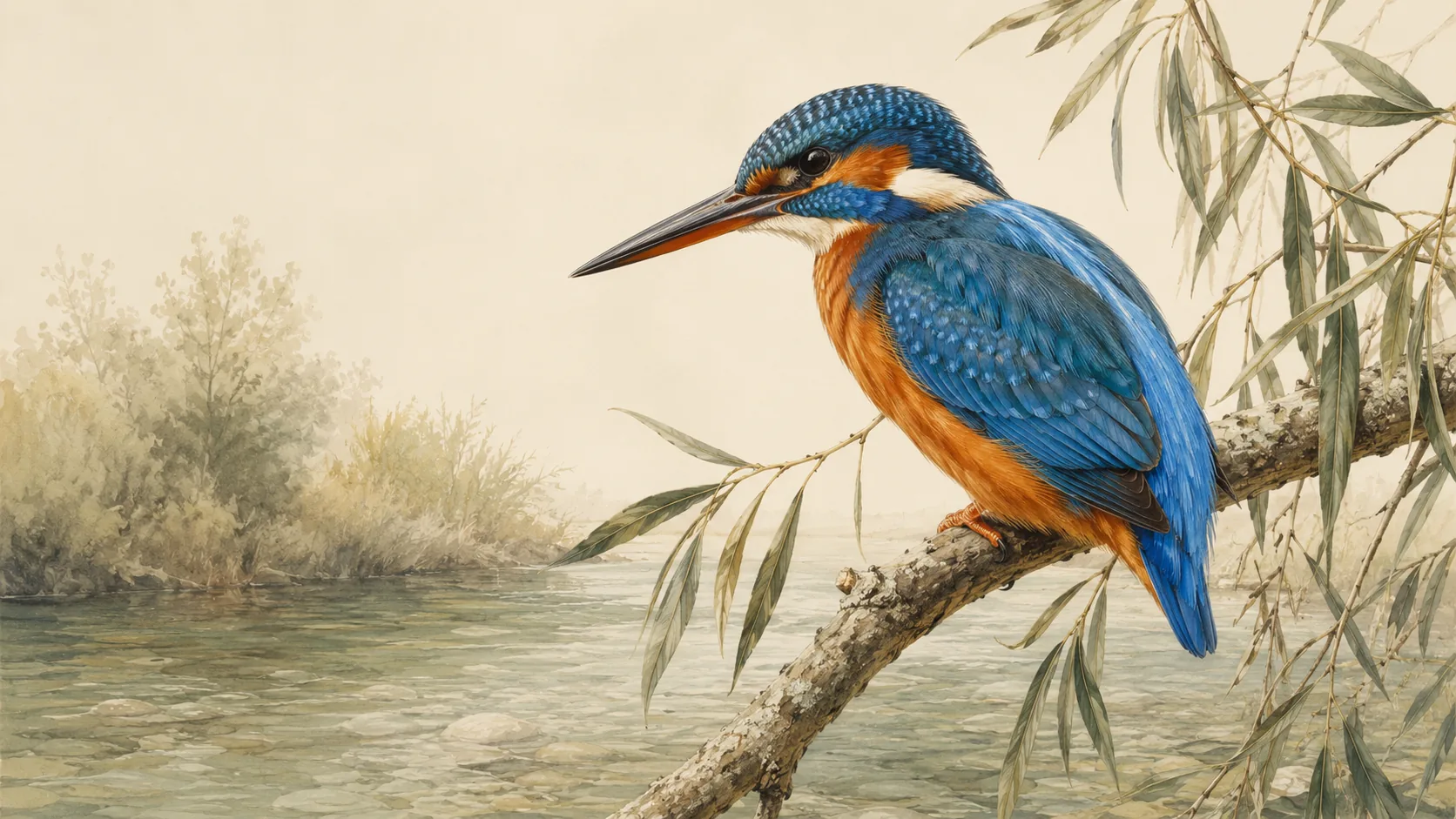
A river in the English Midlands in March. The willows are not yet in leaf. The water is low and clear. Then: a dart of orange-blue light, a high whistle, gone. Blink and you have seen a Common Kingfisher. Blink too slowly and you have not.
Alcedo atthis is the argument against the idea that Britain’s birds are quietly coloured. He is 16 centimetres long - roughly the size of a large sparrow - and he carries a back of bright metallic blue-green that shifts to cyan and then to deep cobalt depending on the angle of light. Against the brown clay of a riverbank or the dark tangle of winter willow roots, the effect is close to surreal. The Woodland Trust notes that only the righteous see the kingfisher; the saying is old enough that no one remembers when it began, but it captures something real about how seldom the bird holds still long enough to be properly seen.
Appearance and identification
The kingfisher is not likely to be confused with anything else in the British Isles. He is unmistakable. His back and wings are that electric blue-green. His breast and flanks are orange, the colour of old copper. His throat and a patch behind his eye are white. His bill is long, heavy, and black. His legs are red. His tail is barely a stub.
Sexing a kingfisher requires a decent look at the bill. Males have entirely black bills. Females carry an orange-red patch at the base of the lower mandible, as if the tip of a paintbrush had been pressed there. In juveniles both sexes have dark bills with pale tips, and the breast colour is slightly duller with a faint green wash to the plumage.
The structural colours in the plumage - the blues and greens - are produced by the same nanostructural physics that creates blue in a Blue Jay or a Morpho butterfly. There is no blue pigment. The feathers contain a lattice of air pockets and keratin that scatters short-wavelength light. A backlit kingfisher feather looks brown.
Weight, from the British Trust for Ornithology’s ringing records, averages around 40 grams for adults, with a range of roughly 34.5 to 45.5 grams. A robin, for comparison, weighs about 16 grams. The kingfisher is more substantial than he looks in flight.
Voice
You will likely hear him before you see him. The call is a sharp, high-pitched piping whistle - a single or repeated “tsee” or “cheee” - carrying cleanly across open water. The BTO describes it as the most reliable early alert to the bird’s presence. Once that whistle is filed in memory, a walk along any lowland English river changes permanently: you will start hearing kingfishers you would previously have missed entirely.
Range and habitat
The kingfisher is widely distributed across the British Isles, resident year-round. The BTO’s breeding surveys show him present in around 46 per cent of 10-kilometre squares in Britain in the breeding season, rising to 55 per cent in winter as birds move away from frozen upland streams toward coastal estuaries and tidal channels. He is absent from northern Scotland, and scarce in upland Wales and the English Pennines wherever fast rocky rivers don’t suit his fishing style.
Globally, Alcedo atthis ranges across the whole of the Palearctic - from southern Scandinavia and the Atlantic coast of Europe east to Japan, south through the Indian subcontinent to Sri Lanka and Southeast Asia, and into sub-Saharan Africa. The IUCN lists the species as Least Concern at the global level. The British breeding population has declined 15 per cent between 1995 and 2023, according to BTO monitoring data, driven primarily by habitat degradation and the effects of hard winters on small bodies.
He needs three things: clear, slow-moving or still water with small fish in it; elevated perches over or beside the water to hunt from; and steep, soft-soiled banks to nest in. He will work a chalk stream, a canal, an ornamental lake, a tidal creek - anywhere the geometry is right. He does not need wilderness. Some of the most reliable urban kingfisher sites in England are stretches of managed canal through the middle of towns.
Diet
The diet is fish. Minnows and sticklebacks are the main prey across most of Britain. He also takes dragonfly nymphs and other aquatic invertebrates, particularly in winter when fish move to deeper water. In especially cold periods, crustaceans enter the diet.
Hunting method: he finds a perch one to three metres above the water’s surface, tilts his head to correct for the refraction that bends the apparent position of fish in water, and dives. The dive itself is close to vertical, with wings folded back. He hits the water at speed and seizes the fish with his bill. He returns to the perch, beats the fish against the branch hard enough to kill it, and then positions it head-first in his bill and swallows it whole. The beating is not optional: a live fish with sharp spines would do real damage going down. After every few meals, a pellet of undigested fish bones and scales is regurgitated at the perch site.
Breeding and nesting
Breeding in Britain runs from April to July. Both parents excavate a horizontal tunnel into a steep earthen bank - clay riverbanks are preferred, cut banks on the outside of meanders ideal - digging with their bills and kicking soil backward with their feet. The tunnel runs 40 to 90 centimetres into the bank before opening into a small nesting chamber. At the chamber end, fish bones and scales accumulate over the course of the season to form a mat that functions as bedding.
The clutch is five to seven eggs. Both parents incubate, sharing shifts through a 20-day incubation period that begins after the last egg is laid. Hatching is synchronised within a day or two. The young fledge 22 to 26 days after hatching, according to BTO ringing data. Two to three broods a year are typical. Pairs that nest early and find adequate food can complete a third brood by late July. After fledging, the young are tolerated for only a short period; adults drive them off their territories, and the juveniles must find their own stretches of water before winter.
The winter problem
The kingfisher’s single genuine biological vulnerability is cold. During hard frosts, streams freeze and fish become unreachable. The species has a low fat reserve and a high metabolic rate. A prolonged hard winter can kill a significant fraction of the British population within weeks. The BTO records show marked population crashes following the cold winters of 1963, 1979, and 1991. Recovery follows, but it takes several breeding seasons to rebuild numbers. This boom-bust dynamic explains why the kingfisher remains locally common in mild years and then disappears from upland and northern rivers after cold ones.
The Woodland Trust notes that the bird is “vulnerable to hard winters and habitat degradation through pollution or poor management of watercourses.” That formulation understates both threats. Agricultural run-off reduces water clarity; reduced clarity reduces the kingfisher’s ability to locate fish. Straightened, managed rivers destroy the cut-bank geometry needed for nesting. These pressures are slow and structural in a way that a hard winter is not.
What the biology implies
The kingfisher has evolved for a very specific ecological slot, and it occupies that slot with more precision than almost any other British bird. The hunting is essentially applied physics: a 40-gram bird correcting in real time for the optical distortion of water, hitting a moving target at speed, and doing it repeatedly enough to sustain a clutch of seven chicks and possibly a second brood. There is nothing approximate about it.
The more you look at the kingfisher’s biology, the more it reads like a constraint satisfaction problem solved over millions of years. Short body for aerodynamics in the dive. Heavy bill for seizing prey underwater. Long tail-less silhouette to minimise drag. Eyes with a double fovea for sharp focus both in air and underwater. Orange breast that is conspicuous in display but invisible against the warm colours of a lit bank when viewed from below by a fish looking up into filtered light.
That last point - the breast being camouflage when viewed from underwater - is the kind of detail that tends not to appear in popular accounts. The bird that looks flamboyant from the bank looks like the dappled underside of an autumn leaf to the minnow at the bottom of the pool.
The kingfisher does not advertise itself. The flash of blue is the incidental consequence of physics. The hunter below the water sees nothing out of the ordinary at all.